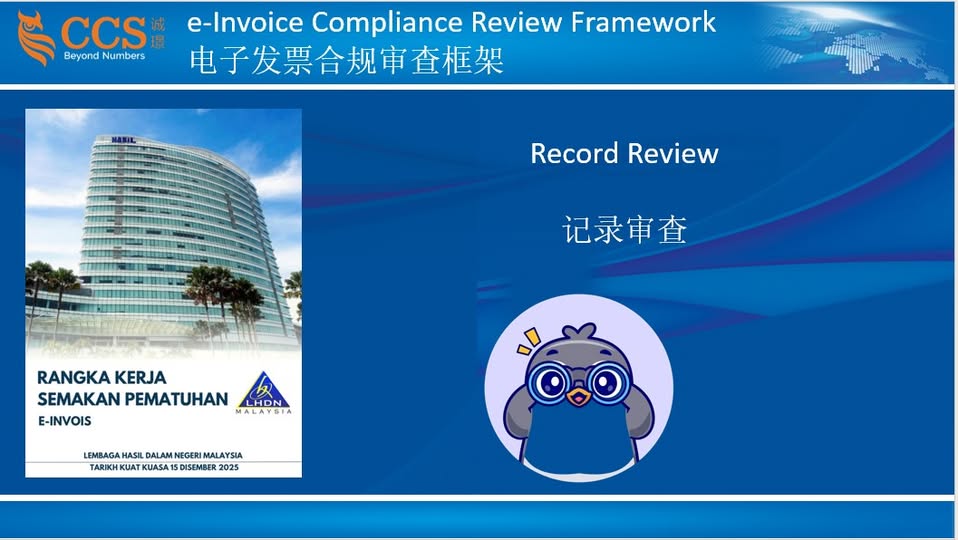
An e-Invoice compliance review is not limited to e-Invoices. Under Section 6.4 of the e-Invoice Compliance Review Framework, an e-Invoice Compliance Officer (PEI) may examine relevant business records to assess whether the taxpayer has properly implemented e-Invoicing.
Records that may be reviewed
The review may cover a range of records, including the company’s financial statements, general ledger, trial balance and profit and loss account. PEI may also examine transaction ledgers, payment vouchers and bank statements to verify that recorded transactions are genuine and complete.
Other documents may be relevant, such as sales agreements, contracts, purchase orders and delivery notes. The review may also include e-Invoice records, including invoices, debit notes, credit notes and refund notes. For example, where goods have been returned, PEI may check whether the relevant e-Invoice adjustments were handled correctly.
Access to records and copies
Under Section 80 of the Income Tax Act 1967, Section 33 of the Petroleum Income Tax Act 1967 and Section 22D of the Labuan Business Activity Tax Act 1990, PEI may access relevant taxpayer records and, where necessary, make copies of documents.
If PEI needs to take original documents or records, a list must be prepared and an acknowledgement of receipt issued. The list must be signed by both the PEI and the taxpayer or tax agent. The taxpayer may review the list and make copies of the documents if needed.
Where accounting or financial records are stored electronically, PEI may access the relevant computers, servers or electronic devices and download accounting data to storage media for review.
Purpose of the review and record-keeping duties
PEI examines the relevant records to determine whether e-Invoice requirements have been met properly and systematically. This may include checking the accuracy and completeness of information, whether e-Invoices were issued within the applicable timeframes, and whether required fields were completed correctly.
Taxpayers should maintain proper business records in line with the relevant LHDNM Public Rulings on record-keeping:
- Public Ruling No. 4/2000 — Sufficient Record Keeping (Companies and Cooperatives) (Amendment)
- Public Ruling No. 5/2000 — Sufficient Record Keeping (Individuals and Partnerships) (Amendment)
- Public Ruling No. 6/2000 — Sufficient Record Keeping (Persons Other Than Companies, Cooperatives or Individuals) (Amendment)
Supporting records for e-Invoices, including source documents and relevant system reports, should be retained for the prescribed period. Incomplete records may lead to difficulties during a compliance review.
The key point is that PEI may examine a range of relevant business records—not just the e-Invoices themselves—to assess compliance. Maintaining complete, accessible records helps businesses respond to that review more effectively.
电子发票合规审查:记录范围、查阅权限与纳税人责任
电子发票合规审查不只检查电子发票本身。根据《e-Invoice Compliance Review Framework》第6.4节,电子发票合规官(PEI)可审查相关业务记录,以评估纳税人是否妥善落实电子发票制度。
可审查的记录
审查范围可能包括公司的财务报表、总分类账、试算平衡表及损益表。PEI 也可能查阅交易分类账、付款凭证及银行对账单,以核实记录中的交易是否真实、完整。
其他相关文件也可能纳入审查,例如销售协议、合同、采购订单及交货单。审查亦可能包括电子发票相关记录,例如发票、借项通知单、贷项通知单及退款通知单。例如,若发生退货,PEI 可能核查相关电子发票调整是否妥善处理。
记录查阅与复制
根据《1967年所得税法令》第80条、《1967年石油所得税法令》第33条及《1990年纳闽商业活动税法令》第22D条,PEI 可在法定权限范围内查阅纳税人的相关记录,并在必要时复制有关文件。
如果 PEI 需要带走原始文件或记录,须编制清单并出具收取确认书。清单须由 PEI 与纳税人或税务代理共同签署。纳税人可以核对清单,并在有需要时复制相关文件。
若会计或财务记录以电子方式储存,PEI 可查阅相关电脑、服务器或电子设备,并将会计数据下载至储存介质进行审查。
审查目的与记录保存责任
PEI 会审查相关记录,以判断纳税人是否妥善且系统地履行电子发票要求。审查可能涉及资料的准确性与完整性、电子发票是否在适用期限内开具,以及必填字段是否正确填写。
纳税人应根据 LHDNM 相关记录保存公共裁定,妥善保存业务记录:
- 第4/2000号公共裁定——充分记录保存(公司与合作社)(修订版)
- 第5/2000号公共裁定——充分记录保存(个人与合伙企业)(修订版)
- 第6/2000号公共裁定——充分记录保存(公司、合作社或个人以外人士)(修订版)
纳税人应在规定期限内保存电子发票的支持文件,包括原始凭证及相关系统报告。记录不完整,可能使企业在合规审查期间难以提供所需资料。
重点是,PEI 可审查多种相关业务记录,而不仅是电子发票。妥善保存完整且便于查阅的记录,有助企业更有效地应对合规审查。