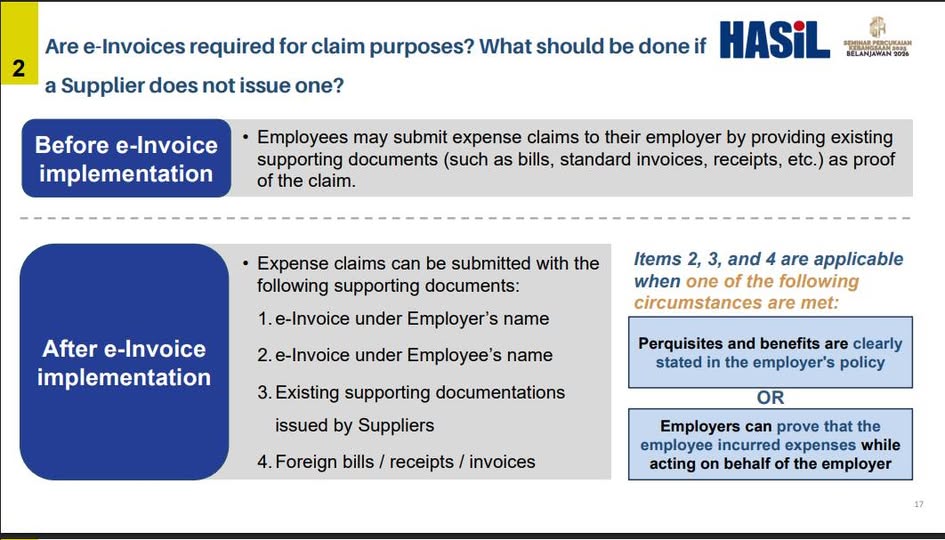
Employees who pay business expenses on behalf of their employer may submit expense claims supported by bills, receipts, invoices or other relevant documents. Under HASiL’s e-Invoice rules, the treatment depends on whether the expense is a genuine staff claim made on the employer’s behalf or a service acquired directly by the Malaysian business from a foreign supplier.
Business expenses incurred overseas
Where an employee pays for expenses incurred overseas on behalf of the employer, neither the employee nor the employer is required to issue a self-billed e-Invoice for those expenses. The employer may rely on foreign bills, receipts, invoices or other existing supporting documents as proof of expense.
This concession applies when the employer can demonstrate that the employee incurred the expense on the employer’s behalf. The expense should therefore be supported by the company’s usual expense-claim procedures and relevant records.
For other staff claims, businesses should request an e-Invoice in the employer’s name where this is possible. If that cannot be arranged, HASiL allows an e-Invoice issued in the employee’s name or existing supporting documents to be used as proof of expense.
Professional membership fees paid to a foreign body
If an employee pays a professional membership fee, such as an ACCA fee payable to a UK professional body, and claims it as a genuine staff expense incurred on the employer’s behalf, the employer may generally use the foreign receipt or invoice as supporting documentation. The overseas-expense concession means that a self-billed e-Invoice is not required where the relevant conditions are met.
However, the fact that the professional body is based overseas does not, by itself, determine the treatment. If the Malaysian business directly acquires services from a foreign supplier, the general cross-border rule may require the Malaysian purchaser to issue a self-billed e-Invoice. The business should assess who acquired the service and whether the payment qualifies as an employee expense incurred on the employer’s behalf.
For imported services subject to the self-billed e-Invoice requirement, the Malaysian purchaser generally has until the end of the month following the earlier of the month in which payment is made or the foreign supplier’s invoice is received, subject to the applicable rules for imported taxable services.
Key point
For both overseas business expenses and professional fees, keep the foreign invoice or receipt and document the business purpose. The staff-claim concession applies when the employee is acting on the employer’s behalf; it should not be assumed to apply automatically to every payment made to a foreign organisation.
员工海外费用与 ACCA 会费:马来西亚电子发票处理
员工代雇主支付业务费用后,可凭账单、收据、发票或其他相关文件提交费用报销。根据 HASiL 的电子发票规定,处理方式取决于这笔费用是否属于员工代表雇主支付的真实费用申报,还是马来西亚企业直接向外国供应商购买服务。
在海外产生的业务费用
如果员工代表雇主支付在海外产生的费用,员工与雇主均无需就该费用开具自开电子发票。雇主可使用外国账单、收据、发票或其他现有支持文件,作为费用凭证。
这项宽免适用于雇主能够证明员工是代表雇主支付有关费用的情况。因此,费用应符合公司的常规报销程序,并有相关记录支持。
对于其他员工费用申报,企业应在可行的情况下要求供应商以雇主名义开具电子发票。如果无法做到,HASiL 允许使用以员工名义开具的电子发票,或现有支持文件,作为费用凭证。
支付给外国专业机构的会员费
如果员工支付专业会员费,例如支付给英国专业机构的 ACCA 会费,并以代表雇主支付的真实员工费用申报,雇主一般可使用外国收据或发票作为支持文件。在符合相关条件时,海外费用宽免意味着无需开具自开电子发票。
不过,专业机构位于海外这一点本身,并不能决定适用的处理方式。如果马来西亚企业直接向外国供应商购买服务,一般的跨境交易规则可能要求马来西亚买方开具自开电子发票。企业应评估服务由谁购买,以及该款项是否符合员工代表雇主支付费用的条件。
对于须开具自开电子发票的进口服务,马来西亚买方一般须在以下较早月份的次月底前完成开具:付款月份,或收到外国供应商发票的月份。实际期限仍须依据适用于进口应税服务的相关规定判断。
重点
无论是海外业务费用还是专业会费,都应保留外国发票或收据,并记录费用的业务用途。员工费用申报宽免适用于员工代表雇主支付费用的情况,不应假设所有支付给外国机构的款项都自动符合条件。