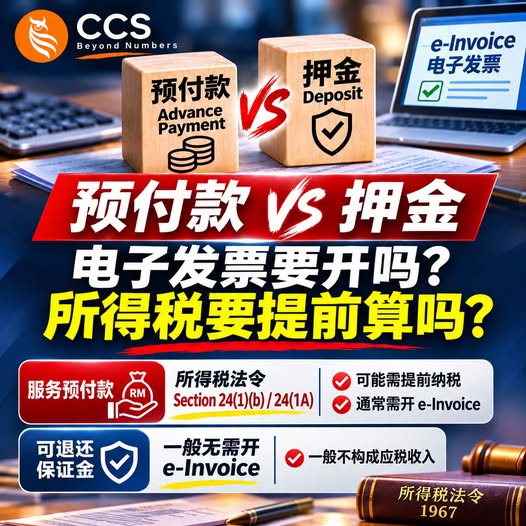
Receiving money from a customer does not, by itself, determine its tax treatment. The key question is what the payment represents: an advance payment for goods or services, or a genuinely refundable security deposit.
Advance payments for services
An advance payment for services to be provided in a future year may be taxable as business gross income before the services are performed.
Under paragraph 24(1)(b) of the Income Tax Act 1967, a debt arising from a contractual liability to pay for services to be provided is generally treated as gross income in the period when that liability arises, whether or not the amount is then due and payable. Where a sum is received for future services before a debt has arisen, subsection 24(1A) generally treats the amount as gross income in the period it is received.
For example, a customer pays RM30,000 in 2026 for consultancy services to be provided in 2027. The amount may be taxable in 2026. Which provision applies depends on when the contractual liability to pay arises. Recording the amount as deferred income in the accounts does not, on its own, defer its recognition for income tax purposes.
Refundable security deposits
A genuine refundable security deposit is generally not treated as business gross income when received, provided it is refundable under the agreement. HASiL’s Public Ruling No. 4/2020 explains that such deposits do not fall within paragraph 24(1)(b) or subsection 24(1A) when received.
The e-Invoice treatment is also different: under HASiL’s e-Invoice General FAQ, an e-Invoice is not required for a refundable deposit, while one is required for a non-refundable deposit.
The name used in an agreement is not conclusive. If an amount described as a “deposit” will be applied towards the price of future services, it may in substance be an advance payment. Its treatment should be assessed based on the agreement’s terms and how the payment is handled. Refundability, whether the amount will be credited against service fees, and what happens if the customer cancels are all relevant.
Tax treatment and e-Invoice timing are not the same
The timing for recognising an amount as taxable income and the requirement to issue an e-Invoice are separate matters. Businesses should assess each under the relevant tax provisions and e-Invoice guidance rather than assume that the same timing applies to both.
References: Income Tax Act 1967, paragraphs 24(1)(b) and subsection 24(1A); HASiL Public Ruling No. 4/2020; HASiL e-Invoice General FAQ, Question 57.
预付款与押金:所得税处理及电子发票要求
收到客户款项,并不代表其税务处理方式已经确定。关键在于这笔款项的性质:它是商品或服务的预付款,还是确实可退还的履约保证金。
服务预付款
即使服务要到下一年度才提供,收到的服务预付款也可能需要在服务尚未完成前计入企业应课税收入。
根据《1967年所得税法令》第24(1)(b)段,若合同责任已经产生,企业因未来服务而拥有的应收款项,一般须在该责任产生的期间计入总收入,不论款项当时是否已经到期或须立即支付。若企业在债务尚未产生前已收到未来服务的款项,第24(1A)款一般规定,该款项须在收款期间计入总收入。
例如,客户在2026年支付 RM30,000,预订于2027年提供的顾问服务。这笔款项可能须在2026年计税。具体适用哪一项条文,取决于合同付款责任何时产生。即使账目将款项记录为递延收入,也不代表所得税上的收入确认时间必然随之递延。
可退还的履约保证金
如果一笔款项根据协议确实可以退还,通常不会在收取时被视为企业总收入。HASiL《Public Ruling No. 4/2020》说明,这类押金在收取时不属于第24(1)(b)段或第24(1A)款所涵盖的款项。
电子发票的处理也有所不同。根据 HASiL 的《e-Invoice General FAQ》,可退还的押金无需开具电子发票;不可退还的押金则须开具电子发票。
协议中使用的名称并非决定性因素。如果一笔称为“押金”的款项最终会抵扣未来服务费,其实质可能是预付款。企业应根据协议条款及实际处理方式判断款项性质,包括款项是否可以退还、是否会抵扣服务费,以及客户取消交易时如何处理。
所得税处理与电子发票开具时间并不相同
将款项确认为应税收入的时间,与开具电子发票的要求,是两个不同的问题。企业应分别根据相关税务条文及电子发票指南评估,不应假设两者的处理时间必然相同。
参考依据:《1967年所得税法令》第24(1)(b)段及第24(1A)款;HASiL《Public Ruling No. 4/2020》;HASiL《e-Invoice General FAQ》第57题。