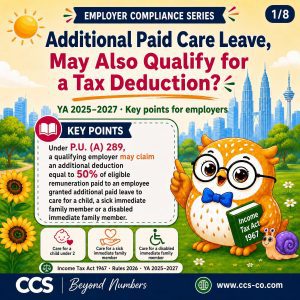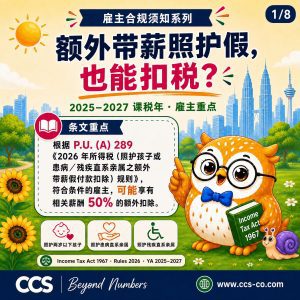
Malaysia’s Income Tax (Deduction for Payment of Additional Paid Leave for the Care of Child or Sick or Disabled Immediate Family Member) Rules 2026 provide qualifying employers with a tax incentive to offer additional paid leave when employees need to care for a child or an immediate family member who is sick or disabled.
In short, compassion comes with a modest tax benefit.
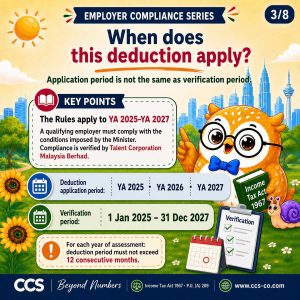
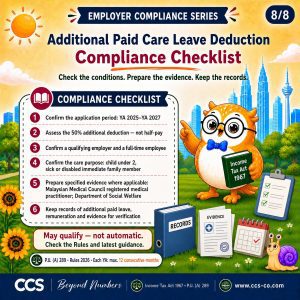
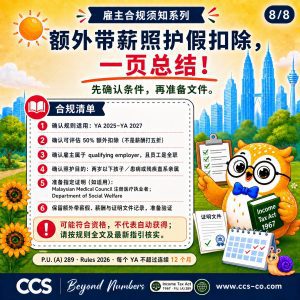
These Rules apply from the Year of Assessment (YA) 2025 to YA 2027.
What Is the Tax Benefit?
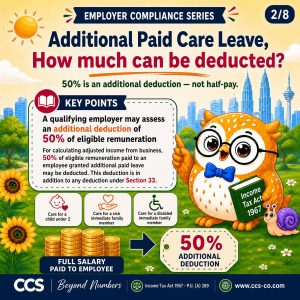
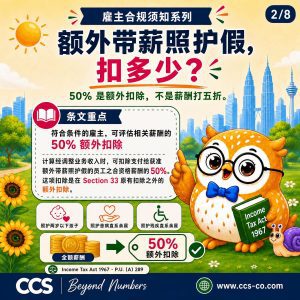
If a qualifying employer pays an employee for additional paid leave, the employer may claim an additional deduction equal to 50% of the qualifying remuneration paid for that leave.
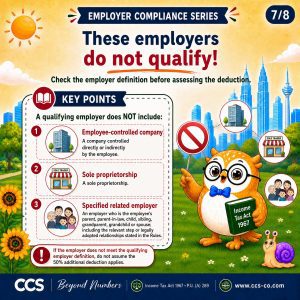
This deduction is available in addition to the ordinary deduction for employee remuneration under section 33 of the Income Tax Act 1967. In other words, it is not a 50% reimbursement from the tax authorities; it is an additional tax deduction.
The additional paid leave must be used to care for:
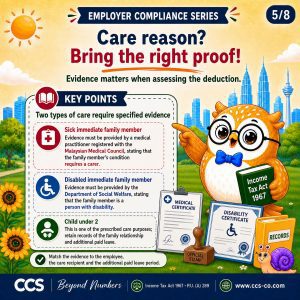
- a child under two years old;
- an immediate family member who is sick; or
- an immediate family member who is disabled.
The deduction is limited to a period of no more than 12 consecutive months in a year of assessment.
Eligibility and Key Conditions
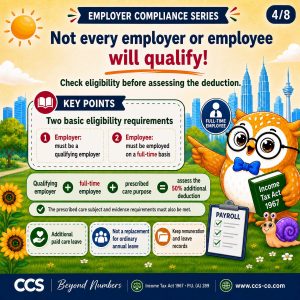
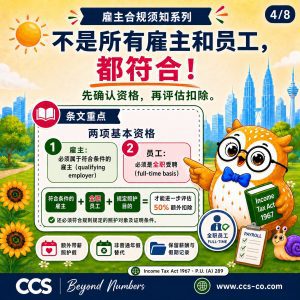
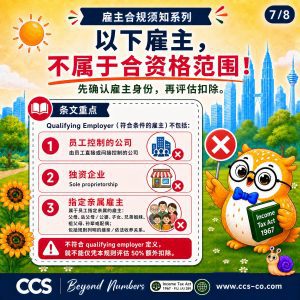
The employee must be employed on a full-time basis.
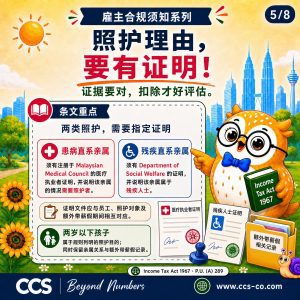
For a sick immediate family member, a medical practitioner registered with the Malaysian Medical Council must certify that the person requires a carer.
For a disabled immediate family member, certification must be obtained from the Department of Social Welfare confirming that the person is a person with disability.
As with many tax incentives, proper documentation remains essential.
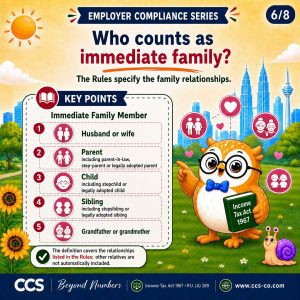
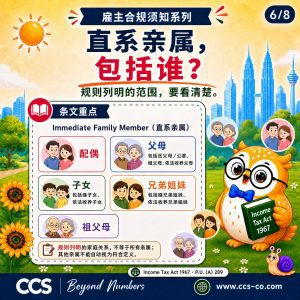
“Immediate family member” includes the employee’s spouse; parents, including parents-in-law, stepparents and legally adopted parents; and children, including stepchildren and legally adopted children.
The employer’s compliance with the relevant conditions must be verified by Talent Corporation Malaysia Berhad (TalentCorp) during the period from 1 January 2025 to 31 December 2027.
A Simple Example
Suppose an employer pays RM4,000 in qualifying remuneration for an employee’s additional paid caregiving leave.
The normal deduction for remuneration may be available under section 33. In addition, these Rules may provide an extra deduction of RM2,000, representing 50% of RM4,000, provided that all the conditions are met.
马来西亚的《2026年所得税(为照顾子女或患病或残疾直系家属而支付额外有薪假期的扣除)规则》,为合资格雇主提供税务优惠,鼓励雇主在员工需要照顾子女或患病或残疾的直系家属时,给予额外有薪假期。
简单来说,雇主多一份体恤,也可获得一项小小的税务优惠。
该规则适用于2025课税年度至2027课税年度。
税务优惠是什么?
如果合资格雇主为员工的额外有薪假期支付薪酬,雇主可申索相等于该项合资格薪酬 50% 的额外扣除。
这项扣除是在《1967年所得税法令》第33条下原本可享有的员工薪酬扣除之外,额外给予的扣除。换句话说,这并不是税务局退还50%的现金,而是额外的应课税收入扣除。
额外有薪假期必须用于照顾:
- 两岁以下的子女;
- 患病的直系家属;或
- 残疾的直系家属。
有关扣除在一个课税年度内,最多只适用于连续12个月的期间。
资格与主要条件
员工必须是全职员工。
如需照顾患病的直系家属,必须由在马来西亚医药理事会注册的医生证明该人士的状况需要照顾者。
如需照顾残疾的直系家属,则必须取得社会福利局的证明,确认该人士属于残疾人士。
与许多税务优惠一样,完整及适当的文件记录仍然十分重要。
“直系家属”包括员工的配偶;父母,包括岳父母、公婆、继父母及依法收养的父母;以及子女,包括继子女及依法收养的子女。
雇主是否符合相关条件,须由**马来西亚人才机构(Talent Corporation Malaysia Berhad,TalentCorp)**在2025年1月1日至2027年12月31日期间进行核实。
简单例子
假设雇主为员工的额外有薪照护假支付了 RM4,000 的合资格薪酬。
除了根据第33条通常可申索的薪酬扣除外,只要所有条件均获满足,雇主还可根据本规则额外申索 RM2,000 的扣除,即RM4,000的50%。