Key Compliance Lessons from Datuk Oh Chong Peng v. LHDN
Case Background and Key Judgment
Datuk Oh Chong Peng v. Ketua Pengarah Hasil Dalam Negeri [2026] 5 MLRA provides important guidance on the tax treatment of directors’ remuneration and tax compliance planning for Malaysian companies.
Datuk Oh Chong Peng (“Datuk Oh”), a retired registered accountant, served as an independent non-executive director of several listed companies and also provided occasional consultancy services.
From December 1997 to December 2016, he was exclusively engaged by two management companies, OCP Holdings and Garzania. All directors’ fees, allowances and consultancy fees received from listed companies and other clients were paid to the management companies and declared as business income under section 4(a). The monthly salary he received from the management companies was declared as employment income.
LHDN took the position that the directors’ fees should instead be classified as employment income under section 4(b). Additional assessments were issued against the taxpayer, together with penalties.
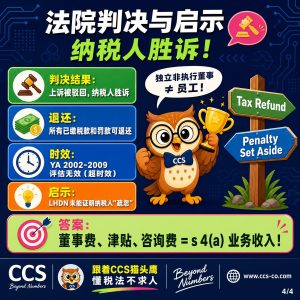
The Court of Appeal in Putrajaya ultimately dismissed LHDN’s appeal and ruled in favour of the taxpayer.
The key points of the judgment were as follows:
- An independent non-executive director is not an employee. The appointment of a director does not, by itself, create an employer–employee relationship.
- Basis of remuneration. Remuneration is governed by the company’s Articles of Association and approved at the Annual General Meeting, rather than by an employment contract.
- Method of payment. Directors’ fees were paid annually, rather than monthly.
- Degree of control. The relationship did not constitute a “master–servant” relationship.
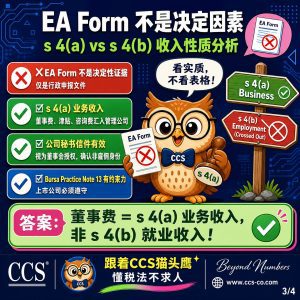
- Nature of the EA Form. The EA Form is an administrative reporting document and cannot be treated as conclusive evidence of an employment relationship.
- Company secretary’s letter. A letter issued by the company secretary concerning the identity and relationship of the companies was regarded as having been authorised by the board.
- Bursa Malaysia Practice Note 13. The Practice Note is binding on listed companies and must be complied with.
- Penalties. LHDN failed to prove that the taxpayer had been negligent. The penalties were therefore set aside.
- Limitation period. The assessments for Years of Assessment 2002 to 2009 were time-barred and invalid.
Key Tax Compliance Recommendations
1. Clearly Distinguish the Nature of Income: Section 4(a) Business Income versus Section 4(b) Employment Income
The key principle is that directors’ fees, allowances and consultancy fees received by an independent non-executive director should be classified as business income under section 4(a), rather than employment income under section 4(b).
An independent non-executive director does not have an employment relationship with the company. Accordingly, the remuneration received should not be treated as employment income.
The legal basis for the remuneration is the company’s Articles of Association, as approved by the Annual General Meeting, rather than an employment contract. Directors’ fees should be received and reported through an appropriate business entity, such as a management company, as business income.
2. Design the Remuneration Structure Carefully: The Method of Payment May Affect the Nature of the Income
The method of payment is an important factor in distinguishing business income from employment income.
Directors’ fees paid annually are more consistent with business income under section 4(a), while fixed remuneration paid monthly is more likely to be regarded as employment income under section 4(b).
When designing directors’ remuneration structures, companies should ensure that the payment method is consistent with the underlying nature of the income.
3. The EA Form Cannot Be the Sole Evidence
The EA Form is an administrative reporting document and cannot, by itself, determine whether an employment relationship exists.
LHDN should not rely solely on the manner in which remuneration is reported in the EA Form to conclude that directors’ fees constitute employment income. The tax assessment should be based on the substance of the relationship, including whether an employment contract exists and the degree of control exercised.
When responding to an assessment by LHDN, companies should be prepared to provide sufficient substantive evidence, such as board resolutions, the Articles of Association and service agreements.
4. Company Secretary’s Letters May Carry Legal Significance
A letter issued by the company secretary concerning the identity and relationship of the companies may be regarded as having been authorised by the board and may carry legal significance.
As a key figure in corporate governance, the company secretary can provide formal documentation that supports the relationship and structure between companies. When preparing documents for a tax dispute, companies should consider using formal letters issued by the company secretary as supporting evidence.
5. Comply with Bursa Malaysia Practice Note 13
Bursa Malaysia Practice Note 13 is binding on listed companies and must be complied with.
Independent non-executive directors of listed companies must satisfy the requirements under the Practice Note. The guidance further supports the nature of the relationship between an independent non-executive director and the company as one that does not constitute an employment relationship.
6. Responding to LHDN Penalties: LHDN Must Establish Negligence
LHDN must prove that the taxpayer had been negligent. In the absence of such proof, the penalty may be considered unreasonable and set aside.
Where the taxpayer’s reporting treatment is supported by consistent commercial logic and established historical practice, it may be difficult for LHDN to prove negligence. Companies should therefore retain complete tax reporting records and written explanations of the reasons for the adopted treatment in preparation for any review by LHDN.
7. Pay Attention to the Limitation Period for Tax Assessments
A tax assessment issued after the expiry of the statutory limitation period may be invalid.
In this case, the assessments for Years of Assessment 2002 to 2009 were found to have been issued outside the statutory limitation period and were therefore invalid.
Companies should understand the applicable five-year or ten-year limitation periods, depending on the circumstances. An objection may be raised against an assessment issued outside the relevant limitation period.
Practical Compliance Checklist
| Area | Compliance Recommendation |
|---|---|
| Payment of directors’ fees | Pay directors’ fees annually and avoid fixed monthly payments where the underlying arrangement is not an employment relationship. |
| Legal basis of remuneration | Ensure that the remuneration is provided for under the Articles of Association and approved at the Annual General Meeting. |
| Tax reporting | Report the remuneration through an appropriate management company as business income under section 4(a), where applicable. |
| Supporting documents | Retain board resolutions, the Articles of Association, service agreements and other substantive evidence. |
| Responding to LHDN | Prepare complete tax reporting records and written explanations of the commercial reasons for the adopted treatment. |
| Limitation period | Monitor the applicable statutory limitation periods for tax assessments. |
Conclusion
Datuk Oh Chong Peng v. Ketua Pengarah Hasil Dalam Negeri [2026] 5 MLRA provides important legal guidance for tax planning and compliance concerning directors’ remuneration in Malaysia.
The key lessons are:
- An independent non-executive director is not an employee. The remuneration may constitute business income under section 4(a), rather than employment income under section 4(b).
- Substance matters more than the form of reporting. The EA Form cannot, by itself, determine the nature of the income.
- Annual payment is an important factor. The payment method may affect the classification of the income.
- Proper documentation is essential. The Articles of Association, board resolutions and company secretary’s letters may serve as important supporting evidence.
- LHDN must establish negligence. Where the taxpayer has adopted a consistent and commercially supported reporting position, it may be difficult for LHDN to prove negligence.
- Limitation periods must be observed. Taxpayers should review whether an assessment was issued within the applicable statutory period.
Source: Datuk Oh Chong Peng v. Ketua Pengarah Hasil Dalam Negeri [2026] 5 MLRA, Court of Appeal, Putrajaya, Civil Appeal No. W-01(A)-685-12-2023, 3 June 2026.
马来西亚董事薪酬的税务处理:Datuk Oh Chong Peng 诉 LHDN 案的合规启示
案例背景与核心判决
Datuk Oh Chong Peng v. Ketua Pengarah Hasil Dalam Negeri [2026] 5 MLRA 一案,为马来西亚公司在董事薪酬税务处理及税务合规规划方面提供了重要指引。
Datuk Oh Chong Peng(“Datuk Oh”)是一名退休注册会计师,曾担任多家上市公司的独立非执行董事,并提供偶尔的咨询服务。
从 1997 年 12 月至 2016 年 12 月期间,他由两间管理公司 OCP Holdings 及 Garzania 独家聘用。他从上市公司及其他客户所收取的董事费、津贴和咨询费,全部支付予管理公司,并按《所得税法令》第 4(a) 条申报为业务收入。他从管理公司领取的月薪,则按就业收入申报。
LHDN 认为,这些董事费应归类为《所得税法令》第 4(b) 条所指的就业收入,并因此向纳税人发出额外评估及施加罚款。
布城上诉法庭最终驳回 LHDN 的上诉,并裁定纳税人胜诉。
判决的核心要点如下:
- 独立非执行董事并非雇员。 董事任命本身并不会产生雇主与雇员之间的关系。
- 报酬的法律依据。 报酬是依据公司章程规定,并经股东周年大会批准,而非依据雇佣合同支付。
- 支付方式。 董事费按年支付,而非按月支付。
- 控制程度。 有关关系不构成“主仆关系”(Master–Servant Relationship)。
- EA Form 的性质。 EA Form 仅是行政申报文件,不能作为判定雇佣关系的决定性证据。
- 公司秘书信件。 公司秘书就公司身份及公司之间关系发出的信件,被视为已获董事会授权。
- Bursa Malaysia Practice Note 13。 该指引对上市公司具有约束力,上市公司必须遵守。
- 罚款。 LHDN 未能证明纳税人存在疏忽,因此罚款被撤销。
- 时效限制。 课税年度 2002 年至 2009 年的评估已超过法定时效,因此无效。
核心税务合规建议
1. 明确区分收入性质:第 4(a) 条业务收入与第 4(b) 条就业收入
核心原则是,独立非执行董事所收取的董事费、津贴和咨询费,应归类为《所得税法令》第 4(a) 条下的业务收入,而非第 4(b) 条下的就业收入。
独立非执行董事与公司之间不存在雇佣关系,因此有关报酬不应被视为就业收入。
有关报酬的法律基础是公司章程,并经股东周年大会批准,而非雇佣合同。董事费应通过适当的商业实体,例如管理公司,收取并申报为业务收入。
2. 谨慎设计薪酬结构:支付方式可能影响收入性质
支付方式是区分业务收入与就业收入的重要因素。
按年支付的董事费,更符合第 4(a) 条业务收入的性质;按月支付的固定薪酬,则较容易被视为第 4(b) 条就业收入。
企业在设计董事薪酬结构时,应确保支付方式与相关收入的实质性质一致。
3. EA Form 不能作为唯一证据
EA Form 只是行政申报文件,不能单凭该表格决定是否存在雇佣关系。
LHDN 不应仅根据 EA Form 中的申报方式,便认定董事费属于就业收入。税务评估应根据双方关系的实质作出,包括是否存在雇佣合同,以及公司对相关人士所行使的控制程度。
企业在应对 LHDN 的税务评估时,应准备充分的实质证据,例如董事会决议、公司章程及服务合同。
4. 公司秘书信件可能具有法律意义
公司秘书就公司身份及公司之间关系发出的信件,可能被视为已获董事会授权,并具有法律意义。
作为公司治理中的重要角色,公司秘书可以提供正式文件,以支持公司之间的关系及架构。企业在准备税务争议文件时,应考虑将公司秘书发出的正式函件作为辅助证据。
5. 遵守 Bursa Malaysia Practice Note 13
Bursa Malaysia Practice Note 13 对上市公司具有约束力,上市公司必须遵守。
上市公司的独立非执行董事必须符合该指引的要求。该指引也进一步支持独立非执行董事与公司之间并不构成雇佣关系的性质。
6. 应对 LHDN 罚款:LHDN 必须证明纳税人存在疏忽
LHDN 必须证明纳税人存在疏忽。若无法提出有关证明,相关罚款可能被视为不合理,并被撤销。
如果纳税人的申报方式具有一致的商业逻辑,并符合长期采用的历史做法,LHDN 可能难以证明纳税人存在疏忽。因此,企业应保留完整的税务申报记录,并以书面形式说明所采用税务处理方式的理由,以便应对 LHDN 的审查。
7. 注意税务评估的法定时效
在法定时效届满后作出的税务评估,可能被判定为无效。
在本案中,课税年度 2002 年至 2009 年的评估被裁定是在法定时效届满后作出,因此无效。
企业应了解适用的五年或十年时效限制,具体视情况而定。如果税务评估是在相关法定时效届满后发出,纳税人可以提出异议。
实务合规清单
| 范畴 | 合规建议 |
|---|---|
| 董事费支付方式 | 按年支付董事费;如果相关安排并非雇佣关系,应避免采用固定按月支付的方式。 |
| 报酬的法律依据 | 确保报酬由公司章程规定,并经股东周年大会批准。 |
| 税务申报 | 在适用情况下,通过适当的管理公司将有关报酬申报为第 4(a) 条下的业务收入。 |
| 支持文件 | 保留董事会决议、公司章程、服务合同及其他实质证据。 |
| 应对 LHDN | 准备完整的税务申报记录,并以书面形式说明所采用税务处理方式的商业理由。 |
| 时效限制 | 关注税务评估所适用的法定时效限制。 |
总结
Datuk Oh Chong Peng v. Ketua Pengarah Hasil Dalam Negeri [2026] 5 MLRA 一案,为马来西亚公司董事薪酬的税务规划及合规处理提供了重要的法律指引。
本案的主要启示包括:
- 独立非执行董事并非雇员。 其报酬可属于第 4(a) 条下的业务收入,而非第 4(b) 条下的就业收入。
- 实质重于申报形式。 EA Form 不能单独决定收入的性质。
- 按年支付是重要因素。 支付方式可能影响收入分类。
- 完整文件记录至关重要。 公司章程、董事会决议及公司秘书信件均可作为重要的辅助证据。
- LHDN 必须证明疏忽。 如果纳税人所采取的申报立场一致,并有商业理由支持,LHDN 可能难以证明纳税人存在疏忽。
- 必须遵守法定时效。 纳税人应审查相关税务评估是否在适用的法定时效内发出。
资料来源: Datuk Oh Chong Peng v. Ketua Pengarah Hasil Dalam Negeri [2026] 5 MLRA,布城上诉法庭,民事上诉编号:W-01(A)-685-12-2023,2026 年 6 月 3 日。