Ship Leasing and the Section 54A Shipping Tax Exemption
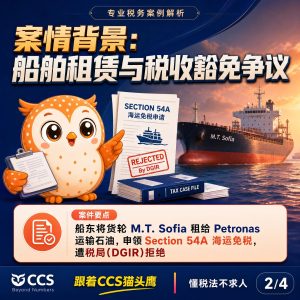
Sobrina Kapal Sdn Bhd leased the cargo vessel M.T. Sofia to Petronas for the transportation of petroleum and claimed the shipping tax exemption under Section 54A of the Income Tax Act 1967. The claim was rejected by the Inland Revenue Board of Malaysia (IRB).
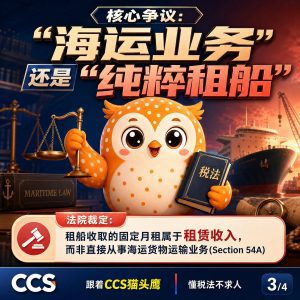
The Court held that the fixed monthly charter fees received by the ship owner constituted lease income, rather than income derived from the direct carrying on of a shipping business involving the transportation of goods under Section 54A.
The High Court allowed the appeal by the tax authority, confirming that income derived from the pure leasing of a vessel does not qualify for the tax exemption under Section 54A.
The key principle arising from the Sobrina Kapal case is that income from the pure leasing of a vessel, whether under a time charter or demise charter, does not constitute income from a shipping business eligible for exemption under Section 54A. This decision provides three practical recommendations for Malaysian shipping and logistics companies in managing their tax compliance and risks.
1. Examine the Legal Substance of Charter Agreements Carefully
When entering into charter agreements with charterers, such as oil companies or major cargo owners, companies must pay close attention to the legal substance of the contractual arrangements.
Where the substance of an agreement involves the payment of a fixed monthly rental and the handover of the vessel for the charterer’s use and deployment, the arrangement may be regarded by the IRB as a lease of an asset. In such circumstances, the income may be treated as rental income rather than income from the transportation of goods by sea that qualifies for exemption under Section 54A of the Income Tax Act 1967.
Compliance recommendation: Companies should, where commercially appropriate, strengthen their substantive participation in shipping operations by assuming voyage-related operating risks and directly participating in cargo scheduling and route management. The agreement should reflect the substance of the transportation services provided, rather than merely the transfer of the vessel for the charterer’s use.
2. Classify and Account for Exempt and Taxable Income Streams Separately
The case demonstrates that the income of a shipping company may comprise different categories. Companies should not automatically report all vessel-related income, such as pure rental income, voyage freight and standby compensation, as exempt income under Section 54A.
Compliance recommendation: Finance and tax teams should establish a robust income classification and accounting system to distinguish accurately between qualifying income from the direct transportation of goods by sea and taxable income arising from asset leasing or ancillary services.
Reasonable disclosure should also be made in tax filings to reduce the risk of retrospective adjustments by the IRB and the imposition of additional assessments and penalties.
3. Strengthen the Operational Substance and Supporting Evidence
The IRB and the Court looked beyond the form of the contractual arrangements and examined the company’s actual operating model.
Companies seeking to rely on the statutory tax benefit under Section 54A must be able to demonstrate that they are, in substance, actively carrying on a shipping business involving the transportation of goods by sea.
Compliance recommendation: Companies should maintain a complete and reliable chain of supporting business records, including vessel registration documents, crew employment and management records, voyage logs, Bills of Lading, and evidence of fuel and port expenses.
These records should be properly maintained and readily available in the event of a tax audit, enabling the company to demonstrate that it is carrying on a shipping business rather than merely leasing an asset.
船舶租赁与第54A条海运税收豁免
Sobrina Kapal Sdn Bhd 将货轮 M.T. Sofia 租赁给 Petronas,用于运输石油,并据此申请《1967年所得税法》第54A条项下的海运税收豁免。然而,该项申请遭到马来西亚内陆税收局(Inland Revenue Board of Malaysia,简称 IRB)拒绝。
法院裁定,船东收取的固定月租属于租赁收入,而非源自直接经营海运货物运输业务的收入,因此不属于第54A条所规定的免税收入。
高庭支持税务机关的上诉,确认纯粹船舶租赁所得不符合第54A条项下的税收豁免条件。
Sobrina Kapal 案所确立的核心原则是:无论属于定期租船(Time Charter)还是光船租赁(Demise Charter),纯粹船舶租赁所得均不属于第54A条项下可享有海运税收豁免的业务所得。该判决为马来西亚海运及物流企业的税务合规与风险管理提出了以下三项具体建议。
一、严格审查租船协议的法律实质
企业在与承租方,例如石油公司或大型货主,签订租船协议时,必须高度重视合同安排的法律实质。
如果协议的实质内容是按月收取固定租金,并将船舶交由承租方使用及调配,该安排可能被内陆税收局视为资产租赁。在此情况下,相关收入可能被认定为租赁收入,而非《1967年所得税法》第54A条所规定的海运货物运输业务所得。
合规建议: 在商业安排允许的情况下,企业应加强自身在航运运营中的实质性参与,例如承担航次相关的营运风险,并直接参与货运调度及航线管理。协议内容应体现实际提供的运输服务,而不应仅仅反映将船舶交由承租方使用的安排。
二、准确划分并独立核算免税与应税收入流
本案表明,海运企业的收入可能包含不同性质的收入类别。企业不应将所有与船舶有关的收入,例如纯租金收入、航次运费及闲置补贴,自动申报为第54A条项下的免税收入。
合规建议: 财务及税务团队应建立严谨的收入分类及核算机制,准确区分符合免税条件的直接海运货物运输收入,以及属于应税范畴的资产租赁收入或附带服务收入。
企业在提交税务申报时,也应作出合理披露,以降低日后遭内陆税收局追溯调整并加征额外评税及罚款(Additional Assessments and Penalties)的风险。
三、夯实运营实质及相关证据链
内陆税收局及法院并未仅依据合同形式作出判断,而是进一步审查了企业的实际运营模式。
企业若要享有第54A条项下的法定税收优惠,必须能够证明其在实质上积极经营海运货物运输业务。
合规建议: 企业应建立并妥善保存完整、可靠的业务证明文件,包括船舶注册文件、船员雇佣及管理记录、航次日志、提单(Bill of Lading),以及燃油及港口费用凭证。
在面对税务审计(Tax Audit)时,企业应能够及时提供上述资料,以证明其实际经营的是海运业务,而非单纯出租资产。