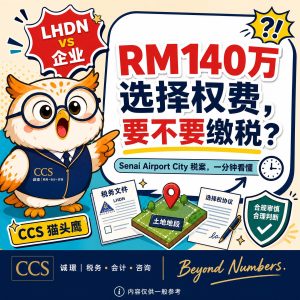
RM1.4 Million Call Option Fee: Is It Taxable?
A sum of money may be regarded as ordinary income, or it may fall within a tax exemption. The answer is sometimes found not only in the amount involved, but also in how the contract is drafted, whether rights have been disposed of, and when the relevant tax approval took effect.
This case review examines Ketua Pengarah Hasil Dalam Negeri v. Senai Airport City Sdn Bhd and explains the key issues through five questions.
What Happened in the Case?
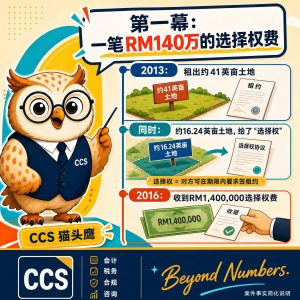
Senai Airport City entered into a leasing arrangement with Hershey Malaysia involving approximately 41 acres of land.
At the same time, Hershey obtained an option over another parcel of approximately 16.24 acres of land. This meant that, within the agreed period, Hershey could require Senai Airport City to lease that land to it.
Senai Airport City subsequently received a Call Option Fee of RM1,400,000.
The issue was whether the RM1.4 million constituted taxable income or fell within the scope of the project’s tax exemption.
LHDN’s Position
LHDN took the position that the Call Option Fee did not fall within the 2016 tax exemption because the land had not actually been sold or leased to Hershey in 2016.
LHDN therefore issued an additional assessment in respect of the income and imposed a penalty.
The Company’s Response
The company argued that Hershey had received more than a document reflecting a possibility to be considered in the future. It had obtained a commercially valuable right that could be exercised within the agreed period.
In other words, although the land had not been transferred and no new lease had immediately been executed, Senai Airport City had already been restricted for a period and could not deal with the land entirely at its own discretion.
The company also argued that the applicable exemption was the tax exemption approved by the Minister of Finance in 2016, rather than the letter issued in 2019. The 2019 explanation could not retrospectively alter the tax treatment of an event that had already occurred in 2016.
The Court’s Decision
The High Court ultimately dismissed LHDN’s appeal and upheld the decision of the Special Commissioners of Income Tax:
- The 2016 tax exemption remained effective.
- The grant of an option could be understood as a disposal of rights over the relevant land. The focus was not limited to whether the land had been formally transferred; the contract and the overall commercial arrangement had to be considered in order to determine the practical effect of the rights granted.
- The 2019 letter could not be applied retrospectively to the tax treatment that had already taken place in 2016.
Accordingly, the additional tax and the penalty imposed under section 113(2) of the Income Tax Act 1967 were set aside. LHDN was also ordered to pay RM15,000 in legal costs.
Three Key Reminders for Businesses
1. Tax treatment does not depend solely on the name of a transaction
Terms such as “Call Option Fee”, “rental” and “service fee” do not, by themselves, determine the tax character of a payment. The actual rights granted, the contractual obligations and the commercial effect are equally important.
2. Timing is critical
The tax exemption approval, the year in which the transaction took place, and any subsequent explanatory or amending documents may directly affect the final tax outcome.
3. The documents must correspond with the facts
Where a business intends to claim a tax exemption, it must carefully verify the scope and conditions of the exemption, the background of the project and the source of the income. Contracts, approval letters, correspondence and relevant commercial evidence should also be properly retained.
Further Clarification on the 2016 and 2019 Exemption Letters
The 2016 tax exemption referred to in this case was not a general “tax-free land sale” exemption, nor was it a universal exemption that automatically applied to all Call Option Fees. It was an income tax exemption incentive granted by the Minister of Finance to Senai Airport City under section 127(3A) of the Income Tax Act 1967.
What Was the 2016 Exemption?
The 2016 Exemption Letter granted a full exemption in respect of the statutory income of the relevant project. The core scope of the wording was:
“statutory income derived from the disposal of rights over plots of land that add value within the development area”
In essence, this referred to an income tax exemption for statutory income derived from the disposal of rights over land parcels that add value within the development area.
The important point was that the 2016 letter used the broader expression “disposal of rights over plots of land”. It did not expressly limit the relevant disposal to a formal sale or lease.
In this case, the RM1,400,000 Call Option Fee received by Senai Airport City was the central issue. The question before the Court was whether granting Hershey an option to require the lease of the land within the agreed period amounted to a “disposal of rights over land”.
The analysis accepted by the Court was that an option did not necessarily transfer ownership of the land immediately. However, it created a legally enforceable right and restricted the landowner’s ability to deal freely with the land.
Therefore, in the contractual and commercial context of this case, the Call Option Fee could fall within the scope of the disposal of land rights described in the 2016 exemption letter.
The Court’s focus was not simply whether the land had been transferred immediately. Rather, it considered whether the company, in receiving the consideration, had granted the other party a substantive right over the land and thereby restricted its own freedom to deal with the land.
What Was the 2019 Letter?
The 2019 letter was an amended or modified tax exemption letter subsequently issued by the Minister of Finance or the relevant government department.
Compared with the 2016 version, the 2019 letter introduced more specific restrictive wording by describing the qualifying disposal as:
“disposal … by way of sale or lease”
This expressly emphasised that the disposal of land rights would potentially qualify for the exemption only where it was carried out by way of sale or lease.
The 2019 letter was therefore narrower and more specific than the 2016 letter. It further described the broader concept of “disposal of rights over land” as disposal “by way of sale or lease”.
Why Could the 2019 Letter Not Be Used to Deny the 2016 Exemption?
The income in dispute was received in the year of assessment 2016. In principle, whether the income qualified for the exemption should be determined by reference to the exemption document that was effective when the income arose—the 2016 Exemption Letter—rather than the 2019 version issued several years later.
The Court’s reasoning may be summarised as follows:
| Time | Document and wording | Significance to the case |
|---|---|---|
| 2016 | Broader exemption wording: disposal of rights over plots of land | This was the document applicable when the RM1.4 million Call Option Fee arose. |
| 2019 | Added the restrictive wording “by way of sale or lease” | This was a subsequent amendment and could not automatically be applied retrospectively to narrow the exemption that already existed in 2016. |
| Year of Assessment 2016 | The Call Option Fee was received | The scope of the exemption effective at that time was the relevant basis for assessment. |
Applying the 2019 restriction retrospectively to 2016 would effectively insert a condition added later into the earlier exemption letter. The Court held that the administrative authority could not, solely through a later letter or subsequent interpretation, retrospectively narrow the scope of the exemption originally approved by the Minister of Finance.
Does This Mean That All Call Option Fees Are Exempt from Income Tax?
No. This distinction is important.
The conclusion in this case was based on several specific conditions. First, Senai Airport City held a 2016 tax exemption granted by the Minister of Finance. Second, the exemption covered income derived from the disposal of rights over land that added value within the development area. Third, the Call Option formed part of the overall land transaction and development arrangement, rather than being a completely independent charge unrelated to the land. Fourth, the Court considered that granting the option involved the granting and restriction of rights over the land.
The accurate conclusion is therefore that, under the specific exemption document, contractual arrangement and factual circumstances of this case, the RM1.4 million Call Option Fee was considered to fall within the scope of the 2016 tax exemption.
This cannot be broadly applied to mean that all Call Option Fees are tax-exempt, or that all Call Option Fees received subsequently will automatically receive the same treatment.
Conclusion
A tax dispute is not simply a matter of assuming that money received must always be taxable, nor that holding an exemption letter means that no tax is payable in every circumstance.
The key questions are where the income came from, what rights it related to, when it arose, and whether it satisfied the conditions of the approved exemption.
The 2016 letter was the original income tax exemption approval containing broader wording, while the 2019 letter was a later amended version that added the restriction “sale or lease”. Since the RM1.4 million Call Option Fee arose in 2016, the Court held that the narrower wording in 2019 could not be applied retrospectively to weaken the exemption that existed in 2016.
The contents of this article are provided for general reference only and do not constitute legal or tax advice. Tax treatment must be analysed on a case-by-case basis with reference to the specific facts, contractual terms, approval documents and applicable law.
RM140万选择权费,到底要不要缴税?
一笔钱,究竟属于“普通收入”,还是可能落入税务豁免范围?答案有时不只取决于金额,更取决于合同如何订立、相关权利是否已经处置,以及有关税务批准何时生效。
以下通过 Ketua Pengarah Hasil Dalam Negeri v. Senai Airport City Sdn Bhd 一案,梳理这宗税务案件所涉及的主要问题。
案件发生了什么?
Senai Airport City 与 Hershey Malaysia 签订租赁安排,涉及约 41 英亩土地。
与此同时,Hershey 还取得另一块约 16.24 英亩土地的选择权。这意味着,在约定期限内,Hershey 可以要求 Senai Airport City 将该土地出租给它。
其后,Senai Airport City 收到一笔 RM1,400,000 的选择权费(Call Option Fee)。
争议在于:这 RM140 万究竟属于应税收入,还是属于有关项目的税务豁免范围?
LHDN 的立场
LHDN 认为,这笔选择权费不属于 2016 年税务豁免范围,因为有关土地在 2016 年并未实际出售或出租给 Hershey。
因此,LHDN 就该笔收入作出追加评估,并同时施加罚款。
企业如何回应?
企业认为,Hershey 取得的并不只是一份“未来再作考虑”的文件,而是一项具有商业价值、并可在约定期限内行使的权利。
换言之,虽然土地并未立即转让,也没有即时签订新的租约,但 Senai Airport City 已在一段期间内受到限制,不能完全按照自己的意愿处置该土地。
企业也主张,适用的应是财政部长于 2016 年批准的税务豁免,而不是后来于 2019 年发出的信函。2019 年的说明不能追溯改变已经发生于 2016 年的税务处理。
法院最后如何判决?
高等法院最终驳回 LHDN 的上诉,并维持特别税务委员会的决定:
- 2016 年的税务豁免继续有效。
- 给予选择权可以被理解为对相关土地权利的一种处置。判断重点不只是土地是否已经正式转让,也必须结合合同及整体商业安排,分析有关权利实际上产生了什么效果。
- 2019 年的信函不能追溯适用于 2016 年已经发生的税务处理。
因此,相关追加税款及根据《1967 年所得税法令》第 113(2) 条作出的罚款被撤销;LHDN 也须承担 RM15,000 的诉讼费。
这宗案件给企业的三个提醒
第一,税务处理不只取决于交易名称
“选择权费”、“租金”、“服务费”或其他名称,不能单独决定付款的税务性质。实际授予的权利、合同义务及商业效果同样重要。
第二,时间点非常关键
税务豁免批准、交易发生的年份,以及随后发布的说明或修订文件,都可能直接影响最终税务结果。
第三,文件必须与事实相符
如果企业要主张税务豁免,就必须仔细核对豁免的范围与条件、项目背景及收入来源,并妥善保留合同、批准书、往来信函及相关商业证据。
关于 2016 年与 2019 年税务豁免信的进一步说明
这里所说的 2016 年税务豁免,并不是一般意义上的“卖地免税”,也不是自动适用于所有选择权费的通用豁免,而是财政部长根据《1967 年所得税法令》第 127(3A) 条授予 Senai Airport City 的一项所得税豁免激励。
2016 年的豁免是什么?
2016 年的 Exemption Letter(税务豁免信)给予相关项目的法定收入全面豁免。其核心范围大意如下:
“statutory income derived from the disposal of rights over plots of land that add value within the development area”
中文可理解为:对在开发区域内、能够增加价值的土地地块权利处置所产生的法定收入,给予所得税豁免。
关键在于,2016 年信函使用了较宽的表达:“disposal of rights over plots of land”,即处置土地地块上的权利。该信函并没有明确限定必须是正式出售(sale)或租赁(lease)。
在本案中,Senai Airport City 收取的 RM1,400,000 Call Option Fee(选择权费)正是争议的核心。法院需要处理的问题是:授予 Hershey 一项可在约定期间内要求租赁土地的选择权,是否属于“处置土地权利”。
法院所接受的分析是:选择权不一定会立即转移土地所有权,但会产生一项具有法律效力的权利,同时限制土地所有人自由处置该土地的能力。
因此,在本案的合同及商业背景下,选择权费可以落入 2016 年豁免信所指的土地权利处置范围。
换言之,法院关注的并不只是“土地有没有马上过户”,而是公司是否为了取得这笔对价,将土地上的某项实质权利授予对方,并因此限制自己处置土地的自由。
2019 年的信函是什么?
2019 年的信函是财政部长或有关政府部门后来发出的修订或修改后的税务豁免信函(amended exemption letter)。
与 2016 年版本相比,2019 年信函加入了更具体的限制性文字,把符合豁免的处置方式写成:
“disposal … by way of sale or lease”
这明确强调,只有通过出售或租赁的方式处置土地权利,才可能符合豁免范围。
因此,2019 年的信函比 2016 年的信函更窄、更具体。它把原来较宽的“处置土地权利”,进一步描述为“通过出售或租赁进行的处置”。
为什么 2019 年信函不能用来否定 2016 年豁免?
因为争议收入是在 2016 年课税年度(YA 2016)收到的。原则上,判断这笔收入是否享有豁免,应当依据收入发生时有效的豁免文件,也就是 2016 年 Exemption Letter,而不是几年后才出现的 2019 年版本。
法院的逻辑可以概括如下:
| 时间 | 文件及内容 | 对本案的意义 |
|---|---|---|
| 2016 年 | 较宽的豁免文字:处置土地地块上的权利 | 这是 RM1.4 million 选择权费发生时适用的文件。 |
| 2019 年 | 加入“by way of sale or lease”的限制性文字 | 这是后来作出的修订,不能自动追溯收窄 2016 年已经存在的豁免。 |
| 2016 年课税年度 | 收到 Call Option Fee | 应以当时有效的 2016 年豁免范围作为判断基础。 |
如果把 2019 年的限制倒过来适用于 2016 年,就等于把后来新增的条件强行纳入早期豁免信中。法院认为,行政机关不能单靠后来发出的信函或事后的解释,追溯缩小财政部长当初已经批准的豁免范围。
这是否代表所有 Call Option Fee 都免所得税?
不是。这是非常重要的区别。
本案的结论建立在几个具体条件之上。第一,Senai Airport City 持有一份财政部长于 2016 年授予的税务豁免。第二,豁免信涵盖的是开发区域内能够增加价值的土地权利处置收入。第三,Call Option 是整体土地交易及开发安排的一部分,而不是完全独立、与土地无关的收费。第四,法院认为,授予选择权实际上涉及土地权利的授予及限制。
因此,准确的说法是:在本案特定的豁免文件、合同安排及事实背景下,RM1.4 million 的 Call Option Fee 被认为属于 2016 年税务豁免的范围。
不能简单将此推广为所有选择权费都免税,或所有后来收到的选择权费都自动适用相同结果。
总结
税务争议不是简单地认为“收了钱就一定要缴税”,也不是认为“拿到豁免书就代表任何情况下都不用缴税”。
真正关键的是:这笔收入从何而来、对应什么权利、发生在什么时候,以及是否符合获批准的豁免条件。
2016 年的信函是使用较宽表述的原始所得税豁免批准;2019 年的信函则是后来加入“sale or lease”限制的修订版本。由于 RM1.4 million 的选择权费属于 2016 年发生的收入,法院认为不能以 2019 年较狭窄的文字追溯削弱 2016 年已经存在的豁免。
以上内容仅供一般参考,不构成法律或税务意见。税务处理须根据具体事实、合同内容、批准文件及适用法律作个别分析。