Understanding the New Incentive Framework (NIF) and the NIA Scorecard
Before looking at FAQ 7, it is important to understand the New Incentive Framework, or NIF.
NIF represents Malaysia’s new approach to investment incentives. It was introduced under Budget 2026 as a policy shift towards a more targeted, tiered and outcome-based incentive system.
The objective is not merely to attract more investment, but to attract higher-quality investment that supports Malaysia’s long-term economic and industrial priorities.
The framework is guided by the National Investment Aspirations and the New Industrial Master Plan 2030. It aims to link incentives to measurable outcomes.
FAQ 7 explains the role of the NIA Scorecard.
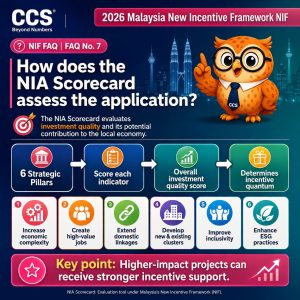
The NIA Scorecard is the evaluation tool used to measure an investment’s quality and its potential contribution to the local economy. Rather than focusing solely on the size of the investment, the Scorecard assesses a project across six strategic pillars: economic complexity, high-value job opportunities, domestic linkages, new and existing economic clusters, inclusivity, and ESG practices.
During the application process, each relevant indicator is scored. These scores are then used to determine the project’s overall investment quality. Ultimately, the final quality score affects the level of tax incentive support. In principle, higher-impact projects may receive more significant support.
The key message is clear:
NIF is not merely asking, “How much are you investing?”
It is asking, “How much value will your investment bring to Malaysia?”
Under NIF, a project is not judged by the thickness of its proposal file. It is judged by whether the investment demonstrates real substance through technology, job creation, local linkages, industry upgrading, inclusivity and ESG practices.
A thick file alone does not guarantee a strong score; real impact does.
了解新投资奖励框架(NIF)与 NIA Scorecard
在了解 FAQ 7 之前,大家需要先明白什么是 NIF,也就是马来西亚新投资奖励框架。
NIF 代表马来西亚投资奖励制度的新方向。它是在 2026 年财政预算案下推出,旨在把投资奖励制度转向更精准、分层式及成果导向的机制。
政府的目标并不只是吸引“更多投资”,而是吸引更具质量、能够支持马来西亚长期经济与工业发展方向的投资。
这个框架主要配合国家投资愿景(National Investment Aspirations,NIA)和《新工业大蓝图 2030》(New Industrial Master Plan 2030,NIMP 2030),并将奖励与可衡量的成果挂钩。
FAQ 7 所解释的,正是 NIA Scorecard 的作用。
NIA Scorecard 是用来评估投资质量,以及项目对本地经济潜在贡献的工具。它并不只是关注投资金额,而是通过六大战略支柱来评估项目:经济复杂度、高价值就业机会、本地链接、新与现有经济集群、包容性,以及 ESG 实践。
在申请过程中,每个相关指标都会被评分。这些分数将用于判断项目的整体投资质量。最终,项目的质量评分会影响税务奖励支持的幅度;原则上,影响力越高的项目,越有机会获得更显著的支持。
所以,重点是:
NIF 不只是问:“你投资多少钱?”
而是问:“你的投资能为马来西亚带来多少价值?”
在 NIF 时代,项目并不是看 proposal 文件夹有多厚,而是看投资是否具备真正的实质贡献——包括技术、就业、本地链接、产业升级、包容性和 ESG。
文件厚,不一定能得分;真正的贡献,才更有机会加分。