FAQ 5: Understanding the Incentives under Malaysia’s New Incentive Framework
Before reviewing FAQ 5, it is important to understand what the New Incentive Framework, or NIF, is and why Malaysia introduced it.
The NIF represents Malaysia’s move to reform its investment incentive system into a more targeted and outcome-based framework. Its purpose is not merely to grant tax incentives because a company invests, but to encourage investments that deliver measurable national outcomes, such as higher-value manufacturing, stronger technology adoption, better employment opportunities and broader economic impact.
The NIF is guided by the National Investment Aspirations and NIMP 2030.
FAQ 5 addresses a very practical question: what types of incentives are available under the NIF?
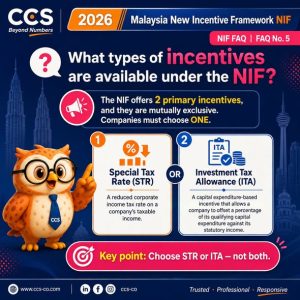
Under the NIF, there are two primary tax incentives, and they are mutually exclusive. In other words, a company must choose one rather than claim both.
The two incentives are the Special Tax Rate (STR) and the Investment Tax Allowance (ITA).
The Special Tax Rate (STR) allows a company to benefit from a reduced corporate income tax rate on its taxable income for a specified period. In simple terms, if a company expects to generate taxable profits relatively soon, the STR may be attractive because it directly reduces the tax rate applied to those profits.
The Investment Tax Allowance (ITA) is different. It is linked to qualifying capital expenditure. A company may use a specified percentage of its qualifying capital expenditure to offset against statutory income. In simple terms, the ITA may be more relevant for projects involving substantial investment in machinery, equipment, plant or production facilities.
The key distinction is straightforward: the STR reduces the tax rate, while the ITA provides an allowance based on qualifying capital expenditure. As the two incentives are mutually exclusive, a company generally needs to choose one rather than claim both.
Instead of first asking whether both incentives can be claimed, companies should ask which incentive best fits their business model, profit timeline and capital expenditure plan.
Under the NIF, the most suitable choice is not necessarily the incentive that appears to offer the greatest benefit. The more appropriate approach is to choose the incentive that genuinely fits the project.
FAQ 5:了解马来西亚新投资奖励框架下的奖励
在阅读 FAQ 5 之前,首先需要了解什么是 NIF,以及马来西亚为何推出这项框架。
NIF,即马来西亚新投资奖励框架,是政府改革投资奖励制度的新方向。其重点不只是“企业进行投资就获得税务奖励”,而是鼓励能够带来可衡量国家成果的投资,例如推动更高价值的制造业、加强技术应用、创造更优质的就业机会,以及扩大整体经济贡献。
NIF 的方向主要配合国家投资愿景(NIA)和新工业大蓝图(NIMP 2030)。
FAQ 5 回答的是一个非常实际的问题:NIF 下有哪些奖励可供选择?
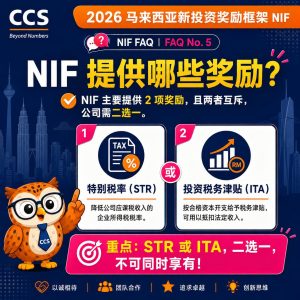
根据 FAQ 5,NIF 主要提供两项税务奖励,而两者是互斥的。换言之,公司必须二选一,不能同时享有这两项奖励。
这两项奖励分别是特别税率(STR)和投资税务津贴(ITA)。
特别税率(STR)是指公司在指定期间内,其应课税收入可适用较低的企业所得税税率。简单来说,如果公司预计能够较快开始盈利并产生应课税利润,STR 可能更具吸引力,因为它可以直接降低适用的税率。
投资税务津贴(ITA)则有所不同。它与合格资本开支挂钩,公司可以使用合格资本开支的一定比例来抵扣法定收入(statutory income)。简单来说,如果项目涉及大量机器、设备、厂房或生产设施投资,ITA 可能更值得考虑。
因此,两者的重点区别十分清楚:STR 是降低税率;ITA 则是根据合格资本开支提供津贴。由于两者互斥,公司通常需要二选一,而不是同时申请。
与其一开始就问“两个奖励可以一起申请吗?”,不如先问:“哪一项更符合我的商业模式、盈利时间表和资本开支计划?”
在 NIF 框架下,最明智的选择不一定是看起来最大的奖励,而是最符合项目实际情况的奖励。