RA was extended to the agricultural sector to encourage local food production and thus increase its supply.
In Budget 2003, chicken and duck farmers who switched from an open house system to a closed house system were given Reinvestment Allowance (RA) for 15 consecutive years.
The RA is given on 60% of qualifying capital expenditure incurred and is allowed to be set off against 70% (100% for promoted areas) of statutory income.
For YAs 2009 and 2010, chicken and duck rearers who reinvest to expand the closed house system in existing or new locations approved by the Ministry of Agriculture and Agro-based Industry are given incentives as follows:
projects located in the promoted areas are eligible for RA of 60% on qualifying capital expenditure to be set off against 100% of the statutory income, and
projects located outside the promoted areas are eligible for RA of 60% on qualifying capital expenditure to be set off against 70% of the statutory income.
Proposal
To encourage more chicken rearers to adopt an environmental-friendly closed house system, it is proposed tax incentives be given as follows:
Accelerated Capital Allowance (ACA) 100% on the qualifying capital expenditure; and
Income Tax Exemption of 100% equivalent to the qualifying capital expenditure.
These tax incentives are given on the Qualifying Capital Expenditure incurred from the year of assessment 2023 until the year of assessment 2025 and are to be fully absorbed within a year.
Effective Date
From the year of assessment 2023 until the year of assessment 2025.
Our website's articles, templates, and material are solely for reference. Although we make every effort to keep the information up to date and accurate, we make no representations or warranties of any kind, either express or implied, regarding the website or the information, articles, templates, or related graphics that are contained on the website in terms of its completeness, accuracy, reliability, suitability, or availability. Any reliance on such information is, therefore strictly at your own risk.
Keep in touch with us so that you can receive timely updates |
Automation Capital Allowance (ACA) is a tax incentive introduced in Budget 2015 to encourage manufacturers to engage in innovative and productive activities, expedite the adoption of automation, especially for labour-intensive industries, and further spur automation initiatives.
The incentive is split into 2 categories of industries i.e.
Category 1: High Labour-intensive Industries (Rubber products, plastics, wood, furniture and textiles); and
Category 2: Industries Other than Category 1
It was proposed in Budget 2020 that the existing Automation Capital Allowance (ACA) incentive for Category 2 of the manufacturing sector be expanded to the services sector to boost productivity and efficiency in labour-intensive industries.
Manufacturing and services companies which incur qualifying capital expenditure on automation equipment are given tax incentives as follows:
Category 1: Labour-Intensive Industry (rubber, plastic, wood and textile products)
ACA of 100% for automation equipment on the first RM4 million for Qualifying Capital Expenditure incurred and can be utilised within 1 year.
Category 2: Industries other than Category1 including the services sector
ACA of 100% for automation equipment on the first RM2 million for qualifying capital expenditure incurred and can be utilised within 1 year.
Both categories are eligible for income tax exemption equivalent to 100% of qualifying capital expenditure incurred for automation equipment. Thus, eligible capital expenditure that can be absorbed is 200%within a year.
The tax incentive is for applications received by the Malaysian Investment Development Authority (MIDA) until 31 December 2023.
Guideline and Procedure for the Application of Automation Capital Allowance (Automation CA) for Services Sector – for an existing company only.
To further drive productivity and improve efficiency through automation, it is proposed the ACA for automation equipment be enhanced as follows:
scope of automation to include the adaptation of Industry 4.0 elements;
scope of tax incentives is expanded to include the agriculture sector; and
capital expenditure threshold for categories 1, 2 and agriculture be aligned and increased to RM10 million.
For applications received by MIDA and the Ministry of Agriculture and Food Security (MAFS) from 1 January 2023 until 31 December 2027.
Updated on 15 July 2023- Dialogue between MOF, LHDNM, and CTIM [21/6/2023]
CTIM proposed the mutually exclusive rules to be applied on an asset basis instead of a company basis.
MOF’s Feedback:
The proposal was duly noted.
Further studies will be conducted regarding the mutually exclusive clause to ensure its suitability for implementation.
For assets under hire purchase, kindly confirm there is no requirement for the hire purchase instalments to commence and end within the qualifying period from 1 January 2023 until 31 December 2027 to qualify for the accelerated capital allowance (“ACA”) claim.
In essence, as long as it is a qualifying asset, the incentive applies to the whole capital expenditure incurred.
LHDNM’s Feedback:
The ACA incentive also applies to assets acquired through hire-purchase agreements.
The eligible capital expenditure for hire-purchased assets is the principal amount incurred during the basic period of a particular assessment year for assets acquired between 1 January 2023 and 31 December 2027.
Therefore, principal payments made outside the incentive period are not eligible to enjoy this incentive.
ACA on capital expenditure up to RM10 million is welcomed.
Still, there should be clarity on whether it is a 200% allowance like in the past (i.e. 100% accelerated capital allowance plus 100% automation capital allowance) or just a 100% accelerated capital allowance.
LHDNM’s Feedback:
This extended Accelerated Capital Allowance (ACA) incentive refers to the incentive under ACA (Automation Enhancement).
This incentive should be read and applied with the income tax order that provides an exemption equal to 100% of the ACA (Automation Enhancement) amount.
This exemption applies to statutory income from eligible projects but is limited to 70%.
The characteristics of the incentive are the same as the original incentive.
This matter will be clarified in the relevant subsidiary legislation.
MOF’s Feedback:
The characteristics of the incentive will be the same as the original incentive.
Disclaimer:
The articles, templates, and other materials on our website are provided only for your reference.
While we strive to ensure that the information presented is current and accurate, we cannot guarantee the completeness, reliability, suitability, or availability of the website or its content, including any related graphics. Consequently, any reliance on this information is entirely at your own risk.
If you intend to use the content of our videos and publications as a reference, we recommend that you take the following steps:
Verify that the information provided is current, accurate, and complete.
Seek additional professional opinions, as the scope and extent of each issue, may be unique.
Background to the Shipbuilding and Ship Repairing Industry
Malaysia’s strategic location on a crucial sea lane has made the country well-positioned to access global trade routes.
The Greek geographer Ptolemy described us as the “Golden Khersonene,” meaning Golden Peninsula, in his atlas Geographica in AD 150.
In modern times, the Malaysian shipbuilding and ship repair (SBSR) sub-sector encompass companies that manufacture seagoing vessels and marine equipment, as well as providers of related services, including ship repair, design, upgrade/ conversion of vessels and maintenance, repair and overhaul (MRO).
Introduced in 2016, the SBSR industry incentives are available for both new and existing companies until the end of 2022.
Current Position
Companies undertaking SBSR activities in Malaysia are eligible for tax incentives as follows:
New Company
Pioneer Status with an income tax exemption of 70% of statutory income for 5 years; or
An Investment Tax Allowance of 60% on Qualifying Capital Expenditure incurred within 5 years and can be set off against 70% of the statutory income for each assessment year.
Existing Company
Investment Tax Allowance of 60% on qualifying capital expenditure incurred within 5 years and can be set off against 70% of the statutory income for each assessment year.
The tax incentive is for applications received by the Malaysian Investment Development Authority (MIDA)from 1 January 2020 until 31 December 2022.
In addition, SBSR companies with bona fide status are also eligible for import duty and sales tax exemption under Item 53, Customs Duties (Exemption) Order 2017 and Item 44, Schedule A, Sales Tax (Persons Exempted from Payment of Tax) Order 2018.
These exemptions are given for bona fide status applications received by the Ministry of Finance until 31 December 2022.
Proposal
To position Malaysia as a regional hub for SBSR, it is proposed that existing tax incentives and bona fide status be extended for 5 years.
Effective Date
For SBSR applications received by MIDA from 1 January 2023 until 31 December 2027.
For bona fide status applications received by the Ministry of Finance from 1 January 2023 until 31 December 2027.
Updated on 15 July 2023- Dialogue between MOF,LHDNM, and CTIM [21/6/2023]
LHDNM confirms that for Ship Building and Ship Repairing activities, the mechanism for implementing tax incentives is through PU(A)112/2006 or PU(A)113/2006.
CTIM sought confirmation that the qualifying company could follow the tax treatment (e.g. losses or capital allowance) mentioned under PU(A) 112/2006 and PU(A) 113/2006, regardless of whether the approval letter made reference to the said PU orders.
LHDNM’s Feedback:
For Ship Building and Ship Repairing activities, the approval letter will specify the specific provisions of the law in granting tax incentive approval and the prescribed approval conditions to ensure that the approved company carries out proper tax compliance services and adheres to the established approval conditions.
Disclaimer:
The articles, templates, and other materials on our website are provided only for your reference.
While we strive to ensure that the information presented is current and accurate, we cannot guarantee the completeness, reliability, suitability, or availability of the website or its content, including any related graphics. Consequently, any reliance on this information is entirely at your own risk.
If you intend to use the content of our videos and publications as a reference, we recommend that you take the following steps:
Verify that the information provided is current, accurate, and complete.
Seek additional professional opinions, as the scope and extent of each issue, may be unique.
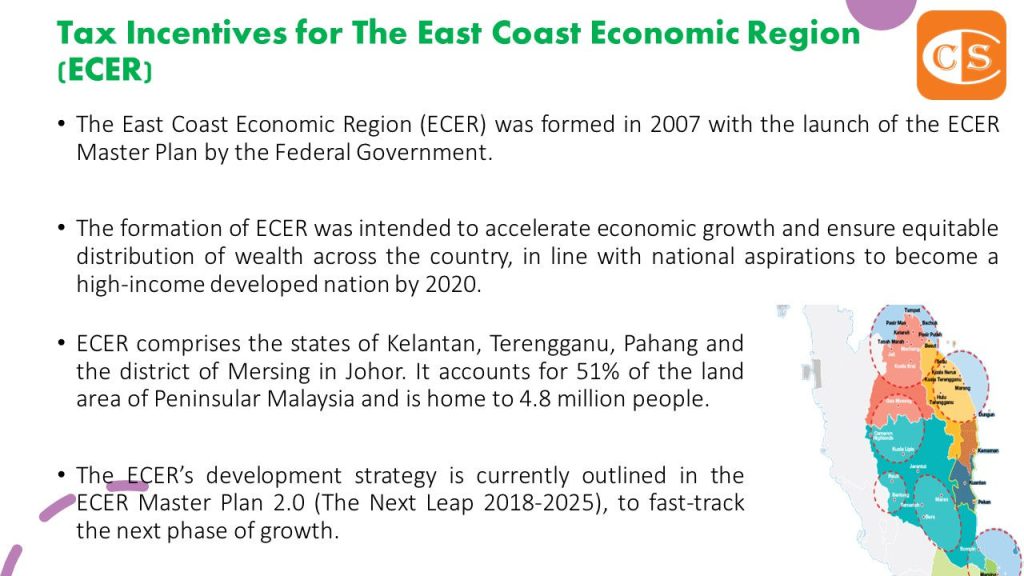
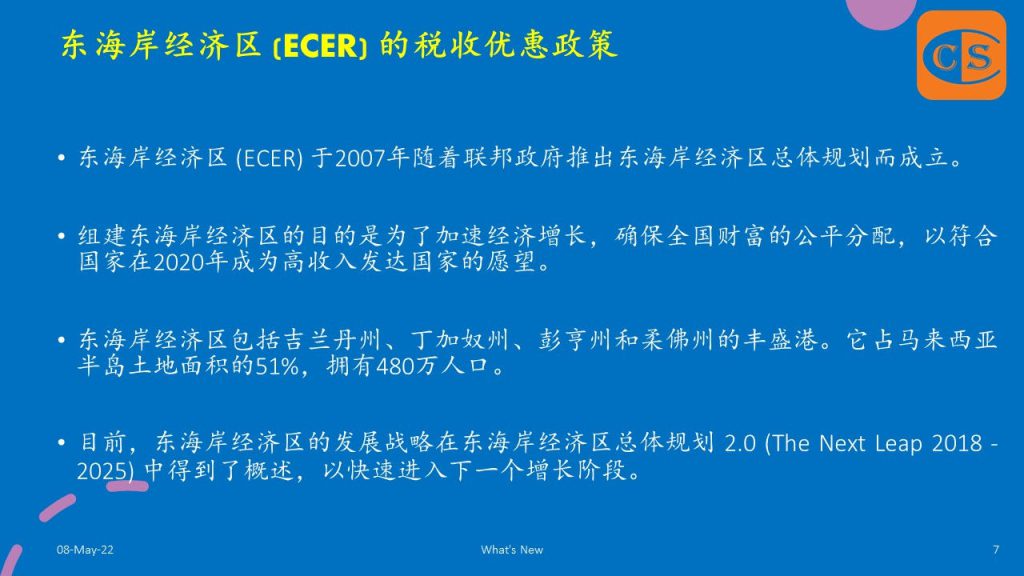
1. The East Coast Economic Region (ECER) was formed in 2007 with the launch of the ECER Master Plan by the Federal Government.2. The formation of ECER was intended to accelerate economic growth and ensure equitable distribution of wealth across the country, in line with national aspirations to become a high-income developed nation by 2020.
3. As a result, the government has provided tax incentives for the ECER
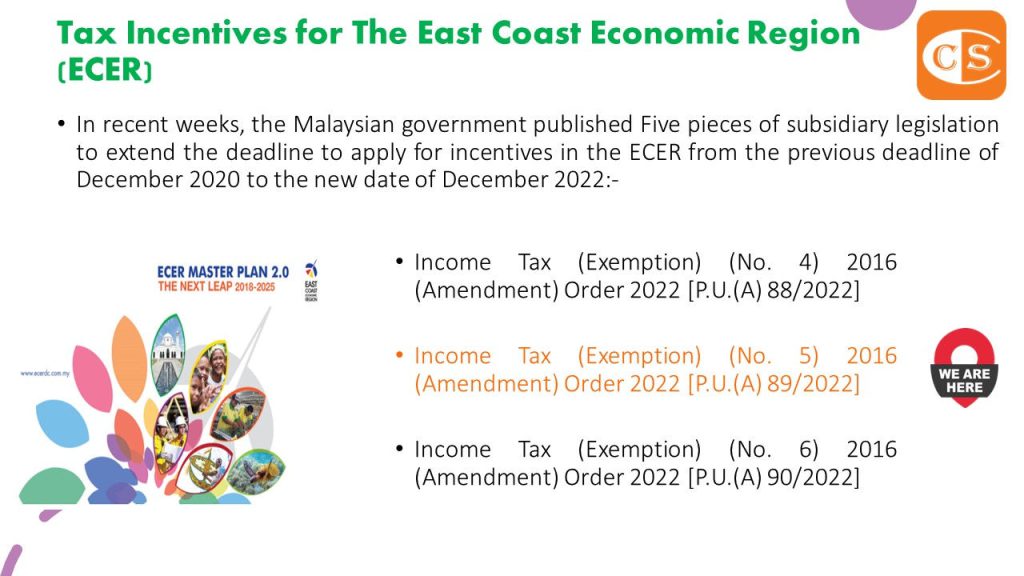
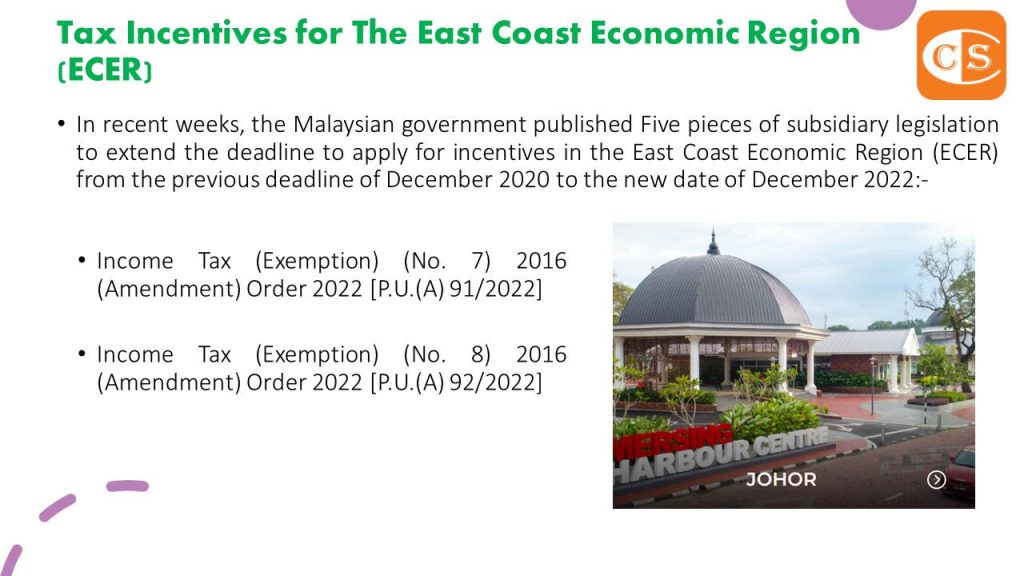
4. In recent weeks, the Malaysian government published Five pieces of subsidiary legislation to extend the deadline to apply for incentives in the ECER from the previous deadline of December 2020 to the new date of December 2022:-
👉 Income Tax (Exemption) (No. 4) 2016 (Amendment) Order 2022 [P.U.(A) 88/2022]
👉 Income Tax (Exemption) (No. 5) 2016 (Amendment) Order 2022 [P.U.(A) 89/2022]
👉 Income Tax (Exemption) (No. 6) 2016 (Amendment) Order 2022 [P.U.(A) 90/2022]
👉 Income Tax (Exemption) (No. 7) 2016 (Amendment) Order 2022 [P.U.(A) 91/2022]
👉 Income Tax (Exemption) (No. 8) 2016 (Amendment) Order 2022 [P.U.(A) 92/2022]
5. Under the Income Tax (Exemption) (No. 5) Order 2016 (‘P.U.(A) 158/2016’), a qualifying person is exempted from paying income tax on statutory income derived from a special qualifying activity that is equal to the rate of allowance specified by the Minister, which shall not be less than 60% and not more than 100% of the qualifying capital expenditure incurred by the qualifying person for such period of consecutive years as the Minister may determine.
1. The Sabah Development Corridor (SDC) Blueprint, which was launched on 28 January 2008, is implemented with the aim of bringing the quality of life of Sabah’s people up another level as well as accelerating the economic growth for Sabah while promoting regional balance and bridging the rural-urban divide and concurrently ensuring sustainable management of state’s resources.
2. In recent weeks, the Malaysian government published three pieces of subsidiary legislation to extend the deadline to apply for incentives in the Sabah Development Corridor (the “SDC”) from the previous deadline of December 2020 to the new date of December 2022:-
1. The East Coast Economic Region (ECER) was formed in 2007 with the launch of the ECER Master Plan by the Federal Government.
2. The formation of ECER was intended to accelerate economic growth and ensure equitable distribution of wealth across the country, in line with national aspirations to become a high-income developed nation by 2020.
3. As a result, the government has provided tax incentives for the ECER
4. In recent weeks, the Malaysian government published Five pieces of subsidiary legislation to extend the deadline to apply for incentives in the ECER from the previous deadline of December 2020 to the new date of December 2022:-
👉 Income Tax (Exemption) (No. 4) 2016 (Amendment) Order 2022 [P.U.(A) 88/2022]
👉 Income Tax (Exemption) (No. 5) 2016 (Amendment) Order 2022 [P.U.(A) 89/2022]
👉 Income Tax (Exemption) (No. 6) 2016 (Amendment) Order 2022 [P.U.(A) 90/2022]
👉 Income Tax (Exemption) (No. 7) 2016 (Amendment) Order 2022 [P.U.(A) 91/2022]
👉 Income Tax (Exemption) (No. 8) 2016 (Amendment) Order 2022 [P.U.(A) 92/2022]
5. The Income Tax (Exemption) (No. 4) Order 2016 (‘P.U.(A) 157/2016’) exempts a qualifying person from income tax for five consecutive years on statutory income obtained from a qualifying activity that is equivalent to 100% of the qualifying capital expenditure incurred by the qualifying person.