
Day: December 24, 2022

  • The International Standards on Auditing (ISAs)

    The International Standards on Auditing (ISAs)

    Structure of the ISAs | 国际审计准则的结构

    The ISAs have a standard structure, as outlined below.

    Introduction

    An explanation of the purpose and scope of the ISA, including how the ISA relates to other ISAs, the subject matter of the ISA, specific expectations on the auditor and others, and the context in which the ISA is set.

    Objectives

    The objective is to be achieved by the auditor as a result of complying with the requirements of the ISA. To accomplish the auditor’s overall objectives, the auditor must use the objectives stated in relevant ISAs in planning and performing the audit, keeping in mind the interrelationships among the ISAs.

    ISA 200.21 (a) requires the auditor to:

    1. Determine whether any audit procedures in addition to those required by the ISAs are necessary for the pursuance of the objectives stated in the ISAs; and
    2. Evaluate whether sufficient appropriate audit evidence has been obtained.

    导言

    解释《国际审计准则》的目的和范围,包括《国际审计准则》与其他《国际审计准则》的关系、《国际审计准则》的主题、对审计师和其他人的具体期望,以及《国际审计准则》的背景。

    目的

    目标是审计师在遵守《国际审计准则》的要求后所要达到的结果。为了实现审计师的总体目标,审计师必须在计划和执行审计时使用相关《国际审计准则》中规定的目的,并牢记《国际审计准则》之间的相互关系。

    国际审计准则 200.21(a) 要求审计师:

    1. 确定除《国际审计准则》要求的审计程序外,是否有必要采取任何审计程序,以实现《国际审计准则》中所述的目的;和
    2. 评估是否已获得足够的适当的审计证据。

    Definitions

    A description of the meanings attributed to specific terms for purposes of the ISAs. These are provided to assist in the consistent application and interpretation of the ISAs. They are not intended to override definitions that may be established for other purposes, such as those contained in laws or regulations. Unless otherwise indicated, these terms carry the same meanings throughout the ISAs.

    Requirements

    This section outlines the specific auditor requirements. Each requirement contains the word “shall.”

    For example, ISA 200.15 includes the following requirement: “The auditor shall plan and perform an audit with professional skepticism, recognising that circumstances may exist that cause the financial statements to be materially misstated.”

    定义

    为《国际审计准则》的目的,对特定术语的含义的描述。提供这些定义是为了帮助《国际审计准则》的一致应用和解释。这些定义并不打算取代为其他目的而确定的定义,如法律或法规中的定义。除非另有说明,这些术语在《国际审计准则》中具有相同的含义。

    要求

    本节概述了具体的审计师要求。每个要求都包含 “应 “字。

    例如,《国际审计准则》200.15 包括以下要求。”审计师应以专业怀疑态度计划和实施审计,认识到可能存在导致财务报表出现重大误报的情况。”

    Application and Other Explanatory Material

    The application and other explanatory material provide further explanation of the requirements of an ISA and guidance for carrying them out. In particular, it may:

    • Explain more precisely what a requirement means or is intended to cover;
    • Where applicable, include considerations specific to smaller entities; and
    • Include examples of procedures that may be appropriate in the circumstances. However, the actual procedures selected by the auditor require professional judgment based on the particular circumstances of the entity and the assessed risks of material misstatement.

    While such guidance does not in itself impose a requirement, it is relevant to the proper application of the requirements of an ISA. The application and other explanatory material may provide background information on matters addressed in an ISA.

    Appendices

    Appendices form part of the application and other explanatory material. The purpose and intended use of an appendix are explained in the body of the related ISA or within the title and introduction of the appendix itself.

    应用和其他解释性材料

    应用和其他解释性材料提供了对国际审计准则要求的进一步解释和执行准则的指导。特别是,它可以

    • 更准确地解释某项要求的含义或打算涵盖的内容。
    • 在适用的情况下,包括针对小型实体 (smaller entities) 的考虑;以及
    • 包括在这种情况下可能适合的程序的例子。 然而,审计师选择的实际程序需要根据该实体的特定情况和所评估的重大误报风险进行专业判断。

    虽然这种指导本身并没有提出要求,但它与正确应用国际审计准则的要求有关。应用和其他解释性材料可以提供关于国际审计准则中所涉及事项的背景信息。

    附录

    附录是申请书和其他解释性材料的一部分。附录的目的和预期用途在相关国际审计准则的正文中或在附录本身的标题和介绍中加以解释。
    Our website's articles, templates, and material are solely for you to look over. Although we make every effort to keep the information up to date and accurate, we make no representations or warranties of any kind, either express or implied, regarding the website or the information, articles, templates, or related graphics that are contained on the website in terms of its completeness, accuracy, reliability, suitability, or availability. Therefore, any reliance on such information is strictly at your own risk.

    Keep in touch with us so that you can receive timely updates |

    要获得即时更新,请与我们保持联系

    1. Website ✍️ https://www.ccs-co.com/ 2. Telegram ✍️ http://bit.ly/YourAuditor 3. Facebook ✍

    4. Blog ✍ https://lnkd.in/e-Pu8_G 5. Google ✍ https://lnkd.in/ehZE6mxy

    6. LinkedIn ✍ https://www.linkedin.com/company/74734209/admin/

    13
  • The Audit Process

    The Audit Process

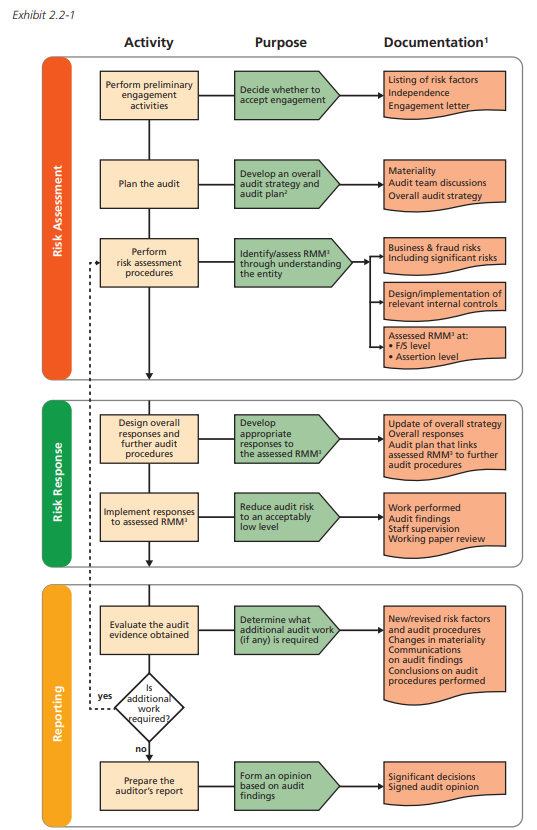
    The audit approach outlined in Guide to Using International Standards on Auditing in the Audits of Small- and Medium-Sized Entities (the Guide) has been divided into:

    • risk assessment,
    • risk response, and
    • reporting.

    This is illustrated in Exhibit 2.2-1 in the Guide.

    Notes: 
    1. Refer to ISA 230 for a complete list of documentation required. 
    2. Planning (ISA 300) is a continual and iterative process throughout the audit. 
    3. RMM = Risks of material misstatement.

    The exhibit outlines the major activities, their purpose, and the documentation for each audit phase.

    Additional information on the activities and documentation required in each of the three phases is outlined throughout the Guide, particularly in Volume 2, which follows a typical audit from start to finish.

    审计风险评估程序 [Risk Assessment Procedures]

    ISA 315 概述了审计师应该遵循的程序,以便用来进行审计风险评估,审计师在制定审计计划时必须考虑这些风险。ISA 315 要求审计师应执行风险评估程序,为判定和评估报表层次重大错报和判定层次重大错报提供依据。ISA 315确认以下三种风险评估程序:

    询问管理层以及其他工作人员

    审计人员必须与客户的管理层讨论审计的目标和期望,以及实现这些目标的计划。

    分析性复核

    分析性复核有助于审计师识别不同寻常的交易,帮助审计师发现一些未察觉到的地方,从而帮助风险评估,以便为设计和执行对风险的反应提供基础。

    观察和检查

    通过观察和检查可以获得关于客户和它所在环境的相关信息。相关例子可能涉及非常广泛的领域,包括观察和检查公司的经营,文件,管理层报告,公司的经营场所,机器设备等等。

    ISA 315 要求风险评估程序至少应包含上述三种程序,并且还要求审计业务合伙人和其团队成员应对客户财报容易出现重大错报的可能性进行讨论。审计过程中任何阶段都可以确定重大风险,ISA 315 要求审计合伙人也应将这些事项传达给没有参与讨论团队成员。

    对于评估的风险的回应 [Responses to Assessed Risks]

    ISA 330 给出指导:根据风险评估结果,指导所需测试的性质和范围。

    Audit Risk (AR) = Inherent Risk (IR) + Control Risk (CR) + Detection Risk (DR)

    其中:

    • AR 是指财务报表在审计前存在重大错报或漏报,而审计人员审计后发表不恰当审计意见的可能性;
    • IR 是指会计报表存在重大错报或漏报,而审计人员审计后发表不恰当审计意见的可能性,无论该错报单独考虑,还是连同其他错报构成重大错报;
    • CR 是指某项认定发生了重大错报,无论该错报单独考虑还是连同其他错报构成重大错报,而该错报没有被企业的内部控制及时防止、发现和纠正的可能性;
    • DR 是指某一认定存在错报,该错报单独或连同其他错报是重大的,但审计师未能发现这种错报的可能性。

    Inherent Risk

    固有风险是指在不考虑内部控制结构的前提下,由于内部因素和客观环境的影响,企业的账户、交易类别和整体财务报表发生重大错误的可能性。固有风险是被审计单位经营过程中所固有的风险,审计师可以通过获取相关的信息,来评价被审计单位的固有风险,确定其对终极审计风险的影响。

    Control Risk

    控制风险是指被审计单位的业务和相应的会计处理发生重大错弊不能被内部控制防止和纠正的可能性。被审计单位建立内部控制的主要目的之一就是要防止错误和舞弊。如果被审计单位的内部控制制度存在重要的缺陷或者不能有效地工作,那么错误和舞弊就会进入被审计单位的财务报表系统,由此产生了控制风险。

    Detection Risk

    检查风险指审计师未能发现被审计单位会计报表上存在的某项重大错报或漏报可能性。

    Our website's articles, templates, and material are solely for you to look over. Although we make every effort to keep the information up to date and accurate, we make no representations or warranties of any kind, either express or implied, regarding the website or the information, articles, templates, or related graphics that are contained on the website in terms of its completeness, accuracy, reliability, suitability, or availability. Therefore, any reliance on such information is strictly at your own risk.

    Keep in touch with us so that you can receive timely updates |

    要获得即时更新,请与我们保持联系

    1. Website ✍️ https://www.ccs-co.com/ 2. Telegram ✍️ http://bit.ly/YourAuditor 3. Facebooks ✍

    4. Blog ✍ https://lnkd.in/e-Pu8_G 5. Google ✍ https://lnkd.in/ehZE6mxy

    6. LinkedIn ✍ https://www.linkedin.com/company/74734209/admin/
    13
  • The Risk-Based Audit: Overview

    The Risk-Based Audit: Overview

    The auditor’s overall objectives, as stated in ISA 200.11, can be summarised as follows:

    • To obtain reasonable assurance about whether the financial statements as a whole are free from material misstatement, whether due to fraud or error, thereby enabling the auditor to express an opinion on whether the financial statements are prepared, in all material respects, under an applicable financial reporting framework; and
    • To report on the financial statements and communicate as required by the ISAs, following the auditor’s findings.

    Reasonable Assurance

    Reasonable assurance is a high but not absolute level of assurance. It is obtained when the auditor has obtained sufficient appropriate audit evidence to reduce audit risk (that is, the risk that the auditor expresses an inappropriate opinion when the financial statements are materially misstated) to an acceptably low level. The auditor cannot provide absolute assurance due to inherent limitations in work. This results from the majority of audit evidence (on which the auditor draws conclusions and bases the auditor’s opinion) being persuasive rather than conclusive.

    如《国际审计准则》第200.11条所述,审计员的总体目标可归纳为以下几点:-

    • 合理保证财务报表整体上不存在由于欺诈或错误造成的重大错报,从而使审计师能够对财务报表是否在所有重大方面根据适用的财务报告框架编制发表意见;以及
    • 按照《国际审计准则》的要求,在审计员的审计结果出来后,对财务报表进行报告和沟通。

    合理保证

    合理保证是一种高度但非绝对的保证。

    当审计师获得足够的适当的审计证据,将审计风险(即当财务报表存在重大误报时,审计师发表不恰当意见的风险)降低到一个可接受的低水平时,就可以获得合理保证。由于工作中固有的局限性,审计师不能提供绝对保证。这是因为大多数的审计证据(审计师据此得出结论并作为审计意见的依据)只是具有说服力,而不是结论性的。

    Inherent Limitations of an Audit

    1. The Nature of Financial Reporting

    The preparation of financial statements involves:

    1. Judgment by management in preparing the financial statements and applying the presentation and disclosure requirements in the applicable financial reporting framework; and
    2. Subjective decisions or assessments (such as estimates) by management involve a range of acceptable interpretations or judgments.

    2. Nature of Audit Evidence Available

    Most of the auditor’s work in forming the auditor’s opinion consists of obtaining and evaluating audit evidence. This evidence tends to be persuasive in character rather than conclusive.

    Audit evidence is primarily obtained from audit procedures performed during the course of the audit. It may also include information obtained from other sources such as:

    • Previous audits;
    • A firm’s quality control procedures for client acceptance and continuance;
    • The entity’s accounting records; and
    • Audit evidence prepared by an expert employed or engaged by the entity

    3. The Nature of Audit Procedures

    Audit procedures, however well-designed, will not detect every misstatement. Consider the following:

    • Any sample of less than 100% of a population introduces some risk that a misstatement will not be detected;
    • Management or others may not provide, intentionally or unintentionally, the complete information required. Fraud may involve sophisticated and carefully organised schemes designed to conceal it; and
    • Audit procedures used to gather audit evidence may not detect that some information is missing.

    4. Timeliness of Financial Reporting

    The relevance/value of financial information tends to diminish over time, so a balance must be struck between the information’s reliability and cost.

    Users of financial statements expect that the auditor will form his or her opinion within a reasonable period of time and at a reasonable cost. Consequently, it is impracticable to address all information that may exist or to pursue every matter exhaustively on the assumption that information is in error or fraudulent until proven otherwise.

    审计的固有局限性

    1. 财务报告的性质

    财务报表的编制涉及:-

    • 管理层在编制财务报表和应用适用的财务报告框架中的表述和披露要求时的判断;以及
    • 管理层的主观决定或评估(如估计)涉及一系列可接受的解释或判断。

    2. 现有审计证据的性质

    审计师形成审计意见的大部分工作包括获取和评估审计证据。这种证据往往是有说服力的,而不是结论性的。

    审计证据主要是从审计过程中执行的审计程序中获得。它也可能包括从其他来源获得的信息,如:

    • 之前的审计。
    • 事务所对客户的接受和持续的质量控制程序。
    • 该实体的会计记录;以及
    • 由该实体雇用或聘请的专家准备的审计证据

    3. 审计程序的性质

    审计程序,无论设计得多么好,都不能发现每一个错报,请考虑以下情况:-

    • 任何低于100%的样本都会带来一些风险,即错报不会被发现。
    • 管理层或其他人可能有意或无意地不提供所需的完整信息。欺诈可能涉及复杂和精心组织的计划,旨在掩盖它;以及
    • 用于收集审计证据的审计程序可能无法发现某些信息的缺失。

    4. 财务报告的及时性

    财务信息的相关性/价值往往会随着时间的推移而降低,因此必须在信息的可靠性和成本之间取得平衡。

    财务报表的使用者希望审计师能在合理的时间内以合理的成本形成他或她的意见。因此,要处理所有可能存在的信息或详尽地追究每一个问题是不切实际的,因为假设信息是错误的或欺诈性的,直到证明不是这样。

    Scope of an Audit

    The scope of the auditor’s work and the opinion provided are usually confined to whether the financial statements are prepared, in all material respects, in accordance with the applicable financial reporting framework.

    As a result, an unmodified auditor’s report does not assure the future viability of the entity nor the efficiency or effectiveness with which management has conducted the affairs of the entity.

    Any extension of this basic audit responsibility, such as that required by local laws or securities regulations, would require the auditor to undertake further work and modify or expand the auditor’s report accordingly.

    Material Misstatements

    A material misstatement (either individually or the aggregate of all uncorrected misstatements and missing/misleading disclosures in the financial statements) has occurred when it could reasonably be expected to influence the economic decisions of users made based on the financial statements.

    Assertions

    Assertions are representations by management, explicit or otherwise, that are embodied in the financial statements. They relate to the recognition, measurement and presentation of classes of transactions and events, account balances and disclosures in the financial statements. For example, the completeness assertion relates to all transactions and events that should have been recorded having been recorded. They are used by the auditor to consider the potential misstatements that may occur.

    审计的范围

    审计师的工作范围和提供的意见通常局限于财务报表是否在所有重大方面都按照适用的财务报告框架编制。

    因此,一份未经修改的审计报告并不能保证该实体未来的生存能力,也不能保证管理层处理该实体事务的效率或效果。

    这一基本审计责任的任何延伸,如当地法律或证券法规的要求,将要求审计员开展进一步的工作,并相应地修改或扩大审计员的报告。

    重大错报

    当重大错报(单独或财务报表中所有未更正的错报和遗漏/误导性披露的总和)可能合理地预期会影响用户根据财务报表做出的经济决策时,该错报已经发生。

    认定

    认定是管理层在财务报表中体现出来的明确或其他的陈述。它们与财务报表中各类交易和事件、账户余额和披露的确认、计量和表述有关。例如,完整性断言涉及到所有应该被记录的交易和事件已经被记录。审计师使用这些认定来考虑可能发生的不同类型的潜在错误陈述。

    Our website's articles, templates, and material are solely for you to look over. Although we make every effort to keep the information up to date and accurate, we make no representations or warranties of any kind, either express or implied, regarding the website or the information, articles, templates, or related graphics that are contained on the website in terms of its completeness, accuracy, reliability, suitability, or availability. Therefore, any reliance on such information is strictly at your own risk.

    Keep in touch with us so that you can receive timely updates |

    要获得即时更新,请与我们保持联系

    1. Website ✍️ https://www.ccs-co.com/ 2. Telegram ✍️ http://bit.ly/YourAuditor 3. Facebooks ✍

    4. Blog ✍ https://lnkd.in/e-Pu8_G 5. Google ✍ https://lnkd.in/ehZE6mxy

    6. LinkedIn ✍ https://www.linkedin.com/company/74734209/admin/
    15