Day: December 14, 2022

  • What Terms have to be agreed upon between an Auditor and their Client?

    What Terms have to be agreed upon between an Auditor and their Client?

    It is crucial to the relationship that the auditor and the client agree on the terms of engagement before beginning their work together.

    In the absence of such terms, there is no clear understanding of responsibilities, and the absence of clear terms of engagement can generate a lot of issues both during the engagement and after it has ended.

    ISA 210 Agreeing the Terms of Audit Engagements deals with the auditor’s responsibilities in agreeing on the terms of the audit engagement with management and, where appropriate, those charged with governance.

    Preconditions for an Audit

    To establish whether the preconditions for an audit are present, the auditor shall:

    1. Determine whether the financial reporting framework to be applied in the preparation of the financial statements is acceptable; and
    2. Obtain the agreement of management that it acknowledges and understands its responsibility
    • For the preparation and fair presentation of the financial statements in accordance with an applicable financial reporting framework;
    • For such internal control as management determines is necessary to enable the preparation of financial statements that are free from material misstatement, whether due to fraud or error.; and
    • To provide the auditor with the following:
      • Access to all information that management is aware of that is relevant to preparing the financial statements, such as records, documentation and other matters;
      • Additional information that the auditor may request from management for the purpose of the audit; and
      • Unrestricted access to persons within the entity from whom the auditor determines it necessary to obtain audit evidence.

    Only if the above criteria can be agreed upon can the auditor accept or continue an audit engagement.

    If the preconditions for an audit are not present, the auditor shall discuss the matter with management.

    Suppose management or those in charge of governance put a limit on the scope of the auditor’s work in a proposed audit engagement, and the auditor thinks that the limit will cause the auditor not to give an opinion on the financial statements. In that case, the auditor shall not accept such a limited engagement as an audit engagement unless required by law or regulation.

    In many cases, the preconditions for an audit can be met, and then the auditor must agree on the terms of the engagement with management and, if applicable, those in charge of governance.

    Agreement on Audit Engagement Terms

    This deal is usually spelt out in a letter of engagement, which will usually include (subject to different jurisdictions’ requirements):

    1. The objective and scope of the audit of the financial statements;
    2. The responsibilities of the auditor;
    3. The responsibilities of management;
    4. Identification of the applicable financial reporting framework for the preparation of the financial statements (for example, IFRS, MFRS, MPERS);
    5. Confirmation that some material misstatement may not be detected;
    6. The basis on which fees are calculated;
    7. Reference to the expected form and content of any reports to be issued by the auditor; and
    8. A statement that there may be circumstances in which a report may differ from its expected form and content;

    An engagement letter is important for the auditor and entity before the engagement begins.

    This ensures there are no misunderstandings about the audit or management roles, those in charge of governance, and the auditor.

    Many professional bodies also require member firms to have an up-to-date engagement letter.

    This protects the auditor’s interests and ensures everyone knows their roles in the engagement.

    Example of an Audit Engagement Letter

    Since different countries have varying requirements, the format and content of an audit engagement letter may vary. Because of this, the following illustrative engagement letters will be used as a guide in conjunction with considerations outlined in ISA 210 and should be varied according to individual requirements and circumstances.

    MIA_ Audit and Assurance Illustrative Guide AAIG 1 Letter of Engagement

    Our website's articles, templates, and material are solely for you to look over. Although we make every effort to keep the information up to date and accurate, we make no representations or warranties of any kind, either express or implied, regarding the website or the information, articles, templates, or related graphics that are contained on the website in terms of its completeness, accuracy, reliability, suitability, or availability. Therefore, any reliance on such information is strictly at your own risk.

    Keep in touch with us so that you can receive timely updates |

    要获得即时更新,请与我们保持联系

    1. Website ✍️ https://www.ccs-co.com/ 2. Telegram ✍️ http://bit.ly/YourAuditor 3. Facebook ✍

    4. Blog ✍ https://lnkd.in/e-Pu8_G 5. Google ✍ https://lnkd.in/ehZE6mxy

    6. LinkedIn ✍ https://www.linkedin.com/company/74734209/admin/

    15
  • What are the Responsibilities of Auditors in relation to Fraud?

    What are the Responsibilities of Auditors in relation to Fraud?

    To start, it is not the responsibility of the auditor to either prevent or discover fraud within the entity that is being audited!

    Management and those charged with governance are the ones responsible for this task.

    However, this does not absolve the auditor of their responsibility to devise audit procedures based on their risk assessment of the possibility that the financial statements include a substantial misrepresentation due to fraud.

    A particular auditing standard pertains to fraud, and it is known as ISA 240, which stands for The Auditor’s Responsibilities Relating to Fraud in an Audit of Financial Statements.

    This standard stipulates that all auditors who perform audits under ISAs must apply it.

    This ISA was created to outline the responsibilities that lie with the auditor regarding fraud matters.

    Since most scams are intended to be disguised, and the perpetrators of fraud will frequently go to great lengths to ensure that they are not found, detecting fraud can be incredibly challenging simply because of the nature of fraud.

    In recent years, fraud has become a serious concern within the field of accounting and auditing, particularly fraud surrounding well-publicised business disasters. Auditors have had some of the blame thrown at them for the problem.

    Fraud is not an error, and ISA 240 clearly distinguishes between fraud and error.

    Fraud is defined in ISA 240.11(a)) as:

    ‘… an intentional act by one or more individuals among management, those charged with governance, employees, or third parties, involving the use of deception to obtain an un- just or illegal advantage.’

    Error, on the other hand, is defined in ISA 240.11(b) as:

    ‘… an unintentional misstatement in the financial statements including the omission of an amount or disclosure.’

    Fraud may often be broken down into two categories:

    • “Management Fraud”; and
    • “Employee Fraud.”

    Management fraud involves the overriding of internal controls by management within the entity.

    The actual amounts involved can be quite significant, and auditors should consider this fact carefully during the planning stage of the audit and during the detailed audit fieldwork.

    Because ISA 240 contains an explicit requirement for the auditor to maintain an attitude of professional scepticism, the auditor can recognise the possibility that a material misstatement could result from fraud.

    For the auditor to keep their professional scepticism, they must let go of any and all beliefs they may have regarding the honesty and integrity of management and those charged with governance.

    The practice of workers taking advantage of gaps in the internal control environment to enrich themselves financially is referred to as employee fraud.

    Amounts can vary and be at both ends of the spectrum (i.e. they could be very small or very substantial amounts).

    Responsibilities of the Auditor

    ISA 240 outlines the responsibilities of the auditor, and this ISA requires the auditor to consider fraud (and error) at the planning stage with the expectation that the financial statements may contain material misstatement as a result of fraud and/or error.

    The auditor must remember that the financial statements may contain material misstatements resulting from fraud and/or error. The auditors are expected to:

    • Discuss fraud risk and incidence with management and those charged with governance;
    • Discuss with the engagement team how the financial statements could be wrong in a way that is important, either because of fraud or because of errors. Think about whether one or more signs of fraud are present;
    • Perform audit procedures to test the appropriateness of journal entries, test the risk of management override of internal controls, review accounting estimates and their appropriateness and understand the business rationale for transactions outside the normal course of business;
    • Obtain specific representations from management and those charged with governance, including its assessment of the risk of fraud, and
    • Consider the implications of the auditor’s legal and regulatory obligations.

    审计师必须记住,财务报表可能包含由于欺诈和/或错误造成的重大错报。审计师应做到与管理层和负责管理的人讨论欺诈风险和发生率。

    • 与参与团队讨论财务报表如何可能因为欺诈或错误而出现重要的错误。思考是否存在一个或多个欺诈的迹象。
    • 执行审计程序,测试分录的适当性,测试管理层推翻内部控制的风险,审查会计估计及其适当性,并了解正常业务过程以外的交易的商业理由。
    • 从管理层和负责管理的人那里获得具体陈述,包括其对欺诈风险的评估,以及
    • 考虑审计师的法律和监管义务的影响。

    Fraud issues must be discussed at the planning meeting for the audit team. This is a very important requirement.

    This conversation must include the audit engagement partner, and it gives the engagement team’s more experienced members a chance to share their ideas about how and where the financial statements may contain material misstatement because of fraud.

    Usually, a discussion like this would be about:

    • How management could override the entity’s internal controls, and how the financial statements could be misstated due to fraud.
    • How could the entity manipulate the financial statements for the purposes of “earnings management.”
    • Whether there are incentives or pressures for management or others to commit fraud—for example, a breach of loan covenants.
    • How management and those charged with governance implement sufficient controls and oversee employees who have access to cash or other assets of the entity.
    • Whether management or other key employees have had an unusual change of lifestyle or demonstrate unexplained behaviour.
    • Ensuring that all members of the engagement team maintain a degree of professional scepticism throughout the audit engagement.
    • Whether there is any circumstances present that may give rise to a presence of fraudulent activity.
    • Discuss how unpredictable audit testing can be undertaken and the nature, timing and extent of that testing.
    • How audit procedures are selected to respond to the risk that the financial statements contain a material misstatement due to fraud.
    • Discussions concerning any allegations of fraudulent activity.

    通常情况下,这样的讨论会是关于:-

    • 管理层如何凌驾于实体的内部控制之上,以及财务报表如何因欺诈而被误报。
    • 该实体如何为 “收益管理 “的目的操纵财务报表。
    • 管理层或其他人是否有进行欺诈的动机或压力– 例如,违反贷款契约的行为。
    • 管理层和负责管理的人如何实施足够的控制,并监督可以接触实体的现金或其他资产的员工。
    • 管理层或其他关键员工是否有不寻常的生活方式变化或表现出无法解释的行为。
    • 确保参与团队的所有成员在整个审计工作中保持一定程度的专业怀疑态度。
    • 是否存在任何可能导致存在欺诈活动的情况。
    • 讨论如何进行不可预测的审计测试以及该测试的性质、时间和范围。
    • 如何选择审计程序,以应对财务报表中因欺诈而出现重大错报的风险。
    • 讨论有关任何欺诈活动的指控。

    Interaction between ISA 240 and ISA 315 Identifying and Assessing the Risks of Material Misstatement through Understanding the Entity and its Environment

    By the provisions of ISA 315, the auditor must understand the entity and the environment in which it operates. In addition, the auditor must consider the possibility of the financial statements being material misstatements due to fraud.

    When conducting their risk assessment, the auditor must ensure that they discuss with management and those charged with governance how they oversee management’s internal controls and how these internal controls reduce the risk of fraud.

    This discussion must take place before the auditor begins their risk assessment.

    There is no absolute certainty (nor conclusive) in discussions with management and those charged with governance.

    The simple fact that the auditor has discussed the risk of fraud with management and, where applicable, those charged with governance, who may confirm that no fraud has been committed during the year (or that they are not aware of any allegations of fraud), is not enough to reduce the risk of material misstatement due to fraud to an acceptable level.

    In addition to this, the auditor is responsible for ensuring the following things:

    • Consider whether one or more fraud risk factors are present.
    • Perform analytical procedures to identify whether any unusual or unexpected trends have occurred in the financial statements.
    • Refer to other information that has come to light which may indicate whether the financial statements contain a material misstatement due to fraud.

    Fraudulent Financial Reporting

    Fraudulent financial reporting is the act of management and those charged with governance to deceive the users of the financial statements by manipulating them in such a way as to achieve the desired outcome (usually by focusing on levels of profits management and those charged with governance wish to report and therefore manipulating the figures above this line or focusing on stories of net assets).

    This practice is also referred to as “earnings management”.

    A wide variety of objectives, including the desire to decrease taxes liabilities, the production of statistics that do not break loan covenants, and the enhancement of investor trust in the entity, can all be considered potential motivations for engaging in fraudulent financial reporting.

    Altering the accounting records or other supporting documents used as a basis for preparing financial statements is the primary tool of fraudulent financial reporting. In addition to this, fraudulent financial reporting can be accomplished by misapplying accounting principles or through:

    • Recording fictitious journal entries, particularly those close to the year-end;
    • Inappropriately adjusting assumptions and changing judgements used to estimate account balances;
    • Omitting, advancing or delaying recognition in the financial statements of events and transactions that have occurred during the reporting period;
    • Concealing or not disclosing facts that could affect the amounts recorded in the financial statements;
    • Engaging in deliberately complex transactions that are structured to misrepresent the financial position or financial performance of the entity; and
    • Altering records and terms related to significant and unusual transactions.

    Audit Procedures in relation to Fraud

    The auditor should establish audit procedures with the risk assessment in mind that the financial statements may include material misrepresentation due to fraud.

    When carrying out the auditing procedure, the auditor must always keep some healthy professional scepticism in mind.

    The following are audit tests that cover a wide variety of scenarios, and each auditor should design their own methods to be client-specific when it comes to addressing potential instances of fraud:

    • Unannounced visits by the auditor to conduct inventory counts at locations not previously visited by the auditor.
    • Developing an element of unpredictability in audit procedures.
    • Reviews management information for periods other than the reporting date and investigate any unusual transactions or amendments.
    • Performing substantive analytical procedures using disaggregated data. For example, looking at the gross profit margins by location, line of business or month and comparing the results of these procedures to the auditor’s expectations.
    • Seeking additional audit evidence from sources outside the entity.
    • Where other firms of auditors are used (component auditors), for example, at one or more subsidiaries, divisions or branches, discussing with them the extent of the work necessary to address the risk of material misstatement due to fraud.
    • Performing computer-assisted audit techniques such as data mining to test for anomalies in a population.
    • Where an act of fraud has been committed, discuss with the entity’s staff the controls in place and how they address the risk.
    • Performing procedures on account reconciliations for periods other than the reporting date.
    • Testing the integrity of computer-produced records and transactions.

    以下是涵盖各种情况的审计测试,每个审计师在处理潜在的欺诈事件时,应根据客户的具体情况设计自己的方法:

    • 审计师进行突击拜访,在审计师以前没有访问过的地方进行库存清点。
    • 在审计程序中推敲不可预测的因素。
    • 审查报告日期以外的管理信息,调查任何不寻常的交易或修正。
    • 使用分类数据执行实质性分析程序。例如,按地点、业务范围或月份查看毛利率,并将这些程序的结果与审计师的预期相比较。
    • 从实体以外的来源寻求额外的审计证据。
    • 在使用其他审计师事务所(组成审计师)的情况下,例如,在一个或多个子公司、部门或分支机构,与他们讨论应对欺诈导致的重大错报风险所需的工作范围。
    • 执行电脑辅助审计技术,如数据挖掘,以测试人口中的异常情况。
    • 在欺诈行为已经发生的情况下,与该实体的工作人员讨论现有的控制措施以及它们如何应对风险。
    • 对报告日期以外的时期进行账户核对的程序。
    • 测试电脑产生的记录和交易的完整性。
    Our website's articles, templates, and material are solely for you to look over. Although we make every effort to keep the information up to date and accurate, we make no representations or warranties of any kind, either express or implied, regarding the website or the information, articles, templates, or related graphics that are contained on the website in terms of its completeness, accuracy, reliability, suitability, or availability. Therefore, any reliance on such information is strictly at your own risk.

    Keep in touch with us so that you can receive timely updates |

    要获得即时更新,请与我们保持联系

    1. Website ✍️ https://www.ccs-co.com/ 2. Telegram ✍️ http://bit.ly/YourAuditor 3. Facebook ✍

    4. Blog ✍ https://lnkd.in/e-Pu8_G 5. Google ✍ https://lnkd.in/ehZE6mxy

    6. LinkedIn ✍ https://www.linkedin.com/company/74734209/admin/

    17
  • How do Accounting Standards interact with the work of an Auditor?

    How do Accounting Standards interact with the work of an Auditor?

    Accounting standards, such as the International Financial Reporting Standards (IFRS), Malaysian Financial Reporting Standards (MFRS) and Malaysian Private Entities Reporting Standard (MPERS), are among the most important components of a set of financial statements.

    会计准则,如国际财务报告准则(IFRS)、马来西亚财务报告准则(MFRS)和马来西亚私营实体报告准则(MPERS),是一套财务报表的最重要组成部分。

    As a result of its role in prescribing how the accounting treatment of material items should be handled within the financial statements, accounting standards are often regarded as the most important component of an audit of historical information.

    由于其在规定财务报表中应如何处理重大项目的会计处理方面的作用,会计准则通常被视为历史信息审计的最重要组成部分。

    The auditor must give an opinion on whether the financial statements “provide a True and Fair View” or “present fairly in all material aspects.”

    This is the objective of the auditing process.

    Because of this, it is within the scope of the auditor’s responsibility to report on whether or not the financial statements have been prepared in accordance with the relevant financial reporting framework (hence the question, “have the financial statements been prepared in accordance with the relevant financial reporting standards?”).

    This is because the technical correctness of the financial statements is implicit in an unmodified audit opinion.

    审计师必须对财务报表是否 “提供了真实和公平的观点 “或 “公平地反映了所有重大方面 “发表意见。

    这是审计过程的目标。

    正因为如此,报告财务报表是否按照相关的财务报告框架编制属于审计师的责任范围(因此,问题是 “财务报表是否按照相关的财务报告标准编制?)

    这是因为财务报表的技术正确性隐含在无保留审计意见中。

    Example:

    The TC Mattress Company, often known as TC, prepares its financial statements using MFRS and announces its results up to 2022.

    TC allowed each of its employees to purchase company shares on January 1, 2022, in what is seen as a significant business event.

    These employees’ share options will become exercisable in four years (vest in four years’ time).

    TC has not included any accounting inputs or disclosures in the financial statements because there was no cash flow in the year that ended on December 31, 2022, and the options will not vest until 2025.

    As a result, management is proposing to include the monetary amounts in the financial statements for the year that ended on December 31, 2025, rather than including them in the financial statements for the year that ended on December 31, 2022.

    Currently, the auditors are doing an audit on the financial statements for the financial year that concluded on December 31st, 2022. In accordance with MFRS 2 Share-Based Payment provision, an entity is required to record an expense if it provides employees (or management) with the opportunity to purchase shares in the company (share options).

    This is because the employees are benefiting from a form of remuneration, but the entity also benefits from the services.

    In accordance with MFRS 2, an expense must be computed considering the fair value of the share options as of the date they were granted (1 January 2022).

    Suppose TC does not include the expense (and the corresponding increase in equity) in the financial statements that cover the period ending 31 December 2022.

    In that case, the auditors will be required to issue a qualified opinion on the basis that the financial statements do not comply with the requirements outlined in MFRS 2.

    This is because the transaction in question is regarded as being material.

    Typically, shares, share options or other equity instruments are granted to employees as part of their remuneration package, in addition to a cash salary and other employment benefits.

    As can be seen from the above illustration, if the auditors were unaware of the provisions in MFRS 2, there would be a far greater possibility for them to provide an inaccurate audit opinion (which would be reckless).

    通常情况下,除了现金工资和其他就业福利外,股票、股票期权或其他股权工具也经常被授予雇员,作为其薪酬方案的一部分。

    从上面的例子可以看出,如果审计师不知道 MFRS 2 中的规定,他们提供不准确的审计意见的可能性就会大得多(这将是鲁莽的)。

    Accounting standards outline the definitions, recognition criteria, measurement rules and disclosure requirements that reporting entities must comply with in their financial statements; hence their importance cannot be over-emphasised.

    During the audit engagement, auditors will perform their duties per auditing standards, such as the International Standards on Auditing (ISAs).

    The ISAs will make it possible to conduct an effective and efficient audit.

    会计准则概述了报告实体在其财务报表中必须遵守的定义、确认标准、计量规则和披露要求;因此其重要性怎么强调都不为过。

    在审计工作中,审计师将根据审计准则履行其职责,如《国际审计准则》(ISA)。

    《国际审计准则》将使其有可能进行有效和高效的审计。

    However, auditors must also ensure that their technical knowledge of accounting standards is up to scratch because otherwise, they will not be able to conclude whether or not material items within the entity’s financial statements that they are auditing are correct.

    At various phases of the audit, the auditor will additionally take into consideration the following issues pertaining to financial reporting:

    然而,审计师也必须确保他们对会计准则的技术知识是合格的,因为否则,他们将无法得出结论,他们所审计的实体的财务报表中的重要项目是否正确。

    在审计的各个阶段,审计师将额外考虑到与财务报告有关的以下问题:-

    Planning

    Financial statement risk is the risk that the financial statements contain material misstatements.

    This may result from an incorrect interpretation of accounting standards, inaccurate recording of transactions or disclosure.

    Financial statement risk might lead to an overstatement or understatement of the value of an account balance, or it could result in an item being recognised within the financial statements when it should not be recognised (or vice versa).

    In addition, the Financial statement Risk may result in an item or items in the financial statements being improperly stated (or not being disclosed), respectively.

    The auditor will, during the planning stage, take into consideration the accounting provisions that are relevant to the audit client. This will enable the auditor to consider the risk posed by the financial statements during the planning stage.

    财务报表风险是指财务报表包含重大错报的风险。

    这可能是由于对会计准则的不正确解释、交易的不准确记录或披露造成的。

    财务报表风险可能导致高报或低报一个账户余额的价值,或者可能导致一个项目在财务报表中被确认,而它不应该被确认(或者反之)。

    此外,财务报表风险可能导致财务报表中的一个或多个项目被不适当地陈述(或未被披露),分别。

    在计划阶段,审计师将考虑到与审计客户相关的会计规定。这将使审计师在规划阶段考虑财务报表所带来的风险。

    During the Audit

    The auditor will compile evidence to back up the numbers stated in the financial statements.

    Then they will examine whether or not this evidence shows a risk of misstatement due to the improper application of accounting rules.

    A portion of the auditor’s report will consist of a report on whether or not the financial statements have been prepared in compliance with the applicable financial reporting framework.

    For the auditor to report on whether or not the financial statements have been prepared in compliance with the applicable financial reporting framework, the auditor will need to know the applicable accounting standards included in the applicable financial reporting framework.

    Some auditing criteria for the accounting industry are inherently challenging (for example, MFRS 124 Related Party Disclosures).

    When it has been recognised that accounting standards are inherently difficult to audit, a specific direction has been provided in the form of an auditing standard.

    For instance, the International Standards on Auditing (ISA) 550, Related Parties, which provides direction for the auditor on the issues surrounding the audit of related parties, is one such example.

    审计师将汇编证据来支持财务报表中的数字。

    然后,他们将审查这些证据是否显示出由于会计规则的不当应用而导致的错报风险。

    审计师报告的一部分将包括关于财务报表的编制是否符合适用的财务报告框架的报告。

    为了让审计师报告财务报表的编制是否符合适用的财务报告框架,审计师需要了解适用的财务报告框架中所包含的适用会计准则。

    一些会计行业的审计标准本身就具有挑战性(例如,MFRS 124 关联方披露)。

    当人们认识到会计准则在本质上难以审计时,就会以审计准则的形式提供具体的指导。

    例如,《国际审计准则》(ISA)550 “关联方 “就是这样一个例子,它为审计师提供了有关关联方审计问题的指导。

    Pre-completion stage of the Audit

    At the end of the audit, the auditor will decide whether or not the financial statements generated by management comply with the applicable financial reporting framework.

    These decisions (i.e. compliance with accounting standards) will be made at the conclusion stage of the audit.

    Suppose the auditor determines that the company does not comply.

    In that case, the company will evaluate the implications of the non-compliance for the auditor’s report (which, if the non-compliance is not remedied, will result in a modified opinion due to dis- agreement).

    In circumstances where the auditor has discovered a material breach of an accounting standard.

    In that case, they are obligated to address the situation with those charged with governance to emphasise how serious the matter is.

    The auditor should try to convince management and, if applicable, those charged with governance to fix the problem that led to the disagreement. A qualified (modified) audit opinion should always be a last resort.

    在审计结束时,审计师将决定管理层生成的财务报表是否符合适用的财务报告框架。

    这些决定(即是否符合会计准则)将在审计的结论阶段作出。

    假设审计师确定公司没有遵守。在这种情况下,公司将评估不符合规定对审计报告的影响(如果不符合规定的情况没有得到补救,将导致因不符合规定而产生的修改意见)。

    在审计师发现有重大违反会计准则的情况下。在这种情况下,他们有义务向负责管理的人说明情况,强调此事的严重性。

    审计师应努力说服管理层,如果适用的话,说服负责治理的人解决导致分歧的问题。有保留(修改)的审计意见应始终是最后的手段。

    Our website's articles, templates, and material are solely for you to look over. Although we make every effort to keep the information up to date and accurate, we make no representations or warranties of any kind, either express or implied, regarding the website or the information, articles, templates, or related graphics that are contained on the website in terms of its completeness, accuracy, reliability, suitability, or availability. Therefore, any reliance on such information is strictly at your own risk.

    Keep in touch with us so that you can receive timely updates |

    要获得即时更新,请与我们保持联系

    1. Website ✍️ https://www.ccs-co.com/ 2. Telegram ✍️ http://bit.ly/YourAuditor 3. Facebook ✍

    4. Blog ✍ https://lnkd.in/e-Pu8_G 5. Google ✍ https://lnkd.in/ehZE6mxy

    6. LinkedIn ✍ https://www.linkedin.com/company/74734209/admin/

    20
  • Who Inspects Auditor’s work to ensure that they are doing it correctly?

    Who Inspects Auditor’s work to ensure that they are doing it correctly?

    Statutory audit work is necessary for many jurisdictions (However, certain businesses may opt to have a voluntary audit, their financiers or investors may need an audit, or the entity’s Constitution may dictate that the financial statements must be audited).

    Audit firms will have to do internal reviews of their work.

    They will also be visited by their professional body, regulatory inspectors, or both.

    In general, visits are typically carried out by reviewers from professional bodies to ensure that member firms are performing audit work to the required levels of standards and to ensure that they are complying with auditing standards (International Standards on Auditing).

    When it is discovered that a firm is lacking in certain areas, the inspector would generally bring this to the attention of the audit engagement partner(s) to better understand why the firm is lacking in certain areas.

    Sanctions can be brought against the auditor if it is determined that the audit work was inadequate. These sanctions can range from a follow-up visit later so that the inspector can determine whether the firm has considered recommendations and improved on the inadequate audit work to more severe sanctions such as removing the audit firm’s audit registration and the imposition of fines.

    In Malaysia, a visit of this nature is referred to as a “Practice Review.”

    Practice Review is essential in improving audit quality, bolstering efficient regulation of the accounting profession and safeguarding the public interest.

    The Malaysian Institute of Accountants has given the MIA Practice Review Committee the authority to conduct surveillance activities on audit firms (AFs) registered with the Institute.

    These activities aim to ensure that audit practitioners perform their audit work in accordance with the International Standards of Auditing (ISAs), professional standards, and legal and regulatory requirements.

    The Practice Review Programme (PRP) is established under Section B250: Quality Assurance and Practice Review of the By-Laws of MIA.

    Practice Review is a process whereby members’ audit practice standards and procedures are assessed to ensure they comply with professional standards and legal and regulatory requirements.

    As MIA is an IFAC member, the PRP is a mandatory requirement that forms the substance of the Statements of Membership Obligations (SMOs), in particular, SMO1, on the requirements to conduct practice reviews of its member firms.

    The Practice Review Programme has 3 objectives:

    • Confirm members’ obligation to maintain, apply and observe the standards promulgated by the Institute.
    • To carry out the regulatory role that is mandated by the Accountants Act of 1967 and to bring our practices in line with the most recent advancements made on a global scale;
    • To increase the level of trust that the business community has in the professionalism maintained by our members of the MIA.

    The PRP does not set new standards. Instead, the Practice Review Department reviews the compliance with existing professional and regulatory standards that auditors, regardless of the size of their firm, are expected to comply with.

    MIA applies a risk-based approach to selecting audit firms for practice review.

    The selection of firms for review is based on their risk profiles, developed using information obtained from the Annual Return submitted by AFs and other relevant sources.

    Audit firms may also be selected for review based on referrals from other regulatory bodies in Malaysia or other committees of the Institute.

    Some of the most common questions a file reviewer will ask themselves during a review are:

    • Has the audit firm undertaken adequate audit planning before executing the audit
    • Has the audit firm considered fraud issues at the planning stage?
    • Has an appropriate audit strategy and audit plan been constructed?
    • Have financial statement materiality levels and performance materiality levels been determined at the planning stage?
    • Has an appropriate risk assessment been carried out?
    • Did the auditor understand the entity subject to audit and the environment in which the client operates?
    • Is there an up-to-date letter of engagement between the client and the auditor
    • Are the skills and technical competence required conducive to the staff assigned to this audit?
    • Were the procedures adopted during the detailed audit fieldwork responsive to the assessed levels of risk?
    • Has adequate audit documentation been prepared to allow an auditor, without any previous connection to the audit, to understand the nature, timing and extent of the audit procedures performed?
    • Has there been appropriate supervision and review of the audit engagement?
    • Has sufficient and appropriate audit evidence covered the material areas of the audit?
    • Has there been adequate audit engagement partner involvement in the audit
    • Have there been representations obtained from management and, where applicable, those charged with governance?
    • Are specific representations required by auditing standards incorporated within the written representation obtained from management and, where applicable, those charged with governance?
    • Has the audit client considered subsequent events and undertaken an appropriate going concern review?
    • Have the materiality levels been revisited at the audit’s completion stage to ensure they are still appropriate?
    • If the level of misstatements identified is approaching the materiality levels or has exceeded the materiality levels, has the auditor considered the need for extending their audit procedures and if so, is the extension of such procedures adequate to reduce the risk of material misstatement?
    • Has the auditor evaluated the identified misstatements and communicated those misstatements to management and, where applicable, those charged with governance?
    • Has an emphasis on matter paragraph been appropriately incorporated into the audit report (where fundamental uncertainty needs to be communicated to the users of the financial statements)?
    • Is the audit report appropriately signed and dated (for ‘cold’ file reviews only)?
    • Has the work determined at the planning stage been adequately cross-referenced to the detailed audit work?

    Note:

    The above list is by no means exhaustive, and there are many other areas of the audit that reviewers will be keen to ensure have been appropriately covered.

    The aforementioned items are merely some of the essential areas that auditors will be looking for, and what is most important is that an audit file can able “tell a story” about how the audit engagement partner arrived at their conclusion regarding whether or not the financial statements give a true and fair view (or present fairly in all material respects).

    Practice Review Framework

    Firm Selection Approach

    MIA uses a risk-based approach for selecting audit firms for practice review, which has been streamlined under the Practice Review Framework, to select firms based on a risk profiling system using information extracted from the Annual Return submitted by Audit Firms.

    Audit firms may also be selected for review based on referrals from other regulatory bodies in Malaysia or other committees of the Institute.

    The identity of the audit firm is kept confidential at all times from all parties who are not directly involved in the practice review of the firm, including the PRC and staff of the Institute.

    Scopes of Review

    Firm-level Inspections:

    Practice Review inspects the audit firm’s system of quality control (firm-level inspections) to ensure that they comply with the requirements of ISQC 1 [effective from December 15, 2022: ISQM 1 & 2].

    Engagement Inspections:

    Practice Review’s approach in performing inspections of individual engagements comprises detailed engagement inspections of audit firms to assess whether the audit work complies with relevant professional standards.

    The sample of files selected for practice review should reflect the firms’ overall operations and size.

    Types of Ratings

    After the practice review, the reviewer must table a report to the PRC.

    Before the deliberation of the report, the reviewer will delete any reference to the audit firm’s identity to preserve confidentiality.

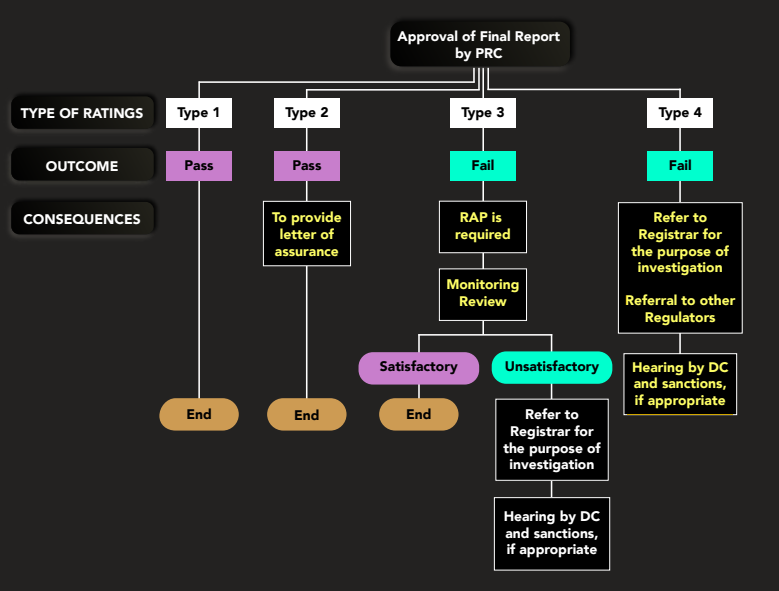
    The PRC shall determine a rating for the report in the following manner, considering the practice review report and the audit firm’s comments.

    Types of Rating

    Type 1

    The firm complies with ISQC 1 [effective from December 15, 2022: ISQM 1 & 2], applicable professional standards, and legal and regulatory requirements. No breach of mandatory auditing standards was noted. It signifies a comfortable pass, and no further action is required.

    Type 2

    Minimal, non-pervasive weaknesses are noted in compliance with ISQC 1 [effective from December 15, 2022: ISQM 1 & 2] and mandatory auditing standards. Weaknesses are noted in some engagement files but not in others. It requires written assurance and commitment from audit firms that remedial action and improvement shall be implemented.

    Type 3

    Where it considers that the audit firm has some severe weaknesses, which were pervasive in complying with applicable professional standards and legal and regulatory requirements during the course of carrying out the engagement in which the work was performed.

    Evidence obtained thereon was inadequate and/or inappropriate. Thus, the basis needed to form the opinions was not adequately supported.

    This requires the audit firm to submit a RAP to rectify all areas of weakness.

    Monitoring review on the implementation of the approved RAP will be imposed on the audit firms within the specific time period as prescribed in the MIA By-Laws.

    Type 4

    A situation where an audit firm has committed an offence, or a breach against the laws and regulations of the country and MIA’s regulations or the basis needed to form the opinions expressed on the engagement reviewed was not supported for reasons as stipulated in the MIA By-Laws.

    If the firm is rated as Type 4, a complaint shall be lodged with the Registrar.

    Our website's articles, templates, and material are solely for you to look over. Although we make every effort to keep the information up to date and accurate, we make no representations or warranties of any kind, either express or implied, regarding the website or the information, articles, templates, or related graphics that are contained on the website in terms of its completeness, accuracy, reliability, suitability, or availability. Therefore, any reliance on such information is strictly at your own risk.

    Keep in touch with us so that you can receive timely updates |

    要获得即时更新,请与我们保持联系

    1. Website ✍️ https://www.ccs-co.com/ 2. Telegram ✍️ http://bit.ly/YourAuditor 3. Facebook ✍

    4. Blog ✍ https://lnkd.in/e-Pu8_G 5. Google ✍ https://lnkd.in/ehZE6mxy

    6. LinkedIn ✍ https://www.linkedin.com/company/74734209/admin/
    16