Tag: Qualifying Person

  • Tax Incentive for Investment  in a Bionexus Status Company

    Tax Incentive for Investment in a Bionexus Status Company

    Principal Rules – Tax Incentive

    According to the Income Tax (Deduction for Investment in a BioNexus Status Company) Rules 2016 [P.U.(A) 306/2016]:

    • a qualifying person is permitted a deduction of an amount equivalent to the actual value of investment made by the qualifying person in a BioNexus Status Company
    • for the investment period between January 1, 2016, and December 31, 2020. 

    Amendment Rules

    On 22 June 2022, the Minister, in the exercise of the powers conferred by paragraph 154(1)(b) of the Income Tax Act 1967 [Act 53], gazetted the Income Tax (Deduction for Investment in a Bionexus Status Company) (Amendment) Rules 2022 [P.U (A) 212/2022].

    The Amendment Rules, deemed to have come into operation on January 1, 2021, have extended the eligibility period for the incentive to include qualifying investments made from January 1, 2021, all the way through December 31, 2022.

    A Friendly Reminder

    It is important to keep in mind that in order to be eligible for this tax incentive, the conditions that are outlined in the Principal Rules must be satisfied.

    Conditions for Deductions

    The investment made by the qualifying person in a BioNexus status company must be approved by the Minister of Finance.

    The application must be submitted on or after the 1st of January 2021 and not later than the 31st of December 2022 through the Malaysian Bioeconomy Corporation Sdn Bhd.

    Malaysia Bioeconomy Development Corporation Sdn. Bhd

    means a company incorporated under the Companies Act 2016/1965 whose function is for the purpose of developing the biotechnology industry in Malaysia.

    Qualifying Person means—

    1. a company incorporated under the Companies which is not related to another company which has been given a similar tax deduction for investment into a BioNexus status company [Rule 4(1)(b)]; or
    2. an individual who is a Malaysian citizen, resident and has a business income source, and who is not a family member/relative of a person who owns any of the paid-up capital of the BioNexus status company [Rule 4(1)(c)].

    BioNexus Status Company means—

    A company incorporated under the Companies Act which is engaged in a business of life sciences such as:

    • biology, medicine;
    • anthropology, ecology; or
    • any other branches of science

    which deal with living organisms and their organisation, life processes and relationships to each other and their environment.

    Qualifying Investment

    The investment must be for the purpose of financing activities at the initiation of commercialisation stage of a new business approved by the Minister.

    • “new business” means the first biotechnology business undertaken by a BioNexus status company;
    • initiation of commercialization stage” means the stage of research, assessment and development of an initial concept or prototype before the technology or product is commercialized but excludes the increase of production capacity, product development or product marketing.

    Investment is in the form of:

    • cash with no obligation to be repaid; or
    • holding of paid-up capital, i.e. investment which is paid in cash in respect of ordinary shares.

    Cessation of Tax Deduction

    The deduction allowed to a qualifying person under these Rules shall cease in the basis period for a year of assessment when the BioNexus status company begins the commercialization of the activities in respect of which the investment is made, which is based on the date of the first sales invoice.

    Disposal of Investment in the form of holding of Paid-up Capital in respect of Ordinary Shares

    Where an investment is in the form of holding paid-up capital, the ordinary shares shall not be disposed of within five years from the date of the last investment

    In the event that the ordinary shares are sold for a sale consideration within five years of the date of the investor’s latest investment, then the amount received by the investor shall be taxable to the investor upon receipt of the proceeds.

    • The taxable amount shall not exceed the total tax deduction claimed in relation to the investment.

    Non-application

    1. has made an investment in BioNexus status company which has been granted an exemption under the Income Tax (Exemption)(No. 18) Order 2007;
    2. has made a claim for reinvestment allowance under Schedule 7A to the Income Tax Act 1967(“ITA1967”) or investment allowance for the service sector under Schedule7B to the ITA1967;
    3. has been granted an incentive under the Promotion ofInvestmentsAct1986;
    4. has been granted an exemption under section 127 of the ITA1967;
    5. has made a claim for deduction under any rules made under section 154 of the ITA1967 except –
      1. the rules in relation to an allowance under Schedule3 to the ITA1967 (i.e. rules in relation to capital allowance, etc.);
      2. the Income Tax (Deduction for Audit Expenditure) Rules 2006;
      3. the Income Tax (Deduction for Cost relating to Training for Employees for the Implementation of Goods and Services Tax) Rules 2014; or
      4. the Income Tax (Deduction for Expenses in relation to Secretarial Fee and Tax Filing Fee) Rules 2014.

    20
  • 4: Tax Incentives for The East Coast Economic Region (ECER) – Tax Exemption

    4: Tax Incentives for The East Coast Economic Region (ECER) – Tax Exemption

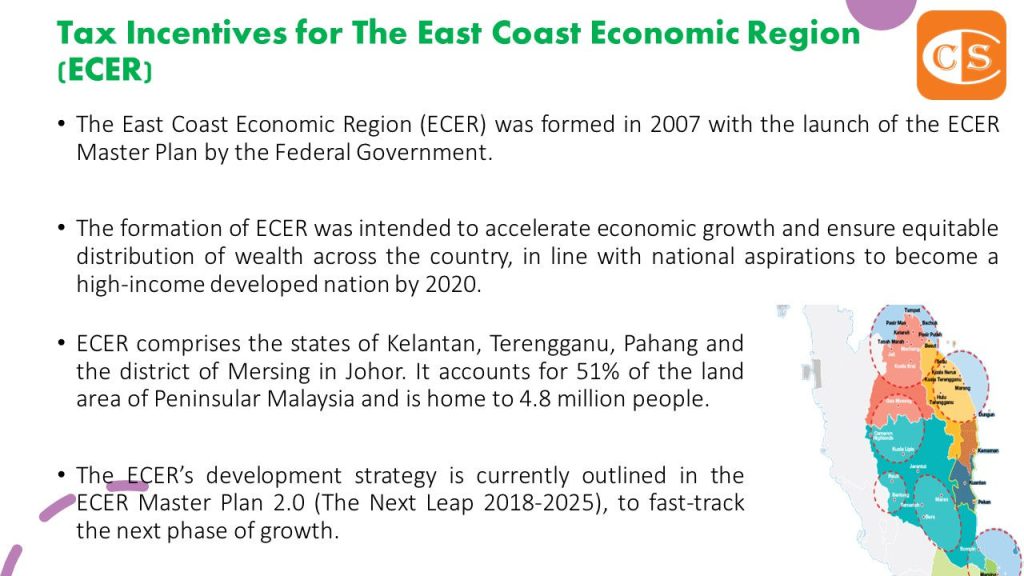
    1. The East Coast Economic Region (ECER) was formed in 2007 with the launch of the ECER Master Plan by the Federal Government.

    2. The formation of ECER was intended to accelerate economic growth and ensure equitable distribution of wealth across the country, in line with national aspirations to become a high-income developed nation by 2020.

    3. As a result, the government has provided tax incentives for the ECER

    4. In recent weeks, the Malaysian government published Five pieces of subsidiary legislation to extend the deadline to apply for incentives in the ECER from the previous deadline of December 2020 to the new date of December 2022:-

    👉 Income Tax (Exemption) (No. 4) 2016 (Amendment) Order 2022 [P.U.(A) 88/2022]

    👉 Income Tax (Exemption) (No. 5) 2016 (Amendment) Order 2022 [P.U.(A) 89/2022]

    👉 Income Tax (Exemption) (No. 6) 2016 (Amendment) Order 2022 [P.U.(A) 90/2022]

    👉 Income Tax (Exemption) (No. 7) 2016 (Amendment) Order 2022 [P.U.(A) 91/2022]

    👉 Income Tax (Exemption) (No. 8) 2016 (Amendment) Order 2022 [P.U.(A) 92/2022]

    👉 To Download All – https://t.me/YourAuditor/2928

    5. In accordance with paragraphs 5A and 6 of The Income Tax (Exemption) (No. 7) Order 2016 (P.U.(A) 160/2016 (*)), a qualifying person is exempt from payment of income tax on statutory income derived from a special qualifying activity at the rate of not less than 70% and not more than 100% as specified by the Minister for a period of consecutive years of assessment as the Minister may determine.

    (*) As amended by the Income Tax (Exemption) (No. 7) 2016 (Amendment) Order 2018 [P.U.(A) 394/2018]

    6. Join our Telegram – https://t.me/YourAuditor

    🌻🌻🌻🌻🌻🌻🌻🌻

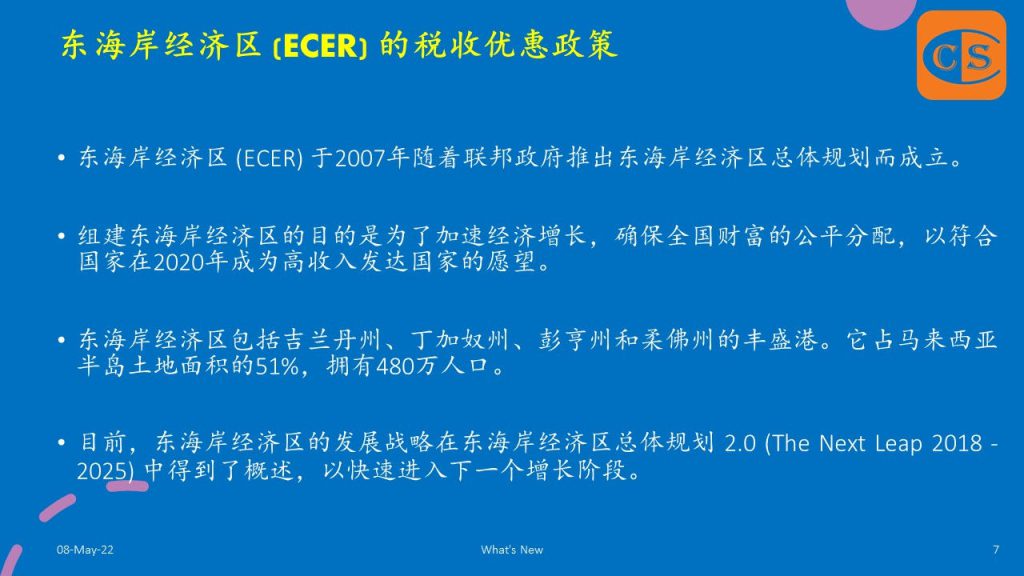
    1. 东海岸经济区(ECER)于2007年随着联邦政府推出东海岸经济区总体规划而成立。

    2. 组建东海岸经济区的目的是为了加速经济增长,确保全国财富的公平分配,以符合国家在2020年成为高收入发达国家的愿望。

    3. 因此,政府为东海岸经济区提供了税收激励措施

    4. 几周前,马来西亚政府在宪报颁布了5项附属立法,将申请东海岸经济区 (ECER) 税收优惠措施的截止日期从之前的 2020 年 12 月延长至 2022 年 12 月:-

    👉 2016年所得税(豁免)(第4号) 2022年(修正)指令 [P.U.(A)88/2022]

    👉 2016年所得税(豁免)(第5号) 2022年(修正)指令 [P.U.(A)89/2022]

    👉 2016年所得税(豁免)(第6号) 2022年(修正)指令 [P.U.(A)90/2022]

    👉 2016年所得税(豁免)(第7号) 2022年(修正)指令 [P.U.(A)91/2022]

    👉 2016年所得税(豁免)(第8号) 2022年(修正)指令 [P.U.(A)92/2022]

    👉 下载 – https://t.me/YourAuditor/2928

    5. 2016年所得税(豁免)(第7号) 指令 [P.U. (A) 160/2016 (*)] 规定,只要遵守 P.U. (A) 160/2016 第5A和6段的规定,符合条件的人士可在部长规定的连续评估年限内,对来自特殊合格活动的法定收入免交不低于 70%,不高于 100% 的所得税。

    (*) 经2016年所得税(豁免)(第4号)2018年(修正)指令 [P.U.(A)394/2018] 修订

    6. 加入 Telegram 群 – https://t.me/YourAuditor

    🌼🌼🌼🌼🌼🌼🌼🌼🌼🌼

    9
  • 2: Tax Incentives for The East Coast Economic Region (ECER) – Tax Exemption

    2: Tax Incentives for The East Coast Economic Region (ECER) – Tax Exemption

    1. The East Coast Economic Region (ECER) was formed in 2007 with the launch of the ECER Master Plan by the Federal Government.2. The formation of ECER was intended to accelerate economic growth and ensure equitable distribution of wealth across the country, in line with national aspirations to become a high-income developed nation by 2020.

    3. As a result, the government has provided tax incentives for the ECER

    4. In recent weeks, the Malaysian government published Five pieces of subsidiary legislation to extend the deadline to apply for incentives in the ECER from the previous deadline of December 2020 to the new date of December 2022:-

    👉 Income Tax (Exemption) (No. 4) 2016 (Amendment) Order 2022 [P.U.(A) 88/2022]

    👉 Income Tax (Exemption) (No. 5) 2016 (Amendment) Order 2022 [P.U.(A) 89/2022]

    👉 Income Tax (Exemption) (No. 6) 2016 (Amendment) Order 2022 [P.U.(A) 90/2022]

    👉 Income Tax (Exemption) (No. 7) 2016 (Amendment) Order 2022 [P.U.(A) 91/2022]

    👉 Income Tax (Exemption) (No. 8) 2016 (Amendment) Order 2022 [P.U.(A) 92/2022]

    👉 To Download All – https://t.me/YourAuditor/2928

    5. Under the Income Tax (Exemption) (No. 5) Order 2016 (‘P.U.(A) 158/2016’), a qualifying person is exempted from paying income tax on statutory income derived from a special qualifying activity that is equal to the rate of allowance specified by the Minister, which shall not be less than 60% and not more than 100% of the qualifying capital expenditure incurred by the qualifying person for such period of consecutive years as the Minister may determine.

    6. Join our Telegram – https://t.me/YourAuditor

    🌻🌻🌻🌻🌻🌻🌻🌻

    1. 东海岸经济区(ECER)于2007年随着联邦政府推出东海岸经济区总体规划而成立。

    2. 组建东海岸经济区的目的是为了加速经济增长,确保全国财富的公平分配,以符合国家在2020年成为高收入发达国家的愿望。

    3. 因此,政府为东海岸经济区提供了税收激励措施

    4. 几周前,马来西亚政府在宪报颁布了5项附属立法,将申请东海岸经济区 (ECER) 税收优惠措施的截止日期从之前的 2020 年 12 月延长至 2022 年 12 月:-

    👉 2016年所得税(豁免)(第4号) 2022年(修正)指令 [P.U.(A)88/2022]

    👉 2016年所得税(豁免)(第5号) 2022年(修正)指令 [P.U.(A)89/2022]

    👉 2016年所得税(豁免)(第6号) 2022年(修正)指令 [P.U.(A)90/2022]

    👉 2016年所得税(豁免)(第7号) 2022年(修正)指令 [P.U.(A)91/2022]

    👉 2016年所得税(豁免)(第8号) 2022年(修正)指令 [P.U.(A)92/2022]

    👉 下载 – https://t.me/YourAuditor/2928

    5. 2016年所得税(豁免)(第5号) 指令 (“P.U.(A)158/2016“) 规定,符合条件的人士从特殊合格活动中获得的法定收入可免交所得税,该收入相当于部长规定的津贴率,该津贴率应不低于合格者在部长可能确定的连续几年内产生的合格的资本支出的60%,也不高于100%。

    6. 加入 Telegram 群 – https://t.me/YourAuditor

    🌼🌼🌼🌼🌼🌼🌼🌼🌼🌼

    9
  • 3: Tax Incentives for The East Coast Economic Region (ECER) – Tax Exemption

    3: Tax Incentives for The East Coast Economic Region (ECER) – Tax Exemption

    1. The East Coast Economic Region (ECER) was formed in 2007 with the launch of the ECER Master Plan by the Federal Government.

    2. The formation of ECER was intended to accelerate economic growth and ensure equitable distribution of wealth across the country, in line with national aspirations to become a high-income developed nation by 2020.

    3. As a result, the government has provided tax incentives for the ECER

    4. In recent weeks, the Malaysian government published Five pieces of subsidiary legislation to extend the deadline to apply for incentives in the ECER from the previous deadline of December 2020 to the new date of December 2022:-

    👉 Income Tax (Exemption) (No. 4) 2016 (Amendment) Order 2022 [P.U.(A) 88/2022]

    👉 Income Tax (Exemption) (No. 5) 2016 (Amendment) Order 2022 [P.U.(A) 89/2022]

    👉 Income Tax (Exemption) (No. 6) 2016 (Amendment) Order 2022 [P.U.(A) 90/2022]

    👉 Income Tax (Exemption) (No. 7) 2016 (Amendment) Order 2022 [P.U.(A) 91/2022]

    👉 Income Tax (Exemption) (No. 8) 2016 (Amendment) Order 2022 [P.U.(A) 92/2022]

    👉 To Download All – https://t.me/YourAuditor/2928

    5. A qualifying person is exempt from paying income tax for ten consecutive years on statutory income derived from a qualifying activity under the Income Tax (Exemption) (No. 6) Order 2016 (‘P.U.(A) 159/2016’), provided that the provisions of paragraphs 5A and 6 of P.U.(A) 159/2016 are adhered to, and the qualifying activity is carried out in The East Coast Economic Region (ECER)

    6. Join our Telegram – https://t.me/YourAuditor

    🌻🌻🌻🌻🌻🌻🌻🌻

    1. 东海岸经济区(ECER)于2007年随着联邦政府推出东海岸经济区总体规划而成立。

    2. 组建东海岸经济区的目的是为了加速经济增长,确保全国财富的公平分配,以符合国家在2020年成为高收入发达国家的愿望。

    3. 因此,政府为东海岸经济区提供了税收激励措施

    4. 几周前,马来西亚政府在宪报颁布了5项附属立法,将申请东海岸经济区 (ECER) 税收优惠措施的截止日期从之前的 2020 年 12 月延长至 2022 年 12 月:-

    👉 2016年所得税(豁免)(第4号) 2022年(修正)指令 [P.U.(A)88/2022]

    👉 2016年所得税(豁免)(第5号) 2022年(修正)指令 [P.U.(A)89/2022]

    👉 2016年所得税(豁免)(第6号) 2022年(修正)指令 [P.U.(A)90/2022]

    👉 2016年所得税(豁免)(第7号) 2022年(修正)指令 [P.U.(A)91/2022]

    👉 2016年所得税(豁免)(第8号) 2022年(修正)指令 [P.U.(A)92/2022]

    👉 下载 – https://t.me/YourAuditor/2928

    5. 2016年所得税(豁免)(第6号) 指令 (“P.U. (A) 159/2016“) 规定,只要遵守 P.U. (A) 159/2016 第5A和6段的规定,并且该合格活动是在东海岸经济区 (ECER) 进行的,合格的人士可以连续十年免交所得税。

    6. 加入 Telegram 群 – https://t.me/YourAuditor

    🌼🌼🌼🌼🌼🌼🌼🌼🌼🌼

    9
  • 1: Tax Incentives for The East Coast Economic Region (ECER) – Tax Exemption

    1: Tax Incentives for The East Coast Economic Region (ECER) – Tax Exemption

    1. The East Coast Economic Region (ECER) was formed in 2007 with the launch of the ECER Master Plan by the Federal Government.

    2. The formation of ECER was intended to accelerate economic growth and ensure equitable distribution of wealth across the country, in line with national aspirations to become a high-income developed nation by 2020.

    3. As a result, the government has provided tax incentives for the ECER

    4. In recent weeks, the Malaysian government published Five pieces of subsidiary legislation to extend the deadline to apply for incentives in the ECER from the previous deadline of December 2020 to the new date of December 2022:-

    👉 Income Tax (Exemption) (No. 4) 2016 (Amendment) Order 2022 [P.U.(A) 88/2022]

    👉 Income Tax (Exemption) (No. 5) 2016 (Amendment) Order 2022 [P.U.(A) 89/2022]

    👉 Income Tax (Exemption) (No. 6) 2016 (Amendment) Order 2022 [P.U.(A) 90/2022]

    👉 Income Tax (Exemption) (No. 7) 2016 (Amendment) Order 2022 [P.U.(A) 91/2022]

    👉 Income Tax (Exemption) (No. 8) 2016 (Amendment) Order 2022 [P.U.(A) 92/2022]

    👉 To Download All – https://t.me/YourAuditor/2928

    5. The Income Tax (Exemption) (No. 4) Order 2016 (‘P.U.(A) 157/2016’) exempts a qualifying person from income tax for five consecutive years on statutory income obtained from a qualifying activity that is equivalent to 100% of the qualifying capital expenditure incurred by the qualifying person.

    6. Join our Telegram – https://t.me/YourAuditor

    🌻🌻🌻🌻🌻🌻🌻🌻

    1. 东海岸经济区(ECER)于2007年随着联邦政府推出东海岸经济区总体规划而成立。 2. 组建东海岸经济区的目的是为了加速经济增长,确保全国财富的公平分配,以符合国家在2020年成为高收入发达国家的愿望。

    3. 因此,政府为东海岸经济区提供了税收激励措施

    4. 几周前,马来西亚政府在宪报颁布了5项附属立法,将申请东海岸经济区 (ECER) 税收优惠措施的截止日期从之前的 2020 年 12 月延长至2022 年 12 月:-

    👉 2016年所得税(豁免)(第4号) 2022年(修正)指令 [P.U.(A)88/2022]

    👉 2016年所得税(豁免)(第5号) 2022年(修正)指令 [P.U.(A)89/2022]

    👉 2016年所得税(豁免)(第6号) 2022年(修正)指令 [P.U.(A)90/2022]

    👉 2016年所得税(豁免)(第7号) 2022年(修正)指令 [P.U.(A)91/2022] 👉 2016年所得税(豁免)(第8号) 2022年(修正)指令 [P.U.(A)92/2022]

    👉 下载 – https://t.me/YourAuditor/2928

    5. 2016年所得税(豁免)(第4号) 指令 (“P.U.(A)157/2016“) 规定,符合条件的人士从符合条件的活动中获得的法定收入,相当于合格的资本支出的 100%,可连续5年免缴所得税。

    6. 加入 Telegram 群 – https://t.me/YourAuditor

    🌼🌼🌼🌼🌼🌼🌼🌼🌼🌼

    11