The Labuan Foundations Act of 2010 regulates the formation of foundations in Labuan as well as their administration and dissolution after they have been established.
What is a Labuan foundation?
A Labuan foundation is similar to a company in that it is a corporate body with a separate legal entity, established to hold assets in its own name to manage the assets for the benefit of its beneficiaries, or particular purposes, or both.
In most cases, it is utilised to administer private wealth and charitable activities.
A Labuan foundation has the following features:
The founder and beneficiaries may/may not be a resident of Malaysia.
Its charter must be duly signed by the founder.
Its properties are situated outside Malaysia unless otherwise approved by the Labuan Financial Services Authority (Labuan FSA), or it is a foundation for charitable purposes.
The main purpose is the management of property, and such purpose must be lawful to Malaysian public policy.
When the property of a Labuan foundation is located in Malaysia, any income derived is subject to taxation under the Income Tax Act 1967; however, when the property is located outside of Malaysia, such income is subject to taxation under the Labuan Business Activity Tax Act 1990.
One of the few common law jurisdictions in the Asia Pacific, the Labuan International Business and Financial Center (IBFC) caters to both trusts and foundations.
Therefore, as an alternative to setting up a trust, investors may instead form a foundation (which is frequently linked to a limited liability partnership), which will allow more control over the assets.
Trusts and foundations are differentiated as follows:
Labuan Foundations (Amendment) Regulations 2022
IN exercise of the powers conferred by subsection 80(1) of the Labuan Foundations Act 2010 [Act 706], the Minister, on the recommendation of the Authority, makes these Regulations, which come into operation on 1 January 2023.
Under these Regulations, the Labuan Foundations Regulations 2010 [P.U. (A) 418/2010] are amended by substituting for the Third Schedule the following schedule:
Our website's articles, templates, and material are solely for reference. Although we make every effort to keep the information up to date and accurate, we make no representations or warranties of any kind, either express or implied, regarding the website or the information, articles, templates, or related graphics that are contained on the website in terms of its completeness, accuracy, reliability, suitability, or availability. Therefore, any reliance on such information is strictly at your own risk.
Keep in touch with us so that you can receive timely updates |
Derivation of income under s 12 of the Income Tax Act 1967
The circumstances under which business income would be considered to be derived from Malaysia and so taxed in Malaysia are outlined in Section 12 of the Income Tax Act 1967 (ITA).
To complement Section 12, the Income Tax Act was updated with new sections 12(3) and 12(4) by the Finance Act 2018.
Beginning on December 28, 2018, these new provisions took effect.
According to the provisions of Section 12(3), a person is considered to have derived their business income from Malaysia if such revenue is attributable to a “Place of Business” located in Malaysia.
Section 12(4) clarifies the meaning and provides examples of what constitutes a place of business.
Guidelines On The Application Of Subsections 12(3) And 12(4) Of The Income Tax Act 1967 In Determining A “Place Of Business”
Guidelines were published on the website of the Inland Revenue Board (IRB) on May 21, 2020.
The title of the guidelines was “Guidelines on the application of Subsections 12(3) and 12(4) of the Income Tax Act 1967 in determining a “Place of Business” (Guidelines).
These guidelines were issued concerning the provisions that were discussed above.
In addition, the Guidelines include nine examples for readers to refer to.
You are strongly encouraged to read the entire Guidelines to obtain all the relevant information.
Guidelines on the application of Subsections 12(3) and 12(4) of the Income Tax Act 1967 in determining a “Place of Business
Recent changes to the Form C
Recent changes were made to Form C by the Inland Revenue Board in preparation for the YA 2022.
One of the most critical changes is for those businesses participating in transfer pricing arrangements.
As a result, the disclosure items have been significantly expanded to cover new areas.
These new areas include stating the characterisation of your company by reference to its functional profile and the business restructuring undertaken by the group during the year.
Other disclosures incorporated into the new Form C include cash pooling, permanent establishments (PEs), dividend declarations and payments, cost contribution arrangements, and others.
Permanent Establishments
Regarding Permanent Establishments (PEs), the taxpayer is responsible for conducting a careful analysis to determine whether or not any of its activities result in a PE for a foreign entity.
If so, this may affect the disclosures that are required to be included in the updated Form C. Taxpayers must disclose whether they have made any interest, royalties and service payments to their head office.
The definition of a permanent establishment, on the face of it, would require the existence of a fixed place of business.
However, a permanent establishment may be deemed to exist despite the absence of a physical fixed place of business.
For example, in the absence of employees or distinct premises, in the taxing country.
Case Law:
In a Belgian case, according to the decision of the Supreme Court, a permanent establishment in Belgium may exist whether or not the taxpayer has a representative or an employee there.
Thus, foreign enterprises owned immovable; leased properties were considered fixed installations producing income and, therefore, permanent establishments (État belge v Société de Gestion).
In an American case, A Swiss resident was found to be doing business in the U.S. through a permanent establishment as he and specially trained employees travelled around the states showing and selling logging equipment he manufactured.
This was a constructive activity in the States, and the inference was that the use of equipment in material proportions might be a permanent establishment even if no actual fixed place of business existed.
Fixed Place of Business Permanent Establishment
The term “permanent establishment” means a fixed place of business in which the company or the enterprise is wholly or partly carried on and shall include especially:
a place of management;
a branch;
an office;
a factory;
a workshop;
a mine, oil well, quarry or other place of extraction of natural resources;
a building site or installation or construction or assembly project;
a farm or plantation;
a place of extraction of timber or forest produce.
In general, therefore, a permanent establishment will usually exist in Malaysia where:
there is a continuity of activity in Malaysia; and
there is active conduct of business in Malaysia.
Example
Most fashion companies have headquarters in their home country, but their factories are usually in a different country.
Since the fashion companies operate in the foreign host country and generate revenue there, the company will be subject to different taxation requirements in each territory.
Position in Malaysia
A person shall also be deemed to have a place of business in Malaysia if the person undertakes any of the following:
carries on supervisory activities in connection with a building or work site, or construction, an installation or an assembly project, or
has another person acting on his behalf who
habitually concludes contracts, or habitually plays the principal role leading to the conclusion of contracts that are routinely concluded without material modification
habitually maintains a stock of goods or merchandise in that place of business from which such person delivers goods or merchandise, or
regularly fills orders on his behalf.
In general, in the Double Taxation Agreements entered into by Malaysia, when the activities of the foreign enterprise are auxiliary or preparatory concerning a business, such activities should not be viewed as a permanent establishment, even when conducted through a fixed place.
This is consistent with the approach adopted in the “permanent establishment” Article 5 of the Organisation for Economic Cooperation and Development Model Treaty.
Article 5 of the Organisation for Economic Cooperation and Development Model Treaty.
For example:
An office of a resident of a contracting state in Malaysia which is used solely for the purchase of goods (i.e. a cost centre) does not constitute a permanent establishment in Malaysia (e.g. Article 5 of the Double Taxation Agreements between Malaysia and the Netherlands, Malaysia and Singapore, Malaysia and the United Kingdom).
But the position may be different, however, if such an establishment is also a sorting, packing or grading office.
Our website's articles, templates, and material are solely for reference. Although we make every effort to keep the information up to date and accurate, we make no representations or warranties of any kind, either express or implied, regarding the website or the information, articles, templates, or related graphics that are contained on the website in terms of its completeness, accuracy, reliability, suitability, or availability. Any reliance on such information is therefore strictly at your own risk.
Keep in touch with us so that you can receive timely updates |
The term “Digital Currency,” which is also known as “Cryptocurrency,” refers to a blockchain-based digital asset that can be bought, sold, and traded on a variety of platforms.
Bitcoin was the first cryptocurrency ever created, all the way back in 2008 and was issued in 2009.
Since that time, a wide variety of people and businesses worldwide have been mining and trading more cryptocurrencies, such as Ethereum, XRP, Tether, Dogecoin, Ripple, etc.
Although cryptocurrencies are legal in Malaysia, they are not considered legal tender.
Different countries and regions worldwide have adopted various approaches regarding how Digital Currency should be taxed.
Guidelines on Taxation of Electronic Commerce
The Inland Revenue Board of Malaysia (IRBM) has introduced guidelines on the taxation of e-commerce that were published on 1 January 2013.
With the evolvement of e-commerce transactions (e-CT), IRBM has published updated Guidelines on Taxation of Electronic Commerce Transactions (the 2019 Guidelines), replacing the earlier guidelines dated 1 January 2013
This new guideline provides some guidance on income tax treatment regarding e-CT. Key terms defined by the 2019 Guidelines include:
“Digital Currency” means a digital representation of value recorded on a distributed digital ledger, whether cryptographically-secured or otherwise, that functions as a medium of exchange and is interchangeable with any money, including through the crediting or debiting of an account.
“Digital Token” means a digital representation recorded on a distributed digital ledger, whether cryptographically-secured or otherwise.
Scope of Charge
Generally, income tax is imposed on the income of any person accruing in or derived from Malaysia.
The 2019 Guidelines state, “any income concerning e-CT is deemed to be derived from Malaysia if it is associated with any activities in Malaysia regardless of whether that income is received in Malaysia or otherwise.”
Scope of Tax Liability for Business
The 2019 Guidelines stipulate that for business income, where the business operations are carried on in Malaysia, the income attributable to those business operations is deemed to be derived from Malaysia.
Guidelines on the tax treatment of Digital Currency Transactions
IRBM is aware of the importance of providing a more in-depth discussion on how taxes should be applied to Digital Currencies and Digital Tokens.
Therefore, to provide more direction on the tax treatment under the Income Tax Act of 1967, IRBM clarified taxpayers by issuing guidelines on the tax treatment of Digital Currency Transactions (“the DCT Guidelines“) on August 26, 2022.
The following paragraphs make up the new 14-page Guidelines:-
Introduction
Interpretation
Income Tax Treatment
Acquisition Cost of Digital Currency
Digital Currency with No Published Value
Income Tax Treatments
In general, the taxability of transactions involving digital currency in Malaysia is determined by Section 3 of the Income Tax Act 1967, which states that any income accruing in or derived from Malaysia or income received in Malaysia from outside Malaysia is subject to taxation.
The whole object of the Income Tax Act is to tax income, and it is, therefore, an exercise of utmost importance for a taxpayer to distinguish the nature of a particular receipt, as Malaysia does not tax capital gain, only revenue gains arising from the disposal of digital currency is taxable.
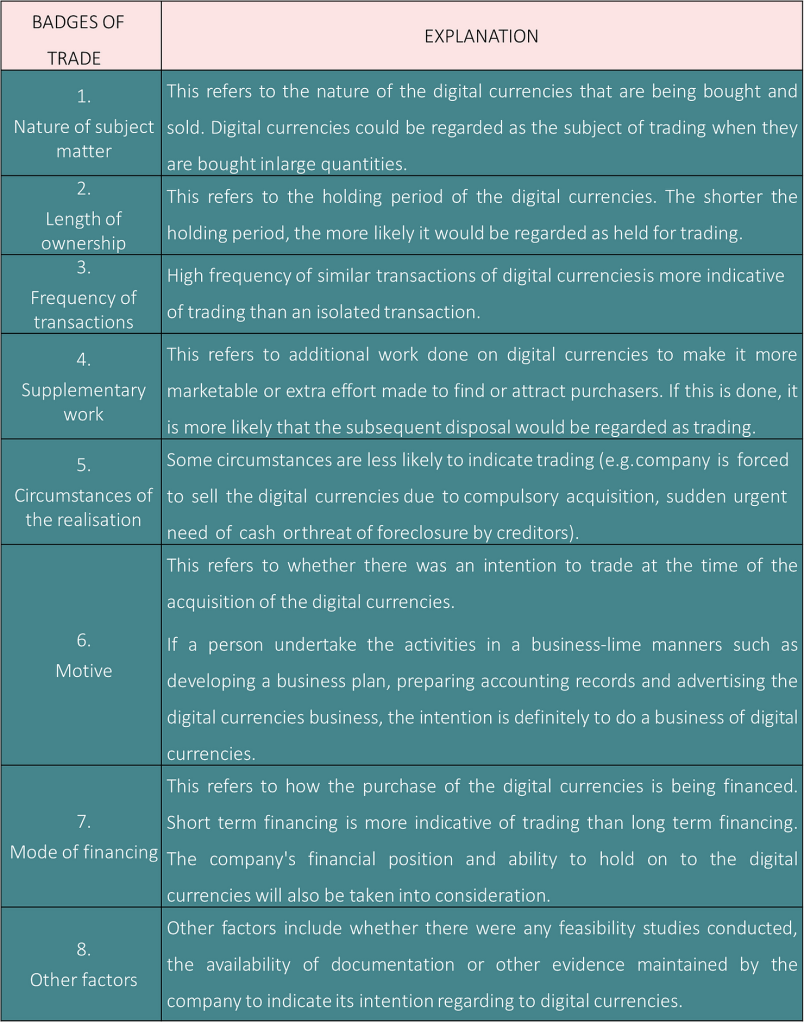
A description of how IRBM determines digital currencies’ gain as a capital or revenue gain is as follows:
Appendix A
The Guidelines stipulate no single badge is a decisive pointer to the existence of a trade. It should be weighed up with all the relevant factors.
So, Tax or Not?
1) The Tax Implications of Trading of Digital Currencies
As is the case with the trading of stocks, businesses that purchase and sell digital currencies as part of their regular business operations will be subject to taxes on the profits generated from trading in digital currencies.
Example 1:
ABC Sdn Bhd is in the business of buying and selling digital currencies.
On 11 September 2021, the company purchased 100 units of Coin Y for RM1,000,000 and sold 50 units of Coin Z for RM1,700,000.
Since ABC Sdn Bhd is carrying a business of trading digital currencies:
the selling of Coin Z for RM1,700,000 should be reported as sales, and
the cost of purchasing Coin Y is deductible.
If the company makes a loss, such loss is tax deductible.
2) The Tax Implications of Investment in Digital Currencies
The factors to consider in determining whether the gain is capital or revenue are described in Appendix A.
Example 2:
ABC Enterprise bought used equipment from CCS Sdn Bhd for 1 unit of digital currency B.
At the point of transaction, 1 unit of digital currency B is equivalent to RM15,000.
ABC Enterprise shall recognise the used equipment as an asset for the business at the value of RM15,000.
The value of the digital currency received for the equipment (RM15,000) is recognised as equipment sales by CCS Sdn Bhd.
After 3 years, the value of the digital currency B increases from RM15,000 to RM30,000.
Digital currency B has been disposed of by CCS Sdn Bhd and the gain on disposal of digital currency B amounted to RM15,000.
If CCS Sdn Bhd’s holding of the digital currencies B satisfies the criteria of capital gains, the disposal is not subject to ITA 1967.
3) The Tax Implications of Digital Currencies Mining
In general, miners of Digital Currencies will be subject to taxation in two different scenarios:
when they are awarded Digital Currency as a reward for their mining activity, and
when they sell or otherwise exchange the reward tokens.
Concerning (1)
According to the DCT Guidelines, if a taxpayer’s mining activities constitute a trade or business, the taxpayer has to recognise gross income upon receipt of the reward tokens in an amount equal to the fair market value of the coins at the time of receipt. Expenses relating to the business will be tax deductible, and losses incurred will be allowed.
Similarly, if a taxpayer performs mining activities as an employee, payments made in cryptocurrency are treated as wages subject to Monthly Tax Deductions (MTD) Rules.
Concerning (2)
The taxability of a miner’s profit from the disposal of payment tokens would depend on whether or not the gain is capital or revenue in nature and is based on badges of trade.
Example 3:
First Taxable Event
Adam mines Bitcoin and receives 6 tokens when the price per coin is $20,000.
If we assume that Adam’s mining activities constitute a trade or business, the $120,000 ($20,000 x 6) worth of Bitcoin he receives will be treated as income and subject to tax at prevailing tax rates.
Second Taxable Event
Adam may trigger a second taxable event upon the sale of the reward tokens, with the amount of gain (or loss) equaling the difference between the sales price and the gross income recognised when Adam initially received the coins in exchange for mining activities.
Assume that Adam sold three of the Bitcoin tokens three years later when the price per coin was $60,000. Adam would recognize a gain of $120,000 ([$60,000 x 3 tokens] – [$20,000 x 3 tokens]).
Since Adam held the three Bitcoins for more than three years, or if this is the only transaction made by Adam in the past 3 years, his holding of the Bitcoins satisfies the criteria of capital nature; the disposal is not subject to ITA 1967.
Other Tax Implications
Mere acquisition and disposal of digital currencies
When a person buys digital currencies such as Bitcoin and Ether merely as part or full payment of any goods and services, the situation does not give rise to taxation.
Example 4:
Fakhri wants to attend a show at Istana Budaya.
The organiser offers a discount of 20% of the ticket price if payment is made using digital currencies.
Fakhri buys digital currency equivalent to the discounted ticket price and pays the organiser.
Receiving digital currencies as a result of free distribution or splitting
A person may receive digital currency for free as a promotion or marketing tool or split existing digital currency such as airdrop and hardfork.
These tokens are not income to the recipient, thus not taxable at the time of receipt.
Gains from the disposal of these tokens in the future will be taxable if the gains are revenue in nature.
Tokens are given in exchange for certain Goods or Services
A person may receive digital currency in exchange for certain goods or services.
The above may be subject to income tax. The value of the goods or services is determined based on the value of the digital currencies at the point of transaction.
Gains from the disposal of these tokens in the future will be taxable if the gains are revenue in nature.
The Acquisition Cost of Digital Currency
For taxation purposes, the acquisition cost of digital currencies must be determined in Ringgit Malaysia (RM).
As digital currencies are treated as intangible assets for taxation purposes, any digital currency in a company’s possession, therefore, needs to be valued in Ringgit Malaysia (RM).
The acquisition cost of digital currency is determined based on the First In, First Out (FIFO) principle unless the taxpayer is able to prove otherwise.
If the acquisition cost of the current asset cannot be determined, the digital currency will be valued using fair value, i.e. at the rate in force on the day of the transaction and based on the acceptable and verifiable digital currency exchanges
Digital currency with no published value
If Digital Currency is received in exchange for property or services and that Digital Currency is not traded on any Digital Currency exchange and does not have a published value, then the fair value of the Digital Currency received is equal to the fair value of the property or services exchanged for the digital currency when the transaction occurs.
What are some best practices for handling Digital Currency?
The most important thing you can do is maintain detailed records of your Digital Currency. Documents that need to be kept concerning digital currency include:
records to determine the nature of the transaction – including whitepaper
records to determine the value of a digital currency based on the online exchange
date of transaction
name of the other party, i.e. digital currency address
receipts of purchase/ transfer of digital currency
exchange records
other records such as records of agents, wallet keys, software
bank statements
receipts/invoices of business expenses
Our website's articles, templates, and material are solely for reference. Although we make every effort to keep the information up to date and accurate, we make no representations or warranties of any kind, either express or implied, regarding the website or the information, articles, templates, or related graphics that are contained on the website in terms of its completeness, accuracy, reliability, suitability, or availability. Any reliance on such information is therefore strictly at your own risk.
Keep in touch with us so that you can receive timely updates |
1. Section 83(3) of the Income Tax Act 1967 states:
👉 Where an employer is about to cease to employ an individual who is or is likely to be chargeable to tax in respect of income in respect of gains or profits from the employment or where an individual under his employment dies, the employer shall, not less than thirty days before the cessation of the employment, or in respect of cessation by reason of death not more than thirty days after being informed of the death of the individual, give notice in the prescribed form to the Director-General of the cessation of the employment
2. The question arises.
👉 So Whether Employer Can Amend Form CP 22A or not?
👉 Can an employer submit more than one copy of the Form CP 22A?