Day: November 12, 2026

  • Defining an Individual Who Is Not Conducting a Business

    Defining an Individual Who Is Not Conducting a Business

    How is an individual who is not conducting a business defined?

    Generally, this refers to a person who is not engaged in commercial, industrial or professional activities that generate income or profit. Such individuals typically receive income from employment or personal savings, or engage in occasional transactions, rather than carrying on ongoing business activities.

    Individual Conducting a Business

    Ms Lim is a freelance make-up artist who provides services to clients and charges professional fees. She is conducting a business because she earns income through her own service activities. An e-Invoice should be obtained when making payment to her.

    Individual Not Conducting a Business

    Mr Tan is a retiree who sells his old personal laptop to another person as a one-off transaction. He is not operating a business and is considered an individual who is not conducting a business. In this example, he is not required to issue an e-Invoice.

    如何界定没有经营业务的个人?

    一般而言,“没有经营业务的个人”是指没有从事能够产生收入或利润的商业、工业或专业活动的人。这类人士的收入通常来自受雇所得或个人储蓄,也可能涉及偶发性交易,而非持续经营业务。

    有经营业务的个人

    林小姐是一名自由化妆师,为客户提供化妆服务并收取专业费用。她通过自己的服务活动赚取收入,因此属于有经营业务的个人。向她付款时,应取得电子发票。

    没有经营业务的个人

    陈先生是一位退休人士,偶尔将自己的旧笔记本电脑出售给他人,属于一次性个人交易。他并未经营业务,因此属于没有经营业务的个人。在这个例子中,他无需开具电子发票。
  • Self-Billed e-Invoices for Interest Payments in Intragroup Financing

    Self-Billed e-Invoices for Interest Payments in Intragroup Financing

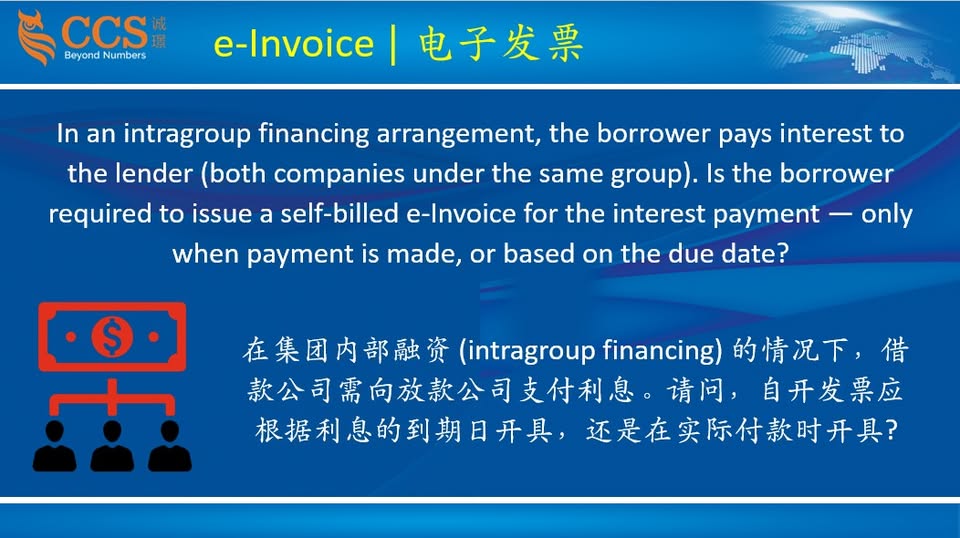
    In an intragroup financing arrangement, when a borrower pays interest to a lender within the same group, should the borrower issue a self-billed e-Invoice based on the interest due date or when payment is made?

    According to HASiL’s guidance, the borrower must issue a self-billed e-Invoice when the interest is paid. The e-Invoice should therefore be generated upon actual payment, not merely when the interest becomes due.

    Example

    Company A, the borrower, borrows RM1,000,000 from Company B, the lender. Both companies are in the same group. The interest rate is 5% per annum, resulting in annual interest of RM50,000. The interest is due on 31 December 2025, but Company A makes the payment on 15 February 2026.

    Company A must issue the self-billed e-Invoice on 15 February 2026, the date the interest is paid. If payment has not been made, the e-Invoice should not be issued on the due date of 31 December 2025.

    集团内部融资利息付款的自开发票处理

    在集团内部融资安排中,借款公司向同集团的放款公司支付利息时,应按利息到期日开具自开发票,还是在实际付款时开具?

    根据内陆税收局(HASiL)的说明,借款方必须在实际支付利息时开具自开发票。因此,电子发票应在付款时生成,而不是仅因利息到期便开具。

    举例说明

    A 公司(借款方)向同集团的 B 公司(放款方)借款 RM1,000,000。年利率为 5%,每年应付利息为 RM50,000。利息到期日为 2025 年 12 月 31 日,但 A 公司直到 2026 年 2 月 15 日才付款。

    A 公司必须在 2026 年 2 月 15 日,也就是实际支付利息当天,开具自开发票。如果当时尚未付款,则不应在利息到期日(2025 年 12 月 31 日)开具电子发票。

  • Issuing a Debit Note e-Invoice for Rebate Claims

    Issuing a Debit Note e-Invoice for Rebate Claims

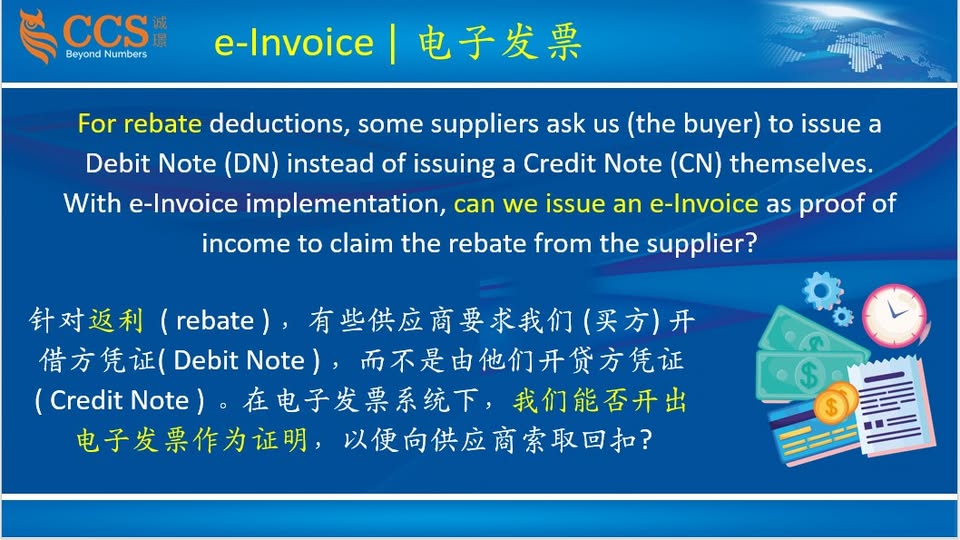
    When a supplier asks the buyer to issue a Debit Note (DN) for a rebate instead of issuing a Credit Note (CN), can the buyer issue an e-Invoice to support the rebate claim?

    According to HASiL’s guidance, the buyer may issue a Debit Note e-Invoice to the supplier for a rebate claim. The buyer must enter the Unique LHDNM ID of the original e-Invoice being adjusted in the “Original e-Invoice Reference Number” field. This links the transactions and supports a clear audit trail and income verification.

    Example

    Supplier A sells products worth RM10,000 to Buyer B. Supplier A later agrees to give Buyer B a rebate of RM500 for meeting sales targets. Instead of issuing a Credit Note, Supplier A asks Buyer B to issue a Debit Note.

    Buyer B may issue a Debit Note e-Invoice to Supplier A for RM500. The Debit Note must reference the Unique LHDNM ID of the original e-Invoice for RM10,000. It documents the rebate claim and records the rebate for Buyer B.

    买方能否开具借方凭证电子发票以申索回扣?

    若供应商要求买方开具借方凭证(Debit Note,DN)来处理回扣,而不是由供应商开具贷方凭证(Credit Note,CN),买方能否开具电子发票作为回扣申索的凭证?

    根据内陆税收局(HASiL)的说明,买方可以向供应商开具借方凭证电子发票,以申索回扣。买方必须在“原始电子发票参考编号”(Original e-Invoice Reference Number)栏位填写被调整的原始电子发票的 LHDNM 唯一识别编号(Unique LHDNM ID)。这有助于关联两笔交易,并保留清晰的审计轨迹及收入核实记录。

    举例说明

    供应商 A 向买方 B 销售价值 RM10,000 的货品。之后,供应商 A 同意因买方 B 达到销售目标而给予 RM500 回扣。供应商 A 要求买方 B 开具借方凭证,而不是由供应商开具贷方凭证。

    买方 B 可以向供应商 A 开具 RM500 的借方凭证电子发票。该凭证必须注明原始 RM10,000 电子发票的 LHDNM 唯一识别编号,以记录回扣申索及买方 B 的回扣收入。

  • Does the e-Invoice Validation Date Determine the Accounting Recognition Date?

    Does the e-Invoice Validation Date Determine the Accounting Recognition Date?

    For accounting purposes, must an e-Invoice be recorded based on its validation date, even if the underlying transaction took place earlier?

    According to HASiL’s guidance, the recognition of income and expenses should continue to follow the applicable accounting standards, such as the accrual basis and MFRS or MPERS. It is not determined by the e-Invoice validation date.

    If there is a timing difference between the transaction date and the e-Invoice validation date, the company may make accounting adjustments or journal entries, where necessary, to align its accounting records.

    Example: Transaction Occurs Before e-Invoice Validation

    A supplier delivers goods on 27 March 2025, but the e-Invoice is validated by LHDNM on 15 April 2025.

    The revenue and expense should be recorded as at 27 March 2025, when the goods were delivered and the transaction took place. The 15 April validation date does not determine the accounting recognition date. If necessary, an adjustment entry may be made to reconcile the timing difference between the accounting and e-Invoice records.

    电子发票的验证日期是否决定会计入账日期?

    在会计处理上,是否必须按照电子发票的验证日期入账?如果相关交易早在较早日期已经发生,又应如何处理?

    根据内陆税收局(HASiL)的说明,收入与支出的确认仍须遵循适用的会计准则,例如权责发生制、MFRS 或 MPERS,并不由电子发票的验证日期决定。

    如果交易日期与电子发票验证日期之间存在时间差,公司可在有需要时进行会计调整或编制调整分录,以协调会计记录。

    举例:交易早于电子发票验证日期发生

    供应商于 2025 年 3 月 27 日交付货物,但电子发票直到 2025 年 4 月 15 日才获 LHDNM 验证。

    收入与支出应以 2025 年 3 月 27 日入账,因为货物于该日交付,交易也于该日发生。4 月 15 日的验证日期并不决定会计确认日期。如有需要,可通过调整分录协调会计记录与电子发票记录之间的时间差异。

  • e-Invoice Treatment for the Sale and Redemption of a Cash Voucher

    e-Invoice Treatment for the Sale and Redemption of a Cash Voucher

    A customer purchases a cash voucher worth RM100. Later, the customer redeems it towards a workshop service worth RM300 and pays the remaining RM200 in cash. How should the e-Invoices be issued?

    When the Cash Voucher Is Sold

    The supplier must issue an e-Invoice for the sale of the RM100 cash voucher. This transaction is treated as the sale of a prepayment instrument; it is not yet income from goods or services.

    Example

    • Date: 10 January 2025

    • Transaction: Sale of cash voucher

    • Amount: RM100

    • e-Invoice: RM100, categorised as a voucher or prepayment

    When the Cash Voucher Is Redeemed

    When the customer redeems the voucher for the RM300 workshop service, the supplier must issue a new e-Invoice for the service. The e-Invoice should show the full service amount of RM300 and deduct the RM100 voucher amount as a prepayment. The customer pays the remaining RM200.

    Example

    • Date: 26 February 2025

    • Workshop service fee: RM300

    • Less prepayment (voucher redeemed): RM100

    • Balance payable: RM200

    • e-Invoice: RM300, with RM100 shown as a prepayment

    This approach records both stages of the transaction: the voucher sale as a prepayment received, and the service provided when the voucher is redeemed.

    现金券销售与兑换的电子发票处理方式

    客户购买一张价值 RM100 的现金券,之后使用该现金券抵扣 RM300 的工作坊服务费用,并以现金支付剩余的 RM200。在这种情况下,应如何开具电子发票?

    出售现金券时

    供应商必须为售出的 RM100 现金券开具电子发票。此交易属于预付款工具的销售,尚未构成商品或服务收入。

    举例

    • 日期:2025年1月10日

    • 交易:出售现金券

    • 金额:RM100

    • 电子发票:RM100,类别为现金券或预付款

    兑换现金券时

    客户使用现金券支付 RM300 的工作坊服务费用时,供应商必须为该服务开具新的电子发票。发票应列明服务总额 RM300,并将 RM100 现金券金额作为预付款扣除。客户支付剩余的 RM200。

    举例

    • 日期:2025年2月26日

    • 工作坊服务费用:RM300

    • 扣除预付款(已兑换的现金券):RM100

    • 应付余额:RM200

    • 电子发票:RM300,并注明 RM100 为预付款

    此处理方式可分别记录交易的两个阶段:出售现金券时收到的预付款,以及兑换现金券时实际提供的服务。