Day: October 21, 2022

  • IRBM’s Response to CTIM on the Tax Corporate Governance Framework (TCGF) & TCGF Guidelines

    IRBM’s Response to CTIM on the Tax Corporate Governance Framework (TCGF) & TCGF Guidelines

    The new Tax Corporate Governance Framework (“TCGF“), dated April 11, 2022, as well as the Guidelines for the TCG Framework (Guidelines), has been published on the website of the Inland Revenue Board of Malaysia (“IRBM”). The TCG Framework and these Guidelines are intended to be read in conjunction with one another.

    For further information, see the article titled “Tax Corporate Governance Framework Introduced.”

    The Chartered Tax Institute of Malaysia (CTIM) has received responses from the IRBM dated 20 September 2022 to members’ comments and requests for clarification on the Tax Corporate Governance Framework and TCGF Guidelines regard to specific issues.

    Issue No 1 – The Criteria

    Refer to paragraph 4.1 of the TCG Framework Guidelines:-
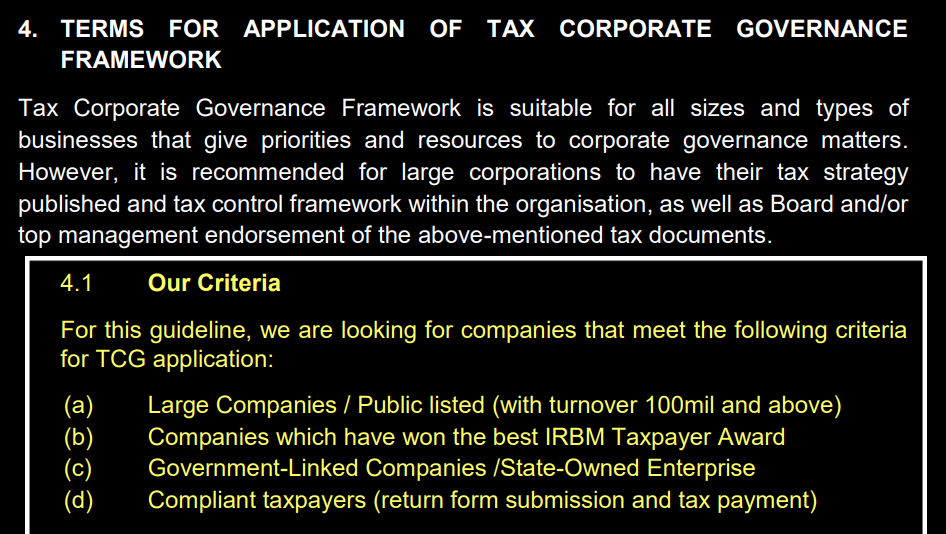
    IRBM has confirmed that other companies, in addition to those mentioned above, are free to come forward voluntarily to apply for and participate in the Tax Corporate Governance Framework (TCGF) Programme.

    Other interested organisations may contact IRBM via [email protected] to communicate their interest or to obtain further information on the Programme.

    Issue No 2 – Application of Tax Corporate Governance

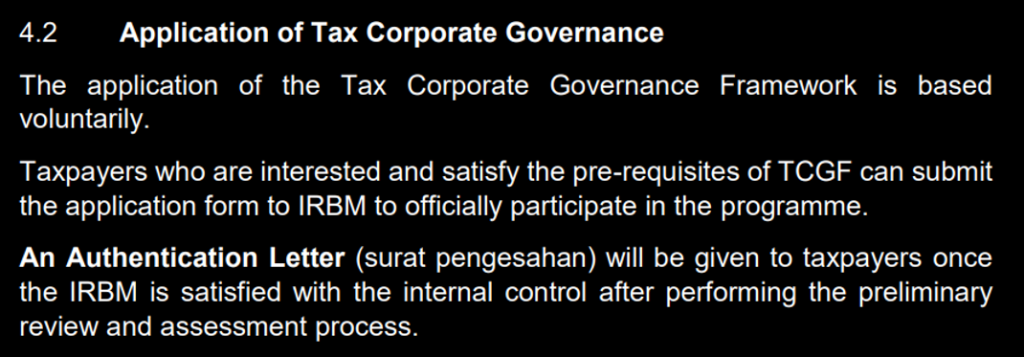
    Refer to paragraph 4.2 of the TCG Framework Guidelines:-
    CTIM members’ comments and requests for clarification:-

    Will the application form to participate in the TCGF Programme be available on the IRBM’s website?

    It is suggested that the IRBM issues a prescribed form for submission by taxpayers to maintain consistency in the applications submitted.

    Please advise the earliest date a taxpayer can apply to participate in the TCGF Programme.

    Is there any deadline to apply?

    It is stated that an authentication letter is given to taxpayers once the IRBM is satisfied with the internal control after performing the preliminary review and assessment process. What is the timeline for the IRBM to issue this letter, and who will conduct the preliminary review and assessment?

    IRBM’s Response:

    A test run of the TCG is being carried out as a pilot project in Malaysia at the moment.

    As a result, an invitation to participate in the programme will be sent from Inland Revenue to the chosen company, and the application form will be made available to them.

    Other interested companies can get in touch with IRBM via [email protected] to express their interest or to gain further information, and notification will only be given to the qualified organisation.

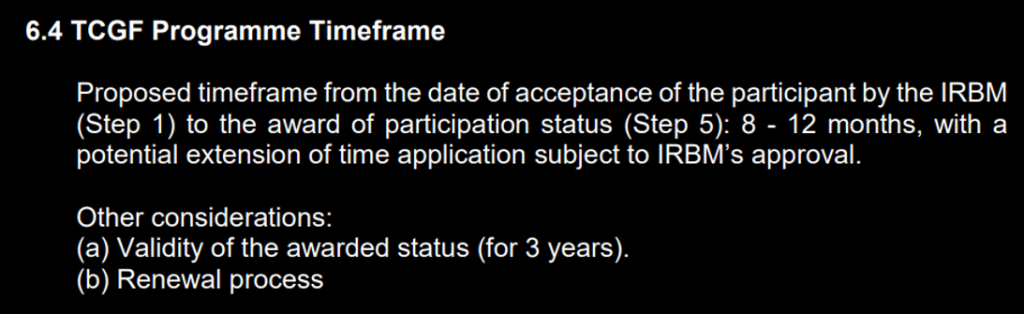
    The framework says that the proposed time frame, which starts when the IRBM accepts the participant as a participant and ends when the participant status is granted, is eight to twelve months.

    A TCG committee will examine this with TCG officers from the branch office.

    Issue No 3 – TCG Review

    Refer to paragraph 9 of the TCG Framework Guidelines:-
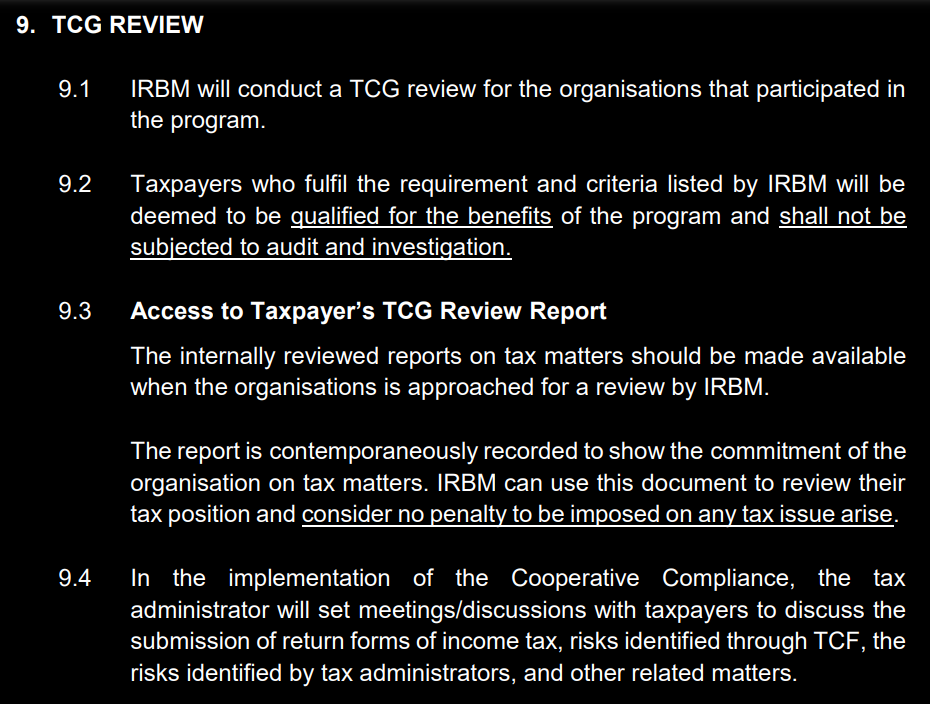
    CTIM members’ comments and requests for clarification:-

    • Please elaborate on the procedures in place to review the TCG. Please also clarify if the TCG will be reviewed by the same IRBM branch which handles the taxpayer’s income tax files.
    • Is there any separate team in the IRBM in charge of the framework? If so, any contact details?
    • Will the review process result in an audit on the taxpayer?
    • Understand that taxpayers who fulfil the requirement and criteria listed by the IRBM will be deemed qualified for the program’s benefits and shall not be subjected to audit and investigation, but for how long (e.g. 3 years, 5 years, etc.) will not be subjected to audit and investigation after the Authentication Letter is issued?
      • Also, please confirm if exclusion from audit and investigation will cover all tax aspects, so long as the framework covers the same taxes, transfer pricing etc.
    • Please confirm that information provided to the IRBM for the purpose of the Programme are strictly confidential and will not be shared with other Government agencies or used against taxpayers to conduct tax audits and investigations.

    IRBM’s Response:

    The TCG review will be conducted by the TCG committee and TCG officers from the branch office, which handles the organisation’s income tax files.

    The IRBM will perform an adequacy review of the organisation’s TCGF and an effectiveness review of the organisation’s tax control framework (TCF).

    Organisations may contact IRBM via [email protected] for any questions regarding TCG Framework and Guidelines.

    The review procedure is primarily for the IRBM to accept the organisation into the programme.

    IRBM will discuss the issues upfront with the organisation if any key tax risk areas are identified during the review.

    Taxpayers that fulfil the requirement will not be subjected to audit and investigation for three (3) assessment years from the date of the award letter. TCGF should be applied comprehensively to collectively enjoy the programme benefit (terms applied).

    The information provided to the IRBM for the purpose of the programme is treated as confidential.

    Issue No 4 – TCG Process

    Refer to paragraph 12 of the TCG Framework Guidelines:-
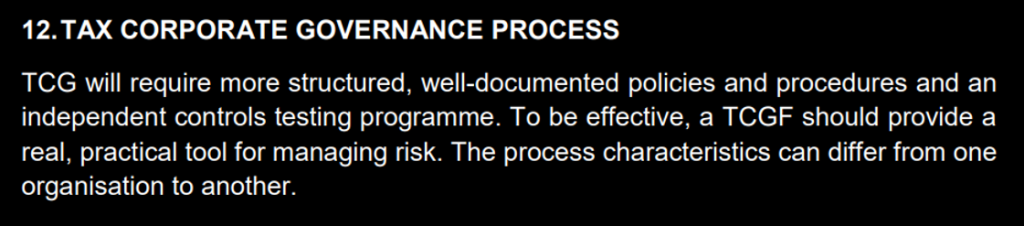
    An approach to implementing tax governance procedures is described in the following process.
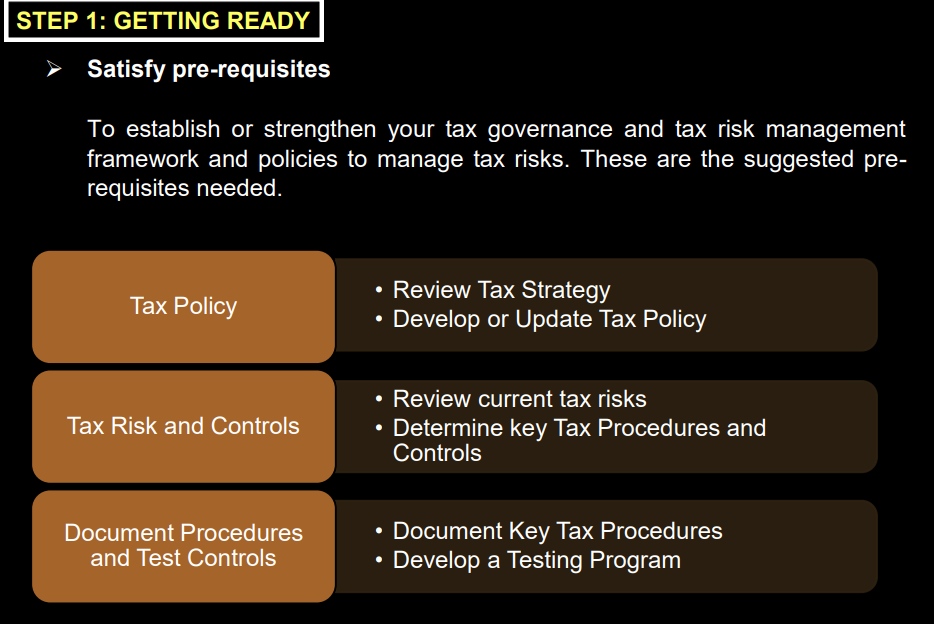
    CTIM members’ comments and requests for clarification:-

    Will thresholds be implemented to determine what constitutes key/material transactions undertaken by the taxpayer (including related party transactions) and thus needs to be specifically addressed in the TCGF in terms of tax risks involved?

    If so, will the threshold be based on absolute value alone as per Paragraph 13.1 of the TCGF Guidelines (or proportion of a certain denominator, e.g. revenue)?

    IRBM’s Response:

    IRBM will not set the thresholds since the organisation may have different needs, sizes and backgrounds. The organisation’s tax control framework shall be able to identify, overcome, control and report tax risks suitable to the organisation’s tax policy/tax strategy and the organisation’s risk appetite.
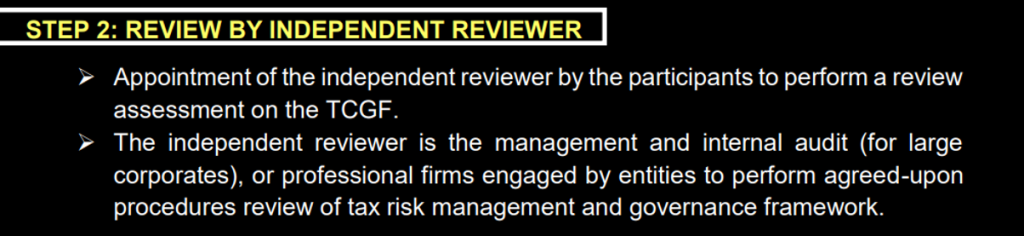
    CTIM members’ comments and requests for clarification:-

    Can an approved tax agent under S.153 of the ITA 1967 undertake this review assessment?

    If the preparation of the TCGF is outsourced to the tax agent, can another entity within the same group act as a tax agent to perform the review (e.g. internal audit service provider)

    IRBM’s Response:

    Yes. An approved tax agent under S.153 of the ITA 1967 can undertake this review assessment. However, for greater independence, the organisation should appoint different parties to perform the review.

    CTIM members’ comments and requests for clarification:-

    Please clarify the methods that will be used by the IRBM to review and evaluate the TCGF. Given that documentation must be made available upon request by the IRBM, please clarify the notice period provided to taxpayers upon the IRBM’s request.

    IRBM’s Response:

    IRBM will perform an adequacy review on the organisation’s TCGF and an effectiveness review on the organisation’s TCF.

    The following methods can be used to check and evaluate TCGF and TCF:

    1. Reperformance
    2. Tests and inspections
    3. Observation d) Questions

    In general, the organisation is responsible for maintaining sufficient documentation to meet the programme’s requirements. We understand that due to certain reasons, the organisation may require more time to prepare the documents.

    Therefore, ample time will be given to the organisation to submit the documentation.

    Issue No 5 – TCGF Programme Timeframe

    Refer to paragraph 6.4 of the TCG Framework:-
    CTIM members’ comments and requests for clarification:-

    We note that upon the award of the participation status in the TCGF Programme, the status is valid for a period of 3 years and renewal is required.

    Please elaborate if taxpayers must undergo Steps 1 to 5 as mentioned in Paragraph 12 of the TCGF Guidelines.

    IRBM’s Response:

    Yes, taxpayers will be required to undergo Steps 1 to 5, as mentioned in Paragraph 12 of the TCGF Guidelines.

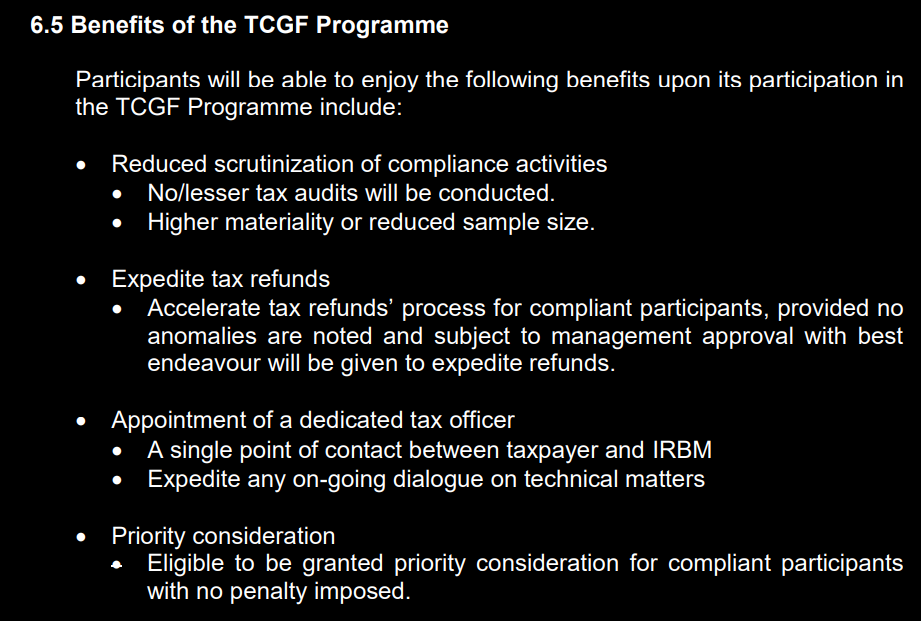
    Issue No 6 – Benefits of the TCGF Programme

    Refer to paragraph 6.5 of the TCG Framework:-
    CTIM members’ comments and requests for clarification:-

    Priority consideration

    • Eligible to be granted priority consideration for compliance participants with no penalty imposed.

    Please elaborate on the benefits available to taxpayers under this category.

    Will taxpayers benefit from reduced penalty rates where there are issues of non-compliance detected?

    If so, please advise the rate of penalty reduction.

    IRBM’s Response:

    The IRBM will assess the reason for non-compliance and see whether sufficient control has been applied at the organisational level for reduced or no penalty consideration.

    The penalty rate will follow the current ruling.

    Issue No 7 – Others

    CTIM members’ comments and requests for clarification:-

    Are there any participation fees charged by the IRBM?

    IRBM’s Response:

    No participation fee is required.

    Our website's articles, templates, and material are solely for reference. Although we make every effort to keep the information up to date and accurate, we make no representations or warranties of any kind, either express or implied, regarding the website or the information, articles, templates, or related graphics that are contained on the website in terms of its completeness, accuracy, reliability, suitability, or availability. Therefore, any reliance on such information is strictly at your own risk.

    Keep in touch with us so that you can receive timely updates |

    要获得即时更新,请与我们保持联系

    1. Website ✍️ https://www.ccs-co.com/ 2. Telegram ✍️ http://bit.ly/YourAuditor 3. Facebook ✍

    4. Blog ✍ https://lnkd.in/e-Pu8_G 5. Google ✍ https://lnkd.in/ehZE6mxy

    6. LinkedIn ✍ https://www.linkedin.com/company/74734209/admin/

    14
  • Identifying the Right Branch for the Taxpayer

    Identifying the Right Branch for the Taxpayer

    On September 27, 2022, the DESIRE Dialogue No.1/2022 was hosted by the Inland Revenue Board of Malaysia (IRBM) in collaboration with the Chartered Tax Institute of Malaysia (CTIM) and other professional organisations to explore concerns about compliance and operations.

    Currently, by typing the SSM incorporation number of a company, the tax agent will be able to obtain the tax file C number of a taxpayer.

    However, tax agents cannot know which Branch this taxpayer belongs to.

    To find out which Branch a taxpayer belongs to, currently, the approach is to either contact the IRBM call centre or email via customer feedback.

    This situation also applies to employer E number filing.

    CTIM comments:

    We would request IRBM to review the above issue.

    IRBM’s response:

    During the process of developing the TAeF2.0 System, proposed enhancements will be taken into consideration.

    Our website's articles, templates, and material are solely for reference. Although we make every effort to keep the information up to date and accurate, we make no representations or warranties of any kind, either express or implied, regarding the website or the information, articles, templates, or related graphics that are contained on the website in terms of its completeness, accuracy, reliability, suitability, or availability. Therefore, any reliance on such information is strictly at your own risk.

    Keep in touch with us so that you can receive timely updates |

    要获得即时更新,请与我们保持联系

    1. Website ✍️ https://www.ccs-co.com/ 2. Telegram ✍️ http://bit.ly/YourAuditor 3. Facebook ✍

    4. Blog ✍ https://lnkd.in/e-Pu8_G 5. Google ✍ https://lnkd.in/ehZE6mxy

    6. LinkedIn ✍ https://www.linkedin.com/company/74734209/admin/

    20
  • Late Payment due to implementation of e-TT System for TT, EFT, and IBG Payment Methods

    Late Payment due to implementation of e-TT System for TT, EFT, and IBG Payment Methods

    On September 27, 2022, the DESIRE Dialogue No.1/2022 was hosted by the Inland Revenue Board of Malaysia (IRBM) in collaboration with the Chartered Tax Institute of Malaysia (CTIM) and other professional organisations to explore concerns about compliance and operations.

    The e-TT system was introduced by the Inland Revenue Board of Malaysia (IRBM) to facilitate tax payment for several types of income tax using Telegraphic Transfer (TT), Electronic Fund Transfer (EFT) and Inter-Bank GIRO (IBG) for both domestic and outside Malaysia taxpayers.

    The system will generate Virtual Account Number (VA) as the unique transaction identification number for each tax payment transaction.

    The system has been available and used since April 1, 2022.

    CTIM comments:

    Introducing the VA account number and closing the existing IRBM bank account has surprised many taxpayers.

    Can IRBM consider a transition period where no penalties are imposed for late payment of taxes made via e-TT (i.e., income taxes, petroleum income taxes, compounds, taxes of public entertainers, withholding tax, RPGT)

    IRBM’s response:

    The IRBM has granted the taxpayer an exemption from the implementation of increases or a late payment tax penalty for all payments received late between April 16 and April 30, 2022.

    Since April 2022 is the first-month e-TT is implemented, any payments made between the 16th and 30th of the same month are granted exemption from imposition of penalty as a concession.

    Our website's articles, templates, and material are solely for reference. Although we make every effort to keep the information up to date and accurate, we make no representations or warranties of any kind, either express or implied, regarding the website or the information, articles, templates, or related graphics that are contained on the website in terms of its completeness, accuracy, reliability, suitability, or availability. Therefore, any reliance on such information is strictly at your own risk.

    Keep in touch with us so that you can receive timely updates |

    要获得即时更新,请与我们保持联系

    1. Website ✍️ https://www.ccs-co.com/ 2. Telegram ✍️ http://bit.ly/YourAuditor 3. Facebook ✍

    4. Blog ✍ https://lnkd.in/e-Pu8_G 5. Google ✍ https://lnkd.in/ehZE6mxy

    6. LinkedIn ✍ https://www.linkedin.com/company/74734209/admin/

    17
  • Declaration Section of Form C Y/A 2022

    Declaration Section of Form C Y/A 2022

    On September 27, 2022, the DESIRE Dialogue No.1/2022 was hosted by the Inland Revenue Board of Malaysia (IRBM) in collaboration with the Chartered Tax Institute of Malaysia (CTIM) and other professional organisations to explore concerns about compliance and operations.

    CTIM comments:

    PEs not registered with the Companies Commission of Malaysia are also required to select in the declaration section of Form C Y/A 2022. Which option should they choose?

    We request IRBM to reconsider options under the “declaration section” of the Form e-C 2022 by including an option under Option 4 that “This return is based on financial statements prepared under any other written law”.

    Concerning a PE which is not registered with the CCM, we understand from the 3rd sentence of IRBM’s response that a PE in Malaysia may submit Form C based on the Head Office audited financial statements prepared under the written law of the respective jurisdiction.

    This shall include a “segment reporting” (i.e., a reporting of the operating segments of a company in the disclosures accompanying its financial statements) on the PE or the financial statements of the PE, which has been audited under the written law of the respective jurisdiction.

    Kindly confirm:

    • In this scenario, the PE may select option 1 in the “declaration section” of Form e-C 2022.
    • In the situation where the financial statements of the PE have not been audited, but the P&L of the PE has been drawn up, and it forms part of the Head Office statutory audited account for the period, the PE may select option 1 in the “declaration section” of Form e-C 2022. Kindly confirm.

    In addition, we would like to request IRBM to include, i.e. the Labuan company incorporated under the Labuan Companies Act 1990, which has elected to be taxed under ITA 1967.

    IRBM’s response:

    PEs not registered with the Companies Commission of Malaysia are not required to submit a tax return form based on audited financial statements since the Income Tax Act of 1967 does not contain a particular provision requiring such reporting. However, to comply with paragraph 82(5) of the Income Tax Act 1967, PE may be compelled to prepare audited financial statements when the tax audit is carried out.

    So, for the purposes of e-C 2022, PE should choose option “2” if they don’t have audited financial statements. Additional options will be considered in the e-C Form 2023.

    The IRBM has also noted the Labuan companies and the requirement for revisions to be incorporated into Form C beginning with the assessment year 2023.

    IRBM also takes note of Labuan companies and the need for amendments to be taken into account in Form C from the assessment year 2023. Companies formed under the Labuan Companies Act of 1990 can also choose how to file in the declaration section. Elections must be made under the act of establishment.

    Our website's articles, templates, and material are solely for reference. Although we make every effort to keep the information up to date and accurate, we make no representations or warranties of any kind, either express or implied, regarding the website or the information, articles, templates, or related graphics that are contained on the website in terms of its completeness, accuracy, reliability, suitability, or availability. Therefore, any reliance on such information is strictly at your own risk.

    Keep in touch with us so that you can receive timely updates |

    要获得即时更新,请与我们保持联系

    1. Website ✍️ https://www.ccs-co.com/ 2. Telegram ✍️ http://bit.ly/YourAuditor 3. Facebook ✍

    4. Blog ✍ https://lnkd.in/e-Pu8_G 5. Google ✍ https://lnkd.in/ehZE6mxy

    6. LinkedIn ✍ https://www.linkedin.com/company/74734209/admin/

    15
  • Submission of Form CP 21/Form CP 22A

    Submission of Form CP 21/Form CP 22A

    On September 27, 2022, the DESIRE Dialogue No.1/2022 was hosted by the Inland Revenue Board of Malaysia (IRBM) in collaboration with the Chartered Tax Institute of Malaysia (CTIM) and other professional organisations to explore concerns about compliance and operations.

    Under Section 83(3) – a notice of cessation of employment (Form CP 22A) must be submitted within 30 days before the date of cessation of employment.

    Under Section 83(4) – the employer is exempted from submitting the notice of cessation if:

    • the employee has been subject to a monthly tax deduction (“PCB“); or
    • the employee’s remuneration is below the taxable thresholds; or
    • the employee will continue working & is not retiring from employment.

    Under Section 83(4) – For foreign leavers, where an employee is about to leave Malaysia for a period exceeding 3 months, the employer is required to furnish Form CP21 not less than 30 days before the expected date of the employee’s departure.

    Where applicable, failure to submit the notice of cessation would mean that the employer is liable to a fine of not less than RM200 and not more than RM20,000 or to imprisonment for a term not exceeding six months or to both.

    Form CP 21

    Previously, in practice, IRBM was not strict with the 30 days notice period before the employee’s departure. In recent times, IRBM has been imposing a fine for every Form CP21, which is late.

    The IRBM has also revisited Forms CP 21 submitted in the earlier assessment years to impose fines.

    CTIM comments:

    We want to request whether IRBM can consider adopting the imposition of the fine for late submission of Form CP 21 for taxpayers with valid reasons.

    Sometimes, the employer may not be aware that the employee (expatriate) will be transferred to another location until the very last minute.

    IRBM’s response:

    Based on the scenario, the employer needs to submit supporting documents to the branch handling the employer’s file to appeal the penalty that has been imposed.

    Form CP 22A

    Where the exemption from notification is applicable, the employer would not have submitted Form CP 22A for local leaver cases.

    However, there are cases where the employee meets the exemption requirement at the cessation time but subsequently decides to leave the workforce.

    In such cases, IRBM has imposed fines on the employer for failure to notify the IRBM.

    CTIM comments:

    We want to request whether IRBM can consider not imposing fines as long as the employer can show signed confirmation from the employee that the individual intends to continue being employed.

    Often, an exiting employee may not be transparent with the employer.

    IRBM’s response:

    If penalties are imposed for failure to submit Form CP 22A, IRBM agrees that the employer submits the employee’s verification documents to prove that he is about to work for the new employer.

    References

    Our website's articles, templates, and material are solely for reference. Although we make every effort to keep the information up to date and accurate, we make no representations or warranties of any kind, either express or implied, regarding the website or the information, articles, templates, or related graphics that are contained on the website in terms of its completeness, accuracy, reliability, suitability, or availability. Therefore, any reliance on such information is strictly at your own risk.

    Keep in touch with us so that you can receive timely updates |

    要获得即时更新,请与我们保持联系

    1. Website ✍️ https://www.ccs-co.com/ 2. Telegram ✍️ http://bit.ly/YourAuditor 3. Facebook ✍

    4. Blog ✍ https://lnkd.in/e-Pu8_G 5. Google ✍ https://lnkd.in/ehZE6mxy

    6. LinkedIn ✍ https://www.linkedin.com/company/74734209/admin/

    21
  • IRBM’s Response to Clarification Sought on Item F9 of the Form e-C 2022

    IRBM’s Response to Clarification Sought on Item F9 of the Form e-C 2022

    The income tax exemption on FSI received by any person (other than a resident company engaging in banking, insurance, or sea or air transport) was removed for all Malaysian-resident taxpayers from January 1, 2022, following the Finance Act 2021.

    As a result, the Inland Revenue Board (IRB) has amended the Corporate Income Tax Return (Form C) for the year of assessment (YA) 2022.

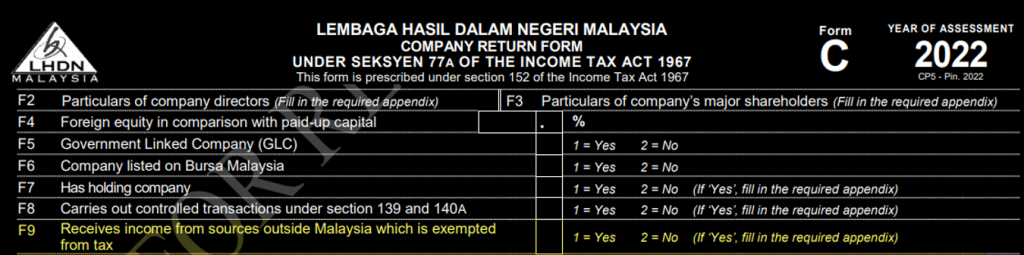
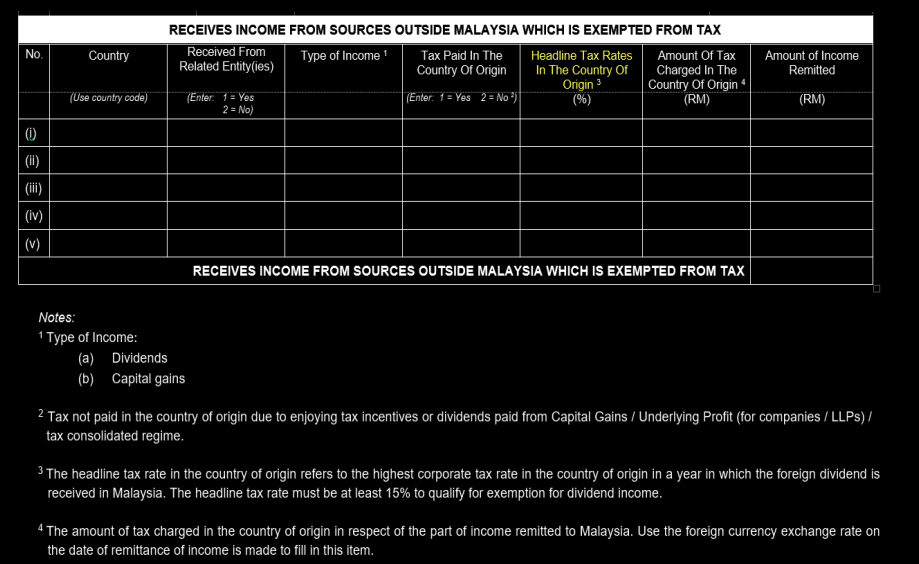
    One of the most important amendments is the addition of a column (item F9) that asks, “Does the company receives income from sources outside Malaysia which is exempted from tax?”

    The taxpayer must now enter:

    • ‘1’ in the box for ‘Yes’ if the company receives income from sources outside Malaysia exempted from tax and complete other information as required in the appendix.
    • ‘2’ in the box for ‘No’ if not relevant.

    IRBM’s Response to Clarification Sought

    The Inland Revenue Board of Malaysia (IRBM) Operations Department has recently clarified the following concerning the completion of item F9 in Form e-C 2022:-

    • Foreign-sourced income received in Malaysia in the 2022 basis period before 1 January 2022 must be included in item F9.
      • Example: Basis period before 1 January 2022
        • A Malaysian resident company with a basis period ending 31 March 2022 also needs to include foreign-sourced income it received in Malaysia from 1 April 2021 to 31 December 2021 in item F9 of Form C 2022.
    • Information on “Headline Tax Rates In The Country Of Origin (%)” and “Amount Of Tax Charged In The Country Of Origin” (RM) is non-mandatory in respect of foreign-sourced income received in Malaysia before 1 January 2022.
    • However, IRBM encourages taxpayers to fill it out if taxpayers have the information, even though it is non-mandatory.
    Our website's articles, templates, and material are solely for reference. Although we make every effort to keep the information up to date and accurate, we make no representations or warranties of any kind, either express or implied, regarding the website or the information, articles, templates, or related graphics that are contained on the website in terms of its completeness, accuracy, reliability, suitability, or availability. Therefore, any reliance on such information is strictly at your own risk.

    Keep in touch with us so that you can receive timely updates |

    要获得即时更新,请与我们保持联系

    1. Website ✍️ https://www.ccs-co.com/ 2. Telegram ✍️ http://bit.ly/YourAuditor 3. Facebook ✍

    4. Blog ✍ https://lnkd.in/e-Pu8_G 5. Google ✍ https://lnkd.in/ehZE6mxy

    6. LinkedIn ✍ https://www.linkedin.com/company/74734209/admin/

    15
  • Revised Special Guidelines: Income Tax Deduction for Community/Charity Projects to curb Covid-19

    Revised Special Guidelines: Income Tax Deduction for Community/Charity Projects to curb Covid-19

    The announcement that contributions (in cash or in-kind) to overcome the COVID-19 outbreak is allowed for deduction under s 34(6)(h) of the Income Tax Act was made by the Government on March 23, 2020.

    A guideline was then issued by the Ministry of Finance (MOF) to explain the conditions and procedures in such claims.

    Further, donations made to vaccination centres (PPVs) would be eligible for tax deductions under the provisions of the National People’s Well-Being and Economic Recovery Package (PEMULIH).

    As a result of this announcement, the guideline issued by the MOF was updated on 2 August 2021 to include contributions to PPVs under s 34(6)(h).

    The Ministry of Finance (MOF) has revised the guidelines published on its website on April 1, 2022, regarding Income Tax Deduction for Community/Charity Projects to curb Covid-19 under Section 34(6)(h) of the Income Tax Act.

    The Guidelines are in Bahasa Malaysia and are named “Garis Panduan Khas Permohonan Potongan Cukai Bagi Projek Komunity/Amal untuk Menangani Wabak Covid-19” (Guidelines).

    The Guidelines can be found here:-

    The Guidelines apply to contributions made from April 1, 2022, to December 31, 2022.

    Key Updates

    1. Qualifying contributions

    Under the Revised Special Guidelines, Qualifying contributions are now limited to:-

    • Equipment – ventilators, beds, air-conditioners and air purifier/filtration
    • Consumables – masks, hand sanitisers, gloves, test kits and personal protective equipment

    Under the revised Special Guidelines, the following are no longer considered qualifying contributions and have been taken off the list of qualifying contributions:

    • Cash
    • Raw food ingredients and ready-to-eat foods
    • Sanitisation services, provision of portable toilets, costs of delivery of supplies
    • Sponsorships such as the provision of permanent or temporary site infrastructure (e.g. marquee tents)
    • Provision of COVID-1 9 vaccination facilities such as halls, equipment and supplies in respect of PPVs

    2. Qualifying Recipients

    Under the Revised Special Guidelines, the donees are restricted to the following:

    • Government departments//agencies
    • Public hospitals
    • Public schools

    Under the revised Special Guidelines, the following recipients who were once eligible to get donations are no longer on the list:

    • Registered non-governmental agencies which are not profit oriented or politically affiliated
    • Private hospitals
    • Universities and educational institutions
    • PPVs throughout the country which are managed by the COVID-19 Immunisation Task Force (CITF) or private sectors with the approval of CITF

    Effective Date

    These guidelines apply to donations made to community or charity projects to combat the spread of the COVID-19 outbreak during the period beginning in February 2020 and ending on December 31, 2022, or until the outbreak of COVID-19 is declared over by the World Health Organisation (WHO), whichever comes first

    Tax deduction claims can be claimed from the assessment year 2020 and are applicable for the assessment year the contribution is made.

    Our website's articles, templates, and material are solely for reference. Although we make every effort to keep the information up to date and accurate, we make no representations or warranties of any kind, either express or implied, regarding the website or the information, articles, templates, or related graphics that are contained on the website in terms of its completeness, accuracy, reliability, suitability, or availability. Therefore, any reliance on such information is strictly at your own risk.

    Keep in touch with us so that you can receive timely updates |

    要获得即时更新,请与我们保持联系

    1. Website ✍️ https://www.ccs-co.com/ 2. Telegram ✍️ http://bit.ly/YourAuditor 3. Facebook ✍

    4. Blog ✍ https://lnkd.in/e-Pu8_G 5. Google ✍ https://lnkd.in/ehZE6mxy

    6. LinkedIn ✍ https://www.linkedin.com/company/74734209/admin/

    17
  • Revised Guidelines on the Application for Approval under Section 44(11C)

    Revised Guidelines on the Application for Approval under Section 44(11C)

    The Ministry of Finance (MOF) has updated the guidelines published on its website on April 1, 2022, regarding the application for approval of COVID-19 Relief Funds under Section 44(11C) of the Income Tax Act.

    The Guidelines are in Bahasa Malaysia and are named “Garis Panduan Permohonan Untuk Kelulusan Di Bawah Subseksyen 44(11C), Akta Cukai Pendapatan 1967 Bagi Tabung Relif COVID-19” (Guidelines).

    The Guidelines can be found here:-

    The revised Guidelines, effective from 1 April 2022 to 31 December 2022, much like the earlier Guidelines, offer direction on the process that must be followed and the requirements that must be met to acquire the approval specified before the formation of COVID-19 Relief Funds.

    Key Updates

    1. Qualified Contributions

    Under the Revised Guidelines, Contributions to the COVID-19 Relief Fund that will currently be accepted are limited to the following categories only:

    • Cash
    • Equipment (e.g., ventilators, patient beds, air conditioners, air purifiers or filtration equipment)
    • Consumables (e.g., masks, hand sanitisers, gloves, test kits and PPE)

    In the previous Guidelines, the following were also considered to be contributions that qualified:

    • Fresh or ready-to-eat food (e.g., rice, oil, sauces, sugar, canned food etc.)
    • Services (e.g., cost of disinfection and sanitisation (of roads, buildings, markets, places of worship etc.), portable toilets and delivery of supplies)
    • Sponsorships (e.g., provision of permanent or temporary infrastructure such as tents or marquee tents)

    2. Qualifying Recipients

    Under the Revised Guidelines, Qualifying recipients from the COVID-19 Relief Fund are now restricted to the following:

    • Government departments or agencies
    • Non-governmental agencies that are registered with the Companies Commission of Malaysia, Registrar of Societies or Legal Affairs Division of the Prime Minister’s Department
    • Government hospitals
    • Government schools
    • Orphanages, old folks’ homes or homes for people with disabilities
    • Homeless, hardcore poor or refugees
    • Animal shelters or zoos

    In the previous Guidelines, qualifying recipients also included the following:

    – Private hospitals

    – Public universities

    Application

    Applications for the establishment of the COVID-19 Relief Fund must be filed between the 30th of April 2020 and the 31st of December 2022, or the day the pandemic is deemed to have ended by the WHO, whichever comes first.

    Our website's articles, templates, and material are solely for reference. Although we make every effort to keep the information up to date and accurate, we make no representations or warranties of any kind, either express or implied, regarding the website or the information, articles, templates, or related graphics that are contained on the website in terms of its completeness, accuracy, reliability, suitability, or availability. Therefore, any reliance on such information is strictly at your own risk.

    Keep in touch with us so that you can receive timely updates |

    要获得即时更新,请与我们保持联系

    1. Website ✍️ https://www.ccs-co.com/ 2. Telegram ✍️ http://bit.ly/YourAuditor 3. Facebook ✍

    4. Blog ✍ https://lnkd.in/e-Pu8_G 5. Google ✍ https://lnkd.in/ehZE6mxy

    6. LinkedIn ✍ https://www.linkedin.com/company/74734209/admin/

    15
  • Electronic Submission of Information requested by the IRB during an Audit

    Electronic Submission of Information requested by the IRB during an Audit

    On September 27, 2022, the DESIRE Dialogue No.1/2022 was hosted by the Inland Revenue Board of Malaysia (IRBM) in collaboration with the Chartered Tax Institute of Malaysia (CTIM) and other professional organisations to explore concerns about compliance and operations.

    It is noted that while submitting the information requested to the IRB via e-mail is preferred, the issue still persists that the IRB officer’s email account has a certain size limit (i.e. each email should not exceed 15 MB).

    Consequently, the information emailed to the IRB has to be emailed over in several batches (which takes up unnecessary time).

    Sometimes, this can mean sending over a dozen emails to the IRB officer.

    Tax Practitioners have cases whereby the IRB officer suggested that the information be emailed to them using their personal email account to circumvent this email size issue.

    However, this method is not preferred as it is not safeguarding the confidentiality of the taxpayer’s information.

    Some officers suggested the use of saving the information onto a USB pen drive, or alternatively,

    It is noted that while submission of the information requested to the IRB via e-mail is preferred, the issue still persists that the IRB officer’s email account has a certain size limit (i.e. each email should not exceed 15 MB).

    Consequently, the information emailed to the IRB has to be emailed over in several batches (which takes up unnecessary time).

    Sometimes, this can mean sending over a dozen emails to the IRB officer.

    We have cases whereby the IRB officer suggested for the information be emailed to them using their personal email account to circumvent this email size issue.

    However, this method is not preferred as it is not safeguarding the confidentiality of the taxpayer’s information.

    Some officers suggested the use of saving the information onto a USB pen drive or, alternatively.

    CTIM comments:

    To ease the submission of the information requested by the IRB via electronic means, while ensuring that taxpayer information is safeguarded, we would suggest for the IRB consider not having an email size limit so that information can be emailed to the IRB in one go.

    IRBM’s response:

    The upload capability for tax audit supporting documents through MITRS platform is now in its last stage of development at IRBM.

    It is anticipated that it will be ready for use by November 2022.

    At this juncture, IRBM will make use of the IRBM OneDrive platform to make it possible for taxpayers or tax agents to submit the document that was requested by the tax audit officer.

    The tax audit officer will provide the taxpayers with a link to use to upload documents (based on an application from the taxpayer if the taxpayer experiences difficulty in submitting the document in big size).

    Our website's articles, templates, and material are solely for reference. Although we make every effort to keep the information up to date and accurate, we make no representations or warranties of any kind, either express or implied, regarding the website or the information, articles, templates, or related graphics that are contained on the website in terms of its completeness, accuracy, reliability, suitability, or availability. Therefore, any reliance on such information is strictly at your own risk.

    Keep in touch with us so that you can receive timely updates |

    要获得即时更新,请与我们保持联系

    1. Website ✍️ https://www.ccs-co.com/ 2. Telegram ✍️ http://bit.ly/YourAuditor 3. Facebook ✍

    4. Blog ✍ https://lnkd.in/e-Pu8_G 5. Google ✍ https://lnkd.in/ehZE6mxy

    6. LinkedIn ✍ https://www.linkedin.com/company/74734209/admin/

    23