Day: October 3, 2022

  • Form C YA 2022: Cash Pooling Arrangements and  Transfer Pricing

    Form C YA 2022: Cash Pooling Arrangements and Transfer Pricing

    Recent changes to the Form C

    Recent changes were made to Form C by the Inland Revenue Board in preparation for the YA 2022. One of the most critical changes is for those businesses participating in transfer pricing arrangements. As a result, the disclosure items have been significantly expanded to cover new areas.

    These new areas include stating the characterisation of your company by reference to its functional profile, the business restructuring undertaken by the group during the year, and whether or not your company engages in cash pooling activities, performs any research and development activities or owns any intellectual properties.

    Transfer Pricing Guidance on Financial Transactions

    Transfer Pricing Guidance on Financial Transactions (“Guidance”) was released by the Organization for Economic Cooperation and Development (“OECD”) in February 2020.

    The Guidance is essential because it is the first time the OECD’s Transfer Pricing Guidelines have been updated to include guidance on on the transfer pricing aspects of financial transactions, which should contribute to consistency in the application of transfer pricing and help avoid transfer pricing disputes and double taxation.

    It also guided on specific issues relating to the pricing of Treasury Functions (Intra-Group Loans, cash pooling, Hedging), Financial Guarantees and Captive Insurance.

    Cash Management

    As we saw a few years ago, at the start of the Covid-19 crisis, liquidity and cash management are becoming increasingly important.

    Benefits of Cash Management

    • Making sure that each company’s liquidity needs, as well as its surpluses, are managed more effectively
    • lowering the total amount of debt that is due in the short term
    • Increasing capacity for self-financing and decreasing reliance on external funding
    • Obtaining more favourable interest rates from the bank as a result of increased volume
    • Providing enhanced visibility of the cash flow position at each entity and a consolidated group perspective to facilitate the making of choices regarding financing and investments.
    • Ensuring better liquidity risk management

    Cash Pooling is a cash management technique that allows a business group of different companies to manage their cash.

    So, what is “pooling cash“?

    This article tells you everything you need to know.

    What is Cash Pooling?

    Even if the group is financially healthy, some parts may have cash flow problems and need to use expensive short-term cash flow financing options like high-interest loans, overdrafts with fees or bank commissions, etc.

    At the same time, some of the group’s entities may have extra cash that just sits in their accounts and doesn’t do much.

    The idea behind cash pooling is to manage cash flow through the holding company and ensure all of the subsidiaries’ bank accounts are in a healthy balance.

    Cash Pooling solves this problem:

    If there is a cash deficit, cash pooling lets the group help those subsidiaries in difficulty and limit banking charges

    If there is a cash surplus, the group is able to capitalise on all of the profits from each subsidiary thanks to cash pooling, which allows for better investments to be made and an increase in interest.

    Cash Pooling Structures

    The use of a cash pool is popular among multinational enterprises as a way of achieving more efficient cash management; there are different ways to pool cash, such as:

    • “physical cash pooling”,; and
    • “notional cash pooling.”

    In a typical Physical Cash Pooling arrangement, the bank account balances of all the pool members are transferred daily to a single central bank account owned by the cash pool leader.

    In the case of a Notional Cash Pool, some of the advantages that come with combining the credit and debit balances of many accounts can be realised, even though there is no actual transfer of amounts taking place between the accounts of the participating members.

    Example of Notional Cash Pooling

    The bank calculates the lending and borrowing interest that would have been received for the notional offset position: this corresponds to the sum of (RM15-RM20-RM10) for RM5.

    Transfer Pricing of Cash Pooling Arrangements

    Generally speaking, cash pooling is implemented mostly by large corporate groups because it requires a certain level of structuring and in-house resources; however, it can be used by any group of several companies.

    The holding company or parent company acts as a cash pool leader (or “Central Strategic Unit”) that distributes liquidity to serve the interests of each subsidiary better.

    Hence, cash pooling arrangements are complex contracts that may involve controlled and uncontrolled transactions.

    Form C Requires Additional Disclosures

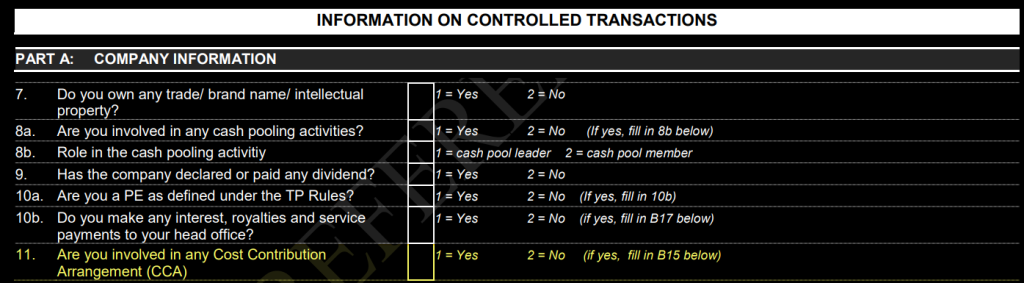
    According to the information provided in Section A of the Appendix of Form C for YA 2022, taxpayers who carry out controlled transactions under sections 139 and 140A must disclose: Are they involved in any cash pooling activities?

    If the answer to the above question is affirmative, further disclose their Role in the cash pooling activities.

    Role in the Cash Pooling Activity

    Cash Pool Leader (The Holding Company)

    A cash pool leader performs no more than a coordination or agency function, with the master account being a centralised point for a series of book entries to meet the pre-determined target balances for the pool members.

    Given such a low level of functionality, the cash pool leader’s remuneration as a service provider will generally be similarly limited.

    Cash Pool Member

    A cash pool member is likely to be participating in providing liquidity as part of a broader group strategy, an arrangement in which the member can have a credit or debit position, which may include among its aims a range of benefits that can only be achieved as part of a collective strategy involving the pool members, done for the benefit of all of the pool participants, and the membership of which is limited to entities within the MNE group.

    Pool participants deposit cash to the pool (or withdraw cash from the pool), not to (or from) a particular cash pool member.

    Transfer Pricing if the Positions of Debt or Receivable become Long-Term

    If cash is deposited or borrowed, and this intra-group transaction subsequently becomes a long-term position, special attention should be paid to the conditions.

    When looking at this situation from the point of view of transfer pricing, the question that needs to be answered is whether or not the transaction is genuinely something other than efficient short-term liquidity management.

    If it is determined that there was, in fact, a long-term loan (or receivable), then the subsequent review of the price based on arm’s-length transactions needs to be based on that decision.

    Our website's articles, templates, and material are solely for reference. Although we make every effort to keep the information up to date and accurate, we make no representations or warranties of any kind, either express or implied, regarding the website or the information, articles, templates, or related graphics that are contained on the website in terms of its completeness, accuracy, reliability, suitability, or availability. Any reliance on such information is therefore strictly at your own risk.

    Keep in touch with us so that you can receive timely updates |

    要获得即时更新,请与我们保持联系

    1. Website ✍️ https://www.ccs-co.com/ 2. Telegram ✍️ http://bit.ly/YourAuditor 3. Facebook ✍

    4. Blog ✍ https://lnkd.in/e-Pu8_G 5. Google ✍ https://lnkd.in/ehZE6mxy

    6. LinkedIn ✍ https://www.linkedin.com/company/74734209/admin/

    18
  • Form C YA 2022: Involved in Cost Contribution Agreement?

    Form C YA 2022: Involved in Cost Contribution Agreement?

    Recent changes to the Form C

    Recent changes were made to Form C by the Inland Revenue Board in preparation for the YA 2022.

    One of the most critical changes is for those businesses participating in transfer pricing arrangements. As a result, the disclosure items have been significantly expanded to cover new areas.

    These new areas include stating the characterisation of your company by reference to its functional profile, the business restructuring undertaken by the group during the year, and whether or not your company engages in cash pooling activities, performs any research and development activities, owns any intellectual properties, or participation in cost contribution arrangements,

    Concept of Cost Contribution Arrangements (CCAs)

    The Malaysian Transfer Pricing Guidelines explain:

    A CCA is a framework (in the form of a contractual agreement) agreed upon among business enterprises to share the costs and risks of developing, producing or obtaining assets, services or rights and to determine the nature and extent of the interests of each participant in those assets, services or rights.

    • Each participant’s proportionate share of the overall contributions to the arrangement will be consistent with the participant’s proportionate share of the overall expected benefits to be received under the arrangement.
    • The participant would be entitled to exploit its interest in the CCA separately as an effective owner, not a licensee.
    • Where a taxpayer enters into a CCA with its associated persons, the arrangement should reflect that of an arm’s length arrangement.

    In General

    In a cost contribution agreement, the participants share the contributions and risks involved in an endeavour.

    Types of CCAs

    Two types of CCAs are commonly encountered:

    • those established for the joint development, enhancement, maintenance, protection or exploitation of intangibles or tangible assets (“development CCAs”); and
    • those for obtaining services (“services CCAs”).

    While each particular CCA should be considered on its own facts and circumstances, a key difference between these two types of CCAs will often be that the former are expected to create ongoing, future benefits for participants. In contrast, the latter will often create current benefits only.

    The characteristics of a CCA

    • the arrangement is made between at least two related parties,
    • each party’s responsibility for the costs is defined by a formula that the parties have agreed on, and
    • each party’s share of the costs must reflect its share of the overall expected benefits to be received under the arrangement.

    Example

    In Year 1, a multinational group comprised of Company A and Company B decided to develop an intangible, which is anticipated to be highly profitable based on Company B’s existing intangibles, its track record and its experienced research and development staff.

    Company A performs, through its own personnel, all the functions expected from an independent entity providing funding for a research and development project:

    • including the analysis of the intangible at stake and the anticipated profits that can be derived from the investment, the evaluation of the funding risk,
    • including the risk that further investment may be required to complete the project, and of the capacity of Company A to take that risk, and the making of decisions to bear, cover, or mitigate that risk.

    The particular intangible in this example is expected to take five years to develop before possible commercial exploitation. If successful is anticipated to have value for 10 years after initial exploitation.

    Company A and Company B decide to undertake the development through a CCA.

    Under the CCA:

    • Company A will provide all funding associated with the intangible development (the development costs are anticipated to be RM100 million per year for 5 years).
    • Company B will contribute to using its existing intangibles and will perform and control all activities related to the development, maintenance, and exploitation of the intangible.

    Form C Requires Additional Disclosures

    According to the information provided in Section A of the Appendix of Form C for YA 2022, taxpayers who carry out controlled transactions under sections 139 and 140A must disclose: Are they involved in any Cost contribution arrangement (CCA)?

    Enter ‘1’ if they are involved in any CCA and disclose the amounts in B15.

    Enter ‘2’ if they are not involved in any CCA, or it’s not relevant.

    Our website's articles, templates, and material are solely for reference. Although we make every effort to keep the information up to date and accurate, we make no representations or warranties of any kind, either express or implied, regarding the website or the information, articles, templates, or related graphics that are contained on the website in terms of its completeness, accuracy, reliability, suitability, or availability. Any reliance on such information is therefore strictly at your own risk.

    Keep in touch with us so that you can receive timely updates |

    要获得即时更新,请与我们保持联系

    1. Website ✍️ https://www.ccs-co.com/ 2. Telegram ✍️ http://bit.ly/YourAuditor 3. Facebook ✍

    4. Blog ✍ https://lnkd.in/e-Pu8_G 5. Google ✍ https://lnkd.in/ehZE6mxy

    6. LinkedIn ✍ https://www.linkedin.com/company/74734209/admin/

    22
  • Form C YA 2022: Are you a Permanent Establishment (PE) as defined under the TP Rules?

    Form C YA 2022: Are you a Permanent Establishment (PE) as defined under the TP Rules?

    Derivation of income under s 12 of the Income Tax Act 1967

    The circumstances under which business income would be considered to be derived from Malaysia and so taxed in Malaysia are outlined in Section 12 of the Income Tax Act 1967 (ITA).

    To complement Section 12, the Income Tax Act was updated with new sections 12(3) and 12(4) by the Finance Act 2018.

    Beginning on December 28, 2018, these new provisions took effect.

    According to the provisions of Section 12(3), a person is considered to have derived their business income from Malaysia if such revenue is attributable to a “Place of Business” located in Malaysia.

    Section 12(4) clarifies the meaning and provides examples of what constitutes a place of business.

    Guidelines On The Application Of Subsections 12(3) And 12(4) Of The Income Tax Act 1967 In Determining A “Place Of Business”

    Guidelines were published on the website of the Inland Revenue Board (IRB) on May 21, 2020.

    The title of the guidelines was “Guidelines on the application of Subsections 12(3) and 12(4) of the Income Tax Act 1967 in determining a “Place of Business” (Guidelines).

    These guidelines were issued concerning the provisions that were discussed above.

    In addition, the Guidelines include nine examples for readers to refer to.

    You are strongly encouraged to read the entire Guidelines to obtain all the relevant information.

    Guidelines on the application of Subsections 12(3) and 12(4) of the Income Tax Act 1967 in determining a “Place of Business

    Recent changes to the Form C

    Recent changes were made to Form C by the Inland Revenue Board in preparation for the YA 2022.

    One of the most critical changes is for those businesses participating in transfer pricing arrangements.

    As a result, the disclosure items have been significantly expanded to cover new areas.

    These new areas include stating the characterisation of your company by reference to its functional profile and the business restructuring undertaken by the group during the year.

    Other disclosures incorporated into the new Form C include cash pooling, permanent establishments (PEs), dividend declarations and payments, cost contribution arrangements, and others.

    Permanent Establishments

    Regarding Permanent Establishments (PEs), the taxpayer is responsible for conducting a careful analysis to determine whether or not any of its activities result in a PE for a foreign entity.

    If so, this may affect the disclosures that are required to be included in the updated Form C. Taxpayers must disclose whether they have made any interest, royalties and service payments to their head office.

    Concept of Permanent Establishment

    The definition of a permanent establishment, on the face of it, would require the existence of a fixed place of business.

    However, a permanent establishment may be deemed to exist despite the absence of a physical fixed place of business.

    For example, in the absence of employees or distinct premises, in the taxing country.

    Case Law:

    • In a Belgian case, according to the decision of the Supreme Court, a permanent establishment in Belgium may exist whether or not the taxpayer has a representative or an employee there.
      • Thus, foreign enterprises owned immovable; leased properties were considered fixed installations producing income and, therefore, permanent establishments (État belge v Société de Gestion).
    • In an American case, A Swiss resident was found to be doing business in the U.S. through a permanent establishment as he and specially trained employees travelled around the states showing and selling logging equipment he manufactured.
      • This was a constructive activity in the States, and the inference was that the use of equipment in material proportions might be a permanent establishment even if no actual fixed place of business existed.

    Fixed Place of Business Permanent Establishment

    The term “permanent establishment” means a fixed place of business in which the company or the enterprise is wholly or partly carried on and shall include especially:

    • a place of management;
    • a branch;
    • an office;
    • a factory;
    • a workshop;
    • a mine, oil well, quarry or other place of extraction of natural resources;
    • a building site or installation or construction or assembly project;
    • a farm or plantation;
    • a place of extraction of timber or forest produce.

    In general, therefore, a permanent establishment will usually exist in Malaysia where:

    • there is a continuity of activity in Malaysia; and
    • there is active conduct of business in Malaysia.

    Example

    Most fashion companies have headquarters in their home country, but their factories are usually in a different country.

    Since the fashion companies operate in the foreign host country and generate revenue there, the company will be subject to different taxation requirements in each territory.

    Position in Malaysia

    A person shall also be deemed to have a place of business in Malaysia if the person undertakes any of the following:

    • carries on supervisory activities in connection with a building or work site, or construction, an installation or an assembly project, or
    • has another person acting on his behalf who
      • habitually concludes contracts, or habitually plays the principal role leading to the conclusion of contracts that are routinely concluded without material modification
      • habitually maintains a stock of goods or merchandise in that place of business from which such person delivers goods or merchandise, or
      • regularly fills orders on his behalf.

    In general, in the Double Taxation Agreements entered into by Malaysia, when the activities of the foreign enterprise are auxiliary or preparatory concerning a business, such activities should not be viewed as a permanent establishment, even when conducted through a fixed place.

    This is consistent with the approach adopted in the “permanent establishment” Article 5 of the Organisation for Economic Cooperation and Development Model Treaty.

    Article 5 of the Organisation for Economic Cooperation and Development Model Treaty.

    For example:

    An office of a resident of a contracting state in Malaysia which is used solely for the purchase of goods (i.e. a cost centre) does not constitute a permanent establishment in Malaysia (e.g. Article 5 of the Double Taxation Agreements between Malaysia and the Netherlands, Malaysia and Singapore, Malaysia and the United Kingdom).

    But the position may be different, however, if such an establishment is also a sorting, packing or grading office.

    Our website's articles, templates, and material are solely for reference. Although we make every effort to keep the information up to date and accurate, we make no representations or warranties of any kind, either express or implied, regarding the website or the information, articles, templates, or related graphics that are contained on the website in terms of its completeness, accuracy, reliability, suitability, or availability. Any reliance on such information is therefore strictly at your own risk.

    Keep in touch with us so that you can receive timely updates |

    要获得即时更新,请与我们保持联系

    1. Website ✍️ https://www.ccs-co.com/ 2. Telegram ✍️ http://bit.ly/YourAuditor 3. Facebook ✍

    4. Blog ✍ https://lnkd.in/e-Pu8_G 5. Google ✍ https://lnkd.in/ehZE6mxy

    6. LinkedIn ✍ https://www.linkedin.com/company/74734209/admin/

    21