
Day: June 12, 2022

  • LLP or Sdn Bhd: What Would Work Best for You? | 那个比较适合我?

    LLP or Sdn Bhd: What Would Work Best for You? | 那个比较适合我?

    Preface

    One of the thoughts that may be going through the minds of those who are considering venturing out on your own and launching your own company is the following: “Exactly what type of business should you register?“

    前言

    对于那些正在考虑创业并创办自己的公司的人来说,他们心中可能会有这样的想法。”到底应该注册什么类型的公司?”

    It is essential to set up your company following the primary categories of companies found in Malaysia. This is because operating an unregistered business can result in monetary penalties or even incarceration, in addition to the problem of having trouble obtaining loans from financial institutions.

    Let us now look at the common types of businesses in Malaysia:-

    • A Company that has been established under the Companies Act 2016,
    • A Sole Proprietorship (An unincorporated business)
    • Conventional Partnership (An unincorporated partnership)
    • A Limited Liability Partnership (LLP) that has been registered under the Limited Liability Partnerships Act 2012

    按照马来西亚现有的主要企业类型去成立你的公司是至关重要的事,这是因为经营未注册的企业,除了可能会导致被罚款或被处于坐牢之外;也面对难以向金融机构申请贷款的窘境。

    现在让我们看看马来西亚常见的企业类型:

    • 根据《2016年公司法令》成立的公司;
    • 独资企业(非法人企业);
    • 传统的合伙企业(非法人合伙企业);
    • 根据《2012年有限责任合伙法令》注册的有限责任合伙公司(LLP)。

    Many choices are available to us, but how can we decide which path to take?

    In this article, we won’t spend much time commenting on the similarities or differences between them; we will compare and contrast the use of Sdn Bhd, a private company that is limited by shares (Sendirian Berhad) and LLP so that you can see which option is best for your business.

    我们有许多选择,但该如何做选择呢?

    在这篇文章中,我们不会花太多时间评论它们之间的异同;我们将比较和对比有限责任合伙公司(LLP)及私人股份有限公司(Sdn Bhd) 的使用情况,以便你能看到哪种形式最适合你的企业。

    Company’s Name | 公司的名称

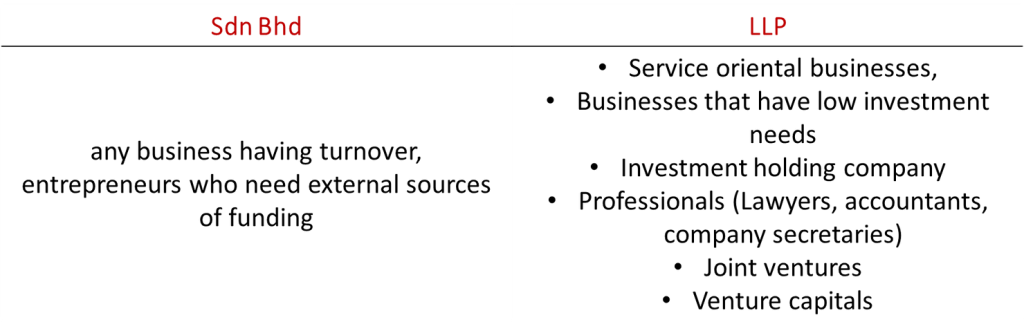
    Ideal For | 适合谁
    No. Of Shareholders/ Partners | 股东/合伙人人数

    Incorporation Costs | 注册费用

    There is an apparent disparity between the costs associated with incorporating, as shown above.

    The leading cause for this is that:

    • the government fee for the formation of an LLP is just RM500, but the government fee for the incorporation of a Sdn Bhd is RM1,000.
    • the process of forming an LLP is less involved than the process of forming a Sdn Bhd,; and
    • the professional fees associated with establishing an LLP are also generally lower.

    如上图所示,与成立公司有关的费用,有限责任合伙公司(LLP)及私人股份有限公司(Sdn Bhd) 之间存在明显的差距。

    造成这种情况的主要原因是:

    • 政府对组建有限责任合伙公司(LLP)的收费仅为 500 令吉,但政府对组建S私人股份有限公司(Sdn Bhd) 的收费为 1,000 令吉。
    • 组建有限责任合伙公司(LLP)的过程比组建私人股份有限公司(Sdn Bhd) 要简单,
    • 与建立有限责任合伙公司(LLP)相关的专业费用一般也较低。

    Legal Document | 法律文件

    If a specifically designed Constitution for a company or an LLP Agreement for a limited liability partnership (LLP) is required, since legal fees are involved, it can significantly increase the costs associated with the incorporation of the two different types of businesses.

    如果需要量身定做的公司章程 [Constitution] 或有限责任合伙公司(LLP)的有限责任合伙公司协议 [LLP Agreement],由于涉及法律费用,就会大大增加这两种不同类型企业的注册成本。

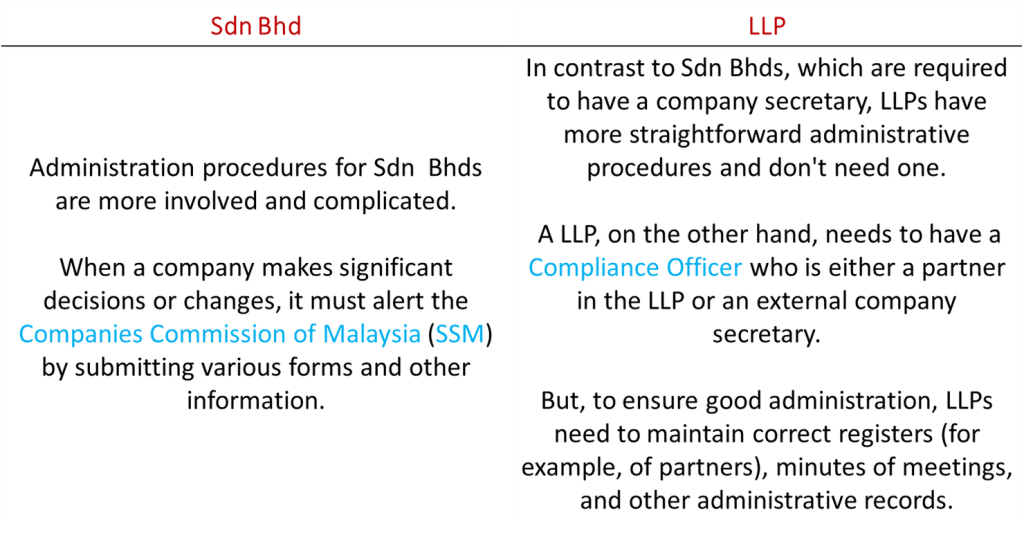
    SSM’s Statutory Requirements & Compliance | 公司委员会法定遵循责任
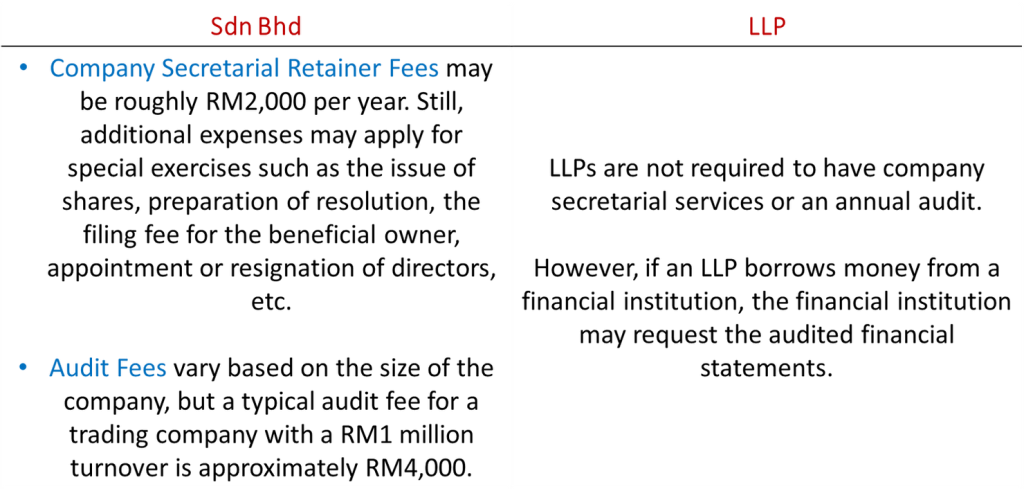
    Annual Maintenance Costs | 年度费用

    The audit fee for a manufacturing company with a RM 10 million turnover is approximately RM 14,000

    Legal Status | 法律地位

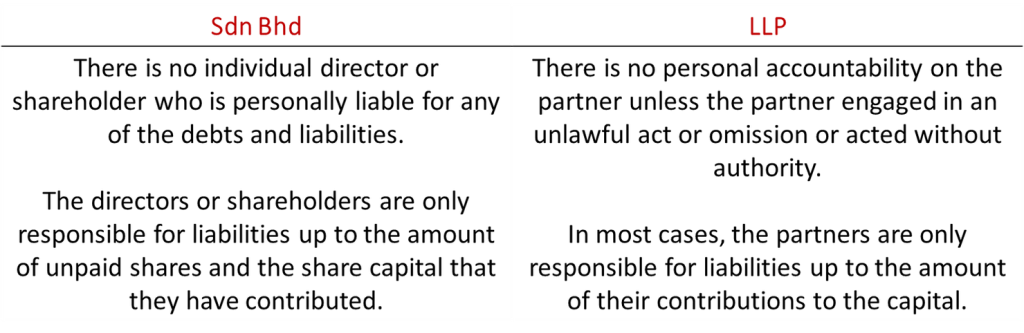
    Protection Against Liabilities | 对债务的保护
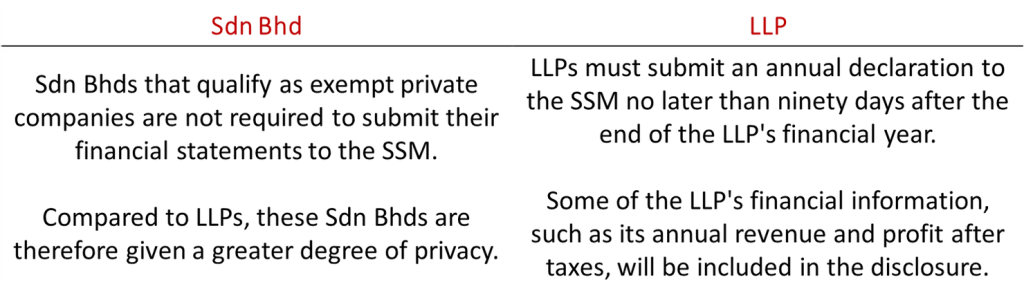
    Transparency | 透明化
    Tax implications | 税务事项

    • The LLP and the Sdn Bhd each file their taxes under their respective names. If specific requirements are met, LLPs and Sdn Bhds are eligible for a lower income tax rate of 17%.
    • However, LLPs, on the other hand, do not benefit from nearly as many tax incentives as Sdn Bhds, such as the Reinvestment Allowance.

    Income Tax of the Shareholders / Partners | 股东/合伙人的所得税

    Taxation of partners in a LLP is analogous to the taxation of shareholders in a Sdn Bhd in that neither is taxed on distributions of profits received from the LLP or dividends received from the Sdn Bhd.

    However, the remuneration of LLP partners or shareholders, such as salary and bonuses, if the LLP or Sdn Bhd employs them, is taxed in the same manner as that of an ordinary employee.

    It is important to remember that the LLP agreement needs to include clauses about the remuneration paid to the LLP’s partners to qualify for a tax deduction,

    有限责任合伙公司(LLP)合伙人的征税与私人有限公司(Sdn Bhd)股东的征税类似,他们都不需要对从有限责任合伙公司(LLP)所获得的分红或在私人有限公司(Sdn Bhd)所收到的股息纳税。

    然而,如果有限责任合伙公司(LLP)或私人有限公司(Sdn Bhd)雇佣了LLP合伙人或股东,他们的薪酬,如工资和奖金,则应与普通员工一样纳税。

    需要记住的是,有限责任合伙公司(LLP) 协议中需要包括关于支付给有限责任合伙公司(LLP) 合伙人的薪酬的条款,以符合扣税的要求。

    Returns to Owners | 拥有者的回报

    Conclusions

    Arguably, the first condition for the structure of a “successful” business is limited liability.

    Without this protection against failure, many businesses would not take unpredictable business risks to succeed.

    If this is the case, then the decision about the appropriate business structure is simple: do you want to form a LLP or a Sdn Bhd?

    Let’s assume that everyone has entirely read this post and paid attention to the considerations and explanations we highlighted above. In this case, I’m sure anyone can quickly determine which option is most suitable and meets their requirements.

    On the other hand, if any activity-driven criteria need to be taken into consideration, professionals can be consulted.

    结论

    可以说,”成功 “企业结构的首要条件是有限责任。

    如果没有这种对失败的保护,许多企业就不会为了成就一番伟业而去承担不可预知的商业风险。

    如果是这样的话,那么关于适当的商业结构的决定就很简单了:你想成立一个有限责任合伙公司 [LLP] 还是一个私人有限公司 [Sdn Bhd]?

    假设大家都能完整地阅读这篇帖子,并注意了上面我们强调的考量和解释。在这种情况下,我相信任何人都能迅速确定哪种方案最适合,并满足他们的要求。

    另一方面,如果需要考虑到任何经营活动所驱动的标准,可以咨询专业人士。

    22
  • 3. How can Audit Firms and Auditors promote Professional Skepticism?

    3. How can Audit Firms and Auditors promote Professional Skepticism?

    Professional Skepticism is influenced by personal behavioural characteristics (i.e., attitudes and ethical values) and the level of competence (i.e., knowledge) of the individual conducting the audit.

    These, in turn, are influenced by education, training, and experience.

    The Professional Skepticism of the engagement team is also influenced by the behaviour of the firm’s leadership and engagement team partners and the firm’s culture and business environment.

    The ISAs and ISQC 1 include requirements and guidance designed to help create an environment at the firm and engagement level where auditors can develop appropriate Professional Skepticism.

    职业怀疑态度受个人行为特征(即态度和道德价值观)以及进行审计的个人的能力水平(即知识)的影响。

    而这些反过来,又受到教育、培训和经验的影响。

    参与团队的职业怀疑态度也受到事务所领导层和参与团队合伙人的行为以及事务所的文化和商业环境的影响。

    国际审计准则 (ISAs) 和国际质量控制标准第1号 (ISQC 1) 涵盖一些要求和指导,主要是为了帮助在事务所和业务层面间创造一个环境,使审计师能够培养适当的职业怀疑精神。

    Firm-Level

    The firm’s leadership and the examples that it sets have a tremendous impact on the culture within the firm. Therefore, the “tone at the top” and the ongoing reinforcement of the necessity of Professional Scepticism on audit engagements are crucial factors that influence the conduct of individuals.

    The firm has the opportunity to set expectations for Professional Scepticism and to underline the significance of doing so, for example, when:

    • Establishes policies and procedures tailored to build an internal culture recognising that quality is crucial in performing engagements.
    • Promoting a quality-oriented internal culture through clear, consistent and frequent actions and messages from all levels of the firm’s management. This can be communicated through various mediums, including but not limited to training seminars, meetings, formal or informal conversations, mission statements, newsletters, or briefing memoranda. Such actions and messages encourage a culture that recognises and rewards high-quality work. They may be incorporated in the firm’s internal documentation and training materials as well as in partner and staff appraisal procedures to support and reinforce the firm’s view on the importance of quality and how, practically, it is to be achieved. 
    • Establishing policies and procedures to assure the firm that it has sufficient personnel with the necessary competence, capabilities, and commitment to ethical principles. In this regard, fostering an internal culture based on quality can be achieved through adopting policies and processes that address performance, evaluation, compensation, and promotion (including incentive systems) that give adequate recognition and reward to the growth and maintenance of competence.
    • Creating and implementing internal training and Continuing Professional Education programmes for employees at all levels of the firm. This can be accomplished in various ways, such as through work experience, training while on the job, mentoring from more experienced personnel (for instance, other members of the engagement team), and independence education. It is noted that the continuing competence of firm personnel depends to a significant extent on an appropriate level of Continuing Professional Education and Development.

    事务所层面

    事务所的领导层及其树立的榜样对事务所内部的文化有着巨大的影响。因此,”高层的基调”和对审计业务中职业怀疑的必要性的不断强化是影响个人行为的关键因素。

    事务所有机会就以下方面设定期望并强调职业怀疑态度的重要性,并在以下情况下强调这样做的重要性,例如,当:-

    • 制定量身定做的政策和流程,以建立一种意识到质量对于执行业务至关重要的内部文化。
    • 通过公司各级管理层的清晰、一致和频繁的行动和信息,促进以质量为导向的内部文化。这可以通过各种媒介进行传达,包括但不限于培训研讨会、会议、正式或非正式对话、使命宣言、新闻通讯或简报备忘录。这样的行动和信息鼓励了一种认可和奖励高质量的工作文化。它们可以被纳入公司的内部文件和培训材料以及合作伙伴和员工评估程序,以支持和加强公司对质量重要性以及如何在实践中实现质量的看法。认识到质量对于执行业务至关重要。
    • 制定政策和流程,以确保公司拥有足够的具备必要的才干、能力和对道德原则承诺的人员。在这方面,可以通过采用绩效、评估、薪酬和晋升(包括激励系统)的政策和流程来实现以质量为基础的内部文化。而这些政策和流程,对能力的持续增长给予充分的认可和奖励。
    • 为公司各级员工制定和实施内部培训和专业后续教育计划。这可以通过多种方式实现,例如通过工作累计经验、在职培训、更有经验的人员(例如,参与团队的其他成员)的指导以及独立性教育。值得注意的是,公司人员能力的持续增长在很大程度上取决于专业后续教育与发展的水平。

    Engagement Level

    At the engagement level, the Engagement Partner is accountable for the overall quality of each audit engagement assigned to that partner.

    The actions of the engagement partner and appropriate communications to the other members of the engagement team emphasise the importance of quality in performing audit engagements and the significance of audit quality, such as the engagement team’s ability to raise concerns without fear of retaliation and the issuance of auditor’s reports that are appropriate for the circumstances.

    Discussing the susceptibility of the entity’s financial statements to a material misstatement by the engagement partner and other key engagement team members is the optimal time to discuss and emphasise with the engagement team the importance of maintaining Professional Scepticism throughout the audit.

    This discussion includes the application of the applicable financial reporting framework to the entity’s facts and circumstances, with a focus on how and where the financial statements may be susceptible to material misstatement due to fraud, as well as how fraud could occur (setting aside beliefs that the engagement team members may have that management and TCWG are honest and have integrity).

    This discussion also provides a basis upon which engagement team members communicate and share new information that may affect risk assessments or the audit procedures performed.

    Other opportunities for the engagement partner to set expectations regarding, and to emphasize the importance of, Professional Scepticism include, for example, when taking responsibility for:

    • The direction, supervision and performance of the audit engagement.
    • Reviews of work performed. In this regard, the engagement partner, in particular, has much knowledge and experience to impart in helping less experienced team members develop a critical and questioning mind through review of, among other matters, critical areas of judgment and significant risks. Timely reviews also allow significant matters (for example, critical areas of judgment, especially those relating to difficult or contentious matters identified during the course of the engagement) to be resolved on or before the date of the auditor’s report.
    • The engagement team undertaking appropriate consultation on difficult or contentious matters

    Even though activities on the level of the firm and the engagement contribute to an attitude of Professional Scepticism, it is still the responsibility of each auditor to keep up an attitude of Professional Scepticism.

    Throughout the entirety of the audit, both professional judgement and Professional Scepticism must be applied.

    By keeping a healthy dose of Professional Scepticism throughout the audit, the auditor can lower the likelihood of making errors such as overlooking unusual circumstances, drawing conclusions that are too broad from audit observations, or making inappropriate assumptions when deciding the nature, timing, and scope of audit procedures and evaluating the results of those procedures.

    参与层面

    在参与层面,项目负责人 [Engagement Partner] 需对分配给他的每项审计业务的整体质量负责。

    项目负责人的行事以及与参与项目的其他成员的适当沟通,强调了执行审计业务的质量以及审计质量的重要性,例如:项目团队成员能够提出怀疑而不必担心遭到报复,以及发布适合具体情况的审计报告。

    项目负责人和其他主要项目团队成员讨论实体财务报表对重大错报的敏感性,是与项目团队成员讨论并强调在整个审计过程中保持职业怀疑态度的重要性的最佳时机。

    这种讨论也包括将适用的财务报告框架应用于该实体的事实和情况,重点关注财务报表如何以及在何处可能因欺诈而出现重大错报,以及欺诈如何发生(抛开项目团队成员可能认为管理层和TCWG是诚实和正直的信念)。

    这种讨论也提供了一个基础,项目团队成员在此基础上沟通和分享可能影响风险评估或所执行的审计程序的新信息。

    项目负责人设定有关职业怀疑态度的期望并强调其重要性的其他机会包括,例如,在承担以下责任时:

    • 对审计业务的指导、监督和执行;
    • 对已完成的工作进行审查。在这方面,特别是项目负责人,有着很多知识和经验可以传授,通过对关键领域的判断和重大风险的审查,帮助经验不足的团队成员培养批判和质疑的精神。及时的审查也使重大事项(例如,关键的判断领域,特别是那些在审计过程中发现的问题或有争议的事项)能够在审计报告出具的日期前解决;
    • 项目团队对问题或有争议的事项进行适当的协商

    即使事务所和业务层面的参与有助于形成职业怀疑的态度,但保持职业怀疑的态度仍然是每个审计人员的责任。

    在整个审计过程中,必须同时运用专业判断和职业怀疑态度。

    通过在整个审计过程中保持健康的职业怀疑态度,审计师可以降低犯错误的可能性,如忽视异常情况,从审计观察中得出过于宽泛的结论,或在决定审计流程的性质、时间和范围以及评估这些流程的结果时做出不适当的假设。

    17
  • 4. At what stage in the Audit Process is Professional Skepticism necessary?

    4. At what stage in the Audit Process is Professional Skepticism necessary?

    Professional Skepticism is relevant and required throughout the audit, despite the fact that it is not mentioned in every ISA. For example:

    1) Engagement Acceptance – For instance, while assessing the integrity of principal owners and management.

    2) Identifying and Assessing Risks of Material Misstatement – For example, when:

    • Performing risk assessment procedures (including the engagement team discussion on the susceptibility of the entity’s financial statements to material misstatement, as discussed previously).
    • Revising the auditor’s assessment of the Risks of Material Misstatement and making changes to the further planned audit procedures as needed, such as when new information contradicts the audit evidence on which the original assessment was based, or when the auditor becomes aware of changes in circumstances, new information, or a change in his or her understanding of the entity and how it works as a result of performing further audits.

    尽管它没有在每一个国际审计准则中提到,职业怀疑论在整个审计过程中都是相关的,也是必须的,例如:-

    1) 项目接受时 [意思就是说 – 接受委任] – 举例,在评估主要所有者和管理层的诚信时;

    2) 识别和评估重大错报的风险时 – 举例,当在:

    • 执行风险评估程序(包括项目团队对实体财务报表对于重大错报的敏感性的讨论,如前所述)。
    • 调整审计师对重大错报风险 [Risks of Material Misstatement] 的评估,及进一步对早已计划的审计程序进行修改,如有需要。举例,当新的信息与最初评估所依据的审计证据相矛盾时,或当审计师意识到情况的变化、新的信息,或在执行深入审计后对该实体及其运作方式的理解发生变化时。

    3) Designing the nature, timing, and scope of further audit procedures that align with the risks of material misstatement and evaluating audit evidence. For example, when:

    • Considering, areas with higher estimated risks, the need to get more evidence or evidence that is more relevant or reliable, such as by putting more emphasis on gathering proof from third parties or from several independent sources.
    • Designing and carrying out substantive analytical procedures, such as evaluating the reliability of data from which the auditor’s expectation is developed, and when identifying and investigating fluctuations or relationships that are inconsistent with other relevant information or that differ from expected values by a significant amount. The auditor’s expectations are an essential part of evaluating the results of analytical procedures and questioning management’s explanations for results that don’t match what was expected.
    • Dealing with situations like when management refuses to let the auditor send a confirmation request.

    4) Forming an Opinion on whether the financial statements are prepared, in all material respects, in accordance with the Applicable Financial Reporting Framework – For example, when:

    • Concluding about whether reasonable assurance was obtained and whether sufficient appropriate audit evidence was obtained to support such conclusion.
    • Considering what will happen to the auditor’s opinion if unable to gather necessary audit evidence.
    • Evaluating whether Financial Statements that are prepared in accordance with a Fair Presentation Framework achieve fair presentation, considering both

    (i) the overall presentation, structure, and content of the financial statements and

    (ii) whether the Financial Statements, including the related notes, represent the underlying transactions and events in a manner that achieve fair presentation

    3)设计与重大错报风险相一致的深入审计程序的性质、时间和范围,并评估审计证据。举例,当:

    • 考虑到,估计风险较高的领域,需要获得更多的证据或更相关或更可靠的证据,举例,更强调从第三方或多个独立来源收集证据。
    • 设计和执行实质性的分析程序 [substantive analytical procedures],包括在评估时产生审计师期望的数据的可靠性,以及当识别和调查与其他相关信息不一致或与预期值有很大差异波动或关系。在评估分析程序(Analytical procedure)和质疑管理层对偏离预期的解释结果时,审计师的期望起着重要的作用。
    • 处理诸如管理层拒绝让审计师发送确认请求的情况。

    4) 就财务报表在所有重大方面,是否按照适用的财务报告框架 [Applicable Financial Reporting Framework] 的编制而形成意见 — 举例,当。

    • 就是否获得了合理的保证以及是否获得了足够且适当的审计证据来支持这一结论。
    • 考虑如果无法收集到必要的审计证据,审计师的意见会有什么影响。
    • 评估按照公允列报框架 [Fair Presentation Framework] 编制的财务报表,是否实现了公允列报,在考虑到

    (i) 财务报表的整体表述、结构和内容,以及

    (ii) 财务报表,包括相关附注,是否以实现公允列报的方式反映了基本交易和事件。

    17