Tag: Shift Work

  • A “Day” for a shift worker is a continuous period of 24 hours beginning at any Point in Time

    A “Day” for a shift worker is a continuous period of 24 hours beginning at any Point in Time

    Palmex Industries Sdn. Bhd. v. Public Prosecutor [1989]

    Section 60C of the Employment Act 1955 states as follows:

    60C. Shift Work (1) Notwithstanding s. 60A(1)(b) and (d) but subject to subsection (1)(a) thereof, an employee who is engaged under his contract of service in shift work may be required by his employer to work more than eight hours in any one day or more than forty-eight hours in any one week but the average number of hours worked over any period of three weeks shall not exceed forty-eight per week. (2) Except in the circumstances described in s. 60A(2)(a), (b), (c), (d), (e), no employee who is engaged under this contract of service in shift work shall work for more than twelve hours in any one day. Section 60C must be read with s. 60A of the Act, which provides as follows:

    60A. Hours of Work

    (1) Except as hereinafter provided, an employee shall not be required under his contract of service to work: (a) more than five consecutive hours without a period of leisure of not less than thirty minutes duration; (b) more than eight hours in one day; (c) in excess of a spread over period of ten hours in one day; (d) more than forty-eight hours in one week: …

    This section stipulates the maximum number of hours an employee can be required to work. Section 60C(1) provides the exception for shift workers.

    A shift worker may be required by his employer to work more than eight hours on any day. Sub-section (2) of s. 60C then limits the number of hours to twelve.

    Reading the two sections together, there is a provision that an employer cannot require an employee to work more than eight hours in one day.

    Still, if the employee is a shift worker, the employer may require him to work more than eight hours on any one day, subject to a maximum of twelve hours.

    Therefore, if an employer requires an employee to work for more than twelve hours in any one day, he contravenes this provision and can be punished under s. 99A of the Act, which is wide enough to cover this contravention.

    In this case, the appellant (the Company/employer) permitted employee X to work more than 12 hours on the said date, from 3 p.m. on 6 April 1986 to 3 p.m. on 7 April 1986, which was in contravention of s. 60C(2) of the Employment Act 1955 and have committed an offence punishable under s. 99A of the Employment Act 1955 thereof.

    The appellant (the Company/employer) also permitted employee Y to work more than 12 hours on the said date, from 3 p.m. on 28 April 1986 to 3.00 p.m. on 29 April 1986, in contravention of s. 60C(2) of the Employment Act 1955 and have committed an offence punishable under s. 99A of the same Act thereof.

    The appellant was found guilty on both charges and was fined RM300 for each charge.

    The ground of appeal involves the interpretation of the word “day” as applicable to shift workers.

    Under s. 2 of the Act, “day” means:

    1. a continuous period of twenty-four hours beginning at midnight; or
    2. for the purposes of Part XII in respect of an employee engaged in shift work, a continuous period of twenty-four hours beginning at any point in time.

    The appellant contended that:

    • The “day” for all their shift workers started at 7 a.m., the start of the first shift.
    • Even for the shift worker who started work at 3 p.m., his “day” was also from 7 a.m. that day.
    • The company has fixed this.
    • Therefore the employee had not worked more than twelve hours in one “day”.

    A “day” for a shift worker is a continuous period of twenty-four hours beginning at any point in time.

    The Court concluded that:

    “At any point in time” means the time he starts his work on a particular day.

    If he starts his work at 7 a.m. on a certain day, a “day” about him will be a continuous period of twenty-four hours from that time.

    If on another day he starts his work at 11 p.m., his “day” will be a continuous period of twenty-four hours from that time.

    An employer cannot fix the “day” for his shift workers.

    In this case, employee X started work at 3 p.m. on 6 April 1986. The “day” concerning him was, therefore, a continuous period of twenty-four hours from 3 p.m. on 6 April 1986.

    His “day” ended at 3 p.m. on 7 April 1986. During this period, he worked for sixteen hours.

    Employee Y‘s “day” was from 3 p.m. on 28 April 1986 to 3 p.m. on 29 April 1986. Teoh also worked for sixteen hours during this period.

    It was contended (and Employee Y admitted) that Employee Y worked on 29 April 1986 from 7 a.m. to 3 p.m. because he wanted to help his friend.

    He changed his shift with a friend.

    The change was allowed by the appellant because it had no choice.

    If a change request was not allowed, the employee could just be absent himself, which would cause work interruption.

    It was submitted that the appellant was therefore justified under s. 60A(2)(e) .

    Section 60C(2) starts with the words “Except in the circumstances described in s. 60A(2)(a), (b), (c), (d), (e) no employee shall require any employee who is engaged under his contract of service in shift work to work for more than twelve hours in any one day.” However, the Court did not agree to this. The Court concluded that Section 60A(2)(e) is not meant for a situation like this. It is meant for a situation where there is an interruption of work which is impossible to foresee. In this case, the interruption, if any, was clearly foreseeable.

    Hence, the appeal of the company was dismissed.

    Our website's articles, templates, and material are solely for reference. Although we make every effort to keep the information up to date and accurate, we make no representations or warranties of any kind, either express or implied, regarding the website or the information, articles, templates, or related graphics that are contained on the website in terms of its completeness, accuracy, reliability, suitability, or availability. Therefore, any reliance on such information is strictly at your own risk.

    Keep in touch with us so that you can receive timely updates |

    要获得即时更新,请与我们保持联系

    1. Website ✍️ https://www.ccs-co.com/ 2. Telegram ✍️ http://bit.ly/YourAuditor 3. Facebook ✍

    4. Blog ✍ https://lnkd.in/e-Pu8_G 5. Google ✍ https://lnkd.in/ehZE6mxy

    6. LinkedIn ✍ https://www.linkedin.com/company/74734209/admin/

    20
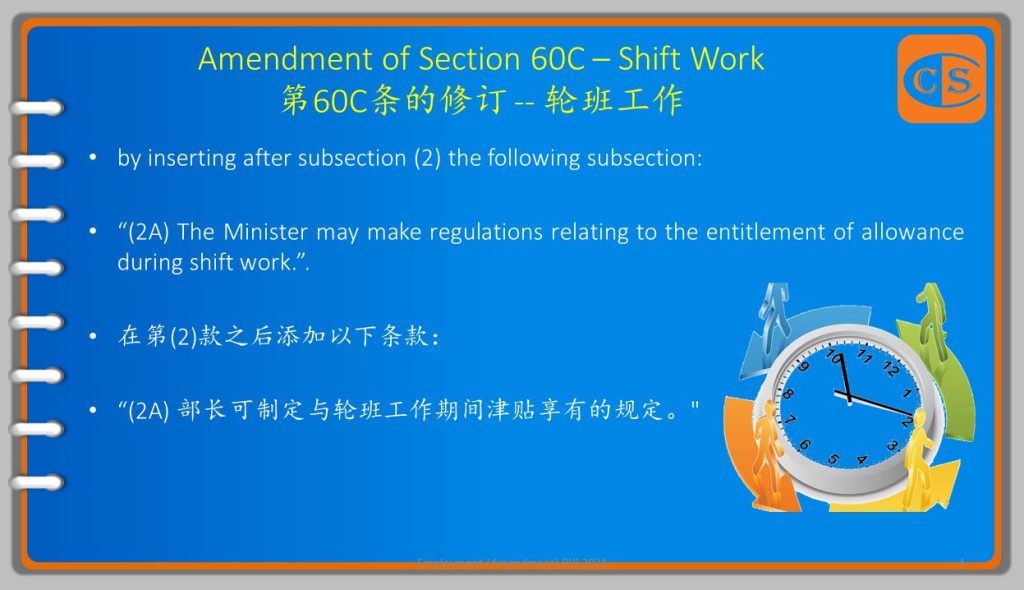
  • Amendment of Section 60C – Shift Work

    Amendment of Section 60C – Shift Work

    Latest Update: 13-5-2022

    1. The Employment (Amendment) Bill 2021 (“the Bill”) was presented on October 25, 2021.

    2. Dewan Rakyat approved the Employment (Amendment) Bill 2021 on March 21, 2022.

    3. Dewan Negara passed the Employment (Amendment) Bill 2021 on March 30, 2022.

    4. The Employment (Amendment) Act 2022 was gazetted into law on May 10, 2022.

    However, [As of 13-5-2022] the Act has not yet come into force.

    [In force means that the Act or the secondary legislation has the force of law.]

    1. 《2021年就业(修订)法案》(”法案”)于2021年10月25日在国会提交。

    2. 下议院于2022年3月21日批准了《2021年就业(修订)法案》。

    3. 上议院于2022年3月30日也通过了《2021年就业(修订)法案》。

    4. 作为立法,2022年5月10日,《2022年就业(修正)法案》在宪报上颁布。

    然而请注意,[截至2022年5月13日] 此法尚未生效

    [生效是指该法或次级立法具有法律效力]。

    According to the ILO, working in shifts is “a method of organization of working time in which workers succeed one another at the workplace so that the establishment can operate longer than the hours of work of individual workers” at different daily and night hours.

    Within the broad category of shift work, we can make a distinction between a fixed shift system and a rotating one.

    Under a fixed shift system, working time can be organized into two or three shifts: the early, late and/ or night shifts.

    This means that one group of workers might work during the morning and early afternoon; another group will work during the late afternoon and evening, and the third group (in a three-shift system) will work during the night.

    Under a rotating shift system, workers might be assigned to work shifts that vary regularly over time; these are called “rotating shifts” because they rotate around the clock (e.g. from a shift in the morning, to one in the afternoon, to one at night).

    If the company’s equipment is running nonstop the whole week, we can speak of “continuous” shift work with 24 hours of work, seven days a week (i.e. 168 hours of company operating time).

    There is a virtually unlimited number of potential shift work patterns.

    根据国际劳工组织,轮班工作是 “一种组织工作时间的方法,在每天和夜间的不同时间,工人在工作场所相互接替,使机构的运作时间长于工人的个人工作时间”。

    在轮班工作这一大类中,我们可以对固定轮班制度和轮换轮班制度进行区分。

    在固定轮班制度下,工作时间可以被组织成两个或三个班次:早班、晚班和/或夜班。

    这意味着,一组工人可能在上午和下午早些时候工作;另一组在下午晚些时候和晚上工作,第三组(在三班制中)在夜间工作。

    在轮换轮班制度下,工人可能被分配到随时间有规律地变化的班次;这些被称为 “轮班”,因为它们是围绕时钟轮换的(例如,从早上的一个班次,到下午的一个班次,到晚上的一个班次)。

    如果公司的设备整个星期都在不停地运行,我们可以说是 “连续 “轮班工作,一周七天,24小时工作(即168小时的公司运营时间)。

    潜在的轮班工作模式的数量几乎是无限的。

    In order to limit the potential negative impacts of shift work, it is recommended that a shift system should be structured with the following aspects in mind:

    • a short cycle period with regular rotation should be used;
    • individual workers should work a few nights in succession;
    • individual workers should have some free weekends with at least two full days off;
    • short intervals between shifts should be avoided;
    • flexibility regarding shift change times and shift length is needed.

    为了限制轮班工作的潜在负面影响,建议轮班制度的结构应考虑到以下方面:-

    • 应采用短周期和定期轮换的方式;
    • 个别工人应该连续工作几个晚上;
    • 个别工人应该有一些自由的周末,至少有两个完整的休息日;
    • 应避免两班之间的短暂间隔;
    • 在换班时间和换班长度方面需要有灵活性。

    1. Some of the most significant amendments suggested to the Employment Act 1955 as a result of the Employment (Amendment) Bill 2021 (“the Bill”) include Amendment of Section 60C – Shift Work

    👉 to reduce of hours of work in one week from 48 to 45 hours

    2. Facebook Live 👉 https://lnkd.in/eMKwGYzD [Mandarin] 3. Join our Telegram – https://t.me/YourAuditor 🌻🌻🌻🌻🌻🌻🌻🌻 1. 2021年劳工(修正)法案对1955年劳工法令提出的一些重要修正,包括第60C条的修订 — 轮班工作 👉 将一周内的工作时间从48小时减少到45小时 2. Facebook Live 👉 https://lnkd.in/eMKwGYzD 3. 加入 Telegram – https://t.me/YourAuditor

    🌼🌼🌼🌼🌼🌼🌼🌼🌼🌼

    Employment (Amendment) Bill 2021 Series 2021年劳工(修正)法案系列

    1. Amendment of Section 2 – Interpretation [对第2条文的修正 – 定义] https://lnkd.in/eRjMe_Ha / https://lnkd.in/eGz7Z9Dx

    2. Amendment of Section 4 – Appeals [对第4条文的修正 – 上诉] https://lnkd.in/eP82B7WQ / https://lnkd.in/eEUfudPU

    3. – Amendment of Section 18A – Calculation of Wages for Incomplete Month’s Work [对第18A条文的修正 – 服务未满整个月的工资计算方法] https://lnkd.in/epj-4VjE / https://lnkd.in/er9JzqCU

    4. Amendment of Section 22 – Limitation on Advances to Employees [对第22条文的修正 – 对雇员预支薪水的限制] https://lnkd.in/emKmjpWe / https://lnkd.in/eTVDFdH7

    5. Amendment of Section 25 – Wages to be Paid through Financial Institution [对第25条文的修正 – 通过金融机构支付工资] https://lnkd.in/eB_XgrCF / https://lnkd.in/e6WfJ2yg

    6. Amendment of Section 25A – Payment of Wages other than through Financial Institution [对第25A条文的修正 – 通过金融机构以外的方式支付工资] https://lnkd.in/eUJMRs9R / https://lnkd.in/e3PhUw37

    7. Amendment of Section 33A – Information Relating to Supply of Employees [对第33A条文的修正 – 与雇员供应有关的信息] https://lnkd.in/eGFCfPZW / https://lnkd.in/ebCtvCu9

    8. Deletion of Part VIII on the prohibition on employing women in night work, underground work [ 删除第八部分关于女性从事夜间工作、地下工作等的任何禁止] https://lnkd.in/e3ktX8xi / https://lnkd.in/ee_i3eD7

    9. Amendment of Section 37- Length of Eligible Period and Entitlement to Maternity Allowance [第37条的修订 – 符合条件的时间长度和享受产假津贴的权利] https://lnkd.in/exxNvppY / https://lnkd.in/e6hiidfN

    10. New Section 41A – Restriction on Termination of Pregnant Female Employee [新的第41A条 – 对终止怀孕女雇员雇佣合约的限制] https://lnkd.in/e75Y3WRY / https://lnkd.in/eZs76yAr

    11. Amendment of Section 42- Restriction on Termination of Female Employee After Eligible Period [第42条的修订 – 对女性雇员在合格期限后 被终止合约的限制] https://lnkd.in/edk6mNSu / https://lnkd.in/ezfke64k

    12. Deletion of Section 44A – Application of this Part Irrespective of Wages of Female Employee [删除第44A条 – 无论女雇员的工资如何,本部分都适用] https://lnkd.in/eUbtB5ia / https://lnkd.in/egngtPPf

    13. Amendment of Section 57 – Termination of Contract [第57条的修订 — 合同的终止] https://lnkd.in/eFabDdsA / https://lnkd.in/ensjPPJJ

    14. Amendment of Section 57A – Employment of Foreign Domestic Employee [第57A条的修订 — 外籍家庭雇员的雇用]’ https://lnkd.in/eNfhVrUC / https://lnkd.in/e94QMAZB

    15. Amendment of Section 57B – Duty to inform Director-General of Termination of Service of Foreign Domestic Employee [第57B条的修订 – 通知总监终止外籍家庭雇员服务的义务] https://lnkd.in/eFyc27Wn / https://lnkd.in/eeggM_AN

    16. Amendment of Section 60A – Hours of Work and Working at Night [第60A条的修订 – 工作时间每周48改成45小时和夜间工作] https://lnkd.in/eHJwU4T5 / https://lnkd.in/eMaDPbtX 17. Amendment of Section 60C – Shift Work [第60C条的修订 — 轮班工作] https://lnkd.in/eRwwe6ie / https://lnkd.in/ev42tQky

    18. Amendment of Section 60F – Sick Leave [第60F条的修订 – 病假] https://lnkd.in/ektGrFZa / https://lnkd.in/euJUaheG

    19. New Section 60FA – 7-day Paternity Leave [新的第60FA条 – 7天陪产假] https://lnkd.in/e4jNjTdv / https://lnkd.in/ertbkK65

    20. Substitution of Section 60k – Employment of Foreign Employee [取代第60K条 – 外国雇员的雇用] https://lnkd.in/e_YEsZJD / https://lnkd.in/e_YEsZJD

    21. New Section 60KA – Termination of Employment of Foreign Employee, etc. [新的第60KA条 – 外国雇员的终止雇用等等] https://lnkd.in/ebBbEQFR / https://lnkd.in/ejCpzEmb

    22. Deletion of Section 60L – Director-General may inquire into Complaint [删除第60L条 – 总监可对投诉进行调查] https://lnkd.in/eiG7iSP8 / https://lnkd.in/eYjZDYSy

    23. New Part XIIC – Flexible Working Arrangement [新的第XIIC部分 – 弹性工作安排] https://lnkd.in/ewW8gxqi / https://lnkd.in/e-5CYfr6

    24. Amendment of Section 69 – Director General’s Power to Inquire into Complaints [第69条的修订 – 总监调查投诉的权力] https://lnkd.in/eDwVsqPw / https://lnkd.in/e97eY-fw

    25. Deletion of Sections 69B, 69C, 69D and 69E [删除第69B、69c、69D和69E条] https://lnkd.in/ek-T48M7 / https://lnkd.in/eu9BRFBF 25. New Section 69F – Discrimination in Employment [新的第69F条 — 就业中的歧视 ] https://lnkd.in/e6_-G8rZ / https://lnkd.in/eVjS9Q7S

    26. Amendment of Section 70 – Procedure in Director General’s Inquiry [第70条的修订 – 总监调查的程序] https://lnkd.in/e6_-G8rZ / https://lnkd.in/eVjS9Q7S

    27. Amendment of Section 73 – Prohibitory Order by Director General to Third Party [第73条的修订 – 总监向第三方发出的禁止令] https://lnkd.in/e6_-G8rZ / https://lnkd.in/eVjS9Q7S

    28. Amendment of Section 77 – Appeal Against Director General’s Order to High Court [对第77条的修订 – 对总监的命令向高庭提出上诉] https://lnkd.in/eqZbmb_h / https://lnkd.in/eEbjDkc3

    29. Amendment of Section 81F – Offence [第81F条的修订 – 罪行] https://lnkd.in/eqZbmb_h / https://lnkd.in/eEbjDkc3

    30. Deletion of Section 81G – Application of this Part [Sexual Harassment] Irrespective of Wages of Employee [删除第81G条 – 无论雇员的工资如何, 本部分 [性骚扰] 都适用] https://lnkd.in/eTsj62rE / https://lnkd.in/eJQFdzx7

    31. New Section 81H – Notice on Sexual Harassment [新的第81H条 – 关于性骚扰的告示牌] https://lnkd.in/ejyK7uCB / https://lnkd.in/eP8GYYNT

    32. Amendment of Section 82 – Service of Summons [第82条的修订 – 传票的送达] https://lnkd.in/eGMUvfca / https://lnkd.in/e22hZMhN

    33. Amendment of Section 84 – Jurisdiction [第84条的修订 – 管辖权] https://lnkd.in/eG-BXhAi / https://lnkd.in/e_gTbnbT

    34. Amendment of Section 86 – Saving clause as to Civil Jurisdiction of Courts [第86条的修订 – 关于法院民事管辖权的保留条款] https://lnkd.in/es6Qjq-A / https://lnkd.in/eHaCZbBK

    35. New Section 87A – Court Order for Payments due to Employee [新的第87A条 – 法院命令向雇员支付应付款项] https://lnkd.in/eTGFdrP6 / https://lnkd.in/eJ9ZRA4E

    36. New Section 90B – Forced Labour [新的第90B条 – 强迫劳动] https://lnkd.in/e_JXjVxf / https://lnkd.in/eq-VRqWU

    37. Deletion of Section 93 – Offences and Penalties Under Part VIII [删除第93条 – 第八部分规定的罪行和处罚] https://lnkd.in/eDu2qZeK / https://lnkd.in/ebPvZFP9

    38. Amendment of Section 99A – General Penalty [第99A条的修订 – 一般处罚] https://lnkd.in/euzRGshx / https://lnkd.in/ena5j6ZB

    39. New Section 101C – Presumption as to Who is an Employee and Employer [新条款101C – 关于谁是雇员和雇主的推定] https://lnkd.in/e2KX3QiB / https://lnkd.in/eFHjknmX

    40. Amendment of Section 102 – Regulations [第102条的修订 – 条例] https://lnkd.in/e8UxFucD / https://lnkd.in/e8PVAmeH

    41. Saving and Transitional [节约条款及过渡性] https://lnkd.in/ehife2BB / https://lnkd.in/ekQAtgmJ

    🌳🌳🌳🌳🌳🌳🌳🌳🌳🌳🌳🌳

    👉 Stay in touch with us

    1. Website ✍️ https://www.ccs-co.com/ 2. Telegram ✍️ http://bit.ly/YourAuditor 3. Instagram ✍ http://tiny.cc/rojzrz 4. Blog ✍ https://lnkd.in/e-Pu8_G 5. Google ✍ https://lnkd.in/ehZE6mxy

    21