
Tag: OECD

  • Form C YA 2022: Cash Pooling Arrangements and  Transfer Pricing

    Form C YA 2022: Cash Pooling Arrangements and Transfer Pricing

    Recent changes to the Form C

    Recent changes were made to Form C by the Inland Revenue Board in preparation for the YA 2022. One of the most critical changes is for those businesses participating in transfer pricing arrangements. As a result, the disclosure items have been significantly expanded to cover new areas.

    These new areas include stating the characterisation of your company by reference to its functional profile, the business restructuring undertaken by the group during the year, and whether or not your company engages in cash pooling activities, performs any research and development activities or owns any intellectual properties.

    Transfer Pricing Guidance on Financial Transactions

    Transfer Pricing Guidance on Financial Transactions (“Guidance”) was released by the Organization for Economic Cooperation and Development (“OECD”) in February 2020.

    The Guidance is essential because it is the first time the OECD’s Transfer Pricing Guidelines have been updated to include guidance on on the transfer pricing aspects of financial transactions, which should contribute to consistency in the application of transfer pricing and help avoid transfer pricing disputes and double taxation.

    It also guided on specific issues relating to the pricing of Treasury Functions (Intra-Group Loans, cash pooling, Hedging), Financial Guarantees and Captive Insurance.

    Cash Management

    As we saw a few years ago, at the start of the Covid-19 crisis, liquidity and cash management are becoming increasingly important.

    Benefits of Cash Management

    • Making sure that each company’s liquidity needs, as well as its surpluses, are managed more effectively
    • lowering the total amount of debt that is due in the short term
    • Increasing capacity for self-financing and decreasing reliance on external funding
    • Obtaining more favourable interest rates from the bank as a result of increased volume
    • Providing enhanced visibility of the cash flow position at each entity and a consolidated group perspective to facilitate the making of choices regarding financing and investments.
    • Ensuring better liquidity risk management

    Cash Pooling is a cash management technique that allows a business group of different companies to manage their cash.

    So, what is “pooling cash“?

    This article tells you everything you need to know.

    What is Cash Pooling?

    Even if the group is financially healthy, some parts may have cash flow problems and need to use expensive short-term cash flow financing options like high-interest loans, overdrafts with fees or bank commissions, etc.

    At the same time, some of the group’s entities may have extra cash that just sits in their accounts and doesn’t do much.

    The idea behind cash pooling is to manage cash flow through the holding company and ensure all of the subsidiaries’ bank accounts are in a healthy balance.

    Cash Pooling solves this problem:

    If there is a cash deficit, cash pooling lets the group help those subsidiaries in difficulty and limit banking charges

    If there is a cash surplus, the group is able to capitalise on all of the profits from each subsidiary thanks to cash pooling, which allows for better investments to be made and an increase in interest.

    Cash Pooling Structures

    The use of a cash pool is popular among multinational enterprises as a way of achieving more efficient cash management; there are different ways to pool cash, such as:

    • “physical cash pooling”,; and
    • “notional cash pooling.”

    In a typical Physical Cash Pooling arrangement, the bank account balances of all the pool members are transferred daily to a single central bank account owned by the cash pool leader.

    In the case of a Notional Cash Pool, some of the advantages that come with combining the credit and debit balances of many accounts can be realised, even though there is no actual transfer of amounts taking place between the accounts of the participating members.

    Example of Notional Cash Pooling

    The bank calculates the lending and borrowing interest that would have been received for the notional offset position: this corresponds to the sum of (RM15-RM20-RM10) for RM5.

    Transfer Pricing of Cash Pooling Arrangements

    Generally speaking, cash pooling is implemented mostly by large corporate groups because it requires a certain level of structuring and in-house resources; however, it can be used by any group of several companies.

    The holding company or parent company acts as a cash pool leader (or “Central Strategic Unit”) that distributes liquidity to serve the interests of each subsidiary better.

    Hence, cash pooling arrangements are complex contracts that may involve controlled and uncontrolled transactions.

    Form C Requires Additional Disclosures

    According to the information provided in Section A of the Appendix of Form C for YA 2022, taxpayers who carry out controlled transactions under sections 139 and 140A must disclose: Are they involved in any cash pooling activities?

    If the answer to the above question is affirmative, further disclose their Role in the cash pooling activities.

    Role in the Cash Pooling Activity

    Cash Pool Leader (The Holding Company)

    A cash pool leader performs no more than a coordination or agency function, with the master account being a centralised point for a series of book entries to meet the pre-determined target balances for the pool members.

    Given such a low level of functionality, the cash pool leader’s remuneration as a service provider will generally be similarly limited.

    Cash Pool Member

    A cash pool member is likely to be participating in providing liquidity as part of a broader group strategy, an arrangement in which the member can have a credit or debit position, which may include among its aims a range of benefits that can only be achieved as part of a collective strategy involving the pool members, done for the benefit of all of the pool participants, and the membership of which is limited to entities within the MNE group.

    Pool participants deposit cash to the pool (or withdraw cash from the pool), not to (or from) a particular cash pool member.

    Transfer Pricing if the Positions of Debt or Receivable become Long-Term

    If cash is deposited or borrowed, and this intra-group transaction subsequently becomes a long-term position, special attention should be paid to the conditions.

    When looking at this situation from the point of view of transfer pricing, the question that needs to be answered is whether or not the transaction is genuinely something other than efficient short-term liquidity management.

    If it is determined that there was, in fact, a long-term loan (or receivable), then the subsequent review of the price based on arm’s-length transactions needs to be based on that decision.

    Our website's articles, templates, and material are solely for reference. Although we make every effort to keep the information up to date and accurate, we make no representations or warranties of any kind, either express or implied, regarding the website or the information, articles, templates, or related graphics that are contained on the website in terms of its completeness, accuracy, reliability, suitability, or availability. Any reliance on such information is therefore strictly at your own risk.

    Keep in touch with us so that you can receive timely updates |

    要获得即时更新,请与我们保持联系

    1. Website ✍️ https://www.ccs-co.com/ 2. Telegram ✍️ http://bit.ly/YourAuditor 3. Facebook ✍

    4. Blog ✍ https://lnkd.in/e-Pu8_G 5. Google ✍ https://lnkd.in/ehZE6mxy

    6. LinkedIn ✍ https://www.linkedin.com/company/74734209/admin/

    18
  • Form C YA 2022 – Characterisation of Entities for Transfer Pricing Purposes: Service Activities

    Form C YA 2022 – Characterisation of Entities for Transfer Pricing Purposes: Service Activities

    Recent changes were made to Form C by the Inland Revenue Board in preparation for the YA 2022. One of the most critical changes is for those businesses participating in transfer pricing arrangements. As a result, the disclosure items have been significantly expanded to cover new areas.

    These new areas include stating the characterisation of your company by reference to its functional profile, the business restructuring undertaken by the group during the year, and whether or not your company engages in cash pooling activities, performs any research and development activities or owns any intellectual properties.

    Form C Requires Additional Disclosures

    The taxpayer is NOW obligated to provide an entity characterisation concerning its business activities, specifically its manufacturing, distribution, and service activities; for instance, whether

    • manufacturing activities are carried out as a toll manufacturer, contract manufacturer, full-fledged manufacturer, or any other form of manufacturing;
    • distribution activities are carried out as a full-fledged distributor, commissionaire distributor, agent distributor, limited risk distributor, licenced distributor or any other form of distribution;
    • service activities are carried out as a management-service provider, IT service provider, treasury or any other service form.

    The accurate definition of the entity is critical, and it must be decided based on an analysis of the transfer pricing functions, assets, and risks (FAR).

    Definition of Intra-Group Services

    The OECD defines an ‘Intra-Group Service’ as:

    “An activity (e.g. administrative, technical, financial, commercial, etc.) for which an independent enterprise would have been willing to pay or perform for itself.”

    The Malaysian Transfer Pricing Guidelines define an ‘Intra-Group Service’ as:

    “Intragroup services are services provided by one or more members of a multinational group to benefit the other members.

    In general, the types of services that members of a multinational group can provide to each other include, but are not limited to, management services, administrative services, technical and support services, purchasing, marketing and distribution services and other commercial services that typically can be provided concerning the nature of the group’s business.

    The costs of such services, initially borne by the parent or other service companies within the multinational group, are eventually recovered from other associated persons through intragroup arrangements.“

    Challenges for Pricing Intra-Group Services

    Throughout business history, intra-group services have typically been priced using a standard method, i.e., remuneration determined by the (net) cost of providing the service, and typically with a relatively modest markup of only 2-5%.

    This was typically done primarily for practical convenience so that a lengthy and expensive transfer pricing study was not had to be carried out, rather than doing this for the goal of tax planning.

    Nevertheless, over the years, tax authorities have been more critical and have disputed the basis for allocation of expenses, the markup level, and also, more fundamentally, the manner of (cost-based) remuneration for certain intra-group services.

    Transfer Pricing Considerations For Intra Company Management Services, Published by Lee Hishammuddin Allen & Gledhill.

    Download to read more

    The OECD’s Guidance on Intra-Group Services

    In its Transfer Pricing Guidelines for Multinational Enterprises and Tax Administrations 2017, the Organization for Economic Co-operation and Development (OECD) provides guidance on transfer pricing for intra-group services.

    The guidance can be found in Chapter VII of the Transfer Pricing Guidelines, titled “Special Considerations for Intra-Group Services.”

    Malaysian TP Guidelines 2012: Part VI

    What is an Intra-Group Service?

    A “service offered by one company within an MNE group to another company within that same MNE group” is what’s referred to as an “intra-group service,”

    Benefits Test

    The test for identifying intra-group services is to determine whether an independent enterprise would have been willing to pay for the service or to perform it for itself. The term for this evaluation is the Benefits Test.

    • Sometimes it’s straightforward to work out if an intra-group service has been provided
    • If the situation is less clear-cut, you will need to do a more complex analysis; the Malaysian Transfer Pricing Guidelines outline some of them below:-
      • Shareholder Activities
      • Duplication
      • Incidental Benefits
      • On-call Services

    Shareholder Activities

    Photo: Kevin Su

    It would not be considered an intra-group service if a parent or holding company provided a service to one of the MNE group members as a shareholder.

    This wouldn’t be considered an intra-group service; instead, it would be regarded as a shareholder activity. Because the MNE group member likely did not request the service, the costs associated with providing it should be borne by the parent business.

    Duplication

    Duplicative services are services performed by a group member that merely duplicates a service that another group member is already performing in-house or that a third party is performing.

    Incidental Benefits

    This refers to services performed by one member of a multinational group, such as a shareholder or coordinating centre, which relates only to specific group members but incidentally provides a benefit to other group members.

    On-call services

    Photo: Fong Chong Kok

    An on-call service is where a parent company or a group service centre is on-hand to provide financial, managerial, technical, legal or tax advice to group members at any time.

    Suppose you conclude that an independent enterprise would incur standby charges for the service in comparable circumstances. In that case, you should classify the service’s availability as an intra-group service and identify a suitable arm’s length charge.

    The following table summarises the types of services that may be chargeable and that are non-chargeable:

    Characterisation of Intra-Group Service Activity

    When referring to the provision of intra-group services, the term “management fee” is frequently employed as a synonym for “any charge between related parties.”

    However, according to the information that was provided in Section A of the Appendix of Form C for YA 2022, the following is a list of the roles that are included in the provision of intra-group services:

    1. Management-Service Provider;
    2. IT Service Provider;
    3. Treasury;
    4. Others

    There is no uniform international definition for Intra-Group Services, which results from the heterogeneity in the understanding of such services in the reality of MNEs.

    Hence, the Management-Service provider, IT Service Provider, and Treasury terms aren’t defined elsewhere in the C 2022 Guidebook.

    Management-Service provider

    From a literal understanding of the words, Management Services include arranging and coordinating any activity to provide services to group members. These activities technically include organising, supervising, monitoring, planning, controlling and directing resources such as human resources, finance, technology, physical and others.

    Nevertheless, Section A of the Appendix in Form C for YA 2022 indicates that Technology (referred to as “IT Service”) and Finance (referred to as “Treasury”) are two separate elements.

    Management-Service provider herein refers to the party that provides services to group members.

    IT Service Provider

    From a literal understanding of the words, an IT Service Provider is an entity within the group that offers functions, maintenance, and support of information technology devices, as well as services such as, but not limited to, computer systems application development and maintenance; systems integration and interoperability; operating system maintenance and design; computer systems programming; computer systems software support; planning and security relating to information technology devices; data management consultation, information technology education and consulting; information technology planning and standards; and establishment of local area network and workstation management standards to other group members.

    Treasury Function

    In its Transfer Pricing Guidance on Financial Transactions 2020, the Organization for Economic Co-operation and Development (OECD) indicates that for MNE groups, the management of group finances is an important and potentially complex activity where the approach adopted by individual businesses will depend on the structure of the company itself, its business strategy, place in the business cycle, industry sector, currencies of operation, etc.

    A vital function of a corporate treasury may be, for example, to optimise liquidity across the MNE group to ensure that the business has sufficient cash available and that it is in the right place when it is needed and in the right currency.

    Treasury activities include intra-group loans, Cash Pooling and Hedging. Other examples of activities which the treasury may have responsibility for include:

    • raising debt (through bond issuances, bank loans or otherwise) and
    • raising equity, and
    • managing the relationship with the MNE group’s external bankers and independent credit rating agencies.
    Our website's articles, templates, and material are solely for reference. Although we make every effort to keep the information up to date and accurate, we make no representations or warranties of any kind, either express or implied, regarding the website or the information, articles, templates, or related graphics that are contained on the website in terms of its completeness, accuracy, reliability, suitability, or availability. Any reliance on such information is therefore strictly at your own risk.

    Keep in touch with us so that you can receive timely updates |

    要获得即时更新,请与我们保持联系

    1. Website ✍️ https://www.ccs-co.com/ 2. Telegram ✍️ http://bit.ly/YourAuditor 3. Facebook ✍

    4. Blog ✍ https://lnkd.in/e-Pu8_G 5. Google ✍ https://lnkd.in/ehZE6mxy

    6. LinkedIn ✍ https://www.linkedin.com/company/74734209/admin/

    21
  • Tax Corporate Governance Framework introduced

    Tax Corporate Governance Framework introduced

    On April 11, 2022, in response to the growing expectation that organisations in Malaysia will implement governance practices that enhance the accountability, transparency, and integrity of the tax system, the Inland Revenue Board of Malaysia (IRBM) published:

    • The Tax Corporate Governance Framework (“TCGF”); and
    • The Tax Corporate Governance Guidelines (TCGG).

    This Tax Corporate Governance Framework intends to provide an overview of the IRBM’s expectations on the Tax Corporate Governance process and structure that should exist in organisational settings. It guides applying tax risk management principles and managing tax risks, such as identifying and treating tax compliance risks, in meeting an organisation’s tax obligations.

    Besides promoting good governance practices, these initiatives are also relevant in enabling the organisation and the IRBM to implement the TCGF Programme in Malaysia.

    The Organisation for Economic Co-operation and Development (OECD)’s report on Co-operative Tax Compliance: Building Better Tax Control Frameworks, Published on May 13, 2016, defined a TCF as a component of the system of internal control that an organisation uses to ensure that the tax returns and disclosures it produces are accurate and complete.

    The IRB has closely aligned their definition of TCF with that of the OECD, which is outlined as follows:-

    • Tax strategy established;
    • Applied comprehensively;
    • Responsibility assigned;
    • Governance documented;
    • Testing performed; and
    • Assurance provided.

    Is the TCGF for every Company?

    Because it is a framework focused on promoting good tax governance and tax risk management of a company, in theory, any corporation should be able to commit to the TCGF.

    However, to comply with the requirements of implementing a TCGF, companies must document the tax management strategies they adopt formally and spell out the accountability for such strategies and the tax risk management that is carried out.

    Additionally, companies are obliged to develop methods to analyse and assess both the effectiveness of their operations and the degree to which they comply with the framework that has been established.

    Consequently, there is no “one size does not fit all”. This is in line with the assertions in the guidelines given by the IRB, which said that there is no particular format to adhere to because different businesses have varying requirements.

    An updated version of the Guidelines

    In light of those above, the IRB has uploaded an updated version of the Guidelines and a FAQ for Tax Corporate Governance Framework & Guidelines dated July 27, 2022.

    The revised Guidelines:

    • Make it clear that an organisation that has been given participation status and intends to renew its participation status must inform the IRB accordingly within 12 months before the status expires.
    • Provide more information regarding the TCG review procedure that will be carried out by an organisation, an independent reviewer, and the IRB.

    FAQs for Tax Corporate Governance Framework & Guidelines

    The FAQs clarify that:

    • The TCG programme is not similar to the voluntary disclosure programme;
    • There is no fee charged to participate in the TCG programme;
    • Expenses incurred to implement the TCG are capital in nature and not allowable for tax deduction under subsection 33(1) ITA 1967;
    • Organisations not participating in the TCG programme will not be targeted for an audit.
    • It is expected that organizations declare their tax policies and/or tax strategies in any format that is available to the general public (for example, on their websites and in their annual reports). In the event that this is not done, there will be no penalties, but it may have an effect on how the IRB reviews and evaluates the TCG of the organisation.
    19
  • 2022 edition of OECD Transfer Pricing Guidelines

    2022 edition of OECD Transfer Pricing Guidelines

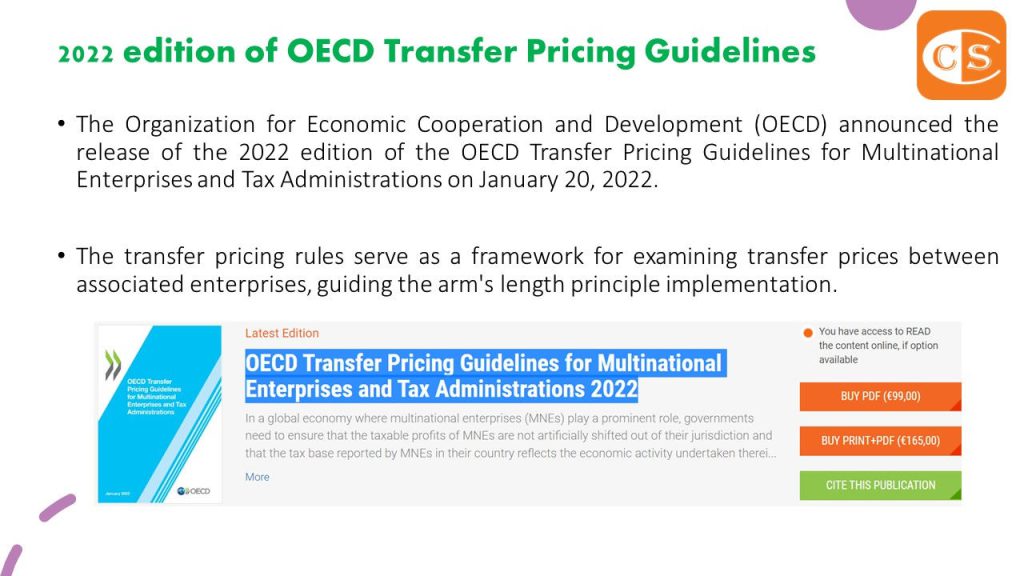
    1. The Organization for Economic Cooperation and Development (OECD) announced the release of the 2022 edition of the OECD Transfer Pricing Guidelines for Multinational Enterprises and Tax Administrations on January 20, 2022.

    2. The transfer pricing rules serve as a framework for examining transfer prices between associated enterprises, guiding the arm’s length principle implementation.

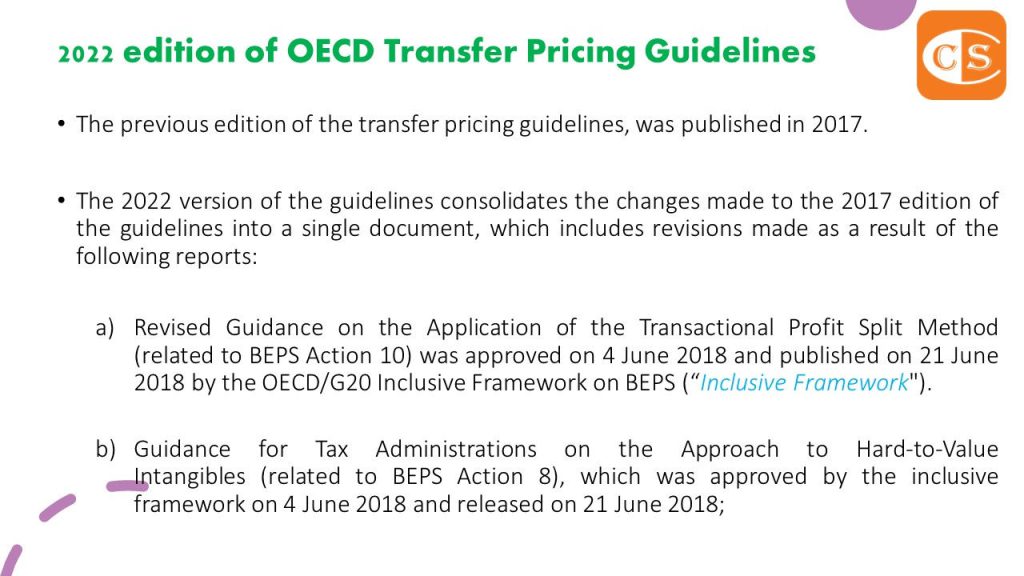
    3. The previous edition of the transfer pricing guidelines, was published in 2017. The 2022 version of the guidelines consolidates the changes made to the 2017 edition of the guidelines into a single document, which includes revisions made as a result of the following reports:

    a) Revised Guidance on the Application of the Transactional Profit Split Method

    b) Guidance for Tax Administrations on the Application of the Approach to Hard-to-Value Intangibles

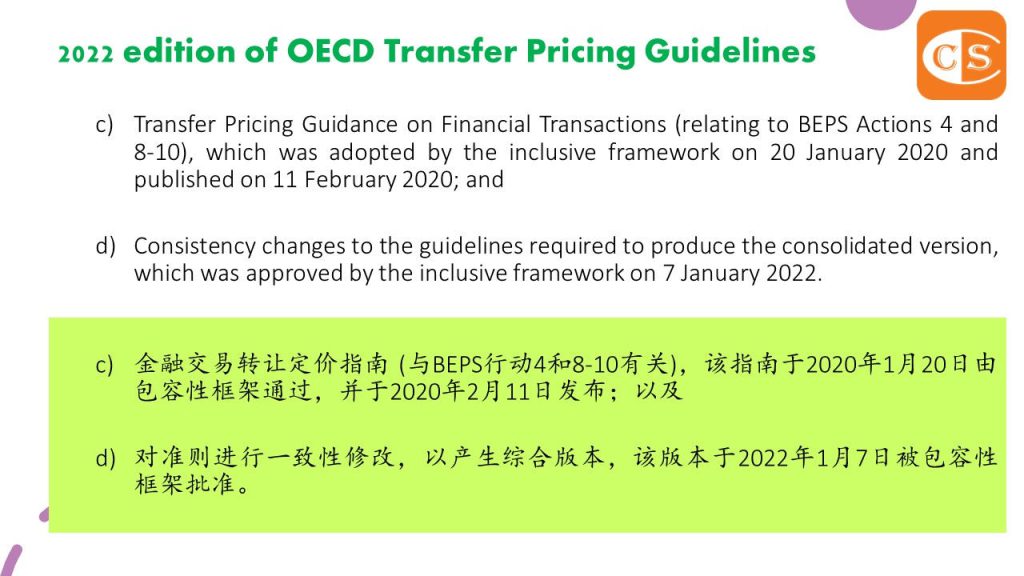
    c) Transfer Pricing Guidance on Financial Transactions 4. To Download All – https://lnkd.in/ew3gpz9E 5. Join our Telegram – https://t.me/YourAuditor

    🌻🌻🌻🌻🌻🌻🌻🌻

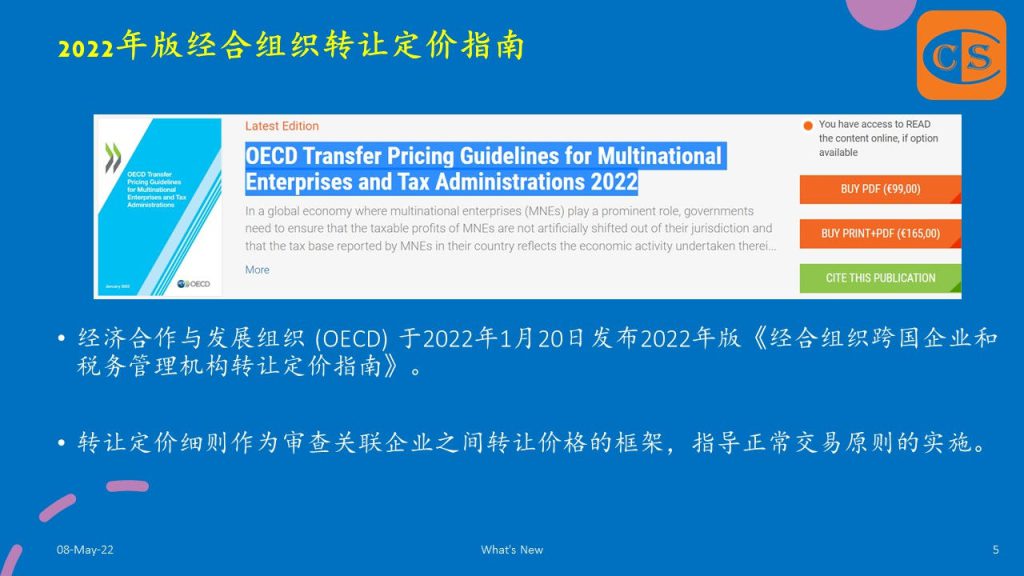
    1. 经济合作与发展组织(OECD)于2022年1月20日发布2022年版《经合组织跨国企业和税务管理机构转让定价指南》。

    2. 转让定价细则作为审查关联企业之间转让价格的框架,指导正常交易原则的实施。

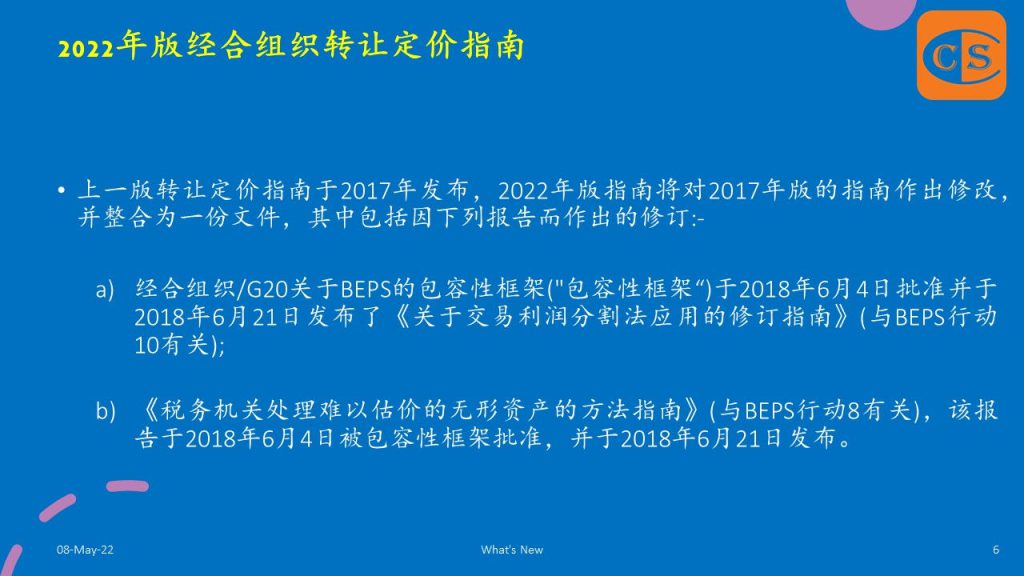
    3. 上一版转让定价指南于2017年发布,是最新的版本。2022年版指南将对2017年版的指南作出修改,并整合为一份文件,其中包括因下列报告而作出的修订:-

    a) 修订后的 交易性利润分割法应用指南

    b) 税务局关于适用难以估价的无形资产方法的指南

    c) 金融交易转让定价指南

    4. To Download All – https://lnkd.in/ew3gpz9E 5. 加入 Telegram 群 – https://t.me/YourAuditor

    🌼🌼🌼🌼🌼🌼🌼🌼🌼🌼

    11
  • TP FAQs 1: What does “Three-Tiered Approach” to Transfer Pricing Documentation mean?

    TP FAQs 1: What does “Three-Tiered Approach” to Transfer Pricing Documentation mean?

    转让定价同期资料 [Contemporaneous Transfer Pricing Documentation] 概念,源自于20世纪 90 年代初期的美国。

    纳税人在与关联方进行交易前或交易时确定关联方交易定价所依赖的文件和信息被称为 “同期转让定价文件“。

    为了打击 “税基侵蚀和利润转移” (Base Erosion and Profit Shifting,简称 “BEPS”),经济合作与发展组织(The Organisation for Economic Co-operation and Development,简称 “OECD”)及二十国集团(英语:Group of Twenty,缩写:G20)在2013年合作制定了一个15点行动计划。

    转移定价的文件是这些行动之一的主题,被称为

    • “BEPS行动13:重新审查转移定价文件”

    The concept of Contemporaneous Transfer Pricing Documentation originated in the United States in the early 1990s.

    Documentation and information that taxpayers have relied upon to determine the pricing of a related party transaction before or at the time of undertaking the transactions with related parties are referred to as “contemporaneous transfer pricing documentation.“

    To combat “Base Erosion and Profit Shifting,” sometimes known as “BEPS,” the OECD and the G20 countries collaborated in 2013 to produce a 15-point Action Plan.

    The documentation of the transfer pricing was the subject of one of these actions, which was referred to as

    • “BEPS Action 13: Re-examine Transfer Pricing Documentation.”

    三层结构 | Three-Tiered Structure

    为了能够达到上述目标,各国应采取标准化的转让定价文件编制方法,即三层结构,包括主体文档、本地文档和国别报告(”CbC报告”),以便能够达到上述目标。这将使各国能够成功实现其目标。

    To be able to reach the aims mentioned above, the countries should adopt a standardised approach to transfer pricing documentation that includes the three-tiered structure encompassing a Master file, a Local file, and a Country-by-Country Report (“CbC Reporting”) to be able to reach the goals that were outlined above.

    Three-Tiered Approach to Documentation

    主体文档 | Master File

    一个跨国企业的全球业务概况、其创造和拥有无形资产的总体转让定价政策、其金融活动、以及其全球收入和经济活动的分配,都应包括在主体文档中。这将使跨国企业的转让定价专注在全球经济、法律、金融和税收。

    跨国企业在编制主体文档时,应作出良好的判断以决定适当的详细程度。

    经合组织的指南有道出,主体文档并不需要包括所有详细的细节,这一点尤其重要。然而,也有理由担心,关于当地交易的信息可能会影响某个税务机关对什么是合理商业判断的看法。

    所需信息可分为五类,即跨国企业的

    • 组织结构
    • 一项或多项业务的描述
    • 无形资产
    • 公司间财务活动
    • 财务和税务状况

    An overview of an MNE’s global operations, its overall transfer pricing policies for the creation and ownership of intangibles, its financial activities, and its global allocation of income and economic activity should be included in the master file.

    This will allow the transfer pricing practices of the MNE to be placed in the global economic, legal, financial, and tax context.

    MNEs should exercise good judgement while generating the master file to decide the appropriate level of detail.

    This is particularly important when taking into mind the fact that the OECD guidelines state it is not required for the master file to include detailed details. However, there is also cause for concern that the information on local transactions may affect the perspective that a particular tax authority has of what constitutes reasonable business judgement.

    The required information can be grouped into five categories:

    • The MNE organisational structure
    • A description of the MNE’s business or businesses
    • The MNE’s intangibles
    • The MNE’s intercompany financial activities
    • The MNE’s financial and tax positions
    本地文档 | Local File

    本地文档包括本地公司集团内部的交易信息。

    与主体文档一样,BEPS 为本地文档中应包含的信息提供了指导方针:

    • 本地实体的管理结构
    • 在纳税年度内所执行的公司内部交易
    • 相关公司间的协议
    • 转让定价的方法和应用
    • 本地实体的财务状况

    虽然主体文档提供了一个高层次的摘要,然而本地文档则提供有关特定的重大公司间交易的更深入的信息;参照《2012年马来西亚转让定价指南》,关键要素包括:-

    • 组织结构
    • 集团财务报告
    • 业务/行业的性质和市场条件
    • 受控交易
    • 定价政策
    • 有关影响定价政策制定的因素的假设、策略和信息
    • 职能分析
    • 可比性分析
    • 转让定价方法的选择和应用

    The Local File includes information on the intracompany transactions within the local company.

    In the same way, as with the Master File, the BEPS provides guidelines for the information that should be included in local files:

    • The management structure of the local entity
    • Intracompany transactions executed during the tax year
    • Related intercompany agreements
    • Transfer pricing methodology and application
    • Local entity financials

    While the Master File offers a high-level summary, however, the Local File provides more in-depth information concerning particular significant intercompany transactions; referring to The Malaysian Transfer Pricing Guidelines 2012, key elements include:

    • Organisational Structure,
    • Group financial report
    • Nature of the business/industry and market conditions
    • Controlled transactions,
    • Pricing policies.
    • Assumption, strategies and information regarding factors that influenced the setting of pricing policies
    • Functional Analysis,
    • Comparability Analysis,
    • Selection and Application of Transfer Pricing Methods.
    Photo: 王春友

    有时候,本地文档在关联交易部分,往往也可能需要披露以下的信息:

    • 价值链分析
    • 对外投资
    • 关联股权转让;以及
    • 关联劳务

    Sometimes, the Local File may also often require the following disclosures in the controlled transactions section:

    • Value chain analysis,
    • foreign investments,
    • related equity transfers; and
    • Intra Group Services
    国别报告 | CbCR

    税基侵蚀和利润转移(BEPS)行动计划认识到,通过向税务部门提供足够的信息来评估高层次的转让定价和其他与 BEPS 相关的风险,从而提高税务部门的透明度是解决 BEPS 问题的一个重要事项。

    《行动计划 13》为跨国公司提供了一个模板,让它们每年都要为其开展业务的每个税收管辖区报告其中所列信息,该报告被称为国别报告(CbCR)。

    根据《指南》,国别报告是三层文件架构中的最后一个组成部分,它必须提供所有实体和每个税收管辖区关于以下八个要素的汇总信息(不包括任何公司间的调整或抵消):-

    • 关联方和非关联方的收入及总和,包括特许权使用费、服务费、利息收入溢价,以及与关联方或非关联方交易所得的任何其他款项,不包括股息
    • 税前利润
    • 支付的所得税,包括预扣税
    • 应计所得税,即报告年度的应课税利润所记录的应计当期税务的总和,不包括储备金或递延税款或不确定的税务责任准备金
    • 按全职等值计算的雇员人数
    • 规定的资本
    • 留存收益;以及
    • 除现金和现金等价物之外的有形资产

    但是,要注意的是,CbC 报告旨在成为税务机关的风险评估工具,”不应该被用来替代基于全面功能分析和全面可比性分析的个别交易和价格的详细转让定价分析”。

    The Base Erosion and Profit Shifting (BEPS) Action Plan recognised that enhancing transparency for tax administrations by providing them with adequate information to assess high-level transfer pricing and other BEPS-related risks is a crucial aspect of tackling the BEPS issues.

    Action Plan 13 provides a template for multinational companies to report annually and for each tax jurisdiction in which they do business, the information set out therein. This report is called the Country-by-Country Reporting (CbCR).

    According to the Guidelines, the CbC report, which is the last component of the three-tiered documentation package, must provide aggregate information (without any intercompany adjustments or eliminations) for all entities and each tax jurisdiction on the eight elements listed below:

    Revenue by related and unrelated parties and the sum, including royalties, service fees, interest income premiums, and any other amounts derived from transactions with related or unrelated persons, excluding dividends;

    • Profits before income tax;
    • Income tax paid, including withholding taxes;
    • Income tax accrued, that is, the sum of the accrued current tax expense recorded on taxable profits of the year of reporting, excluding reserves or deferred taxes or provisions for uncertain tax liabilities;
    • The number of employees on a full-time equivalent basis;
    • Stated capital;
    • Retained earnings; and
    • Tangible assets other than cash and cash equivalents.

    However, it is important to note that the CbC report is intended to be a risk assessment tool for the tax authorities and “should not be used as a substitute for a detailed transfer pricing analysis of individual transactions and prices based on a full functional analysis and a full comparability analysis.”

    特殊事项文档 | Special Matters Documentation

    参考马来西亚 2012 年转让定价指南 [The Malaysian Transfer Pricing Guidelines 2012],会发现同期资料,其实还包括了以下这些特殊事项文档:

    • 成本分摊协议
    • 关联劳务
    • 无形资产
    • 关联金融援助

    Referring to The Malaysian Transfer Pricing Guidelines 2012, you will find that the contemporaneous information includes the following special matters documents:-

    👉 Cost Contribution Arrangement;

    👉 Intra Group Services;

    👉 Intangible Properties;

    👉 Intragroup Financing.

    Our website's articles, templates, and material are solely for reference. Although we make every effort to keep the information up to date and accurate, we make no representations or warranties of any kind, either express or implied, regarding the website or the information, articles, templates, or related graphics that are contained on the website in terms of its completeness, accuracy, reliability, suitability, or availability. Any reliance on such information is therefore strictly at your own risk.

    Keep in touch with us so that you can receive timely updates |

    要获得即时更新,请与我们保持联系

    1. Website ✍️ https://www.ccs-co.com/ 2. Telegram ✍️ http://bit.ly/YourAuditor 3. Facebook ✍

    4. Blog ✍ https://lnkd.in/e-Pu8_G 5. Google ✍ https://lnkd.in/ehZE6mxy

    6. LinkedIn ✍ https://www.linkedin.com/company/74734209/admin/

    12