Tag: Limited Liability Partnership

  • Review of Income Tax Rate for Micro, Small and Medium Enterprises

    Review of Income Tax Rate for Micro, Small and Medium Enterprises

    Update: The Ismail Sabri Government Budget is no longer applicable. Malaysia’s national budget for 2023 was re-tabled again in February 2023.

    To Download Revised Budget 2023 Speech and some other related publications – https://www.ccs-co.com/post/budget-2023-malaysia-madani

    Current Position

    A Company or Limited Liability Partnership (LLP) that has a paid-up capital of RM2.5 million and below with an annual sales turnover not exceeding RM50 million is categorised as Micro, Small and Medium Enterprises (MSME).

    They are subjected to income tax of:

    • 17% (preferential tax rates) for the first RM600,000 of chargeable income; and
    • 24% (prevailing tax rate) on the remaining chargeable income.

    Proposal

    To boost MSME competitiveness and promote economic growth, it is suggested to cut the tax rate on chargeable income for the first RM150,000 from 17% to 15%, while maintaining the tax rates for the remaining taxable income at 17% and 24% as follows:-

    Effective Date

    For the year of assessment 2023.

    Comments

    The reduction of tax rates for the first RM150,000 of chargeable income can provide some relief for MSMEs, which are often cash-strapped and struggling to stay afloat, especially during the COVID-19 pandemic.

    By reducing their tax burden, MSMEs can have more resources to invest in their business and grow their operations. This, in turn, can contribute to economic growth and job creation.

    Footnotes

    A MSME will not be entitled to the preferential tax rate if more than:

    • 50% of the paid-up capital of its ordinary shares is directly or indirectly owned by a related company
    • 50% of the paid-up capital of the ordinary shares of the related company is directly or indirectly owned by the first-mentioned company, or
    • 50% of the paid-up capital of the ordinary shares of the first-mentioned company and the related company is directly or indirectly owned by another company.

    “Related Company” means a company which has a paid-up capital in respect of its ordinary shares of more that RM2.5m at the beginning of the basis period for a year of assessment.

    Practice Note

    The Inland Revenue Board (IRB) released Practice Note No 3/2020 and Practice Note No 4/2020 to explain gross income from business sources of not more than RM50m.

    According to the practice note, investment holding companies not listed on Bursa Malaysia are not eligible for the preferential tax rate because they do not have business income. However, Investment holding companies listed on Bursa Malaysia will be considered to have business income and qualify for the preferred tax rate.

    Our website's articles, templates, and material are solely for reference. Although we make every effort to keep the information up to date and accurate, we make no representations or warranties of any kind, either express or implied, regarding the website or the information, articles, templates, or related graphics that are contained on the website in terms of its completeness, accuracy, reliability, suitability, or availability. Any reliance on such information is therefore strictly at your own risk.

    Keep in touch with us so that you can receive timely updates |

    要获得即时更新,请与我们保持联系

    1. Website ✍️ https://www.ccs-co.com/ 2. Telegram ✍️ http://bit.ly/YourAuditor 3. Facebook ✍

    4. Blog ✍ https://lnkd.in/e-Pu8_G 5. Google ✍ https://lnkd.in/ehZE6mxy

    6. LinkedIn ✍ https://www.linkedin.com/company/74734209/admin/

    23
  • Review of Tax Incentive for Equity Crowdfunding

    Review of Tax Incentive for Equity Crowdfunding

    Update: The Ismail Sabri Government Budget is no longer applicable.

    Malaysia’s national budget for 2023 was re-tabled again in February 2023; for more info, please visit – https://www.ccs-co.com/post/budget-2023-malaysia-madani.

    This tax incentive included in Budget 2023, tabled in Parliament on 7 October 2022, was not included in Budget 2023 (Re-tabled) on 24 February 2023.

    Response from MOF: MOF is currently reviewing off-budget items.

    The phrase “MOF is currently reviewing off-budget items” typically refers to the Ministry of Finance (MOF) evaluating or examining expenses or financial matters that are not included in the official budget. Off-budget items are expenditures or revenue sources not directly accounted for in the regular budgeting process.

    Governments often create budgets to allocate funds for various programs, projects, and expenses. However, certain financial activities may fall outside the scope of the official budget. These off-budget items could include emergency spending, special funds, grants, subsidies, or other financial transactions not explicitly accounted for in the regular budgeting process.

    When the MOF reviews off-budget items, they are scrutinising these financial activities to assess their impact, legality, appropriateness, or potential risks. This review aims to ensure transparency, fiscal responsibility, and effective financial management within the government. It helps identify discrepancies, assess the necessity and effectiveness of off-budget items, and make informed decisions regarding their continuation or modification.

    Current Position

    In Budget 2021, individual investors who invest in equity crowdfunding platforms approved by the Securities Commission (SC) will be allowed a tax exemption for a specified amount of aggregate income.

    The proposal has been legislative under the Income Tax (Exemption) (No 4) Order 2022.

    Under the Order, 50% of the amount invested for each year of assessment will be deductible against the individual’s aggregate income, subject to the conditions as follows:

    1. the eligible amount for tax exemption is limited to RM50,000 each year of assessment;
    2. the deductible amount is limited to 10% of the aggregate income for that year of assessment. The excess amount will be disregarded;
    3. the Securities Commission Malaysia must verify the investor, investee company and amount of investment made;
    4. the investor must not have any family relationship with the investee company;
    5. the investment must be made through an equity crowdfunding platform approved by the Securities Commission Malaysia; and
    6. the investment is not allowed to be disposed of within 2 years from the date of investment.

    The tax incentive is for investments made from January 1, 2021, until December 31, 2023.

    Proposal [This tax incentive included in Budget 2023, tabled in Parliament on 7 October 2022, was not included in Budget 2023 (Re-tabled) on 24 February 2023]

    To attract more individual investors to invest in start-up companies through equity crowdfunding, it is proposed tax incentives be reviewed as follows:

    • scope of tax incentives be expanded to include investments made by individuals investor through Limited Liability Partnership Nominee Company; and
    • the investment period to be extended for 3 years.

    Effective Date

    For investment made from 1 January 2024 until 31 December 2026.

    Our website's articles, templates, and material are solely for reference. Although we make every effort to keep the information up to date and accurate, we make no representations or warranties of any kind, either express or implied, regarding the website or the information, articles, templates, or related graphics that are contained on the website in terms of its completeness, accuracy, reliability, suitability, or availability. Therefore, any reliance on such information is strictly at your own risk.

    Keep in touch with us so that you can receive timely updates |

    要获得即时更新,请与我们保持联系

    1. Website ✍️ https://www.ccs-co.com/ 2. Telegram ✍️ http://bit.ly/YourAuditor 3. Facebook ✍

    4. Blog ✍ https://lnkd.in/e-Pu8_G 5. Google ✍ https://lnkd.in/ehZE6mxy

    6. LinkedIn ✍ https://www.linkedin.com/company/74734209/admin/

    16
  • Forms E & CP 8D – Employees Information

    Forms E & CP 8D – Employees Information

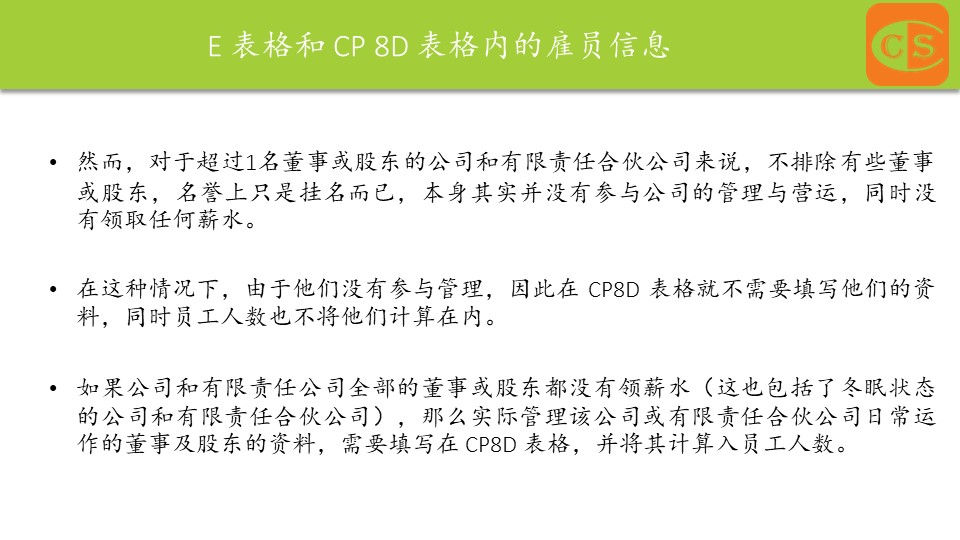
    1. When it comes to completing Form E and Form CP 8D, one of the questions that employers frequently ask is

    👉 In the event that the Company or Limited Liability Partnership (LLP) is dormant and there are no more employees, what should be completed

    2. Another frequently asked question is

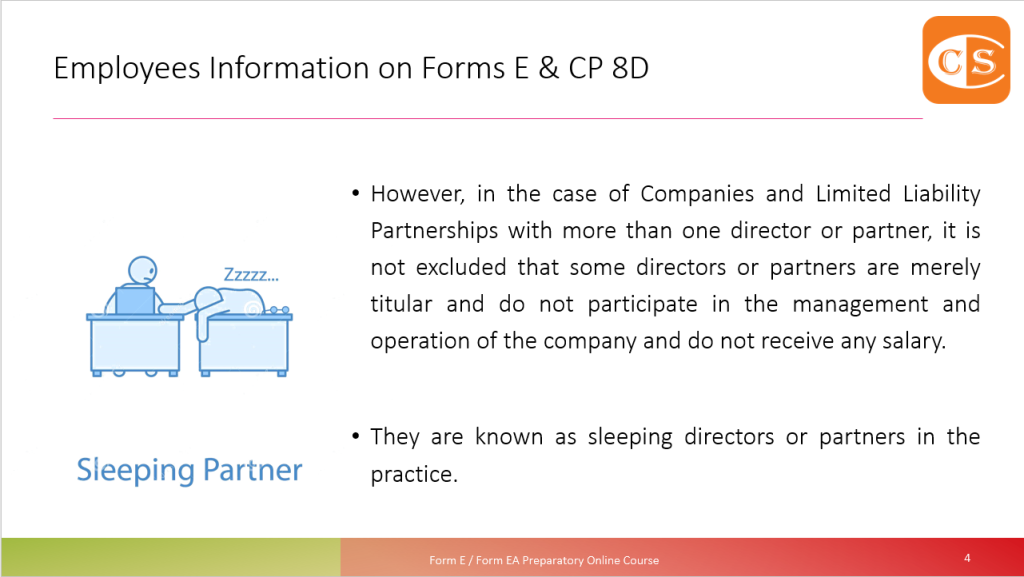
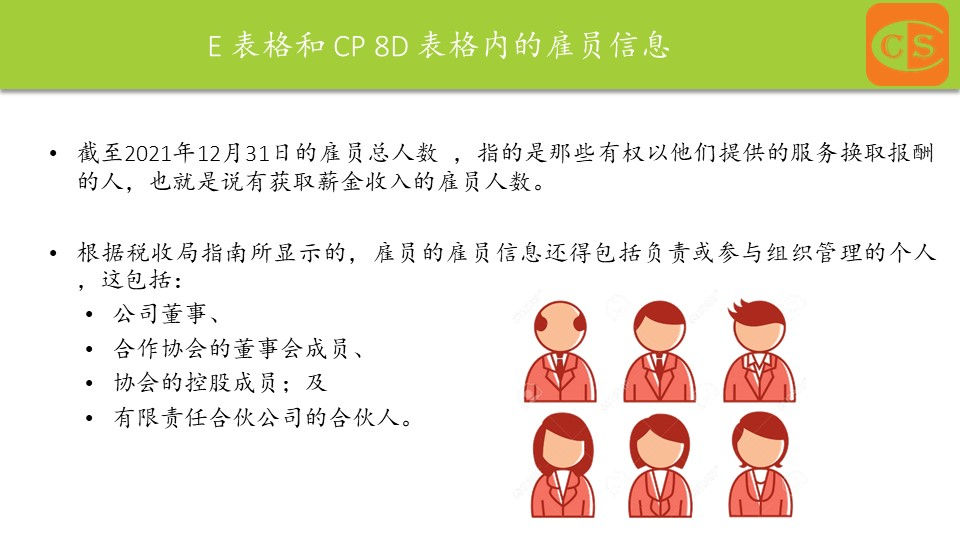
    👉 How do I fill out the form for directors and partners of Companies and Limited Liability Partnerships (LLPs) if all the directors and partners have not been paid?

    🌸🌸🌸🌸🌸🌸🌸🌸🌸🌸🌸

    1. 雇主在填写 Form E 以及 Form CP 8D 时,会经常问的一个问题就是:

    👉 如果公司冬眠状态,完全没有员工了,那么应该要怎样填

    2. 另外一个常见的问题是:

    👉 公司 [Company] 及有限责任合伙公司 [LLP] 的董事及股东,如果都没有领薪水,需要怎样填?

    🌻🌻🌻🌻🌻🌻🌻🌻🌻

    1. Something About “Form TP 1”

    TP 1 表格,什么来的?

    https://lnkd.in/em-i-VWx

    2. Mandatory Adoption of Prescribed Forms CP21, CP22, CP22A, and CP22B

    强制性采用指定的表格 CP21、CP22、CP22A 和 CP22B

    https://lnkd.in/eBwiFntG

    3. Employer’s tax obligation Under Income Tax Act 1967

    1967年所得税法令下,雇主需要注意的条文

    https://lnkd.in/emgbwkBj

    4. CP22, PCB, Form E & EA, CP22A, CP21: Employer’s Liability to Employees for Tax Purposes – From Commencement to Cessation

    税务上,雇主对于员工的责任 – 从入职开始到离开

    https://lnkd.in/epBAHych

    5. The Difference between a Contractor / Freelancer and an Employee

    承包商/自由职业者和雇员之间的区别

    https://lnkd.in/e9nMixUW

    6. Perquisite vs Benefits in Kind

    额外补贴 vs 实物利益

    https://lnkd.in/e6Ke3SXn

    7. Forms E & CP 8D – Employees Information

    雇员信息

    https://lnkd.in/exp6nX_m

    🌳🌳🌳🌳🌳🌳🌳🌳🌳🌳🌳🌳

    9
  • Tax Clearance Letter: Closing the Income Tax File – Limited Liability Partnerships (LLP)

    Tax Clearance Letter: Closing the Income Tax File – Limited Liability Partnerships (LLP)

    1) The Inland Revenue Board (IRB) has published Operational Guidelines No. 3/2021, titled “Permohonan Surat Penyelesaian Cukai Bagi Syarikat, Perkongsian Liabiliti Terhad Dan Entiti Labuan” on its website in Bahasa Malaysia.

    2) The Guidelines, which were issued on June 30, 2021, supersede GPHDN 2/2019, which was published on November 12, 2019.

    🌼🌼🌼🌼🌼🌼🌼🌼🌼🌼

    1) 内陆税收局(IRB)在其网站上发布了马来文版本的第3/2021号操作指南,题为 “Permohonan Surat Penyelesaian Cukai Bagi Syarikat, Perkongsian Liabiliti Terhad Dan Entiti Labuan”。

    2)该指南于2021年6月30日发布,取代了2019年11月12日发布的 GPHDN 2/2019。

    12
  • Filing of Form Q by A Person who is Aggrieved by an Assessment

    Filing of Form Q by A Person who is Aggrieved by an Assessment

    1. A person who is aggrieved by an assessment made on him by the Director-General of Inland Revenue (DGIR) for any year of assessment is entitled to appeal such assessment under Section 99 of the Income Tax Act 1967 (ITA).

    2. According to paragraph 99(1) of the ITA, an appeal must be filed by filing a Form Q within thirty (30) days of receiving the notice of assessment.

    🌼🌼🌼🌼🌼🌼🌼🌼🌼🌼🌼🌼🌼🌼🌼🌼🌼🌼🌼🌼🌼🌼🌼🌼🌼

    1. 一个人如果对税收局总监(DGIR)就任何一个评估年度对他所做的评估/课税感到不满,有权根据 1967年所得税法令第99条对该评估/课税提出上诉。

    2. 根据 1967年所得税法令第99(1)条,上诉必须在收到评估通知后的30天内,通过提交Q表格。

    11