
Tag: International Auditing and Assurance Standards Board

  • What Function Does the International Auditing and Assurance Standards  Board(IAASB)Play?

    What Function Does the International Auditing and Assurance Standards Board(IAASB)Play?

    The International Auditing and Assurance Standards Board, also known as the IAASB, is responsible for setting the International Standards on Auditing (ISAs).

    It is an independent body that sets international standards of high quality on aspects of:

    • Auditing;
    • Assurance;
    • Quality Control;
    • Review; and
    • Related services.

    The International Auditing and Assurance Standards Board were established in March 1978. Before that, it was known as the International Auditing Practices Committee (IAPC), and its activity used to be concentrated on three main areas at the time:

    • Objects and scope of audits of Financial Statements;
    • Engagement letters; and
    • General auditing guidelines.

    It is easy to see how the work of the International Auditing and Assurance Standards Board (IAASB) has dramatically progressed since 1991, when the guidelines initially developed by the International Auditing Practices Committee (IAPC) were renamed the International Standards on Auditing (ISAs).

    In 2002, the IAPC changed its name to the International Auditing and Assurance Standards Board (IAASB), and the International Federation of Accountants (IFAC) approved a series of reforms. These reforms were primarily designed (among other things) to strengthen the standard-setting process, which included the operations at the IAASB.

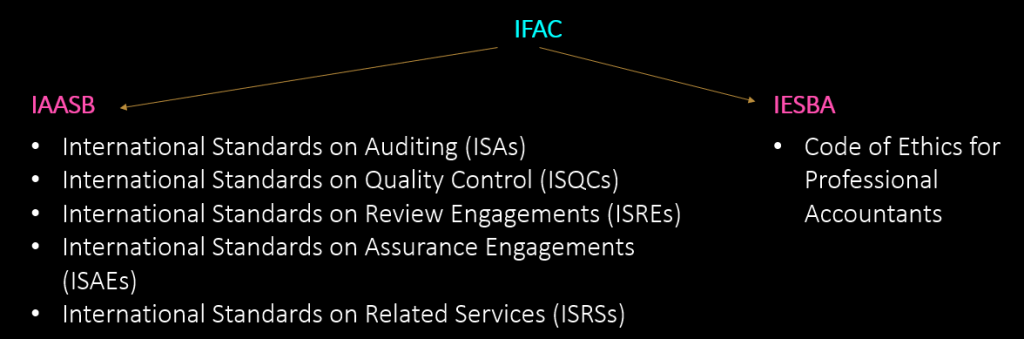
    The International Auditing and Assurance Standards Board (IAASB) is a technical standing committee of the International Federation of Accountants (IFAC) that has close ties to the International Ethics Standards Board for Accountants (IESBA), which is responsible for the production of the Code of Ethics for Professional Accountants. The following is an example that illustrates the hierarchy:
    According to the introduction to the revised edition of International Standards on Quality Control, Auditing, Assurance, and Related Services Pronouncements (2011), the standards that the IAASB produced are considered authoritative content.

    As these standards are authoritative, they must be followed in an audit conducted in accordance with the ISAs.

    In addition to publishing documents that are considered to be “authoritative,” the IAASB also publishes materials that are considered to be “non-authoritative,” which provide a type of “advice” rather than requirements. These are:

    • International Auditing Practices Notes (IAPNs) – These are designed to provide practical assistance to auditors rather than impose mandatory requirements.
    • Practice Notes Relating to Other International Standards.
    • Staff Publications – these are designed to raise awareness of new or emerging issues about the standards and to direct attention to the relevant parts of IAASB pronouncements.

    Some jurisdictions will have their bodies that are responsible for standard-setting. For instance, the Financial Reporting Council is the organisation in charge of establishing standards in the UK.

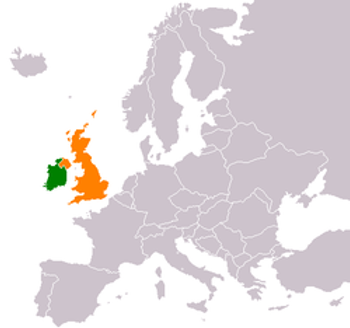
    Some nations have decided to adopt ISAs, but such laws will need to be modified before they can be implemented. For instance, in the United Kingdom, ISAs are adopted; however, they are modified in certain areas so that they are compatible with UK standards; the resulting documents are nevertheless referred to as ISAs (UK and Ireland).

    Example
    The auditor is required by ISA 570 Going Concern to determine whether management has made a going concern assessment that covers a period of 12 months beginning on the date of the financial statements. 
    
    However, in the United Kingdom and Ireland, this assessment of the company's ability to continue operations should encompass a period of one year beginning on the day that the financial statements are approved (or the date that is likely to be approved). 
    
    Because of this, the ISA for the United Kingdom and Ireland spans a period of time that is distinct from that of the mainstream ISA; this exemplifies how the standard-setters have adapted the latter to be applicable only in the United Kingdom and Ireland. 
    
    In the UK the going concern ISA is known as ISA (UK and Ireland) 570  Going Concern. 
    
    In the UK and Ireland ISAs are frequently referred to as  ‘ISA  pluses’ because they contain additional or amended requirements to the mainstream ISA that is issued by the IAASB.
    18
  • Improving Audit Quality 1: An Overview

    Improving Audit Quality 1: An Overview

    Back to N Years Ago

    When I was younger (wow, this makes me feel so old), audit quality was not really a “thing.” I watched my superiors perform audits they believed to be sufficient, and my colleagues and I were taught to follow in their footsteps.

    We conducted what we believed to be good audits but were never informed that we would be subjected to a review by a firm or an external third party.

    Enron Scandal: The Fall of a Wall Street Darling

    The Enron scandal drew attention to accounting and corporate fraud as its shareholders lost $74 billion in the four years leading up to its bankruptcy, and its employees lost billions in pension benefits.

    Sarbanes-Oxley Act of 2002 (SOX)

    The Sarbanes-Oxley Act of 2002 is a federal law in the US that established sweeping auditing and financial regulations for public companies. Lawmakers created the legislation to help protect shareholders, employees and the public from accounting errors and fraudulent financial practices.

    This was done in response to the widespread perception that audits had been conducted improperly in the United States.

    With the passage of the Sarbanes-Oxley Act of 2002 (SOX), which also established the Public Company Accounting Oversight Board (PCAOB) to oversee the audits of public companies, the requirement that audits be inspected by a government regulator was established.

    Since then, regulators with comparable responsibilities have been established in a total of 54 different jurisdictions across the globe. This is shown by the fact that these jurisdictions have joined the International Forum of Independent Audit Regulators (IFIAR – https://www.ifiar.org/)

    For instance, the Financial Reporting Council in the United Kingdom took on this task in 2003, the Australian Securities and Investments Commission in 2004, and the Audit Oversight Board (AOB) of the Securities Commission Malaysia in 2010.

    Practice Review Committee under the Malaysian Institute of Accountants

    However, the Malaysian Institute of Accountants’ Practice Review Committee conducted its inaugural meeting after Council approved the By-Laws on Practice Review in December 2002 and field review under the Practice Review Programme commenced in 2004.

    Adoption of ISQC 1

    In 2004, the International Auditing and Assurance Standards Board (IAASB), working under the direction of the International Federation of Accountants (IFAC), gave its approval to the ISQC 1 standard [Firm Level Quality Control – https://www.ccs-co.com/post/isqc-1-firm-level-quality-control], which addresses quality control for firms that perform audits and reviews of historical financial information and other assurance and related services engagements.

    In order to fulfil the requirements established by IFAC, the Malaysian Institute of Accountants (MIA) has mandated that all registered accountants and auditors (practitioners) in the country must conform with ISQC 1 by the end of June 2006. The standards introduce several new concepts and requirements in respect of quality control within auditing firms. As a consequence of this, auditing firms are having extra responsibilities to fulfil in regard to the implementation of new quality control safeguards and procedures.

    ISQC 1 is not the same as ISA 220 “Quality Control for Audits of Historical Financial Information” which sets out the quality control standards to be applied to individual audit engagements. On the other hand, the ISQC 1 focuses on firms and the people that work within them to ensure compliance with various professional standards, regulatory, and legal requirements.

    A study was then carried out in 2007 by the Malaysian Institute of Accountants (MIA) and the Universiti Teknologi MARA (UiTM) suggests that the application of ISQC 1 in Malaysian small and medium audit firms is fairly restricted. The majority of small and medium-sized audit firms follow non-standard operating procedures in their day-to-day work, which fundamentally does not reflect full compliance with ISQC 1.

    Understanding the International Standards on Quality Control 1

    Definitions – https://www.ccs-co.com/post/isqc-1-definitions

    It covers

    1. leadership responsibilities for quality within the firm;
      1. https://lnkd.in/gKSKWAPC
    2. ethical requirements;
      1. https://lnkd.in/gAzwW3gv
    3. acceptance and continuance of client relationships and specific engagements;
      1. https://lnkd.in/gaYQX88e
    4. human resources;
      1. https://lnkd.in/g8Ax_F6X
    5. engagement performance;
      1. https://lnkd.in/gWg8GSSx
      2. https://lnkd.in/g7k_mGA8
    6. monitoring; and
      1. https://lnkd.in/gjPSPWa7
    7. documentation.
      1. https://lnkd.in/gHvf26bk

    Auditing firms are required by the standards to document the proof that each of the seven components of their quality control system is functioning properly and to keep this documentation for the appropriate amount of time.

    Moving Forward

    Enhancing the quality should also be a primary focus during this advantageous moment.

    On the basis of the most recent results of the Practice Review, which are depicted in the statistics contained within this report, practitioners are strongly encouraged to ensure that their firms comply with all of the necessary requirements, whether it be at the level of the entire firm or at the level of each individual engagement.

    The audit firms NOT ONLY need to get familiar with and comprehend the important sections of the International Standard on Auditing (ISA), the International Standard on Quality Control 1 (ISQC 1), the Companies Act 2016 (CA 2016), the MIA By-Laws, and any other applicable professional standards and laws, in addition, the audit firms also need to begin making preparations well in advance to comply with newly implemented standards, notably ISQM 1 and 2.

    ISQM 1 & ISQM 2

    ISQM 1 & ISQM 2 will be effective from 15 December 2022.

    20