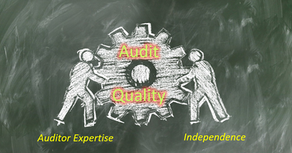
Sadly, there is no one agreed-upon definition of what constitutes a quality audit. The Center for Audit Quality (CAQ) identifies the following as the two primary pillars around which audit quality is built:
Auditor Expertise; and
Independence (*)
(*) Independence refers to external auditors’ interests being independent of those of company management
Several elements determine the quality of an audit; nevertheless, the combination of these two cornerstones increases the level of trust and confidence in business financial statements and serves as the foundation for the quality of an audit.
About the Center for Audit Quality (CAQ)
The Center for Audit Quality (CAQ) is an autonomous public policy organisation dedicated to enhancing investor confidence and public trust in the global capital markets. The CAQ fosters high-quality performance by public company auditors; convenes and collaborates with other stakeholders to advance the discussion of critical issues that require action and intervention; and advocates policies and standards that promote public company auditors’ objectivity, effectiveness, and responsiveness to dynamic market conditions. Based in Washington, DC, the CAQ is affiliated with the American Institute of CPAs.
According to the International Auditing and Assurance Standards Board (IAASB), a quality audit is more likely to have been accomplished by an engagement team that:-
Exhibited appropriate values, ethics, and attitudes,
Was sufficiently knowledgeable, skilled, and experienced, and had sufficient time allocated to perform the audit work,
Applied a rigorous audit process and quality control procedures that complied with the law, regulation, and applicable standards,
Provided valuable and timely reports, and
Interacted appropriately with relevant stakeholders.
Audit Quality Standards
According to International Forum of Independent Audit Regulators (IFIAR), a robust quality control system is vital to enhancing and sustaining audit quality. As a result, quality control systems are a primary focus of many inspection Programmes.
A matter of particular concern is that inspectors’ results about quality control inspections have fluctuated widely over time. Because of this, the International Accounting Standards Board (IAASB) issued two new standards in December 2020 to reinforce and modernise how firms use quality management:-
ISQM 1 Quality Management for Firms that Perform Audits or Reviews of Financial Statements, or Other Assurance or Related Services Engagements
ISQM 2 Engagement Quality Reviews
These standards direct audit firms to improve the robustness of their monitoring and remediation, embed quality into their corporate culture and the “tone at the top,” and improve the robustness of engagement quality reviews.
In June of 2022, the Auditing Standards Board (ASB, which is the AICPA’s senior committee for auditing, attestation, and quality control applicable to the performance and issuance of audit and attestation reports for non-issuers.) adopted comparable standards.
In Malaysia
These two new Quality Management Standards have also been approved by the Malaysian Institute of Accountants on 17 September 2021
These standards will come into effect on 15 December 2022, in line with all major jurisdictions adopting the ISQM and ISAs.
The firm shall establish policies and procedures designed to provide it with reasonable assurance that the firm and its personnel comply with relevant ethical requirements.
第20段:会计师事务所应当制定政策和程序,以合理保证会计师事务所及其人
员遵守相关职业道德要求。
Independence | 独立性
Para 21:
The firm shall establish policies and procedures designed to provide it with reasonable assurance that the firm, its personnel and, where applicable, others subject to independence requirements (including network firm personnel) maintain independence where required by relevant ethical requirements.
Such policies and procedures shall enable the firm to (Ref: Para. A10)
Communicate its independence requirements to its personnel and, where applicable, others subject to them; and
Identify and evaluate circumstances and relationships that create threats to independence, and take appropriate action to eliminate those threats or reduce them to an acceptable level by applying safeguards, or, if considered appropriate, to withdraw from the engagement, where withdrawal is possible under applicable law or regulation.
Such policies and procedures shall require: (Ref: Para. A10)
Engagement partners to provide the firm with relevant information about client engagements, including the scope of services, to enable the firm to evaluate the overall impact, if any, on independence requirements;
Personnel to promptly notify the firm of circumstances and relationships that create a threat to independence so that appropriate action can be taken; and
The accumulation and communication of relevant information to appropriate personnel so that:
The firm and its personnel can readily determine whether they satisfy independence requirements;
The firm can maintain and update its records relating to independence; and
The firm can take appropriate action regarding identified threats to independence that are not at an acceptable level.
The firm shall establish policies and procedures designed to provide it with reasonable assurance that it is notified of breaches of independence requirements and to enable it to take appropriate actions to resolve such situations.
The policies and procedures shall include requirements for: (Ref: Para. A10)
Personnel to promptly notify the firm of independence breaches of which they become aware;
The firm to promptly communicate identified breaches of these policies and procedures to:
The engagement partner who, with the firm, needs to address the breach; and
Other relevant personnel in the firm and, where appropriate, the network, and those subject to the independence requirements who need to take appropriate action; and
Prompt communication to the firm, if necessary, by the engagement partner and the other individuals referred to in subparagraph 23(b)(ii) of the actions taken to resolve the matter, so that the firm can determine whether it should take further action.
At least annually, the firm shall obtain written confirmation of compliance with its policies and procedures on independence from all firm personnel required to be independent by relevant ethical requirements. (Ref: Para. A10–A11)
The firm shall establish policies and procedures: (Ref: Para. A10)
Setting out criteria for determining the need for safeguards to reduce the familiarity threat to an acceptable level when using the same senior personnel on an assurance engagement over a long period of time; and
Requiring, for audits of financial statements of listed entities, the rotation of the engagement partner and the individuals responsible for engagement quality control review, and, where applicable, others subject to rotation requirements, after a specified period in compliance with relevant ethical requirements. (Ref: Para. A12–A17)
Compliance with Relevant Ethical Requirements (Ref: Para. 20)
遵守相关职业道德要求(参见:第 20 段)
A7.
The IESBA Code establishes the fundamental principles of professional ethics, which include:
Integrity;
Objectivity;
Professional competence and due care;
Confidentiality; and
Professional behaviour.
国际职业会计师道德守则规定了职业道德基本原则,包括:
诚信;
客观;
专业胜任能力和应有的关注;
保密;
职业行为。
A8.
Part B of the IESBA Code illustrates how the conceptual framework is to be applied in specific situations. It provides examples of safeguards that may be appropriate to address threats to compliance with the fundamental principles and also provides examples of situations where safeguards are not available to address the threats.
国际职业会计师道德守则的 B 部分说明了如何在具体情形下运用概念框架,并且举例说明为处理对遵守职业道德基本原则产生不利影响的情形而采取的适当防范措施,以及无法采取防范措施以应对不利影响的情形。
A9.
The fundamental principles are reinforced in particular by:
The leadership of the firm;
Education and training;
Monitoring; and
A process for dealing with non-compliance.
Definition of “Firm,” “Network” and “Network Firm” (Ref: Para. 20–25)
下列途径尤其强化了职业道德基本原则:
会计师事务所领导层的示范;
教育和培训;
监控;
对违规行为的处理。
“会计师事务所”、“网络”及“网络事务所”的定义(参见:第 20-25段)
A10.
The definitions of “firm,” network” or “network firm” in relevant ethical requirements may differ from those set out in this ISA. For example, the IESBA Code3 defines the “firm” as:
A sole practitioner, partnership or corporation of professional accountants;
An entity that controls such parties through ownership, the management or other means; and
An entity is controlled by such parties through ownership, management or other means.
The IESBA Code also provides guidance in relation to the terms “network” and “network firm.”
In complying with the requirements in paragraphs 20–25, the definitions used in the relevant ethical requirements apply in so far as is necessary to interpret those ethical requirements.
Written confirmation may be in paper or electronic form.
By obtaining confirmation and taking appropriate action on information indicating non-compliance, the firm demonstrates the importance that it attaches to independence and makes the issue current for, and visible to, its personnel.
The IESBA Code discusses the familiarity threat that may be created by using the same senior personnel on an assurance engagement over a long period of time and the safeguards that might be appropriate to address such threats.
Determining appropriate criteria to address familiarity threats may include matters such as:
The nature of the engagement, including the extent to which it involves a matter of public interest; and
The length of service of the senior personnel on the engagement.
Examples of safeguards include rotating the senior personnel or requiring an engagement quality control review.
确定适当的标准以应对因密切关系产生的不利影响时,会计师事务所可能考虑下列事项:
业务的性质,包括涉及公众利益的程度;
高级人员提供该项业务的服务年限。
防范措施包括轮换高级人员,或要求实施项目质量控制覆核。
A14.
The IESBA Code recognizes that the familiarity threat is particularly relevant in the context of financial statement audits of listed entities.
For these audits, the IESBA Code requires the rotation of the key audit partner after a pre-defined period, normally no more than seven years, and provides related standards and guidance. National requirements may establish shorter rotation periods.
Considerations specific to public sector audit organizations
对公共部门实体审计机构的特殊考虑
A15.
Statutory measures may provide safeguards for the independence of public sector auditors.
However, threats to independence may still exist regardless of any statutory measures designed to protect it.
Therefore, in establishing the policies and procedures required by paragraphs 20–25, the public sector auditor may have regarded the public sector mandate and addressed any threats to independence in that context.
Listed entities as referred to in paragraphs 25 and A14 are not common in the public sector. However, there may be other public sector entities that are significant due to size, complexity or public interest aspects, and which consequently have a wide range of stakeholders. Therefore, there may be instances when a firm determines, based on its quality control policies and procedures, that a public sector entity is significant for the purposes of expanded quality control procedures.
In the public sector, legislation may establish the appointments and terms of office of the auditor with engagement partner responsibility. As a result, it may not be possible to comply strictly with the engagement partner rotation requirements envisaged for listed entities. Nonetheless, for public sector entities considered significant, as noted in paragraph A16, it may be in the public interest for public sector audit organizations to establish policies and procedures to promote compliance with the spirit of rotation of engagement partner responsibility.