The ethical conduct of professional accountants and auditors is controlled by a set of criteria they must conform to.

Auditors have a direct responsibility to the shareholders of a reporting entity (because auditors are appointed by the shareholders, not by management), but it is generally accepted that the fundamental principles of professional ethics do not just apply to auditors; rather, they apply to all professional accountants.
The presence of a members’ code of ethics and the scrutiny within the profession on members’ eventual conformity with such a code is one of the trademarks of professional qualification, among several other hallmarks.
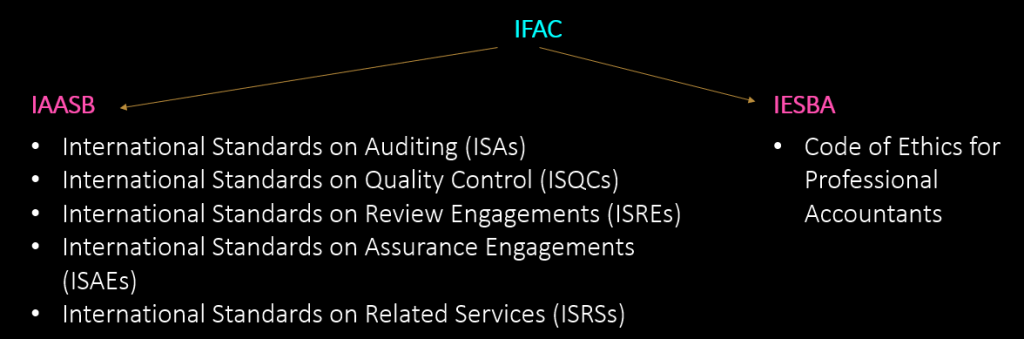
The International Ethics Standards Board for Accountants (IESBA) is responsible for publishing the Code of Ethics for Professional Accountants, sometimes known as “the Code.”

When this article was written, the most recent edition available was the 2021 Edition (readers are directed to IESBA’s website to check later versions published by IESBA).
The Code lays forth the conditions that must be met by professional accountants, regardless of whether or not they are employed in auditing practices.
Member bodies of the International Federation of Accountants (IFAC) must adhere to standards equivalent to or more severe than those outlined in the Code. There is a possibility that the IESBA Code of Ethics will not be followed in some countries due to different ethical constraints.
Both the Malaysian Institute of Certified Public Accountants (MICPA) and the Malaysian Institute of Accountants (MIA) have agreed to uphold the compliance of their members with the international code of ethics for professional accountants [including those of the International Independence Standards] prescribed by the International Ethics Standards Board for Accountants [IESBA] of the International Federation of Accountants (IFAC).
Professional accountants must be aware of the differences and comply with the more stringent requirements and guidance unless a law or regulation prohibits such compliance.
The Code is split into the following component parts:

- Part 1: establishes the Fundamental Principles of professional ethics for accountants, which provides a Professional Framework for applying those principles.
- Part 2: applies to Professional Accountants in business.
- Part 3: applies to Professional Accountants in practice
International Independence Standards:
- Part 4A: Independence for Audit and Review Engagements
- Part 4B: Independence for assurance engagements other than audit and review engagements
A professional accountant is required to observe compliance with five fundamental principles, which are:
- Integrity;
- Objectivity;
- Professional Competence and Due Care;
- Confidentiality; and
- Professional Behaviour.
Integrity
Professional accountants are expected to be honest and straightforward in all their interactions with clients, colleagues, and other business community members throughout their careers.

For professional accountants to demonstrate that they are adhering to the fundamental principles of integrity, they should not let their name be connected with any reports, returns, or other forms of communication if they believe that the information in question:
- contains a materially false or misleading statement;
- contains statements or information obtained recklessly; or
- omits or obscures information required to be included where such omission or obscurity would be misleading.
Where auditors are concerned, it may be the case that an auditor’s opinion on the financial statements is modified
Objectivity
A professional accountant should not allow bias, conflict of interest or undue influence of others to override professional or business judgements.
In some circumstances, the auditor could be put in a position where they are exposed to circumstances that could impair their objectivity. In every circumstance, the auditor needs to ensure that the auditor’s objectivity is not compromised by putting measures that safeguard the auditor’s independence and objectivity.
Professional Competence and Due Care

A professional accountant has a duty to maintain professional knowledge and skill at the level required to ensure that their client receives a competent and professional service.
Audit firms must not accept appointments as auditors unless they are competent and have sufficient resources available to undertake the required work.
Professional accountants also should act diligently under appropriate technical and professional standards when providing professional services. Professional competence comprises:
- Attaining professional competence; and
- Maintaining professional competence.
To achieve the latter, professional accountants must be up-to-date with technical developments.
Continuing Professional Education (CPE) will assist in maintaining professional competence, providing the CPE undertaken is relevant to the professional accountant’s work.
It will also serve to assist the professional accountant in performing work competently within their professional environment.
Confidentiality
Confidentiality is of paramount importance, and Section 114 Confidentiality of Part 1 of the By-Laws (on Professional Ethics, Conduct and Practice) of the Malaysian Institute of Accountants contains the obligations of a professional accountant to maintain confidentiality as well as establishing the circumstances where the professional accountant’s duty of confidentiality can be overridden.
In recognition of the professional accountant’s duty of confidentiality, the accountant should refrain from:

- Disclosing, outside the audit/accountancy firm, confidential information acquired as a result of professional and business relationships without proper and specific authority or unless there is a legal or professional right or duty to disclose.
- Using confidential information acquired as a result of professional and business relationships to their personal advantage or the advantage of third parties.
This duty of confidentiality extends to the outside of the business or practice environment where the professional accountant must observe confidentiality and not inadvertently or otherwise disclose information in a social environment.
In addition to this need, a professional accountant is obligated to protect the confidentiality of any information a potential client or employer provides.
A professional accountant has to be aware of the need to safeguard the confidentiality of information inside a company or other organisation in which they are employed.
A professional accountant must maintain client confidentiality and take all reasonable steps to accomplish this goal.

These steps should include ensuring that staff under the professional accountant’s control and persons from whom the professional accountant seeks advice and assistance also maintain client confidentiality.
Even though auditors and professional accountants have a professional duty of confidentiality, there may be occasions where the professional accountant is required by law, or considers it to be in the public interest to disclose details of clients’ affairs to third parties.
The duty of confidentiality is required to be applied at all times by the professional accountant during the course of their work, except where:
- Disclosure is permitted by law and is authorised by the client or the employer.
- Disclosure is required by law.
- Production of documents or other provision of evidence in the course of legal proceedings; or
- Disclosure to the appropriate public authorities of infringements of the law that came to light;
- There is a professional duty or right to disclose when not required by law, for example:

- when professional bodies are carrying out reviews of work done by professional accountants, and the bodies require sight of the firm’s files to review this audit work;
- to respond to an enquiry or investigation by a professional body or regulatory body;
- to protect the professional interests of a professional accountant in legal proceedings; or
- to comply with technical standards and ethical requirements.
There are two types of disclosure where the duty of confidentiality is to be overridden:
- Obligatory disclosure; and
- Voluntary disclosure

Obligatory disclosure
Where the professional accountant knows or suspects the client to have committed money laundering, treason, drug trafficking or terrorist offences, the professional accountant must disclose all the information at his disposal to a regulatory authority.
Voluntary disclosure
Voluntary disclosure may be required in the following situations:
- Disclosure is required by law;
- Where it is in the public interest to disclose (such as where a criminal offence against the public has been committed);
- Disclosure is required to protect the professional accountant’s interests (for example, defending the professional accountant in a legal case).
Example
During the course of the audit of ABC Berhad, the audit senior saw that recurring quantities of money were being deposited into the bank account of one of the company's directors in the form of round sums.

When added up over the course of the year, the amounts had reached a point where they were considered significant (material); hence, the audit senior questioned the director about the purposes of these transactions.

The director refused to provide the audit senior with any reasonable reasons and said, in an aggressive and threatening way, that the information in question was confidential and must not be released to any third party.

The audit senior's suspicions were piqued by how the director responded, which led them to believe that the director was engaged in money laundering.

Within a professional practice, the suspicion or knowledge of money laundering actions must be reported to a Money Laundering Reporting Officer (MLRO) under the legislation that govern the prevention of money laundering in many different countries.

In this situation, the audit senior would be compelled to report his concerns to the MLRO to comply with the scenario. After then, it would be up to the discretion of the MLRO to decide whether or not the suspicions merited a referral to the regulatory authorities who are tasked with conducting investigations into such concerns.

In situations like this, it is extremely important for neither the audit senior nor the MLRO to make the client aware of any such findings. Doing so would constitute "tipping off" the client and might potentially compromise any inquiry being conducted.
Professional Behaviour

At all times, professional accountants must comply with relevant laws and regulations and avoid all actions which would bring the profession into disrepute.
Accountants need to be seen to behave professionally at all times, and this behaviour extends to the professional accountant’s marketing and advertising.
[It is recommended that a professional accountant seek advice from the appropriate professional organisation if there is any uncertainty regarding the appropriateness of a certain kind of advertising or marketing.]
Professional accountants must not mislead clients or employers by stating that they have professional qualifications when they have not.

Nor should they offer themselves as available for work which they are not professionally competent to undertake.
Professional accountants also should ensure that they do not make disparaging references or unsubstantiated comparisons to the work of others.
The profession’s ongoing efforts to uphold ethical standards in Malaysia
The Malaysian Institute of Certified Public Accountants (MICPA) and the MIA are constantly engaged with their members to provide the required revisions to the code regularly.
These are made possible through continual continuing education programmes or workshops and yearly member outreach, particularly in the year when significant revisions to the code have been implemented.
Both the MICPA’s exam and the MIA’s qualifying examination place a significant emphasis on the concept of the code of ethics. This will guarantee that newly graduated accountants have a solid understanding of the Code of Professional Conduct.
Ethics In The Accounting Profession

Our website's articles, templates, and material are solely for reference. Although we make every effort to keep the information up to date and accurate, we make no representations or warranties of any kind, either express or implied, regarding the website or the information, articles, templates, or related graphics that are contained on the website in terms of its completeness, accuracy, reliability, suitability, or availability. Therefore, any reliance on such information is strictly at your own risk.
Keep in touch with us so that you can receive timely updates |
要获得即时更新,请与我们保持联系
1. Website ✍️ https://www.ccs-co.com/ 2. Telegram ✍️ http://bit.ly/YourAuditor 3. Facebook ✍
- https://www.facebook.com/YourHRAdvisory/?ref=pages_you_manage
- https://www.facebook.com/YourAuditor/?ref=pages_you_manage
4. Blog ✍ https://lnkd.in/e-Pu8_G 5. Google ✍ https://lnkd.in/ehZE6mxy
6. LinkedIn ✍ https://www.linkedin.com/company/74734209/admin/