Tag: Form C

  • Weekly Holidays Act 1950 Applies to Shops, Restaurants and Theatres

    Weekly Holidays Act 1950 Applies to Shops, Restaurants and Theatres

    Weekly Holidays Act 1950 is an Act to provide a weekly holiday for persons employed in shops, restaurants and theatres.

    In this Act, unless the context otherwise requires-

    “restaurant” means any premises in which is carried on principally or wholly the business of supplying meals or refreshments to the public or a class of the public for consumption on the premises;

    “shop” means all directly inter-connected premises or contiguous places used by any person for:-

    1. exposing goods for sale as part of any controlled business carried on by him;
    2. the storage, preparation, processing or manufacture of goods, some or all of which are ordinarily disposed of in the course of any controlled business carried on by him; or
    3. any other purpose of a controlled business carried on by him,

    or, where part only of any premises or places are so used, means that part:

    Provided that the term “shop” shall not include a restaurant or any bazaar for charitable or public purposes or any separate room or workshop used exclusively for the storage, preparation, processing or manufacture of goods which are of a description ordinarily disposed of in a substantial quantities otherwise than as part of the business of a controlled business;

    “theatre” includes any premises intended principally or wholly for the presentation of moving pictures, dramatic performances or stage entertainment or for use as a dance hall;

    “manager” means any person appointed to be in charge of or to manage a shop, theatre or restaurant;

    “proprietor” means the owner of the controlled business in any shop or the licensee of any theatre or restaurant;

    Rules

    Under section 14(1) of the Act, the Minister may make rules for carrying out the purposes of this Act.

    Under section 14(2) of the Act, in particular and without prejudice to the generality of the foregoing power, such rules may-

    1. prescribe anything required to be, or which may be prescribed under this Act;
    2. regulate the exercise of their powers and the discharge of their duties by Inspectors;
    3. require registers and records to be maintained and prescribe the notices to be displayed in establishments to which this Act applies and the form and contents thereof and the manner in which such notices shall be displayed.

    Under section 14(3) of the Act, all rules made under this section shall be published in the Gazette and shall be laid as soon as conveniently may be before the Dewan Rakyat which may, by resolution, amend, approve or disapprove of the same. All rules approved by the Dewan Rakyat with such amendments, if any, as may have been made, shall come into force as from the date of the resolution approving the same.

    Weekly Holidays Rules 1951

    Weekly Holidays Rules 1951, made under section 14 [20 September 1951; L.N. 577/1951], was revised in 2023.

    Notice under subsections 3(2), 5(4) and 7(2) of the Act

    The notice referred to in subsections 3(2), 5(4) and 7(2) of the Weekly Holidays Act 1950 shall be in Form A as specified in the Schedule.

    The proprietor or manager of any shop affected by subsections 3(1), 5(1) and 7(1) of the Weekly Holidays Act 1950 shall send a true copy of every such notice and, where any alteration in such notice becomes necessary, a true amended copy of the such notice to the nearest Labour Office.

    Notice under subsection 3(4) of the Act

    The notice referred to in subsection 3(4) of the Weekly Holidays Act 1950 shall be in Form B as specified in the Schedule.

    The proprietor of any unassisted shop shall send a true copy of every Form B or, where any alteration in such notice becomes necessary, a true amended copy of the notice to the nearest Labour Office within the State in which the shop is situated, within two weeks of the commencement of any trade or business in the such shop.

    Record of whole day holiday

    The proprietor or manager of any shop, restaurant or theatre shall keep a record of the holidays given to each employee in Form C as specified in the Schedule where the employee in the shop, restaurant or theatre is entitled to be given:-

    1. under section 6 of the Act, a holiday of one whole day in each week; and
    2. under subsection 7(3) of the Act, a whole holiday on five other days in every year.

    This record shall:

    1. be kept up to date by the end of each week;
    2. be preserved for a period of at least one year after the end of the year to which the entries in the record refer; and
    3. be kept in a conspicuous place on the premises where the employees mentioned in the record worked or are working.

    Reference

    5 games to keep employees of CCS & Co Plt – Chartered Accountants and Bispoint Group of Accountants connected.

    We put a lot of emphasis on ensuring that our team members enjoy a balanced life outside work.

    Hence, our firm’s Sports and Social Committee is responsible for actively organising an exciting variety of events, such as the Annual Dinner, Annual Trips and Inter-accounting Firm Tournament.

    These events are planned so that our professionals can take some time off to relax and, more importantly, come together to strengthen their sense of community and teamwork.

    This year’s Inter-Accounting Firm Tournament will be held on February 25 and 26, 2023 (Saturday and Sunday). We welcome your support!

    5项活动让 CCS 特许会计师 和 Bispoint Group of Accountants 的员工保持联系。

    我们非常重视我们的团队成员享受工作以外的平衡生活。

    有鉴于此,我们公司的康乐委员会积极举办各种令人兴奋的活动,如年度晚宴、年度旅行和会计师事务所之间的比赛。

    这些活动的策划是为了让我们的专业人员可以抽出一些时间来放松,更重要的是,他们可以聚在一起加强社区意识和团队精神。

    今年的会计师事务所之间的比赛将于2023年2月25日和26日(星期六和星期日)举行。我们欢迎你前来支持!

    Our website's articles, templates, and material are solely for you to look over. Although we make every effort to keep the information up to date and accurate, we make no representations or warranties of any kind, either express or implied, regarding the website or the information, articles, templates, or related graphics that are contained on the website in terms of its completeness, accuracy, reliability, suitability, or availability. Therefore, any reliance on such information is strictly at your own risk.

    Keep in touch with us so that you can receive timely updates |

    要获得即时更新,请与我们保持联系

    1. Website ✍️ https://www.ccs-co.com/ 2. Telegram ✍️ http://bit.ly/YourAuditor 3. Facebook ✍

    4. Blog ✍ https://lnkd.in/e-Pu8_G 5. Google ✍ https://lnkd.in/ehZE6mxy

    6. LinkedIn ✍ https://www.linkedin.com/company/74734209/admin/

    14
  • Form C YA 2022: Cash Pooling Arrangements and  Transfer Pricing

    Form C YA 2022: Cash Pooling Arrangements and Transfer Pricing

    Recent changes to the Form C

    Recent changes were made to Form C by the Inland Revenue Board in preparation for the YA 2022. One of the most critical changes is for those businesses participating in transfer pricing arrangements. As a result, the disclosure items have been significantly expanded to cover new areas.

    These new areas include stating the characterisation of your company by reference to its functional profile, the business restructuring undertaken by the group during the year, and whether or not your company engages in cash pooling activities, performs any research and development activities or owns any intellectual properties.

    Transfer Pricing Guidance on Financial Transactions

    Transfer Pricing Guidance on Financial Transactions (“Guidance”) was released by the Organization for Economic Cooperation and Development (“OECD”) in February 2020.

    The Guidance is essential because it is the first time the OECD’s Transfer Pricing Guidelines have been updated to include guidance on on the transfer pricing aspects of financial transactions, which should contribute to consistency in the application of transfer pricing and help avoid transfer pricing disputes and double taxation.

    It also guided on specific issues relating to the pricing of Treasury Functions (Intra-Group Loans, cash pooling, Hedging), Financial Guarantees and Captive Insurance.

    Cash Management

    As we saw a few years ago, at the start of the Covid-19 crisis, liquidity and cash management are becoming increasingly important.

    Benefits of Cash Management

    • Making sure that each company’s liquidity needs, as well as its surpluses, are managed more effectively
    • lowering the total amount of debt that is due in the short term
    • Increasing capacity for self-financing and decreasing reliance on external funding
    • Obtaining more favourable interest rates from the bank as a result of increased volume
    • Providing enhanced visibility of the cash flow position at each entity and a consolidated group perspective to facilitate the making of choices regarding financing and investments.
    • Ensuring better liquidity risk management

    Cash Pooling is a cash management technique that allows a business group of different companies to manage their cash.

    So, what is “pooling cash“?

    This article tells you everything you need to know.

    What is Cash Pooling?

    Even if the group is financially healthy, some parts may have cash flow problems and need to use expensive short-term cash flow financing options like high-interest loans, overdrafts with fees or bank commissions, etc.

    At the same time, some of the group’s entities may have extra cash that just sits in their accounts and doesn’t do much.

    The idea behind cash pooling is to manage cash flow through the holding company and ensure all of the subsidiaries’ bank accounts are in a healthy balance.

    Cash Pooling solves this problem:

    If there is a cash deficit, cash pooling lets the group help those subsidiaries in difficulty and limit banking charges

    If there is a cash surplus, the group is able to capitalise on all of the profits from each subsidiary thanks to cash pooling, which allows for better investments to be made and an increase in interest.

    Cash Pooling Structures

    The use of a cash pool is popular among multinational enterprises as a way of achieving more efficient cash management; there are different ways to pool cash, such as:

    • “physical cash pooling”,; and
    • “notional cash pooling.”

    In a typical Physical Cash Pooling arrangement, the bank account balances of all the pool members are transferred daily to a single central bank account owned by the cash pool leader.

    In the case of a Notional Cash Pool, some of the advantages that come with combining the credit and debit balances of many accounts can be realised, even though there is no actual transfer of amounts taking place between the accounts of the participating members.

    Example of Notional Cash Pooling

    The bank calculates the lending and borrowing interest that would have been received for the notional offset position: this corresponds to the sum of (RM15-RM20-RM10) for RM5.

    Transfer Pricing of Cash Pooling Arrangements

    Generally speaking, cash pooling is implemented mostly by large corporate groups because it requires a certain level of structuring and in-house resources; however, it can be used by any group of several companies.

    The holding company or parent company acts as a cash pool leader (or “Central Strategic Unit”) that distributes liquidity to serve the interests of each subsidiary better.

    Hence, cash pooling arrangements are complex contracts that may involve controlled and uncontrolled transactions.

    Form C Requires Additional Disclosures

    According to the information provided in Section A of the Appendix of Form C for YA 2022, taxpayers who carry out controlled transactions under sections 139 and 140A must disclose: Are they involved in any cash pooling activities?

    If the answer to the above question is affirmative, further disclose their Role in the cash pooling activities.

    Role in the Cash Pooling Activity

    Cash Pool Leader (The Holding Company)

    A cash pool leader performs no more than a coordination or agency function, with the master account being a centralised point for a series of book entries to meet the pre-determined target balances for the pool members.

    Given such a low level of functionality, the cash pool leader’s remuneration as a service provider will generally be similarly limited.

    Cash Pool Member

    A cash pool member is likely to be participating in providing liquidity as part of a broader group strategy, an arrangement in which the member can have a credit or debit position, which may include among its aims a range of benefits that can only be achieved as part of a collective strategy involving the pool members, done for the benefit of all of the pool participants, and the membership of which is limited to entities within the MNE group.

    Pool participants deposit cash to the pool (or withdraw cash from the pool), not to (or from) a particular cash pool member.

    Transfer Pricing if the Positions of Debt or Receivable become Long-Term

    If cash is deposited or borrowed, and this intra-group transaction subsequently becomes a long-term position, special attention should be paid to the conditions.

    When looking at this situation from the point of view of transfer pricing, the question that needs to be answered is whether or not the transaction is genuinely something other than efficient short-term liquidity management.

    If it is determined that there was, in fact, a long-term loan (or receivable), then the subsequent review of the price based on arm’s-length transactions needs to be based on that decision.

    Our website's articles, templates, and material are solely for reference. Although we make every effort to keep the information up to date and accurate, we make no representations or warranties of any kind, either express or implied, regarding the website or the information, articles, templates, or related graphics that are contained on the website in terms of its completeness, accuracy, reliability, suitability, or availability. Any reliance on such information is therefore strictly at your own risk.

    Keep in touch with us so that you can receive timely updates |

    要获得即时更新,请与我们保持联系

    1. Website ✍️ https://www.ccs-co.com/ 2. Telegram ✍️ http://bit.ly/YourAuditor 3. Facebook ✍

    4. Blog ✍ https://lnkd.in/e-Pu8_G 5. Google ✍ https://lnkd.in/ehZE6mxy

    6. LinkedIn ✍ https://www.linkedin.com/company/74734209/admin/

    18
  • Form C YA 2022 – Characterisation of Entities for Transfer Pricing Purposes: Service Activities

    Form C YA 2022 – Characterisation of Entities for Transfer Pricing Purposes: Service Activities

    Recent changes were made to Form C by the Inland Revenue Board in preparation for the YA 2022. One of the most critical changes is for those businesses participating in transfer pricing arrangements. As a result, the disclosure items have been significantly expanded to cover new areas.

    These new areas include stating the characterisation of your company by reference to its functional profile, the business restructuring undertaken by the group during the year, and whether or not your company engages in cash pooling activities, performs any research and development activities or owns any intellectual properties.

    Form C Requires Additional Disclosures

    The taxpayer is NOW obligated to provide an entity characterisation concerning its business activities, specifically its manufacturing, distribution, and service activities; for instance, whether

    • manufacturing activities are carried out as a toll manufacturer, contract manufacturer, full-fledged manufacturer, or any other form of manufacturing;
    • distribution activities are carried out as a full-fledged distributor, commissionaire distributor, agent distributor, limited risk distributor, licenced distributor or any other form of distribution;
    • service activities are carried out as a management-service provider, IT service provider, treasury or any other service form.

    The accurate definition of the entity is critical, and it must be decided based on an analysis of the transfer pricing functions, assets, and risks (FAR).

    Definition of Intra-Group Services

    The OECD defines an ‘Intra-Group Service’ as:

    “An activity (e.g. administrative, technical, financial, commercial, etc.) for which an independent enterprise would have been willing to pay or perform for itself.”

    The Malaysian Transfer Pricing Guidelines define an ‘Intra-Group Service’ as:

    “Intragroup services are services provided by one or more members of a multinational group to benefit the other members.

    In general, the types of services that members of a multinational group can provide to each other include, but are not limited to, management services, administrative services, technical and support services, purchasing, marketing and distribution services and other commercial services that typically can be provided concerning the nature of the group’s business.

    The costs of such services, initially borne by the parent or other service companies within the multinational group, are eventually recovered from other associated persons through intragroup arrangements.“

    Challenges for Pricing Intra-Group Services

    Throughout business history, intra-group services have typically been priced using a standard method, i.e., remuneration determined by the (net) cost of providing the service, and typically with a relatively modest markup of only 2-5%.

    This was typically done primarily for practical convenience so that a lengthy and expensive transfer pricing study was not had to be carried out, rather than doing this for the goal of tax planning.

    Nevertheless, over the years, tax authorities have been more critical and have disputed the basis for allocation of expenses, the markup level, and also, more fundamentally, the manner of (cost-based) remuneration for certain intra-group services.

    Transfer Pricing Considerations For Intra Company Management Services, Published by Lee Hishammuddin Allen & Gledhill.

    Download to read more

    The OECD’s Guidance on Intra-Group Services

    In its Transfer Pricing Guidelines for Multinational Enterprises and Tax Administrations 2017, the Organization for Economic Co-operation and Development (OECD) provides guidance on transfer pricing for intra-group services.

    The guidance can be found in Chapter VII of the Transfer Pricing Guidelines, titled “Special Considerations for Intra-Group Services.”

    Malaysian TP Guidelines 2012: Part VI

    What is an Intra-Group Service?

    A “service offered by one company within an MNE group to another company within that same MNE group” is what’s referred to as an “intra-group service,”

    Benefits Test

    The test for identifying intra-group services is to determine whether an independent enterprise would have been willing to pay for the service or to perform it for itself. The term for this evaluation is the Benefits Test.

    • Sometimes it’s straightforward to work out if an intra-group service has been provided
    • If the situation is less clear-cut, you will need to do a more complex analysis; the Malaysian Transfer Pricing Guidelines outline some of them below:-
      • Shareholder Activities
      • Duplication
      • Incidental Benefits
      • On-call Services

    Shareholder Activities

    Photo: Kevin Su

    It would not be considered an intra-group service if a parent or holding company provided a service to one of the MNE group members as a shareholder.

    This wouldn’t be considered an intra-group service; instead, it would be regarded as a shareholder activity. Because the MNE group member likely did not request the service, the costs associated with providing it should be borne by the parent business.

    Duplication

    Duplicative services are services performed by a group member that merely duplicates a service that another group member is already performing in-house or that a third party is performing.

    Incidental Benefits

    This refers to services performed by one member of a multinational group, such as a shareholder or coordinating centre, which relates only to specific group members but incidentally provides a benefit to other group members.

    On-call services

    Photo: Fong Chong Kok

    An on-call service is where a parent company or a group service centre is on-hand to provide financial, managerial, technical, legal or tax advice to group members at any time.

    Suppose you conclude that an independent enterprise would incur standby charges for the service in comparable circumstances. In that case, you should classify the service’s availability as an intra-group service and identify a suitable arm’s length charge.

    The following table summarises the types of services that may be chargeable and that are non-chargeable:

    Characterisation of Intra-Group Service Activity

    When referring to the provision of intra-group services, the term “management fee” is frequently employed as a synonym for “any charge between related parties.”

    However, according to the information that was provided in Section A of the Appendix of Form C for YA 2022, the following is a list of the roles that are included in the provision of intra-group services:

    1. Management-Service Provider;
    2. IT Service Provider;
    3. Treasury;
    4. Others

    There is no uniform international definition for Intra-Group Services, which results from the heterogeneity in the understanding of such services in the reality of MNEs.

    Hence, the Management-Service provider, IT Service Provider, and Treasury terms aren’t defined elsewhere in the C 2022 Guidebook.

    Management-Service provider

    From a literal understanding of the words, Management Services include arranging and coordinating any activity to provide services to group members. These activities technically include organising, supervising, monitoring, planning, controlling and directing resources such as human resources, finance, technology, physical and others.

    Nevertheless, Section A of the Appendix in Form C for YA 2022 indicates that Technology (referred to as “IT Service”) and Finance (referred to as “Treasury”) are two separate elements.

    Management-Service provider herein refers to the party that provides services to group members.

    IT Service Provider

    From a literal understanding of the words, an IT Service Provider is an entity within the group that offers functions, maintenance, and support of information technology devices, as well as services such as, but not limited to, computer systems application development and maintenance; systems integration and interoperability; operating system maintenance and design; computer systems programming; computer systems software support; planning and security relating to information technology devices; data management consultation, information technology education and consulting; information technology planning and standards; and establishment of local area network and workstation management standards to other group members.

    Treasury Function

    In its Transfer Pricing Guidance on Financial Transactions 2020, the Organization for Economic Co-operation and Development (OECD) indicates that for MNE groups, the management of group finances is an important and potentially complex activity where the approach adopted by individual businesses will depend on the structure of the company itself, its business strategy, place in the business cycle, industry sector, currencies of operation, etc.

    A vital function of a corporate treasury may be, for example, to optimise liquidity across the MNE group to ensure that the business has sufficient cash available and that it is in the right place when it is needed and in the right currency.

    Treasury activities include intra-group loans, Cash Pooling and Hedging. Other examples of activities which the treasury may have responsibility for include:

    • raising debt (through bond issuances, bank loans or otherwise) and
    • raising equity, and
    • managing the relationship with the MNE group’s external bankers and independent credit rating agencies.
    Our website's articles, templates, and material are solely for reference. Although we make every effort to keep the information up to date and accurate, we make no representations or warranties of any kind, either express or implied, regarding the website or the information, articles, templates, or related graphics that are contained on the website in terms of its completeness, accuracy, reliability, suitability, or availability. Any reliance on such information is therefore strictly at your own risk.

    Keep in touch with us so that you can receive timely updates |

    要获得即时更新,请与我们保持联系

    1. Website ✍️ https://www.ccs-co.com/ 2. Telegram ✍️ http://bit.ly/YourAuditor 3. Facebook ✍

    4. Blog ✍ https://lnkd.in/e-Pu8_G 5. Google ✍ https://lnkd.in/ehZE6mxy

    6. LinkedIn ✍ https://www.linkedin.com/company/74734209/admin/

    21
  • Companies and Limited Liability Partnerships (LLPs) – Return for the Year of Assessment 2022

    Companies and Limited Liability Partnerships (LLPs) – Return for the Year of Assessment 2022

    Filing Programme for Year 2022 – Companies and Limited Liability Partnerships – PDF

    Program Memfail BN 2022

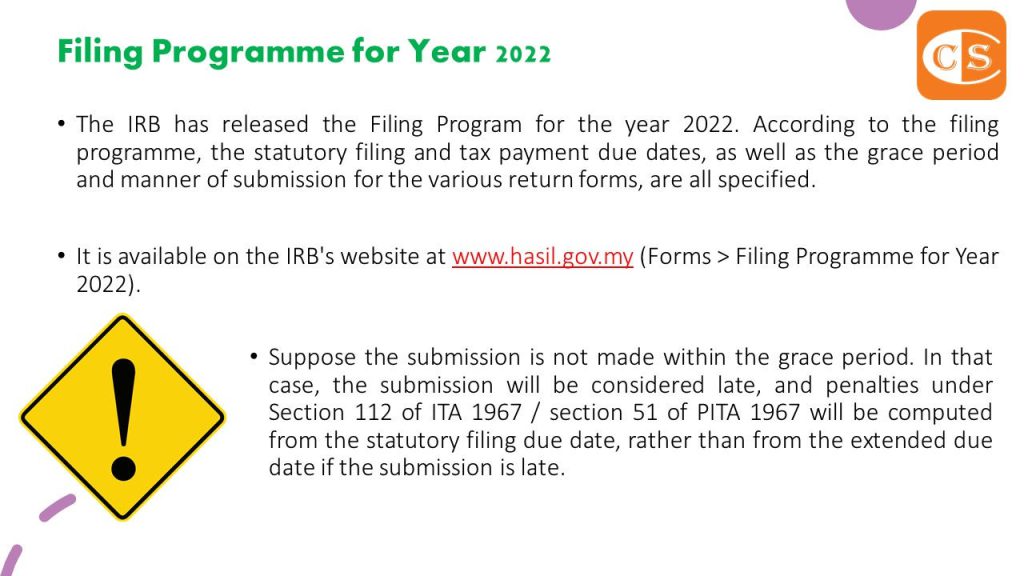
    1. The IRB has released the Filing Program for the year 2022. According to the filing programme, the statutory filing and tax payment due dates, as well as the grace period and manner of submission for the various return forms, are all specified.

    2. It is available on the IRB’s website at www.hasil.gov.my (Forms > Filing Programme for the Year 2022).

    3. The statutory income tax filing deadlines for Companies, Limited Liability Partnerships:-

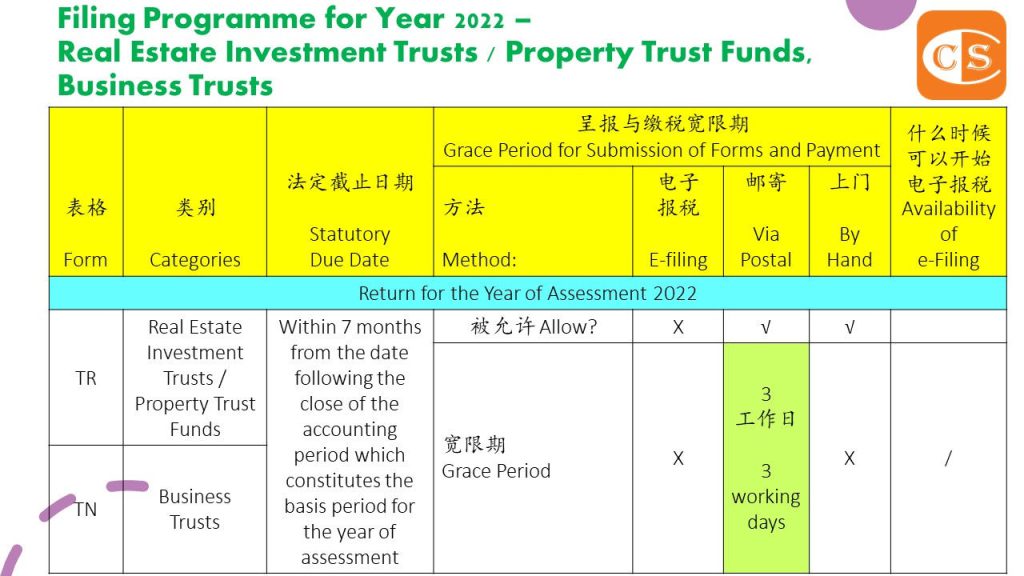
    👉 Within 7 months from the date following the close of the accounting period which constitutes the basis period for the year of assessment

    4. The Inland Revenue Board also has good news for taxpayers with regard to the grace period:-

    👉 1 month via e-filing

    5. To download ✍️ https://www.ccs-co.com/post/what-snew22-2022

    🌻🌻🌻🌻🌻🌻🌻🌻🌻🌻

    1. 内陆税收局已经发布了2022年的申报安排。 根据该申报安排,法定申报 [Statutory Filing] 和缴税日期 [Tax Payment Due Dates],以及各种申报表格的宽限期 [Grace Period] 和提交方式 [Manner of Submission] 都有明确规定。

    2. 此项发布可以在内陆税收局 (IRB) 的网站上找到:www.hasil.gov.my (Forms > Filing Programme for the Year 2022)。

    3. 公司、有限责任合伙公司的法定所得税申报截止日期为:-

    👉 评估年度基础期的会计期间结束后的7个月内

    4. 内陆税收局也为纳税人捎来好消息,宽限期方面:

    👉 如果是通过网上申报的话,多1个月

    5. 下载 ✍️ https://www.ccs-co.com/post/what-snew22-2022

    🌼🌼🌼🌼🌼🌼🌼🌼🌼🌼

    Latest Updates #近期更新

    1. The Publication of MIA’s Practice Review Annual Report 2020/2021

    [MIA 2020/2021年 的实践审查年度报告]

    https://lnkd.in/eRAErf68

    2. Special Income Remittance Programme to Malaysian Residents

    [源自外国汇入马来西亚的收入 特别报税方案]

    https://lnkd.in/eqhVhXda

    3. Post-implementation Review of IFRS 9 — Classification and Measurement

    [国际财务报导准则第9号之 施行后检讨 —分类及衡量]

    https://lnkd.in/eKCRJa-r

    4. Adoption of ISQM 1, ISQM 2 and ISA 220 (Revised)

    [ISQM 1、ISQM 2 和 ISA 220 (修订版)的采纳]

    https://lnkd.in/eDbqMREV

    5. Movable Property Security Interest (MPSI) Bill

    [动产担保权益法案]

    https://lnkd.in/esFqwA-u

    6. IFRS Foundation announcement on the International Sustainability Standards Board (ISSB)

    [国际财务报告准则基金会关于国际可持续发展 准则委员会的公告]

    https://lnkd.in/e_2ZVynM

    7. MASB Updates No.1 November 2021 – IFRS Interpretations Committee (IFRIC) Agenda Decisions

    [马来西亚会计准则委员会 [MASB] 2021年11月第1号更新 – 国际财务报告准则解释委员会(IFRIC)议程决定]

    https://lnkd.in/enJNxX9Q

    8. MASB Updates No.1 November 2021 – IASB Project on Equity Method

    [MASB 2021年11月第1号更新 – 会计准则理事会关于权益法 [Equity Method] 的项目]

    https://lnkd.in/eu3ZX_rB

    9. Bursa Malaysia issues updated Corporate Governance Guide

    [马来西亚证券交易发布更新的 公司治理指南]

    https://lnkd.in/e5pEbgpt

    10. Amendments to the By-Laws (on professional ethics, conduct and practice) of MIA

    [对 MIA 章程 (关于职业道德、行为和实践)的修订]

    https://lnkd.in/euRvPuNy

    11. Labuan Business Activity Tax (Requirements for Labuan Business Activity) Regulations 2021

    [2021年纳闽商业活动税 (纳闽商业活动的要求)条例]

    https://lnkd.in/etg252Kb

    12. Pembangunan Sumber Manusia Berhad (Exemption of Levy) (No. 2) (Amendment) Order 2021 [2021 年人力资源发展有限公司 (免征征税)(第 2 号) (修订) 指令]

    https://lnkd.in/eGmGXRaU

    13. Income Tax (Exemption) (No. 11) Order 2021

    [2021年所得税 (豁免)(第11号) 指令]

    https://lnkd.in/e5e-J8SV

    14. Income Tax (Exchange of Information) Rules 2021 – Request for Information

    [2021年所得税 (信息交流) 细则 – 要求提供信息]

    https://lnkd.in/eUCUWXK6

    15. Stamp Duty (Exemption) (No. 11) 2021 (Amendment) Order 2021

    [2021 年印花税(豁免) (第 11 号)(修订) 指令]

    https://lnkd.in/e_NxSBxF

    16. Income Tax (Exemption) (No. 13) 2013 (Amendment) Order 2021

    [2021年所得税 (豁免)(第 13 号) 2013年(修订) 指令]

    https://lnkd.in/ejJyjQFs

    17. Income Tax Double Deduction for the Sponsorship of Scholarship to Malaysian Student

    [赞助马来西亚学生奖学金的 所得税双重扣税]

    https://lnkd.in/eZp57-Vi

    18. Double Deduction for Expenditure on Provision of Employees’ Accommodation

    [雇员住宿费用双重扣税]

    https://lnkd.in/eWPN2Yrn

    19. Starting from the YA 2022, Company Secretarial and Tax Filing Fees can claim Deduction even not PAID

    [2022课税年度开始,公司秘书费及报税费用,没还钱也可以扣税了]

    https://lnkd.in/eKfh7fkz

    20. “MIA SMPs Channel” – a Dedicated Telegram Channel for SMPs

    [中小会计事务所 (SMPs) 专用 Telegram 频道]

    https://lnkd.in/eKR9nf5v

    21. EPF: extension of 9% statutory contribution rate for Employees

    [EPF: 延长雇员9% 的法定缴款率]

    https://lnkd.in/eJsekn3Z

    22. Income Tax (Industrial Building Allowance) (Tun Razak Exchange Marquee Status Company) (Amendment) Rules 2021

    [2021年所得税 (工业建筑津贴)(敦拉萨国际贸易中心 Marquee 地位公司)(修订) 细则]

    https://lnkd.in/eCiQHGP9

    23. Income Tax (Accelerated Capital Allowance)(Tun Razak Exchange Marquee Status Company) (Amendment) Rules 2021

    [2021年所得税 (资本津贴加速)(敦拉萨国际贸易中心Marquee 地位公司)(修订) 细则]

    https://lnkd.in/eKNBf6vF

    24. Income Tax (Deduction for Relocation Costs for Tun Razak Exchange Marquee Status Company) (Amendment) Rules 2021

    [2021年所得税 (敦拉萨国际贸易中心 Marquee 地位公司 搬迁费用的扣除)(修订) 细则]

    https://lnkd.in/e8UDx5Ki

    25. Income Tax (Deduction for Rental Payments) (Tun Razak Exchange Marquee Status Company) (Amendment) Rules 2021

    [2021年所得税 (租金扣除) (敦拉萨国际贸易中心 Marquee 地位公司)(修订) 细则]

    https://lnkd.in/eiZAG8aP

    26. Income Tax (Exemption) (No. 4) 2013 (Amendment) Order 2021

    [2013年所得税 (豁免)(第4号) (修订) 指令]

    https://lnkd.in/eH7V3YB3

    27. Income Tax (Exemption) (No. 12) Order 2021

    [2021年所得税 (豁免)(第12号) (修订) 指令]

    https://lnkd.in/eyiVRAAr

    28. Special Deduction for Reduction of Rental to SMEs extended to 30.6.2022

    [中小型企业租金特别扣税延长至2022年6月]

    https://lnkd.in/eFuafpPj

    29. Special Deduction for Reduction of Rental to Non-SMEs Tenants extended to 30.6.2022

    [非中小型企业租户租金特别扣税 延长至2022年6月]

    https://lnkd.in/eiCFG9bS

    30. Costs of Renovation and Refurbishment of Business Premise is allowable up to 31.12.2022

    [营业场所翻修和翻新费用 扣税至2022年12月31日]

    https://lnkd.in/dMe-u2bV

    31. Tax Residents to be exempted from tax on the foreign-sourced income until Dec 31, 2026

    [税务居民源自国外的收入将被免征税至2026年12月31日]

    https://lnkd.in/eAu5rcJK

    32. Export of Private Health Care Services – Tax Exemption

    [出口私人保健服务 – 税务豁免]

    https://lnkd.in/e9TrZnRQ

    33. Instruments in relation to an approved M & A – Stamp Duty Exemption

    [与批准的合并或收购有关的文件 – 豁免征收印花税]

    https://lnkd.in/eS9EUKdv

    34. Double Tax Deduction for the Sponsorship of Scholarship to Malaysian Student

    [赞助马来西亚学生奖学金,所得税双重扣税]

    https://lnkd.in/erNAhxAn

    35. RM 20,000 Tax Rebate for the newly set up Company – ⚠️⚠️ Conditions apply ⚠️⚠️

    [开新公司的2万令吉税务回扣是有条件的]

    https://lnkd.in/e4HJG2AW

    36. Finance Act 2021 has been Gazetted

    [2021年财政法令已经在宪报颁布了]

    https://lnkd.in/egpicBGF

    37. IASB Exposure Draft ED/2021/9 Non-current Liabilities with Covenants (Proposed amendments to IAS 1)

    [具合约条款之非流动负债 (国际会计准则第1号)]

    https://lnkd.in/ehtBieY2

    38. 38. IASB Exposure Draft ED/2021/10 Supplier Finance Arrangements (Proposed amendments to IAS 7 and IFRS 7)

    [国际会计准则理事会征求意见稿ED/2021/10 供应商融资安排 (对国际会计准则7和国际财务报告准则7的拟议修正)]

    https://lnkd.in/erky8JY2

    39. SST – Guide on Food & Beverages

    [服务税 – 食品和饮料指南]

    https://lnkd.in/ehRuruRa

    40. SST – Guide on Parking Services

    [服务税 – 停车场服务指南]

    https://lnkd.in/emFT9Ven

    41. SST – Guide on Motor Vehicle Services or Repair

    [服务税 – 机动车服务或维修指南]

    https://lnkd.in/eU25Gkht

    42. Double Tax Deduction for Expenditure in relation to Vendor Development Programme

    [与供应商发展计划有关的支出双重扣税]

    https://lnkd.in/ev2e4W8g

    43. Tax Deduction for Investment in a Project of Commercialisation of Research and Development Findings

    [研究与开发成果商业化项目投资 享有扣税资格]

    https://lnkd.in/eZAfyv2S

    44. FAQs on the implementation of Tax Identification Number, TIN

    [这绝不是天上人间 而是TIN罗地网]

    https://lnkd.in/eJvgtUpk

    45. TP 1 表格,什么来的

    [Something About “Form TP 1”]

    https://lnkd.in/em-i-VWx

    46. Statutory Minimum Wages – Why Pay Raise is Important?

    [法定最低工资 – 为什么加薪很重要]

    https://lnkd.in/eGEvjU6C

    47. Accelerated Capital Allowance For Excursion Bus

    [购买游览巴士享有加速资本津贴]

    https://lnkd.in/eEEjDwvG

    48. Deferment of the implementation of 2% Withholding Tax on Payment [Commission] Made To Agent etc.

    [ 推迟执行向代理商、经销商、分销商支付佣金的2%预扣税]

    https://lnkd.in/e-FkqG7b

    49. HRD Levy Payment for the newly registered employers for January 2022 has been Resumed

    [新注册的雇主,2022年1月恢复支付人力资源开发基金]

    https://lnkd.in/e28NiHsv

    50. Mandatory Adoption of Prescribed Forms CP21, CP22, CP22A, and CP22B

    [强制性采用指定的表格 CP21、CP22、CP22A 和 CP22B]

    https://lnkd.in/eBwiFntG

    51. 只有在扣押令下 IRB 才有权要求银行提供你的信息

    [Power to call for bank information for purpose of making a Garnishee Order application by IRB]

    https://lnkd.in/eQsxcQV8

    52. Tax Concessions Due to COVID-19 Travel Restrictions expired on 31 December 2021

    [新冠肺炎期间的行动限制所给予的税务宽免于2021年12月31日结束]

    https://lnkd.in/eqJzGEmN

    53. Initial Application of MFRS 17 and MFRS 9 – Comparative Information (Amendment to MFRS 17 Insurance Contracts)

    [初次应用 MFRS 17 和 MFRS 9 – 比较信息 (MFRS 17 保险合同的修正)]

    https://lnkd.in/eUMMpfPQ

    54. Filing Programme for Year 2022 – Employers

    [2022年的申报安排 – 雇主 ]

    https://lnkd.in/ee9mhwaW

    55. Filing Programme for Year 2022 – Associations, Deceased Persons’ Estate and Hindu Joint Families

    [2022年的申报安排 – 社团、死者遗产和印度教联合家庭]

    https://lnkd.in/eFErzCmK

    56. Filing Programme for Year 2022 – Other Individuals

    [2022年的申报安排 – 其他人士]

    https://lnkd.in/e3GgsDFg

    57. Filing Programme for Year 2022 – Individuals, Partnerships

    [2022年的申报安排 – 个人、合伙企业]

    https://ccsyourauditor.blogspot.com/2022/01/issue-no-192022-filing-programme-for.html

    58. Filing Programme for Year 2022 – Trust Bodies and Co-Operative Societies

    [2022年的申报安排 – 信托机构和合作社]

    https://ccsyourauditor.blogspot.com/2022/01/issue-no-232022-filing-programme-for.html

    🌳🌳🌳🌳🌳🌳🌳🌳🌳🌳🌳🌳

    👉 专业资讯送到你手中

    1. 网站 ✍️ https://www.ccs-co.com/

    2. Telegram ✍️ http://bit.ly/YourAuditor

    3. Instagram ✍ http://tiny.cc/rojzrz

    4. 部落格 ✍ https://lnkd.in/e-Pu8_G

    5. Google ✍ http://tiny.cc/9oussz

    9
  • Tax Clearance Letter: Closing the Income Tax File – Companies under CA 2016

    Tax Clearance Letter: Closing the Income Tax File – Companies under CA 2016

    LHDNM Operational Guidelines No.3-2021 – Tax Clearance Letter Application

    1) The Inland Revenue Board (IRB) has published Operational Guidelines No. 3/2021, titled “Permohonan Surat Penyelesaian Cukai Bagi Syarikat, Perkongsian Liabiliti Terhad Dan Entiti Labuan” on its website in Bahasa Malaysia.

    2) The Guidelines, which were issued on June 30, 2021, supersede GPHDN 2/2019, which was published on November 12, 2019.

    🌼🌼🌼🌼🌼🌼🌼🌼🌼🌼

    1) 内陆税收局(IRB)在其网站上发布了马来文版本的第3/2021号操作指南,题为 “Permohonan Surat Penyelesaian Cukai Bagi Syarikat, Perkongsian Liabiliti Terhad Dan Entiti Labuan”。

    2)该指南于2021年6月30日发布,取代了2019年11月12日发布的 GPHDN 2/2019。

    9
  • Country-by-Country Reporting (CbCR) Notification using the Form C

    Country-by-Country Reporting (CbCR) Notification using the Form C

    1. Constituent entities can now use the C Form to submit the Country-by-Country Reporting (CbCR) Notification starting in YA 2021.

    2. Constituent entities that file other forms should continue to provide notification in the same manner as before.

    🌻🌻🌻🌻🌻🌻🌻🌻🌻🌻

    1. 从2021年YA开始,成员实体 [Constituent entities] 现在可以使用 Form C 来提交国别报告(CbCR)。

    2. 提交其他表格的成员实体 [Constituent entities],应继续以原有相同的方式提交。

    12