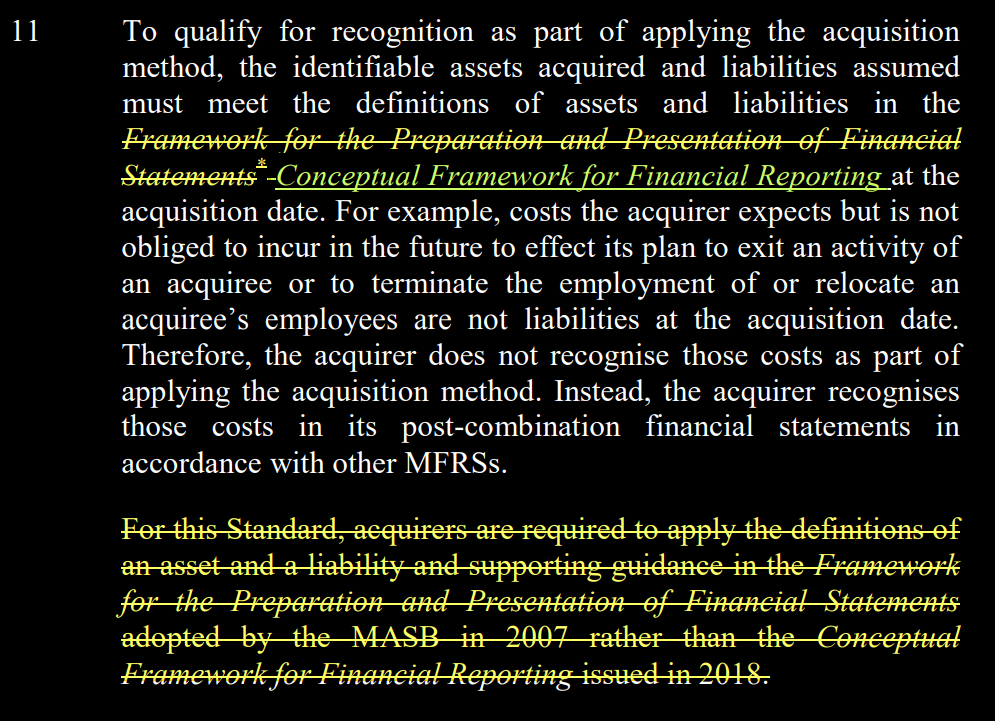
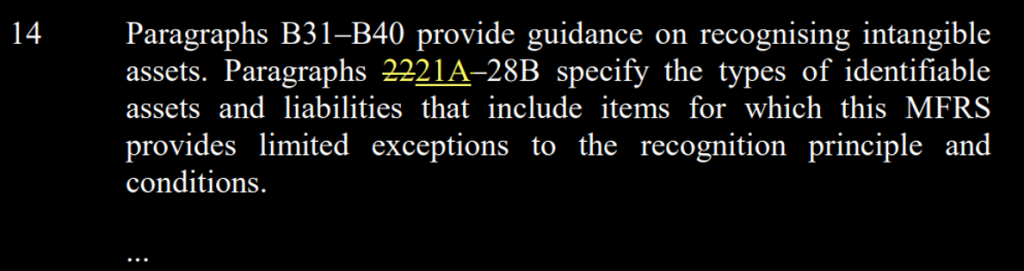
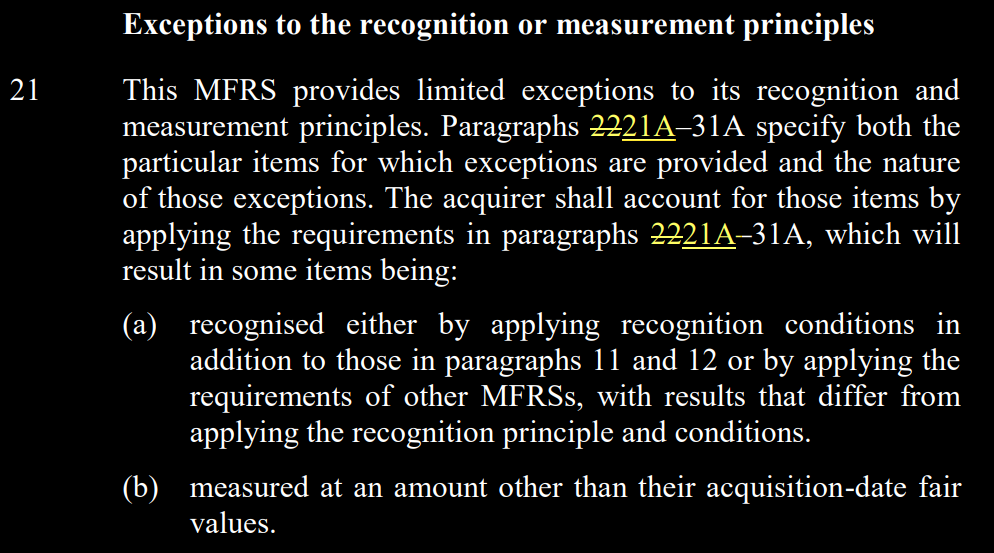
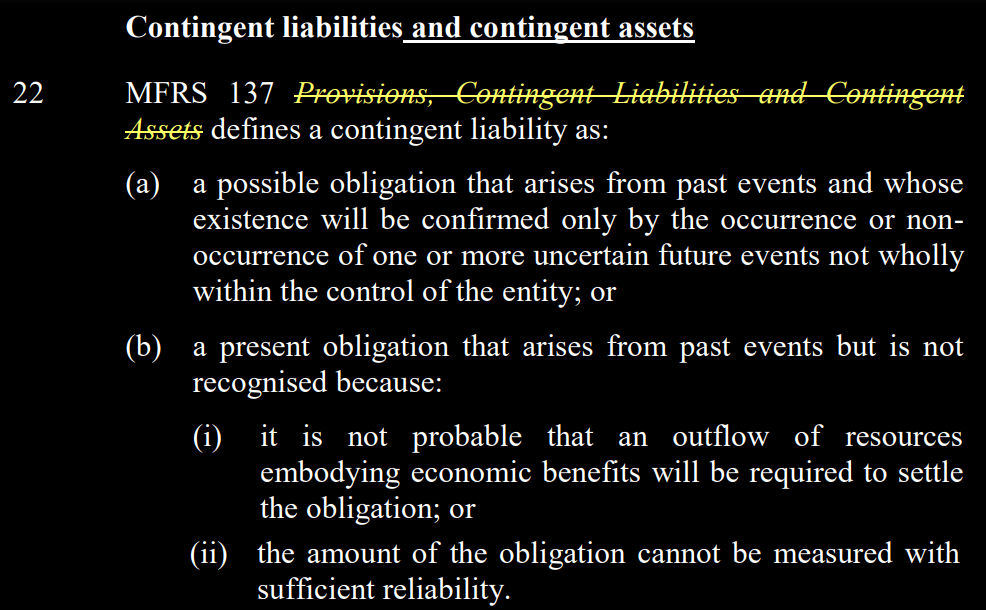
The Accounting Requirements for Business Combinations have not been altered due to the amendments made to MFRS 3 Business Combinations; instead, MFRS 3’s reference to the Conceptual Framework for Financial Reporting has been brought up to date.
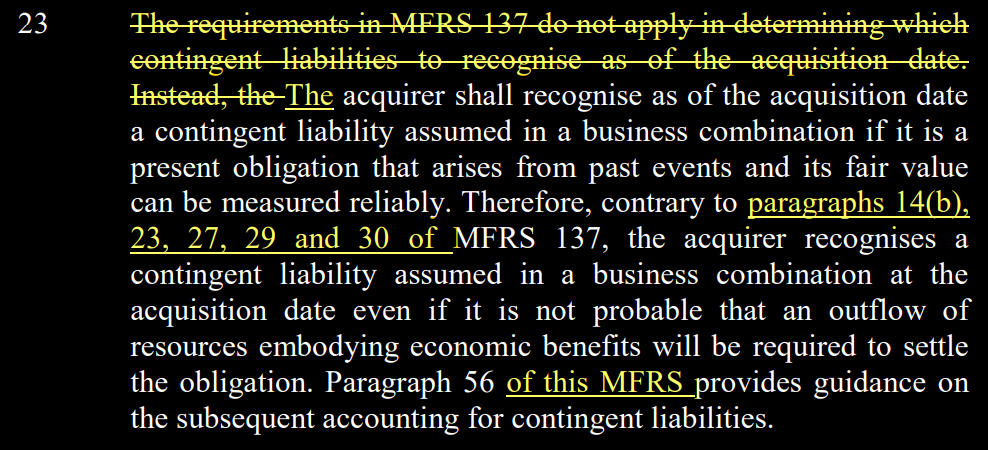
In addition, the amendments make it clear that contingent assets should not be recognised at the acquisition date.
An entity shall apply those amendments to business combinations for which the acquisition date is on or after the beginning of the first annual reporting period beginning on or after 1 January 2022.
Earlier application if at the same time or earlier an entity also applies all amendments made by Amendments to References to the Conceptual Framework in MFRS Standards issued in April 2018.
Amendments:
New text is underlined, and deleted text is struck through.
Paragraph 11 is amended, and the footnote to Framework for the Preparation and Presentation of Financial Statements in paragraph 11 is deleted.
Paragraphs 14, 21, 22 (The headings below paragraph 21 and above paragraph 22 are amended) and 23 are amended;
Paragraphs 21A (A heading is added above the paragraph), 21B, 21C, 23A and 64Q are added;
Since its founding in 2001, the International Accounting Standards Board (IASB) has had a profound impact on the global landscape of financial reporting for companies.
But it was the International Accounting Standards Committee (IASC), during its 27 years of existence from 1973 to 2000, that laid the groundwork for the International Accounting Standards Board (IASB).
International Accounting Standards Committee (IASC) | 国际会计准则委员会
After the end of World War II, each country developed its own set of Generally Accepted Accounting Principles (GAAP, the name used in the United States), sometimes known as the proper accounting practice.
The International Accounting Standards Committee (IASC) was established in 1973 with the objective of developing and issuing international accounting standards and promoting international convergence of national accounting practices.
The Evolution of the IASC into the IASB | IASC 演变为IASB 的过程
During the period from its founding in 1973 to its dissolution in 2001, the IASC developed a set of International Accounting Standards (IAS) that gradually acquired a degree of acceptance in countries around the world.
In their consolidated financial statements, a number of European multinational companies started using International Accounting Standards (IAS) rather than their national generally accepted accounting principles (GAAP) between the years 1987 and 2000.
Corporations such as Nestle, Holderbank/Holcim, Roche, CibaGeigy/Novartis, and UBS were among those involved, as well as companies from Germany such as Schering, Heidelberger Zement, Bayer, Hoechst, and Deutsche Bank.
CPC International, Salomon Inc., and Microsoft are three of the biggest companies in the United States that have begun to confirm that their financial statements correspond to IAS.
In May 2000, the IASC was reorganised. A new IASB Constitution took effect on 1 July 2000. The standards-setting body was renamed the International Accounting Standards Board (IASB). It would operate under a new International Accounting Standards Committee Foundation (IASCF, now the IFRS Foundation).
The IASB is responsible for the research and development of accounting standards. This reorganisation has changed the IASC from being, in a sense, the ‘coordinator’ of national accounting standards to being the ‘setter’ of global accounting standards.
In April 1989, the IASC Board approved a document entitled “A Framework for the Presentation of Financial Statements“, which was issued in July of the same year.
The Conceptual Framework for Financial Reporting (the “Conceptual Framework”) :
is a basic document that sets objectives and the concepts for general purpose financial reporting.
has played an important role in guiding the development of international standards and the evaluation of existing standards.
In 2001 the IASC reorganised itself to form the new International Accounting Standards Board, the IASB, which has been working on updating the Conceptual Framework and developing global accounting standards since its inception.
The first phase of the Conceptual Framework for Financial Reporting was completed in September 2010, while the relevant sections of the Financial Reporting Framework published in 1989 will be replaced, however, it was a bit unfinished as a few concepts and chapters were missing.
The newest and completed Framework published in 2018 comprises 8 chapters.
The Framework addresses:
the objective of general-purpose financial reporting
qualitative characteristics of useful financial information
Is the Framework equivalent to the Standard? | 该框架是否等同于标准?
Allow me to elaborate on one particular point:
The framework itself is NOT a Standard.
Therefore, if you want to decide on the financial reporting of a certain transaction, you need to explore a suitable standard, which could be IFRS or IAS [MFRS in Malaysia].
It is possible that there will be instances when the rules in that IFRS or IAS [MFRS] standard will be in direct contradiction to what is stated in the Framework.
In this particular scenario, we should use the standard rather than the Framework.
When is the appropriate time to use the Framework? | 什么时候是使用该框架的适当时机?
When there are no specific rules for your transaction and you need to build your accounting policy, you should look to the Framework as a starting point because you cannot deviate from its fundamental principles and definitions.