The hotel industry has the opportunity to advertise itself as an enabler and assist in promoting the use of local handicraft products within the premises.
Some examples of these products include songket decorations, ceramic, and wood-based products.
Under normal circumstances, Capital Allowance is granted under Schedule 3 of the Income Tax Act 1967 when an eligible asset (if qualified as a “plant”) is purchased.
Assets with a life span of less than two years are deductible on a replacement basis; subsequent purchases to replace an asset with a value of less than RM2,000 are eligible for a tax deduction under Section 33 of the Income Tax Act 1967.
Proposal
It is proposed that a special tax deduction be given for expenditures on qualified Malaysian-made handicrafts purchased from handicraft entrepreneurs certified by Perbadanan Kemajuan Kraftangan Malaysia incurred by hoteliers.
The amount of this deduction would be capped at RM150,000.
The purpose of this proposal is to support the recovery of Malaysian-made handicraft.
Effective Date
For eligible expenditure on handicraft products incurred from 1 January 2023 until 31 December 2025
Dialogue between MOF, LHDNM and CTIM [21/6/2023]
As mentioned under the current position, the purchase for replacement of assets with a value of less than RM2,000 qualifies for outright deduction under S.33 of the ITA 1967.
CTIM was seeking confirmation on whether this is a concession given by the IRB and where it is legislated.
LHDNM’s Feedback:
It is not a concession.
For asset categories valued at RM2,000 and below, claims can be made through:
Special allowance claims under paragraph 19A of Schedule 3 of the ITA 1967; or
Capital allowance claims under paragraphs 10 and 15 of Schedule 3 of the ITA 1967.
For assets with a useful life not exceeding two years, claims can be allowed on a replacement basis under Section 33 of the ITA 1967.
Are taxpayers given an option whether to choose a special tax deduction claim on the items or to claim capital allowance / outright tax deduction under S33 if, let’s say, this item is potentially a long-lasting item that is capital in nature?
LHDNM’s Feedback:
Companies are allowed to choose to claim eligible capital expenditure as:
special tax deduction for Malaysian handicraft products; or
deduction under subsection 33(1) of the ITA 1967; or
capital allowance under Schedule 3 of the ITA 1967.
The tax treatment option, once decided, is final and cannot be amended.
CTIM sought clarification on what are the “ceramic and wood-based products in hotel premise” in the context illustrated.
The articles, templates, and other materials on our website are provided only for your reference.
While we strive to ensure that the information presented is current and accurate, we cannot guarantee the completeness, reliability, suitability, or availability of the website or its content, including any related graphics. Consequently, any reliance on this information is entirely at your own risk.
If you intend to use the content of our videos and publications as a reference, we recommend that you take the following steps:
Verify that the information provided is current, accurate, and complete.
Seek additional professional opinions, as the scope and extent of each issue, may be unique.
Regarding Form e-C 2022, CTIM has offered feedback and comments to the Inland Revenue Board of Malaysia (IRBM).
The Inland Revenue Board of Malaysia issued its response on 29 July 2022 and 2 August 2022, respectively.
Despite this, on 11 August 2022, CTIM provided IRBM with additional feedback and comments on the form e-C 2022 after IRBM‘s responses were provided.
The IRBM issued their responses on September 9, 2022, to the following sections of Form e-C 2022 mentioned in the CTIM Additional Feedback and Comments on 11 August 2022.
Issue No 1: Item A2 and A7 – Disclosure in the Form e-C relating to Foreign Source Income
1.1 Referred to the “Summary of Statutory Income from sources of business(es) and partnership(s) outside Malaysia received in Malaysia starting from 1 July 2022.“
Currently, the TAeF allows disclosure of 1 country under 1 business source only.
How do the taxpayers disclose the information in a situation where the foreign source income (FSI) is from multiple countries in one business source (e.g., Business 1)’?
IRBM’s response on 2 August 2022:
Income reporting should be done separately by the country. For e-Filing, the system allows the use of the same business code for each reporting business income from different countries.
A2 of the e-Form C 2022 (i.e., Summary of statutory income from sources of business(es) and partnership(s) outside Malaysia received in Malaysia effective from 1 July 2022)
CTIM additional feedback and comments on 11 August 2022:
Based on IRBM’s response above, CTIM notes that the system allows the same business code for different countries. However, Form e-C only allows disclosure of 1 business source for 1 country.
IRBM’s response on 9 September 2022:
Income from similar activities from the same country should be combined and reported in the same row and space. Income segregation for the same business code from the same country does not need to be done for FSI reporting in e-C 2022.
CTIM additional feedback and comments on 11 August 2022:
Based on the A2 of the e-Form C 2022 (i.e., Summary of statutory income from sources of business(es) and partnership(s) outside Malaysia received in Malaysia effective from 1 July 2022), the e-Form C 2022 system seems to have not been updated to allow disclosure of foreign business income for more than 1 country under 1 business source.
As extracted below, it appears that row 2 has been fixed as Business 2, row 3 as Business 3, and so on.
CTIM would like to seek further clarification from IRBM on whether:-
IRBM will update its system to allow taxpayers to select “business identification” manually, or
As long as the taxpayers inserted the same business code in different rows, the IRBM will take these disclosures as foreign business income under 1 business source (even though the business identification column does not match).
IRBM’s response on 9 September 2022: Taxpayers can use the same business code for each country concerned on different rows to indicate companies doing the same business in those countries.
The proposal from CTIM will be considered when designing e-C for the subsequent assessment year.
CTIM additional feedback and comments on 11 August 2022:
Example: ABC Sdn Bhd has two business sources:
providing engineering services and
trading machines.
ABC Sdn Bhd has branches in Singapore and Hong Kong that provide the same engineering services.
In YA 2022, the following information is available for the Form e-C disclosure:
Based on the example given above, can IRBM guide how the “Summary of statutory income …. In Malaysia” and the “Summary of Statutory Income from sources …. received in Malaysia from outside Malaysia” be completed?
IRBM’s response on 9 September 2022:
Based on the limited information above, the following are general guidelines for reporting in e-C 2022:
The statutory income of business 1 in Malaysia is reported in column A1 and appendix A1 respectively.
The statutory income of business 1 in Singapore and Hong Kong is reported either in column A2 and appendix A2 or column A 20 and appendix A20 depending on when the income is remitted. This reporting is subject to the business income in Singapore and Hong Kong having been taxed in those countries.
Interest income from Singapore and Hong Kong must be reported in either column appendix A7 and appendix A7 or columns A 20 and appendix A20, depending on when the income is remitted.
The ultimate tax reporting and calculation will be determined by the relevant circumstances in connection with:
the management of company activities,
the date of remittance of income sourced outside of Malaysia, and
the income tax status in the place of origin.
1.2 Capital Allowance disclosure
CTIM additional feedback and comments on 11 August 2022:
Using the same example above –
How does a taxpayer complete Item C1a (Attachment) of Form e-C for YA 2022?
If the remaining portion of the FSI is received in Malaysia in YA 2023, how does a taxpayer complete Item C1a (Attachment) in Form e-C for YA 2023?
Only a portion of the statutory FSI is received in Malaysia in YA 2022. In this case, how do we disclose the amount of the CA utilised (absorbed) under Item C1a (Attachment) of Form e-C for YA 2022?
IRBM’s response on 9 September 2022:
The disclosure of information regarding capital allowances in schedule 3 of appendix C1a for form e-C2022 is only required if the business income was derived from Malaysia (referring to column and Appendix A1).
Issued No 2: Item A20 – Income from sources outside Malaysia received in Malaysia for the period from 01.01.2022 to 30.06.2022 [If 7 = MY]
CTIM additional feedback and comments on 11 August 2022:
Referring to IRBM’s response on 2 August 2022 (as follows), it appears that a direct translation of the sentence means “the FSI received in Malaysia shall refer to the gross amount“.
Kindly confirm that the actual FSI remitted shall be taken as the gross income instead, i.e., there is no requirement to re-compute the gross income of which the FSI is remitted into Malaysia.
IRBM’s response on 9 September 2022:
There is no need to re-compute the remitted income because it is gross income based on the provisions of Section 6, Part XX of the ITA 1967.
Issue No 3: Part E – Summary of losses for business and partnership that are subject to restriction under Section 44(5F)
Previously, this section was used to report normal business and pioneer losses with the heading of the appendix: Summary of Losses (Including Pioneer Losses after tax relief period).
It is now renamed to cover losses subject to restriction under Section 44(5F).
However, the Guidebook 2022 still stipulates that this section is “Including Pioneer Losses After Tax Relief Period” (see screenshot below):
CTIM additional feedback and comments on 11 August 2022:
As highlighted before, the query concerns the disclosure of the pioneer loss that is subject to the Promotion of Investment Act 1986 (“PIA”).
The tax treatment of the unabsorbed pioneer loss after the expiry of the pioneer status period is governed under Section 25(5) of the PIA (not Section 44(5F) of the ITA).
As such, kindly confirm that taxpayers are not required to disclose the unabsorbed pioneer loss that is governed under the PIA in Part E Attachment of Form e-C YA 2022.
This is because Part E Attachment is only for disclosure of business loss and any pioneer loss that is governed under the ITA.
As mentioned before, the taxpayers can still continue to maintain the movement of the pioneer losses after the tax relief period (that is governed under the PIA) separately using the HK-F2 (not part of the Form e-C YA 2022 to be submitted to the HASIL) for tax audit purposes.
IRBM’s response on 9 September 2022:
This column is intended to report loss positions subject to restrictions under section 44(5F) of the ITA 1967 and includes losses post-pioneer status period.
IRBM will amend the label of this attachment so that it is more applicable to all circumstances when they develop the future return form.
Issue No 4: Declaration Section
Option 2 in the declaration section of the YA2021 Form C was worded as “This return form is prepared based on unaudited accounts.‘
If a company cannot get its audited financial statements signed by the filing due date but still wishes to submit its tax return, it would select “Option 2′.
Option 2 also applies to a Permanent Establishment (‘PE’) that is not registered with the Companies Commission of Malaysia (“SSM”) and would not have audited financial statements for tax purposes.
However, the scenario would no longer fit into any of the above options in the YA 2022 Form C.
CTIM understand that under the law, unless an audit exemption is granted, a company must submit its tax return based on signed audited financial statements. However, it is not uncommon that the audited accounts could not be ready by the filing due date due to various reasons.
CTIM’s initial feedback and comments:
In these circumstances, we would like to seek clarification, particularly:
Is the company permitted to submit its tax return for YA 2022 based on draft audited financial statements without an audit exemption?
IRBM’s response on 2 August 2022:
Form C needs to be drawn up based on the financial statements prepared according to the act of its establishment as provided under section 77A of the ITA 1967.
For companies incorporated under the Companies Act 2016, form C needs to be submitted based on the audited financial statements signed by the approved company auditor unless the company gets an exemption under the Companies Act 2016 from submitting audited accounts.
Therefore, the submission of Form C must be based on option 1.
If the form C submission is not based on audited financial statements, the form C submission will be rejected.
CTIM additional feedback and comments on 11 August 2022:
The above response does not address the issue of a PE which is not registered with SSM.
Kindly clarify
IRBM’s response on 9 September 2022:
Sections 561 and 562 of the Companies Act 2016 apply to foreign companies that conduct business in Malaysia.
The company must submit a tax return form per section 77A(4) of the Income Tax Act 1967, and it must be based on financial statements that have been compiled in line with the act of its establishment.
Because of this, PEs in Malaysia are required to submit Form C based on audited financial statements under the rules of the PE establishment statute in Malaysia or the act governing the parent company of the PE.
Submission of tax return forms based on management accounts is invalid and will be subject to penalty under section 112 of the ITA 1967.
With that, the choice in the Declaration Section of form C has remained.
Our website's articles, templates, and material are solely for reference. Although we make every effort to keep the information up to date and accurate, we make no representations or warranties of any kind, either express or implied, regarding the website or the information, articles, templates, or related graphics that are contained on the website in terms of its completeness, accuracy, reliability, suitability, or availability. Therefore, any reliance on such information is strictly at your own risk.
Keep in touch with us so that you can receive timely updates |
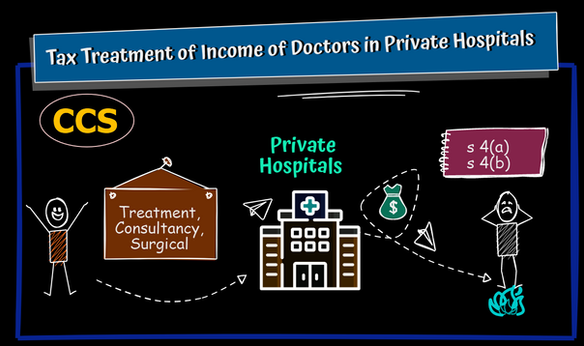
I am sure many of you will still remember the widespread allegation that doctors (from now on referred to as the doctor) who provide medical services (e.g., treatment, consultancy, surgical, etc.) in Private Hospitals were evading taxes many years ago, and LHDN conducted audits as a result.
It is not only permissible but common to set up a private limited company (Sdn Bhd, from now on referred to as “the Company”) to carry on business.
However, when it comes to doctors, this raises a new dilemma as to whether the income in question is taxed in the doctor’s personal name or in the name of the company he has set up.
The Inland Revenue Board of Malaysia (“IRBM”) has then communicated to the Malaysian Medical Association (“MMA”) via letter dated 28 June 2018 to notify them that effective from the year of assessment (“YA”) 2017, services rendered to the Private Hospitals regardless of the existence or nonexistence of a written agreement, the payment received by a Doctor will be subjected to tax as business income of an individual
The IRB has published on its website, dated 16 March 2022, technical guidelines regarding the tax treatment of doctors’ income in Private Hospitals.
The Guidelines are in Bahasa Malaysia and are named “Garis Panduan Layanan Cukai Ke Atas Pendapatan Pengamal Perubatan (Doktor Pakar) Di Hospital Swasta Sama Ada Ditaksir Di Bawah Individu Atau Syarikat“.
The doctor will have two different sources of business income, each of which must be stated on the Income Tax Return Form as a separate business source to comply with Section 4(a) of the Income Tax Act 1967.
To be assessed in the name of the Doctor
Consultation fees and other payments received from Private Hospital, even if:
the Doctor sets up a company and enters into an agreement with a private hospital to provide specialist services to patients
the Doctor sets up a company with other doctors and enters into an agreement with a private hospital to provide specialist services to patients through the company.
Whether the contract entered into with a private hospital is in the name of the Doctor or the Company, the tax treatment is the same in both cases.
Income Tax Return: Form B
To be assessed in the name of the Company
If the company’s primary activity is engaging in activities related to medical, such as selling medical products, pharmaceutical products, and health aids; or
If the doctor operates a clinic:
located in a private hospital where patients receive specialist care without being referred by the private hospital, and the doctor does not use any private hospital facilities to treat patients; or
not inside the private hospital, and the services provided to patients do not include any private hospital
Income Tax Return: Form C
Income to be Assessed as an Employment Income
Status of the Doctor:
As an Employee
The doctor who serves for the Private Hospital under a contract of service, whether full or part-time
As a shareholder and director
When a doctor is both a shareholder and a director of the Private Hospital, regardless of whether they are a Specialist Doctor there or not,
The salaries received for consultation services, surgery, or any treatment provided will be assessed as the employment income of the Doctor by Section 4(b) of the Act.
Income Tax Return: Form BE
Deductible Expenses
The Guidelines also explain and give examples of certain kinds of expenses that may be tax-deductible in arriving at the adjusted income, such as the following:
Professional indemnity insurance (PII)
Employer’s contribution to the Employees Provident Fund (EPF). The Guidelines also explain when a contribution would not be tax-deductible.
Fees incurred to attend Continuing Professional Development (CPD) seminars, workshops or conferences approved under CPD Review Committees
Rental pay to the private hospital for:
consultation rooms,
surgical instruments, or
operating rooms
Other allowable expenses under Section 33(1) of the Act
However, under section 39 of the ITA, certain expenses are prohibited as deductions, such as private expenses or expenses of a capital nature.
Is Travelling Expenses Tax Deductible?
In general, travelling expenses are not deductible expenses unless:
The travel is part of employment/official duties (required by your employer or necessitated by the circumstances of the business) and not because of your personal circumstances (where you live);
To expand on this, quite simply, getting to and from your regular place of work is not deductible, regardless of how far this may be.
Travel costs are a necessary consequence of the work or duties;
The employer demands the doctor undertakes the travel, or the doctor is required to travel for business purposes; and
The travel is undertaken during working/business hours.
Mfula vs the Federal Commissioner of Taxation
Dr Mfula was both a salaried employee and a locum doctor/surgical assistant, billing hospitals under his Australian business number (ABN).
Whilst working as a locum via the Global Medics agency in Wagga Wagga, Dr Mfula travelled by car from his home in Melbourne and flew to other sights in NSW. He sought to claim car travel and food/incidental costs in the tens of thousands, whilst the hospitals covered accommodation and flights.
Dr Mfula noted that no allowances were paid to him. Furthermore, he was not required to use his vehicle for work purposes, and he was required to pay for his meals.
Dr Mfula could not claim any travelling expenses except for work as a surgical assistant, for which he worked at multiple sites on the same day. All other car travel was deemed home to work and not ‘on work’ or at the direction of an employer.
Despite arguing that a meal allowance was rolled into his hourly rate, meal costs were also disallowed.
Overall, this is not fantastic news for mobile medical professionals. Your travel expenses, including those for your vehicle, lodging, and food, are not likely tax deductible unless you demonstrate that you satisfied specific requirements and kept detailed records.
Capital Allowance
A Doctor who incurs capital expenditures on assets or equipment used for business purposes is entitled to claim a capital allowance under Schedule 3 of the ITA 1967.
Our website's articles, templates, and material are solely for reference. Although we make every effort to keep the information up to date and accurate, we make no representations or warranties of any kind, either express or implied, regarding the website or the information, articles, templates, or related graphics that are contained on the website in terms of its completeness, accuracy, reliability, suitability, or availability. Any reliance on such information is therefore strictly at your own risk.
Keep in touch with us so that you can receive timely updates |
Since a partnership is not a legal person it cannot own fixed assets. These, therefore, belong jointly to the individual partners.
Those who own the plant or machinery and use it in the course of their trade, business, or profession are the ones who are generally eligible for the capital allowances. Nevertheless, a notable exemption is provided for beneficial ownership in Director General of Inland Revenue v Teo Tuan Kwee(1998) MSTC 3,648.
Director-General of Inland Revenue v Teo Tuan Kwee(1998) MSTC 3,648. The taxpayer was the proprietor of a lorry transport business. He purchased four motor lorries for his business. Three of the lorries were acquired on hire purchase while the fourth was purchased directly from the seller.
The taxpayer was assessed to income tax on his income from his lorry transport business and dividends from shares.
The taxpayer appealed against the assessment. He argued that no deductions were allowed by the Revenue in respect of capital allowances which he claimed were due to him under Sch. 3 of the Income Tax Act 1967 (“the Act”) on the capital expenditure incurred by him for the purchase of the four motor lorries.
The Revenue had rejected the taxpayer’s claim for initial and annual allowances on the lorries on the grounds that the taxpayer was not the legal owner of the lorries.
The lorries had been registered in the names of third parties who had lent their names in consideration of earning monthly rentals for the haulage permits which were in their respective names.
The Special Commissioners held that the taxpayer was entitled to capital allowances under Sch. 3 of the Act as he had incurred capital expenditure by purchasing the four lorries for his lorry transport business.
The Revenue appealed to the High Court. The Revenue contended that capital allowances were only available to the owner of the lorries. Although the taxpayer had incurred capital expenditure in acquiring the lorries, he was not the registered owner of the lorries.
The question for determination was whether para. 15 and 46 of Sch. 3 of the Act referred to legal ownership or could be extended to beneficial ownership
As a result, any capital allowances allowed for income tax purposes in respect of assets are calculated for the year of assessment and these are divided among the partners in accordance with the profit-sharing ratios.
Any allowance that cannot be set off due to the insufficiency of profits is carried forward and forms part of the allowances for the next assessment year.
Where there is a change in the partnership, for example, cessation or admission of a partner, so long as the businesses remain substantially the same and are carried on as one continuing business, capital allowances are calculated as if the business was conducted by the same persons.
That is to say that the capital allowances are allocated only amongst those who are partners at the end of the relevant basis period in their profit-sharing ratios.
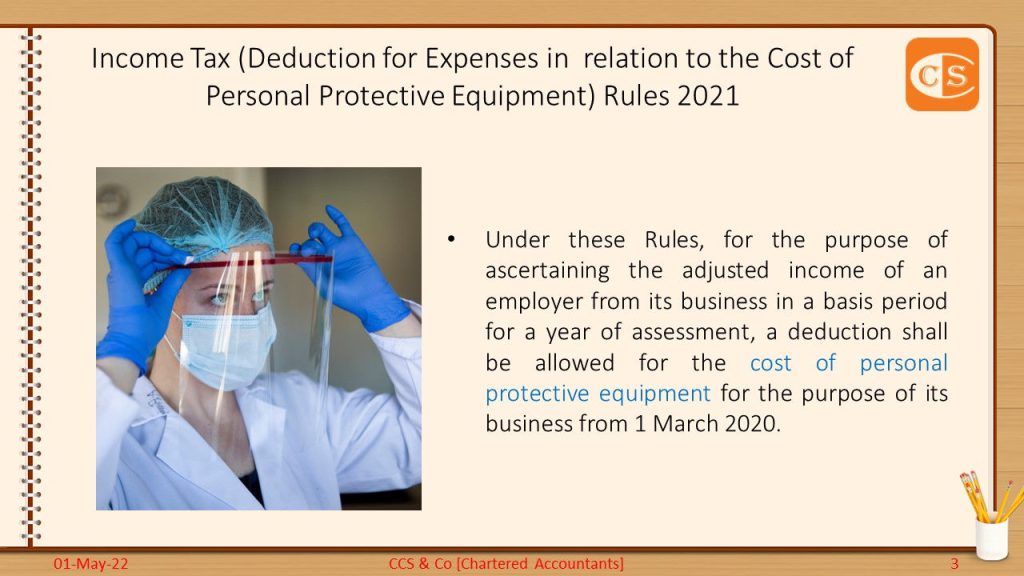
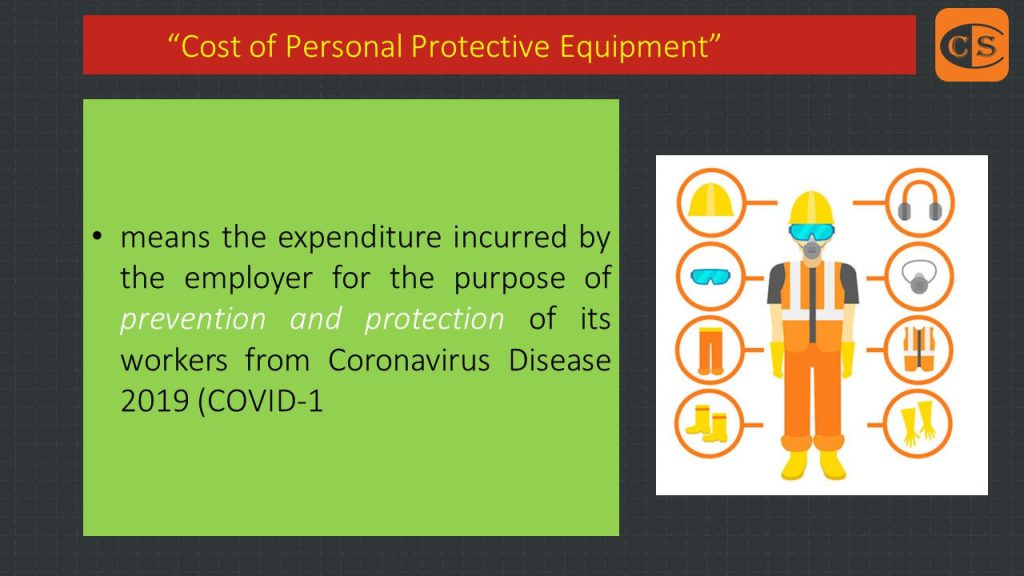
1. Tax deductions for employers on the cost of personal protective equipment (PPE) are offered by the Income Tax (Deduction for Expenses in Relation to the Cost of Personal Protective Equipment) Rules 2021, which are effective from YA 2020 and define personal protective equipment (PPE) as “expenditure incurred by the employer for the purpose of prevention and protection of its workers from COVID-19.” 2. From the first day of March 2020, the deduction for spending on personal protective equipment (PPE) will be applied against adjusted income. 3. However, a deduction will not be given in which:
the employer has claimed capital allowances under the Income Tax Act on the cost of such personal protective equipment, or
the employer has claimed ACA under the Income Tax (Accelerated Capital Allowance) (Machinery and Equipment. Including Information and Communication Technology Equipment) Rules 2021 on the cost of such personal protective equipment.
2. 2021年6月15日,政府在宪报上,颁布了 2021年所得税(针对个人防护装备费用的扣税)细则 [Income Tax (Deduction for Expenses in relation to the Cost of Personal Protective Equipment) Rules 2021]
1) IN exercise of the powers conferred by paragraph 154(1)(b) of, and paragraphs 10 and 15 of Schedule 3 to, the Income Tax Act 1967 [Act 53], the Minister makes these Rules, which were gazetted on 15 June 2021.
2) These Rules shall have effect from the year of assessment 2020.。
3) These rules provide that qualifying plant expenditure incurred by a person in the basis period for a year of assessment from 1 March 2020 until 31 December 2021 and used for the purpose of his business, capital expenditure incurred in relation to provision of machinery and equipment including information and communication technology equipment except motor vehicle qualify for an initial allowance of 20% and an annual allowance of 40%.
4) As specified in the Income Tax (Accelerated Capital Allowance) (Machinery and Equipment, Including Information and Communication Technology Equipment) Rules 2021, capital portions of instalment payments made during the period on machinery and equipment purchased under hire purchase arrangements would be eligible for the ACA.
5) Anyone who has incurred plant expenditure and has already claimed ACA under the Income Tax (Accelerated Capital Allowance) (Automation Equipment) Rules 2017 or exemption under the Income Tax (Exemption No 8) Order 2017 would not be eligible to claim. 1. 大家应该知道,公司买 Assets,只要符合 Plant 的定义,都可以扣税
5. 2021年6月15日,政府在宪报上,颁布了 2021年所得税(加速资本津贴)(机械和设备,包括信息和通信技术设备)细则 [Income Tax (Accelerated Capital Allowance) (Machinery and Equipment including Information and Communication Technology Equipment) Rules 2021]