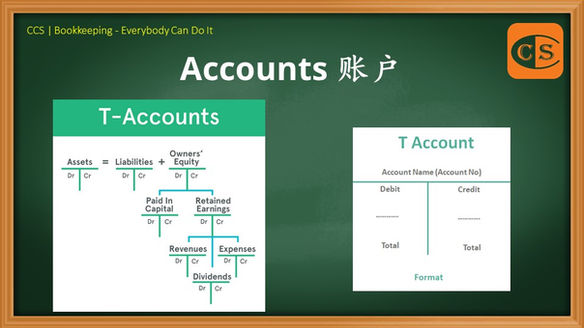
1. A double-entry accounting system is one in which every transaction impacts at least two different accounts.
2. One or more accounts should be debited, and one or more accounts should be credited in order to balance the books.
3. When a transaction has only two accounts affected, a straightforward entry should be made.
4. In addition, when a transaction has an impact on more than two accounts, a compound entry should be created. Let us now take a look at this example.
1. To create a profit, every company puts its resources and efforts.
2. In the process, several events that have a financial impact on the company occur.
3. We need to analyze and summarize the accounting records and all of the events that have taken place so that internal and external stakeholders might use this information for decision-making.
4. Keeping records of all financial activities in a business is called bookkeeping, which is a part of accounting.
5. Sales and purchases are two of the most common types of transactions within a business.
6. Purchases result in an increase in supplies but a decrease in cash.
7. There are fewer goods and more money as a result of sales.
8. Due to the availability of this information, the company can make various decisions regarding suppliers and clients.
9. As previously said, bookkeeping is the element of accounting that consists only of recording all transactions that occur within a company.
10. Accounting is a broader term that encompasses the bookkeeping process and the process of preparing all financial statements for a company.
11. Some individuals describe it as follows:-
👉 Bookkeeping can be done by everyone who understands its basics.
👉 The preparation of financial statements, however, requires relevant accounting knowledge or an accounting degree
🌻🌻🌻🌻🌻🌻🌻🌻🌻🌻🌻🌻
Bookkeeping – Everybody Can Do It / #簿记 – #人人都能做到系列
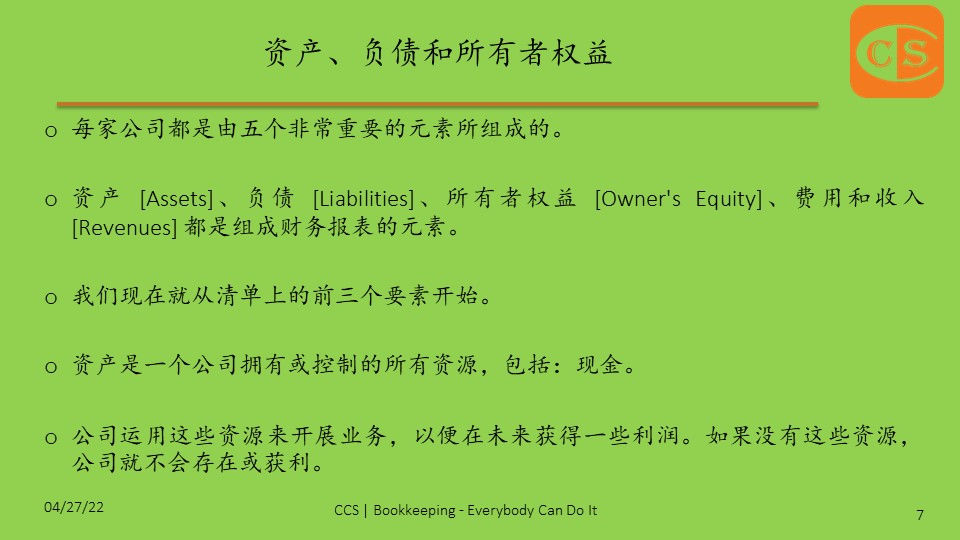
1. Every company is comprised of five very significant elements.
2. Assets, Liabilities, Owner’s Equity, Expenses, and Revenues are all elements that make up the financial statements.
3. We’ll start with the first three elements on the list now.
4. Assets are all resources that a company owns or controls, including cash.
5. The company employs these resources to carry out its operations to obtain some profit in the future. The company would not exist or profit if these resources were not made available.
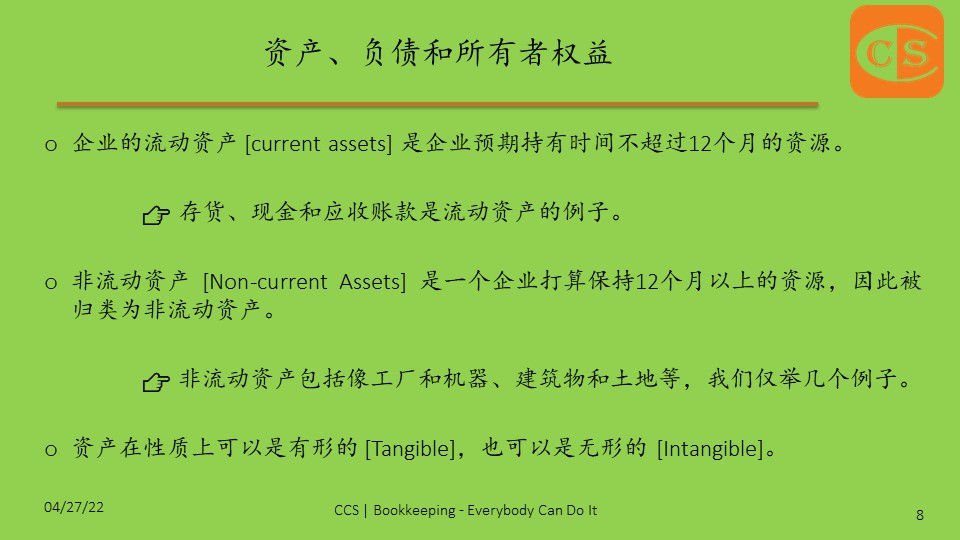
6. A business’s Current Assets are assets that a business expects to hold for less than 12 months.
👉 Inventory, cash, and accounts receivable are examples of current assets.
7. Non-current Assets are items that a company intends to maintain for more than 12 months and are therefore classified as such.
👉 Non-Current Assets include things like plants and machinery, buildings, and land, to name a few examples.
8. Assets can be both Tangible and Intangible in nature.
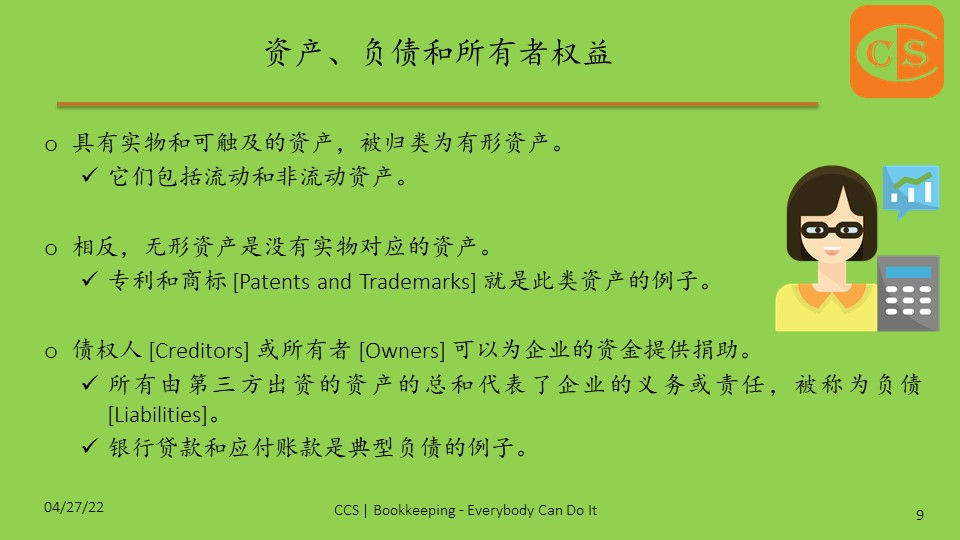
9. Assets with physical substance and the ability to be touched are classified as tangible assets.
👉 They include both current and non-current assets. 10. In contrast, intangible assets are assets that do not have a physical counterpart.
👉 Patents and Trademarks are examples of such assets.
11. Creditors or Owners can contribute to the funding of the business.
👉 The total sum of all assets that have been funded by third parties represents an obligation for the business and is referred to as Liabilities.
👉 A bank loan and accounts payable are examples of typical Liabilities.
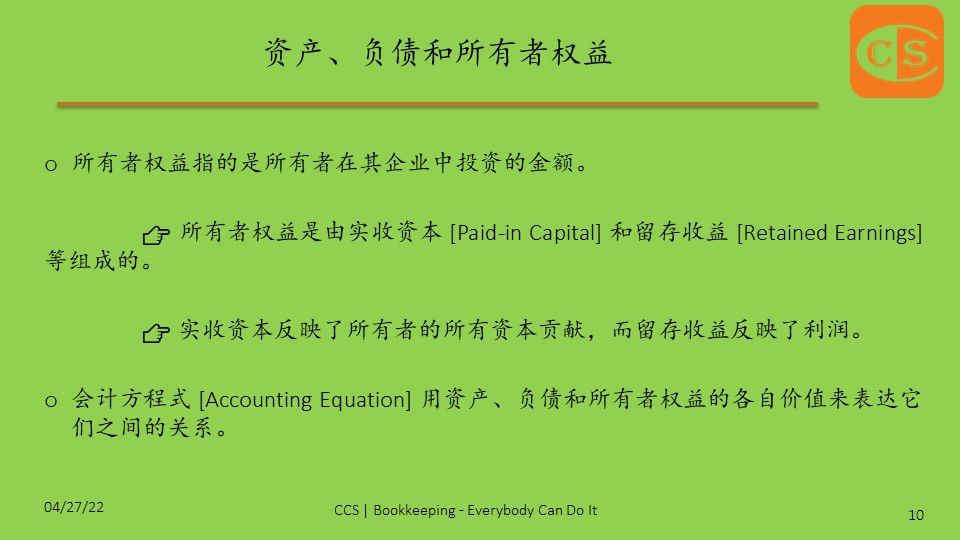
12. Owner’s equity refers to the amount of money invested by the owners in their businesses. Owners’ equity is made up of Paid-in Capital and Retained Earnings, among other things. Paid-in-capital reflects all of the capital contributions made by the owners, whereas retained earnings reflect the profit.
13. An Accounting Equation expresses the relationship between assets, liabilities, and owner’s equity in terms of their respective values
🌻🌻🌻🌻🌻🌻🌻🌻🌻🌻🌻🌻
Bookkeeping – Everybody Can Do It / #簿记 – #人人都能做到系列
1. The underlying concept of the Accounting Equation is that the entire value of all assets should equal the sum of the amounts due to third parties and the amount of money invested by the owners in their businesses. [i.e. Assets = Liabilities + Owner’s Equity]
2. Every company should be familiar with the concept of the Accounting Equation since it provides a clear picture of a company’s financial status.
3. It indicates that the company is in an excellent financial condition if the value of owners’ equity exceeds the value of liabilities [Owner’s Equity > Liabilities].
👉 This is because more of the assets are obtained via company money rather than through a loan.
4. The opposite is true if the value of liabilities exceeds the company’s equity value [Owner’s Equity < Liabilities].
👉 This indicates that the company is in a terrible financial condition since more assets are bought through debt rather than capital.
👉 Companies that are just getting started often find themselves in this scenario [In other words, there isn’t enough money to start a business].
5. To better comprehend the concept behind the accounting equation, I want to provide you with the following illustration. 6. Consider the following scenario:
👉 a company owns machinery, office equipment, stock, and money in its bank account.
👉 All of these items are worth RM200K when taken together.
👉 The company obtained an RM120K bank loan to purchase the machinery and office equipment it needs to run its operations.
👉 The owners are responsible for supplying the inventory and the funds in the bank account.
👉 Liabilities total RM120K, but the value of ownership equity is RM80K [RM200 = RM120 + RM80] in this instance.
🌻🌻🌻🌻🌻🌻🌻🌻🌻🌻🌻🌻
Bookkeeping – Everybody Can Do It / #簿记 – #人人都能做到系列
1. Let’s look at various business events and how they influence the accounting equation, as a result, a conclusion regarding what a “transaction” is can be reached after that.