
Tag: Auditing

  • What Function Does the International Auditing and Assurance Standards  Board(IAASB)Play?

    What Function Does the International Auditing and Assurance Standards Board(IAASB)Play?

    The International Auditing and Assurance Standards Board, also known as the IAASB, is responsible for setting the International Standards on Auditing (ISAs).

    It is an independent body that sets international standards of high quality on aspects of:

    • Auditing;
    • Assurance;
    • Quality Control;
    • Review; and
    • Related services.

    The International Auditing and Assurance Standards Board were established in March 1978. Before that, it was known as the International Auditing Practices Committee (IAPC), and its activity used to be concentrated on three main areas at the time:

    • Objects and scope of audits of Financial Statements;
    • Engagement letters; and
    • General auditing guidelines.

    It is easy to see how the work of the International Auditing and Assurance Standards Board (IAASB) has dramatically progressed since 1991, when the guidelines initially developed by the International Auditing Practices Committee (IAPC) were renamed the International Standards on Auditing (ISAs).

    In 2002, the IAPC changed its name to the International Auditing and Assurance Standards Board (IAASB), and the International Federation of Accountants (IFAC) approved a series of reforms. These reforms were primarily designed (among other things) to strengthen the standard-setting process, which included the operations at the IAASB.

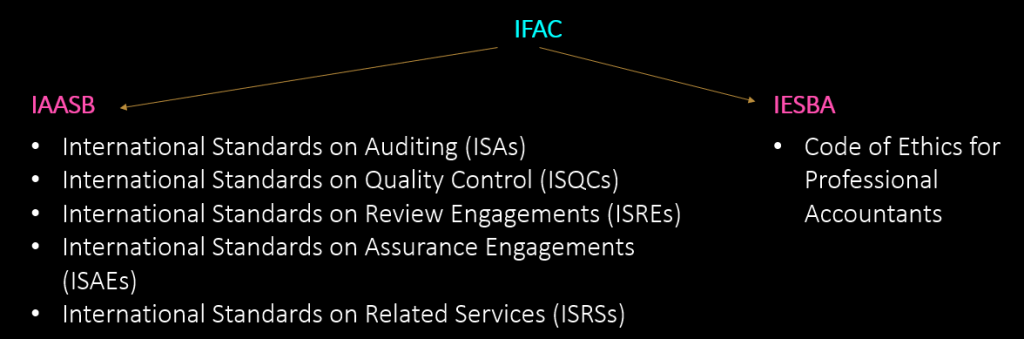
    The International Auditing and Assurance Standards Board (IAASB) is a technical standing committee of the International Federation of Accountants (IFAC) that has close ties to the International Ethics Standards Board for Accountants (IESBA), which is responsible for the production of the Code of Ethics for Professional Accountants. The following is an example that illustrates the hierarchy:
    According to the introduction to the revised edition of International Standards on Quality Control, Auditing, Assurance, and Related Services Pronouncements (2011), the standards that the IAASB produced are considered authoritative content.

    As these standards are authoritative, they must be followed in an audit conducted in accordance with the ISAs.

    In addition to publishing documents that are considered to be “authoritative,” the IAASB also publishes materials that are considered to be “non-authoritative,” which provide a type of “advice” rather than requirements. These are:

    • International Auditing Practices Notes (IAPNs) – These are designed to provide practical assistance to auditors rather than impose mandatory requirements.
    • Practice Notes Relating to Other International Standards.
    • Staff Publications – these are designed to raise awareness of new or emerging issues about the standards and to direct attention to the relevant parts of IAASB pronouncements.

    Some jurisdictions will have their bodies that are responsible for standard-setting. For instance, the Financial Reporting Council is the organisation in charge of establishing standards in the UK.

    Some nations have decided to adopt ISAs, but such laws will need to be modified before they can be implemented. For instance, in the United Kingdom, ISAs are adopted; however, they are modified in certain areas so that they are compatible with UK standards; the resulting documents are nevertheless referred to as ISAs (UK and Ireland).

    Example
    The auditor is required by ISA 570 Going Concern to determine whether management has made a going concern assessment that covers a period of 12 months beginning on the date of the financial statements. 
    
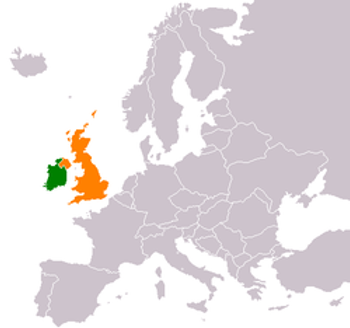
    However, in the United Kingdom and Ireland, this assessment of the company's ability to continue operations should encompass a period of one year beginning on the day that the financial statements are approved (or the date that is likely to be approved). 
    
    Because of this, the ISA for the United Kingdom and Ireland spans a period of time that is distinct from that of the mainstream ISA; this exemplifies how the standard-setters have adapted the latter to be applicable only in the United Kingdom and Ireland. 
    
    In the UK the going concern ISA is known as ISA (UK and Ireland) 570  Going Concern. 
    
    In the UK and Ireland ISAs are frequently referred to as  ‘ISA  pluses’ because they contain additional or amended requirements to the mainstream ISA that is issued by the IAASB.

    18
  • 1. Professional Skepticism In An Audit Of Financial Statements

    1. Professional Skepticism In An Audit Of Financial Statements

    The auditing practice requires a high level of Professional Skepticism at all times.

    在审计领域,职业怀疑论的概念无处不在。

    In the same way that a Jedi from Star Wars is always working to improve his or her understanding of the “force,” an auditor is always working to improve his or her capacity to exercise Professional Skepticism.

    When carrying out an assurance engagement, having a healthy dose of Professional Skepticism lays the groundwork for the decision-making process.

    就像《星球大战》中的绝地武士不断努力磨练自己对 “力量 “的理解一样,审计师也在不断提高自己运用职业怀疑论的能力。

    在进行审计工作时,正是职业怀疑主义为决策提供了基础。

    A brief definition of Professional Skepticism

    In the IAASB’s Handbook of International Quality Control, Auditing, Review, Other Assurance, and Related Services Pronouncements, the glossary of words includes the following definition of the term “Professional Skepticism”:

    “an attitude that includes a questioning mind, being alert to conditions which may indicate possible misstatement due to error or fraud, and a critical assessment of audit evidence.”

    职业怀疑的简要定义

    在国际审计与鉴证准则理事会(The International Auditing and Assurance Standards Board — IAASB) 的《国际质量控制、审计、审阅、其他鉴证及相关服务公告》手册中,词汇表对 “职业怀疑”诠释如下:-

    "要有质疑及对审计证据批判性的态度。职业怀疑态度要求不断质疑所获得的信息及审计证据是否显示会存在舞弊性的重大错报 [material misstatement]"。

    In line with the above definition, it is easy to see that Professional Skepticism is a skill that auditors should continually strive to build and improve, however, this skill is not easily assessable.

    Moreover, it cannot be developed in a single day. Specifically, it is a skill that takes time to acquire with experience. Skepticism in the professional world is mostly seen as thinking rather than an attitude.

    Auditors need to be Professionally Skeptical when performing their tasks, which drives their behaviour to adopt a questioning attitude when analyzing audit materials and drawing conclusions.

    When viewed in this light, the core ethical principles of objectivity and auditor independence are inextricably tied to the Professional Skepticism that underpins them. 

    按照上述定义,不难看出职业怀疑态度是审计人员应不断努力建立和提高的技能,然而这项技能是不容易被评估的。而且,也不可能在一天之内就可以培养出来。

    具体的说,它是一种需要时间随着经验而获得的技能。更多的时候,职业怀疑在专业领域往往被看作是一种思维,而不是一种态度。

    审计人员在执行任务时,需要秉职业怀疑的心态,这促使他们的行为在分析审计材料和得出结论时采取质疑的态度。

    从这个角度来看,客观性和审计师独立性的核心原则与支撑它们的职业怀疑论密不可分。

    Auditor’s Independence

    The Auditor’s Independence enhances their capacity to act with integrity, be objective, and maintain an attitude of Professional Skepticism.

    Professional Skepticism also includes being alert to, for example, audit evidence that contradicts other audit evidence obtained, or information that brings into question the reliability of documents or responses to inquiries to be used as audit evidence.

    In addition, it includes being alert to conditions that may indicate possible fraud and circumstances that suggest the need for audit procedures in addition to those required by the ISAs.

    审计人员的独立性

    审计人员的独立性增强了其能力,使其能够诚信行事、客观对待,并保持职业怀疑的态度。

    职业怀疑态度还包括对以下情况保持警惕,例如,与其他审计证据相矛盾的审计证据,或使人怀疑作为审计证据的文件或查询答复的可靠性的信息。

    此外,它还需要密切关注这些情况:

    • 可能存在的舞弊;以及
    • 出现除了国际审计准则 [ISAs] 规定的审计要求,还需要采取更深入的审计程序的情况

    Professional Skepticism also includes a Critical Assessment of audit evidence, which comprises both information that supports and corroborates management’s assertions, and any information that contradicts such assertions.

    In this context, applying Professional Skepticism means questioning and considering the sufficiency and appropriateness of audit evidence obtained in light of the circumstances.

    For instance, this may be the case when fraud risk factors are present and a single document of a type that is susceptible to fraud is the only supporting evidence for a material financial statements amount. In this scenario, the auditor should apply Professional Skepticism. 

    When there is reason to suspect the authenticity of the findings being audited or when there are indications that fraud may have taken place, the ISAs mandate that the auditor conducts an additional investigation and determine what modifications or additions to the auditing procedures are required to resolve the issue.

    职业怀疑还包括对审计证据的批判性评估 [Critical Assessment],其中包括支持和作证管理层认定 [Assertions],以及任何与此类认定相矛盾的信息。

    在这种情况下,套用职业怀疑态度意味着需要根据情况对所获得的审计证据的充分性和适当性进行质疑和考量。

    例如,当存在舞弊风险因素,且容易受舞弊影响的单一文件是某一重要财务报表金额的唯一支持性证据时,这种情况就可能会出现。此时,审计师应施展其职业怀疑态度。 

    当有理由怀疑被审计结果的真实性或有迹象表明可能发生了舞弊行为时,《国际审计准则》要求审计师进行额外的审查,以确定需要对审计程序进行哪些修改或补充以解决该问题。

    At the same time, it is not acceptable for the auditor to omit an audit procedure for which there is no alternative or to be content with audit evidence that is less convincing simply because the auditing process is difficult, time-consuming, or costly.

    Finally, it is essential to note that a subjective personal belief in the honesty and integrity of management and those charged with governance (TCWG) does not relieve the auditor from maintaining Professional Skepticism or accepting less than persuasive audit evidence when reasonable assurance is obtained.

    同时,审计人员不能仅仅因为审计程序困难、耗时或成本高而省略没有替代方案的审计程序,或满足于说服力较低的审计证据。

    最后,要注意的是,个人主观的相信管理层和负责治理的人(TCWG)是诚实和正直的,并不能解除审计人员在获得合理保证时秉持职业怀疑的态度,或接受说服力不强的审计证据。 

    21
  • MIA: Covid-19 FAQs on Auditing

    MIA: Covid-19 FAQs on Auditing

    Our website's articles, templates, and material are solely for reference. Although we make every effort to keep the information up to date and accurate, we make no representations or warranties of any kind, either express or implied, regarding the website or the information, articles, templates, or related graphics that are contained on the website in terms of its completeness, accuracy, reliability, suitability, or availability. Any reliance on such information is therefore strictly at your own risk.

    Keep in touch with us so that you can receive timely updates |

    要获得即时更新,请与我们保持联系

    1. Website ✍️ https://www.ccs-co.com/ 2. Telegram ✍️ http://bit.ly/YourAuditor 3. Facebook ✍

    4. Blog ✍ https://lnkd.in/e-Pu8_G 5. Google ✍ https://lnkd.in/ehZE6mxy

    6. LinkedIn ✍ https://www.linkedin.com/company/74734209/admin/

    8