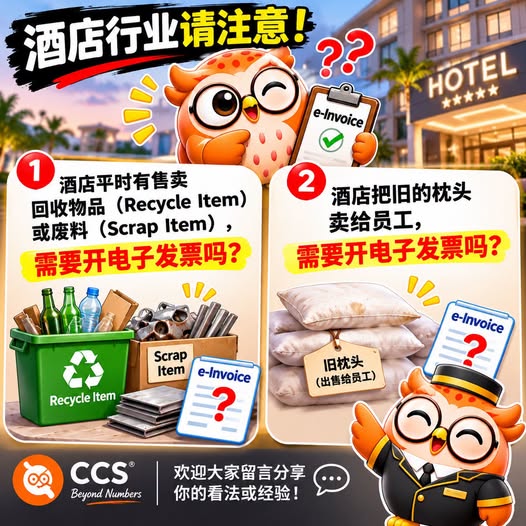
Does a hotel need to issue an e-Invoice when it sells used pillows? Must even a pillow that has served countless guests be reported to LHDN?
Two practical questions have come up:
- Does a hotel need to issue an e-Invoice when selling recyclable or scrap items, such as waste paper, scrap metal or other used materials?
- What about old pillows or other retired items sold to hotel employees?
Selling Scrap Items
In principle, an e-Invoice may be required. A hotel’s business transactions are not limited to room bookings and meals. The sale of waste paper, scrap metal or old equipment may also give rise to e-Invoice obligations, even if these are not part of the hotel’s main business activities.
However, this does not necessarily mean that a separate e-Invoice must be issued for every transaction. If the buyer does not request an e-Invoice and the transaction meets the consolidated e-Invoice requirements applicable at the time, the hotel may consider including it in a consolidated e-Invoice.
The buyer’s status, transaction amount and any specific restrictions should also be considered. Different treatment may apply if the hotel itself is exempt from e-Invoicing.
Selling Old Pillows to Employees
In principle, this is also a sale. Even if a pillow has hosted countless nights of sleep, selling it to an employee is still a transaction.
For example, if a hotel sells an old pillow to an employee for RM10, and the employee does not request an e-Invoice and the transaction qualifies for consolidation, the hotel may consider including it in a consolidated e-Invoice. If the employee requests an e-Invoice, the hotel should issue an individual e-Invoice in accordance with the applicable requirements.
A pillow may retire after five years, while an employee may still be working overtime after five years. But before the pillow’s retirement, if it is sold for RM10, the hotel still needs to consider its e-Invoice obligations.
A Reminder for Businesses
E-Invoicing is not limited to a company’s main sources of revenue. Transactions involving the sale of scrap items, old furniture and other assets may also need to be considered.
Whether each transaction requires a separate e-Invoice, can be included in a consolidated e-Invoice, or should be handled in another way depends on the applicable HASiL guidance.
In short: the item may be old, but the invoice should not be overlooked.
酒店出售废料和淘汰资产,也需要开电子发票吗?
酒店出售旧枕头,也要开电子发票吗?难道连陪伴过无数位客人的枕头,LHDN 也不放过?
最近有人提出了两个实际问题:
- 酒店出售废纸、废铁、旧金属等可回收物品或废料时,是否需要开具电子发票?
- 酒店将淘汰的旧枕头或其他旧物品卖给员工,又该如何处理?
出售废料
原则上,这类交易可能需要开具电子发票。酒店的商业交易不只包括客房和餐饮服务。出售废纸、废铁或旧设备,即使并非酒店的主要营业活动,也可能产生电子发票义务。
不过,这并不代表每笔交易都必须单独开票。如果买方没有要求电子发票,且交易符合当时适用的合并电子发票条件,酒店可以考虑将该交易纳入合并电子发票。
酒店也应考虑买方身份、交易金额及是否适用特定限制。如果酒店本身获豁免实施电子发票,则可能适用不同处理方式。
出售旧枕头给员工
原则上,这同样属于销售交易。即使枕头陪伴过许多客人安睡,只要酒店将其出售给员工,就仍然是一项交易。
例如,酒店以 RM10 将旧枕头卖给员工。如果员工没有要求电子发票,且该交易符合合并开票条件,酒店可以考虑将其纳入合并电子发票。如果员工要求电子发票,酒店则应根据适用规定开具个人电子发票。
枕头睡了五年可以退休,员工工作了五年却可能还在加班。但枕头退休前若以 RM10 售出,酒店仍需考虑相关的电子发票义务。
给企业的提醒
电子发票关注的不只是企业的主要收入来源。出售废料、旧家具及其他资产所产生的交易,也可能需要纳入考量。
是否必须逐笔开票、能否纳入合并电子发票,或应如何处理,仍须根据适用的 HASiL 指南判断。
简单来说:东西可以旧,发票不能漏。