
Day: March 21, 2023

  • Are Investors Required to Pay Taxes on Income Distributed by Unit Trust Equity and Bond Funds

    Are Investors Required to Pay Taxes on Income Distributed by Unit Trust Equity and Bond Funds

    Income distributed by unit trust funds, equity funds, and bond funds will be subject to taxation, and investors will receive tax credits to be claimed in their respective tax returns.

    Investors can claim the tax credits under Section 110(9A) of the Income Tax Act 1967 (ITA).

    If unit trust funds, equity funds, and bond funds receive Foreign Source Income (FSI) income, that income will be subject to taxation at the level of the funds.

    Tax credits under Section 132 or 133 of the ITA can be claimed if that income has been taxed outside the country. Distributions received by unit holders (investors) are considered to be received from Malaysia under Section 61(1B) of the ITA. Tax credits can be claimed under Section 110(9A) of the ITA.

    Sections 61(1) & 61(1B) of the Income Tax Act 1967

    Section 61(1) outlines the rules for how a trust is treated for tax purposes.

    The trustees are considered the “trust body” and are treated as persons for tax purposes, except for certain provisions.

    Any property or income belonging to the trust or a trustee of the trust is treated as belonging to the trust body. However, gains from the sale of investments in a unit trust are not considered income of the trust body.

    Beneficiaries of the trust are considered to have an “ordinary source” of income from the trust, and their share of the trust body’s total income is deemed their statutory income for tax purposes.

    Beneficiaries are assessed and taxed on income from their ordinary source or any additional source related to the trust. These rules do not apply to someone with income included in their gross income from employment.

    This section explains how a trust is taxed, with the trustees being treated as the “person” for tax purposes and beneficiaries being taxed on income from the trust.
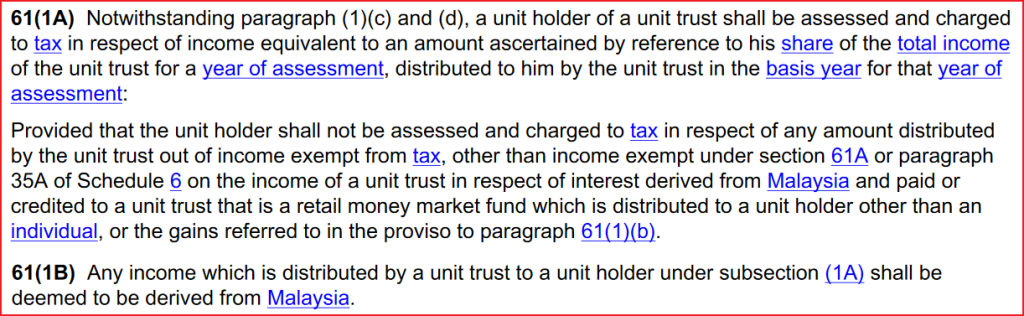
    Section 61(1A) states that a unit holder of a unit trust will be assessed and charged with tax in relation to their share of the total income of the unit trust, which is distributed to them during the basis year for that year of assessment. However, suppose the income distributed by the unit trust is tax exempted. In that case, the unit holder will not be charged for the tax unless it falls under specific exemptions listed in the section.

    Section 61(1B) explains that any income distributed by a unit trust to a unit holder under subsection (1A) will be treated as income derived from Malaysia.

    Provisions

    Trusts are subject to the prevailing tax principles and provisions of the Income Tax Act as for other chargeable persons. There are also specific provisions relating to income from trusts and income of trusts, and these are:

    • Section 2 – Definition of ‘trust body”
    • Section 21A – Basis period of a trust
    • Section 61 – Trusts generally
    • Section 62 – Discretionary trusts
    • Section 63 – Trust annuities
    • Section 73 – Trustees as chargeable persons
    • Section 77A – Return of income
    • Section 107C – Estimate of tax payable and payment of instalments
    • Section 110(8) and (9) – Set-off for tax deducted Schedule 1, paragraph 2(c) – Rate of tax

    Disclaimer:

    The articles, templates, and other materials on our website are provided only for your reference.

    While we strive to ensure that the information presented is current and accurate, we cannot guarantee the completeness, reliability, suitability, or availability of the website or its content, including any related graphics. Consequently, any reliance on this information is entirely at your own risk.

    If you intend to use the content of our videos and publications as a reference, we recommend that you take the following steps:

    1. Verify that the information provided is current, accurate, and complete.
    2. Seek additional professional opinions, as the scope and extent of each issue, may be unique.

    免责声明:

    我们网站上的文章、模板和其他材料只供参考。

    虽然我们努力确保所提供的信息是最新和准确的,但我们不能保证网站或其内容,包括任何相关图形的完整性、可靠性、适用性或可用性。因此,您需要承担使用这些信息所带来的风险。

    如果你打算使用我们的视频和出版物的内容作为参考,我们建议你采取以下步骤:

    1. 核实所提供的信息是最新的、准确的和完整的。
    2. 寻求额外的专业意见,因为每个问题的范围和程度,可能是独特的。

    Keep in touch with us so that you can receive timely updates

    请与我们保持联系,以获得即时更新。

    1. Website ✍️ https://www.ccs-co.com/ 2. Telegram ✍️ http://bit.ly/YourAuditor 3. Facebook ✍

    4. Blog ✍ https://lnkd.in/e-Pu8_G 5. Google ✍ https://lnkd.in/ehZE6mxy

    6. LinkedIn ✍ https://www.linkedin.com/company/74734209/admin/

    11
  • CTIM Online Resources can now be accessed from anywhere

    CTIM Online Resources can now be accessed from anywhere

    The Chartered Tax Institute of Malaysia (CTIM), originally formed under the auspices of the Malaysian Institute of Accountants (MIA), was established in 1991. Currently, CTIM has approximately 3800 members comprising accountants, licensed tax agents, lawyers, members from commerce and industry and other tax practitioners like members from the IRB. Since its inception, CTIM has actively created awareness of and promoted the tax profession to meet the country’s demand for qualified and trained tax practitioners. At the CTIM Resource Centre, which is located at the CTIM headquarters on Megan Avenue II in Kuala Lumpur, members have access to the online resources listed below:

    CTIM is glad to announce to its members that beginning on February 13, 2023, all of the aforementioned online materials will be available for remote access via the TeamViewer software programme.

    This service is free to members and is only available for members.

    For members interested in utilising the aforementioned service:

    Please download remote access to CTIM online resources user manual for more information:

    Disclaimer:

    The articles, templates, and other materials on our website are provided only for your reference.

    While we strive to ensure that the information presented is current and accurate, we cannot guarantee the completeness, reliability, suitability, or availability of the website or its content, including any related graphics. Consequently, any reliance on this information is entirely at your own risk.

    If you intend to use the content of our videos and publications as a reference, we recommend that you take the following steps:

    1. Verify that the information provided is current, accurate, and complete.
    2. Seek additional professional opinions, as the scope and extent of each issue, may be unique.

    免责声明:

    我们网站上的文章、模板和其他材料只供参考。

    虽然我们努力确保所提供的信息是最新和准确的,但我们不能保证网站或其内容,包括任何相关图形的完整性、可靠性、适用性或可用性。因此,您需要承担使用这些信息所带来的风险。

    如果你打算使用我们的视频和出版物的内容作为参考,我们建议你采取以下步骤:

    1. 核实所提供的信息是最新的、准确的和完整的。
    2. 寻求额外的专业意见,因为每个问题的范围和程度,可能是独特的。

    Keep in touch with us so that you can receive timely updates

    请与我们保持联系,以获得即时更新。

    1. Website ✍️ https://www.ccs-co.com/ 2. Telegram ✍️ http://bit.ly/YourAuditor 3. Facebook ✍

    4. Blog ✍ https://lnkd.in/e-Pu8_G 5. Google ✍ https://lnkd.in/ehZE6mxy

    6. LinkedIn ✍ https://www.linkedin.com/company/74734209/admin/

    10
  • Frequently Asked Questions (FAQ) on Mutual Agreement Procedures (MAP)

    Frequently Asked Questions (FAQ) on Mutual Agreement Procedures (MAP)

    Mutual Agreement Procedures (MAP) resolve international tax disputes between two or more countries.

    MAP allows the competent authorities of the countries involved to work together to eliminate any double taxation that may arise due to conflicting tax laws or interpretations.

    This procedure is typically initiated by a taxpayer who believes that they have been subjected to double taxation, and the competent authorities of the relevant countries will then work together to resolve the issue through mutual agreement.

    MAP can be a lengthy process, but it is an important tool for promoting cross-border trade and investment by providing greater certainty and predictability for taxpayers. Inland Revenue Board of Malaysia (IRBM) has published a new list of Frequently Asked Questions (FAQ) related to Mutual Agreement Procedures (MAP) on its official website.

    This list covers a wide range of topics, including:

    • General information,
    • MAP application procedures,
    • Issues covered
    • Examples of MAP issues,
    • Documentation requirements, and
    • the implementation of MAP.

    IRBM has also released the updated contact details of the competent authorities responsible for processing MAP applications, effective January 1, 2023.

    We encourage interested parties to visit the IRBM website to access this information and stay informed about any changes or updates related to MAP procedures.

    Disclaimer:

    The articles, templates, and other materials on our website are provided only for your reference.

    While we strive to ensure that the information presented is current and accurate, we cannot guarantee the completeness, reliability, suitability, or availability of the website or its content, including any related graphics. Consequently, any reliance on this information is entirely at your own risk.

    If you intend to use the content of our videos and publications as a reference, we recommend that you take the following steps:

    1. Verify that the information provided is current, accurate, and complete.
    2. Seek additional professional opinions, as the scope and extent of each issue, may be unique.

    免责声明:

    我们网站上的文章、模板和其他材料只供参考。

    虽然我们努力确保所提供的信息是最新和准确的,但我们不能保证网站或其内容,包括任何相关图形的完整性、可靠性、适用性或可用性。因此,您需要承担使用这些信息所带来的风险。

    如果你打算使用我们的视频和出版物的内容作为参考,我们建议你采取以下步骤:

    1. 核实所提供的信息是最新的、准确的和完整的。
    2. 寻求额外的专业意见,因为每个问题的范围和程度,可能是独特的。

    Keep in touch with us so that you can receive timely updates

    请与我们保持联系,以获得即时更新。

    1. Website ✍️ https://www.ccs-co.com/ 2. Telegram ✍️ http://bit.ly/YourAuditor 3. Facebook ✍

    4. Blog ✍ https://lnkd.in/e-Pu8_G 5. Google ✍ https://lnkd.in/ehZE6mxy

    6. LinkedIn ✍ https://www.linkedin.com/company/74734209/admin/

    8
  • Guide and Flowchart for Submission of Form and Appendix for the 2% WHT under Section 107D

    Guide and Flowchart for Submission of Form and Appendix for the 2% WHT under Section 107D

    On its website, the Inland Revenue Board of Malaysia (IRBM) has published the following Guide and Flowchart:

    The Inland Revenue Board of Malaysia (LHDNM) has provided the latest Amended Form CP107D(2) [Amendment 1/2023].

    The amendment is intended to align the 2% tax deduction amount calculation.

    The procedure for submitting the form that must be complied with by the paying company is as follows:

    A. SUBMISSION OF FORM AND APPENDIX

    The paying company is required to fill in Form CP107D [Amendment 2/2022] and Appendix CP107D(2) [Amendment 1/2023] provided by LHDNM.

    The completed form and attachment must be submitted via email according to the payment centre below:

    For payment at the counter or by post, the Form and appendix must be submitted to the email address above.

    The payment centre will take action on the submitted appendix as follows:

    • If the submitted appendix is complete, the payment centre will email the Acknowledgement Slip of Appendix CP107D(2) to the paying company. or
    • If the submitted appendix is incomplete, the payment centre will return the appendix by email to the paying company.

    B. PAYMENT SUBMISSION

    1. The paying company can only make payment at the payment counter or by post after receiving the Acknowledgement Slip of Appendix CP107D(2) from the payment centre.
    2. Please attach the following documents when making payment at the counter or by post:
      1. Acknowledgement Slip of Appendix CP107D(2);
      2. Form CP107D [Amendment 2/2022];
      3. Appendix CP107D(2) [Amendment 1/2023]; and
      4. Payment instrument (check/bank draft).
    3. The payment amount must equal the S107D deduction (2%) as stated in the Acknowledgement Slip of Appendix CP107D(2).
    4. Different payment amounts will be rejected by the payment centre and returned to the paying company.
    5. The payment centre counter will issue a receipt if the submitted payment is accurate.

    Below is the Flowchart for Submission of Form, Appendix, and Payments under Section 107D of the ITA 1967 dated 13 January 2023 released by IRBM:-

    References:

    Disclaimer:

    The articles, templates, and other materials on our website are provided only for your reference.

    While we strive to ensure that the information presented is current and accurate, we cannot guarantee the completeness, reliability, suitability, or availability of the website or its content, including any related graphics. Consequently, any reliance on this information is entirely at your own risk.

    If you intend to use the content of our videos and publications as a reference, we recommend that you take the following steps:

    1. Verify that the information provided is current, accurate, and complete.
    2. Seek additional professional opinions, as the scope and extent of each issue, may be unique.

    免责声明:

    我们网站上的文章、模板和其他材料只供参考。

    虽然我们努力确保所提供的信息是最新和准确的,但我们不能保证网站或其内容,包括任何相关图形的完整性、可靠性、适用性或可用性。因此,您需要承担使用这些信息所带来的风险。

    如果你打算使用我们的视频和出版物的内容作为参考,我们建议你采取以下步骤:

    1. 核实所提供的信息是最新的、准确的和完整的。
    2. 寻求额外的专业意见,因为每个问题的范围和程度,可能是独特的。

    Keep in touch with us so that you can receive timely updates

    请与我们保持联系,以获得即时更新。

    1. Website ✍️ https://www.ccs-co.com/ 2. Telegram ✍️ http://bit.ly/YourAuditor 3. Facebook ✍

    4. Blog ✍ https://lnkd.in/e-Pu8_G 5. Google ✍ https://lnkd.in/ehZE6mxy

    6. LinkedIn ✍ https://www.linkedin.com/company/74734209/admin/

    11