IRB 的上诉,定于明年1月17日在上诉法院 (Court of Appeal) 进行案件管理 (Case Management)。
Our website's articles, templates, and material are solely for you to look over. Although we make every effort to keep the information up to date and accurate, we make no representations or warranties of any kind, either express or implied, regarding the website or the information, articles, templates, or related graphics that are contained on the website in terms of its completeness, accuracy, reliability, suitability, or availability. Therefore, any reliance on such information is strictly at your own risk.
Keep in touch with us so that you can receive timely updates |
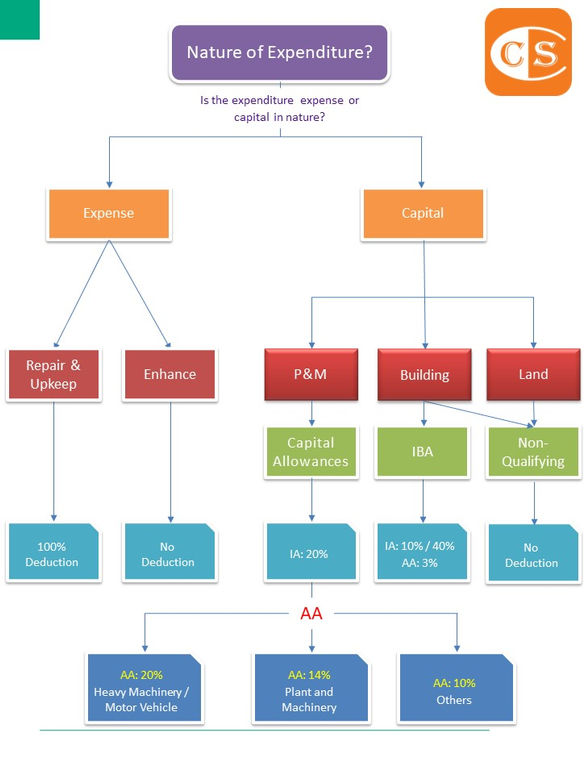
Capital Allowances are a complex tax technical area largely governed by case law and precedent.
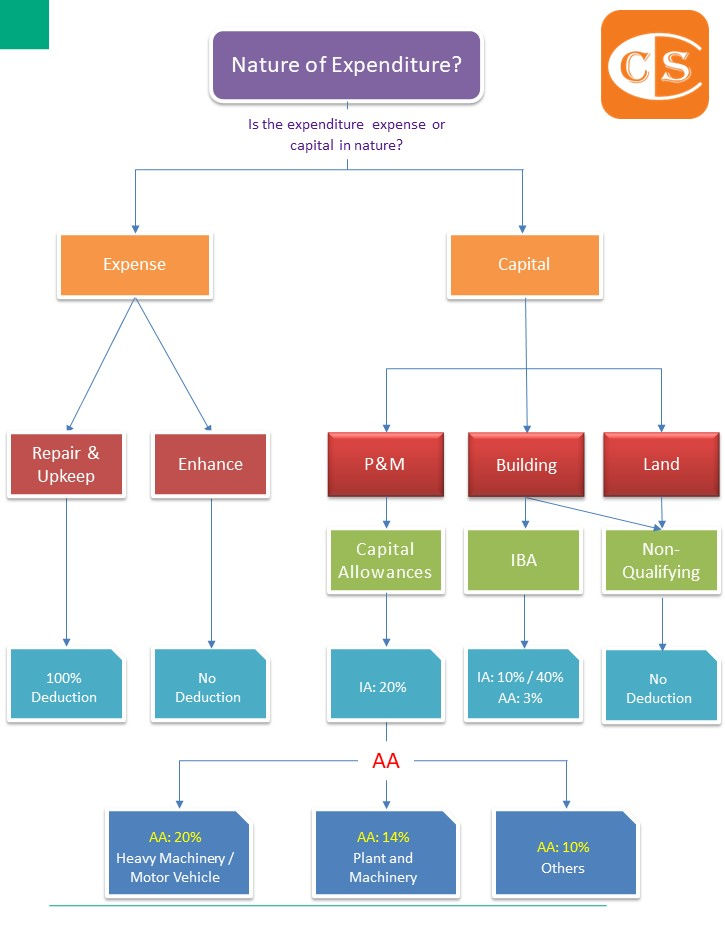
As illustrated in Fig. below, before calculating the Capital Allowances available in respect of capital expenditure incurred, two criteria must be considered:
Is the expenditure expense or capital in nature?
If it is capital, is it incurred on qualifying assets – i.e. P&M as per Schedule 3 of the Income Tax Act 1967, Industrial Buildings [also covered under Schedule 3 of the Income Tax Act 1967], or non-qualifying assets?
In most cases, a person can reduce their overall gross income from a source such as a business or rental property by deducting expenses related to repairs and renewals.
Paragraph 33(1)(c) of the Income Tax Act 1967 (“ITA”) allows a deduction for the expenses wholly and exclusively incurred for:
the repair of premises, plant, machinery or fixtures employed in the production of gross income; or
the renewal, repair or alteration of any implement, utensil or article so employed in the production of gross income from that source other than implements, utensils or articles on which the expenditure would be qualifying plant expenditure for the purposes of Schedule 3 of the ITA.
However, the cost of reconstructing or rebuilding:
any premises, buildings, structures or works of a permanent nature;
any plant or machinery; or
any fixtures
are not allowed as a deduction from the gross income in ascertaining the adjusted income from that source.
The ITA does not include a definition for the word “Repair”
The word “repair” is defined as “to restore (a composite, structural, and others) to good condition by renewing or replacing the damaged parts” in The Shorter Oxford English Dictionary On Historical Principles – Third Edition.
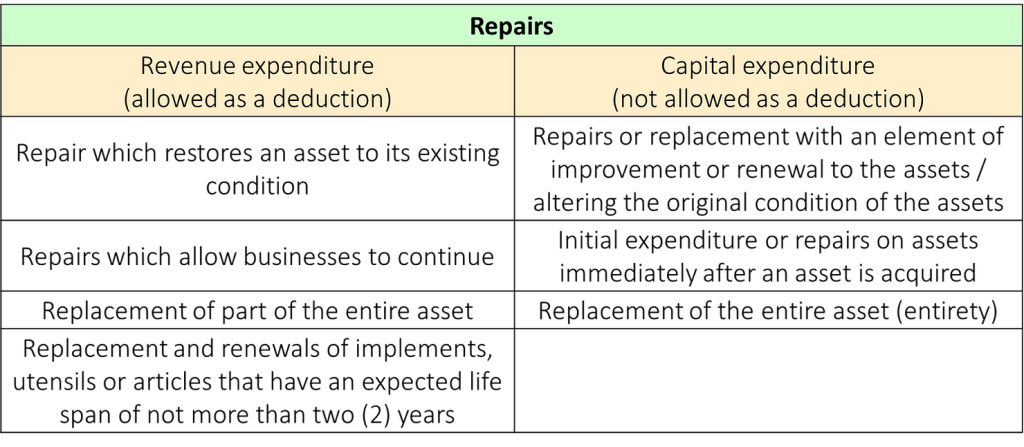
In general, the term “repair” refers to the process by which an asset is returned to its initial condition without any component of improvement, addition, or alteration being included in the process.
This can be accomplished by renewing or replacing the parts of the asset that are damaged or inoperable, respectively.
When the effectiveness of an asset has decreased from its initial state because it has been employed in the operations of the business for some time, the asset requires some form of maintenance or repair.
In layman’s terms, it is an expense that was made purely to put the asset in the state it is currently in, enabling it to perform correctly to the level of efficiency it had previously possessed.
To put it another way, the process of repairing anything should not require the reconstruction or rebuilding of the entire asset or a significant portion of the entire asset.
Implements, utensils or articles with a life span of less than two years
Expenditure incurred on the replacement, repairs and renewal of implements, utensils or articles used in the production of income is allowed as a deduction against gross income on a replacement basis.
Generally, replacing implements, utensils or articles with an expected life span of not more than two (2) years is allowed as a deduction in ascertaining the adjusted income.
Normally, expenditure allowed on a replacement basis is the expenditure on the replacement of small items in terms of size and price.
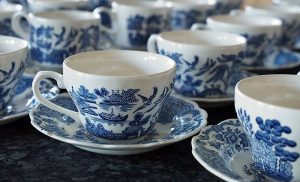
Examples of implements, utensils or articles that can be allowed as a deduction on a replacement basis include dishes, spoons, forks, knives and pots.
The determination of the life span of an asset will be based on the facts of each case, and a person who wishes to claim a deduction on the asset is responsible for determining its life span.
The tax treatment on replacing implements, utensils or articles with an expected life span of not more than two (2) years applies to all types of business.
Restaurant C (RC) has been in operation since 2017.
In 2021, RC incurred expenses of RM2,000 to purchase 200 dinner plates to replace some of the existing chipped and cracked crockeries.
RC can claim those expenses for deduction against gross income on a replacement basis for the year assessment 2021.
However, for expenditure allowed on a replacement basis for implements, utensils or articles used in the production of income, such expenses shall be allowed when incurred for the second time.
Expenses incurred for the first time on the asset are regarded as capital expenditure and are not allowed as a deduction.
The same applies to the estimated provision provided to replace implements, utensils or articles used in the production of income which is not allowed since the expenditure is not incurred.
Our website's articles, templates, and material are solely for you to look over. Although we make every effort to keep the information up to date and accurate, we make no representations or warranties of any kind, either express or implied, regarding the website or the information, articles, templates, or related graphics that are contained on the website in terms of its completeness, accuracy, reliability, suitability, or availability. Therefore, any reliance on such information is strictly at your own risk.
Keep in touch with us so that you can receive timely updates |