Day: August 15, 2022

  • Updated Guidelines: Application for Tax Clearance Letter (TCL) for a Company, LLPs & Labuan Entity

    Updated Guidelines: Application for Tax Clearance Letter (TCL) for a Company, LLPs & Labuan Entity

    Operational Guidelines No. 1/2022 dated May 24, 2022, in Bahasa Malaysia, titled “Permohonan Surat Penyelesaian Cukai Bagi Syarikat, Perkongsian Liabiliti Terhad Dan Entiti Labuan,” were released on the IRB’s website in June 2022.

    DOWNLOAD

    This version of the Operational Guidelines replaces the previous version, Operational Guidelines No. 3/2021, which was issued on June 30, 2021.

    For the Operational Guidelines No. 3/2021, please read:

    The updated Guidelines, similar to the previous Operational Guidelines (No. 3/2021):

    • describe the procedures for applying for tax clearance letters (TCL); and
    • provide guidance on the documents that must be submitted with the application for Companies, Limited Liability Partnerships (LLPs), and Labuan Entities.

    The most significant changes are as follows:

    • According to the Revised Operational Guidelines, the Orders of Release or Dissolution under Section 491 of the Companies Act 2016 (CA):
      • Do not have to be submitted along with the application for the TCL for Companies that are being wound up by court order.
      • It is to be submitted to close a tax file number after receipt of the TCL.
    • For LLPs winding up by court order, the Dissolution Order now needs to be submitted with the application for the TCL.

    The Client Charter of the Malaysian Inland Revenue Board requires that the SPC be issued no later than 14 working days after the date an application with all the necessary documents and information as detailed in Appendix 1 is submitted.

    Application for the SPC

    For a Company to apply for Tax Clearance Letter, the applicant must submit the application forms as follows to the branch that manages the company’s income tax file:

    For LLP, to apply for Tax Clearance Letter, the applicant must submit the application form as follows to the branch that manages the LLP’s income tax file:

    For a Labuan Entity, to apply for Tax Clearance Letter, the applicant must submit the application form as follows to the Labuan International Unit of the Labuan Branch:

    Issuance of the SPC

    The SPC will be issued, subject to the following conditions:

    1. Complete application form and supporting documents have been submitted;
    2. Tax Return Forms up to the latest assessment year / Form E up to the latest year of remuneration have been received;
    3. Audit actions up to the latest assessment year have been completed;
    4. No remaining tax arrears;
    5. The employee’s monthly tax deduction (PCB) has been paid in full; and
    6. No legal action for criminal and/or civil cases

    Closing the Income Tax File

    For a Company, to close the income tax file after the SPC is issued, applicants are required to submit the following documents:-

    Category of DissolutionMembers’ voluntary winding-up​Creditors’ voluntary winding-upWinding-up by court orderCessation of business (foreign company)Strike Off / Dormant company
    Section 439(2)(a) Notice of resolution✅✅​​​
    Section 440(1) Statutory declaration of inability of company to continue business and that meeting of the company and its creditors have been summoned​✅​​​
    Section 443 Declaration of solvency✅​​​​
    Section 484Statement of affairs​​✅​​
    Section 513(1) Notice of appointment and address of liquidator (Voluntary winding up)✅​​​​
    Section 513(1)Notice of appointment and address of liquidator (Creditors’ winding up)​✅​​​
    Section 513(1)Notice of appointment and address of liquidator (Court winding up)​​✅​​
    Section 514(1) Liquidator’s account of receipts and payments and statements✅✅✅​​
    Section 578(1) Notice by foreign company of cessation of business​​​✅​

    Non-availability of Return Form for the Current Assessment Year

    The use of e-Filing is mandatory for Companies and LLPs.

    However, if the e-Filing system for the current assessment year is not yet available, for Tax Clearance Letter Purposes only, Forms C/PT for the previous assessment year may be used by amending the assessment year. For example:

    The use of e-Filing (e-E) is mandatory for employers comprising Companies, LLPs and Labuan Companies.

    Form E for the previous year of remuneration can be used by amending the remuneration year if the e-Filing system for the current year of remuneration is not yet available. For example:

    Disclaimer: The information in this article should not be construed as legal advice, and we assume no responsibility or liability for any decisions made or actions taken from this article should not be construed as legal advice, and we assume no responsibility or liability for decisions made or actions taken as a result of reading this article. ‍

    Our website's articles, templates, and material are solely for reference. Although we make every effort to keep the information up to date and accurate, we make no representations or warranties of any kind, either express or implied, regarding the website or the information, articles, templates, or related graphics that are contained on the website in terms of its completeness, accuracy, reliability, suitability, or availability. Any reliance on such information is therefore strictly at your own risk.

    Keep in touch with us so that you can receive timely updates |

    要获得即时更新,请与我们保持联系

    1. Website ✍️ https://www.ccs-co.com/ 2. Telegram ✍️ http://bit.ly/YourAuditor 3. Facebook ✍

    4. Blog ✍ https://lnkd.in/e-Pu8_G 5. Google ✍ https://lnkd.in/ehZE6mxy

    6. LinkedIn ✍ https://www.linkedin.com/company/74734209/admin/

    19
  • Labuan Tax Developments

    Labuan Tax Developments

    The following Amendment Acts have been gazetted on 9 June 2022 and are deemed to have come into operation on 1 January 2019:

    1. Labuan Companies (Amendment) Act 2022;
    2. Labuan Financial Services and Securities (Amendment) Act 2022; and
    3. Labuan Islamic Financial Services and Securities (Amendment) Act 2022

    These three Amendment Acts 2022 contain amendments to the Labuan Companies Act 1990, Labuan Financial Services and Securities Act 2010 and Labuan Islamic Financial Services and Securities Act 2010.

    Labuan Companies (Amendment) Act 2022

    Labuan was never intended to be a “tax haven,” and the government of Malaysia has always been on guard against the possibility that it will be abused to facilitate international money laundering.

    Following the implementation of the Base Erosion and Profit Shifting (BEPS) Action Plan in 2013 by the OECD and G20 countries, which led to the development of minimum standards and best practice in tax, Malaysia has committed to implementing and adhering to these minimum standards.

    Ring-fencing

    One of the most crucial objectives of the Labuan Companies (Amendment) Act 2022 is to eliminate away with provisions that are linked to the ring-fencing features.

    When a preferential tax regime or tax incentive explicitly or implicitly excludes resident taxpayers from taking advantage of its benefits, or when an entity that benefits from the regime is explicitly or implicitly prohibited from operating in its domestic market, this is referred to as “ring-fencing” the regime or incentive.

    Therefore, the restrictions and notification requirements in subsections (4), (5) and (6) of section 7 of the principal Act relating to Labuan companies’ transactions with residents and Malaysian Ringgit are repealed by this amending Act as they are no longer applicable.

    Requirements relating to Resident Director

    A Labuan company is required to have at least one director, and that director can be a resident director, according to the provisions of Section 87(1) of the Principal Act. This provision will be changed such that it stipulates that a Labuan company must have at least one resident director among its board of directors,

    Please refer to the Amendment Acts for other amendments made to the Principal Act:-

    Labuan Financial Services and Securities (Amendment) Act 2022

    Labuan Islamic Financial Services and Securities (Amendment) Act 2022

    Our website's articles, templates, and material are solely for reference. Although we make every effort to keep the information up to date and accurate, we make no representations or warranties of any kind, either express or implied, regarding the website or the information, articles, templates, or related graphics that are contained on the website in terms of its completeness, accuracy, reliability, suitability, or availability. Any reliance on such information is therefore strictly at your own risk.

    Keep in touch with us so that you can receive timely updates |

    要获得即时更新,请与我们保持联系

    1. Website ✍️ https://www.ccs-co.com/ 2. Telegram ✍️ http://bit.ly/YourAuditor 3. Facebook ✍

    4. Blog ✍ https://lnkd.in/e-Pu8_G 5. Google ✍ https://lnkd.in/ehZE6mxy

    6. LinkedIn ✍ https://www.linkedin.com/company/74734209/admin/

    18
  • Guidelines on Prescribed Labuan Business Activities for Non-Licensed Trading Entities in the LIBFC

    Guidelines on Prescribed Labuan Business Activities for Non-Licensed Trading Entities in the LIBFC

    The Labuan business activity comprises trading and non-trading trading activities.

    Section 2B of the Labuan Business Activity Tax Act 1990 (LBATA) provides that a Labuan entity carrying on a Labuan business activity must comply with specific substance requirements to benefit from the 3% preferential tax rate:-

    1. To employ an adequate number (ranging from two to four, depending on the type of activity) of full-time employees in Labuan;
    2. To incur an adequate amount of annual operating expenditure (ranging from RM50,000 to RM3 million depending on the type of activity) in Labuan; and
    3. Any condition about control and management in Labuan (in relation to Labuan non-trading activity only, effective from 1 January 2021).

    The Labuan Business Activity Tax (Requirements for Labuan Business Activity) Regulations 2021 [P.U. (A) 423/2021], which has revoked Regulations 2018, specify the minimum number of full-time employees and annual operating expenditure in respect of a Labuan entity carrying on a Labuan trading activity and Labuan non-trading activity in Schedule 1 and Schedule 2, respectively.

    The required minimum number of full-time employees and annual operating expenditures for the Labuan Business Activity Tax (Requirements for Labuan Business Activity) Regulations 2021 remain the same compared to Regulations 2018; the only change is the addition of a new category (item 20) for Labuan entities that engage in certain business activities, which are detailed below:

    • administrative services
    • accounting services
    • legal services
    • backroom processing services
    • payroll services
    • talent management services
    • agency services
    • insolvency related services
    • management services other than Labuan company management.

    These requirements under Regulations 2021 come into effect retrospectively from 1 January 2019.

    Labuan entities that do not meet the substance requirements are taxed at 24% of their chargeable profits for the YA.

    According to section 2B(1B), the term "chargeable profits" is defined as "shall be net profits as reflected in the audited accounts in respect of such Labuan business activity..." This would include capital gains and other forms of income that would otherwise be exempt from taxation under the ITA, such as foreign sourced income, dividends, unrealised profits or gains, etc. [Such businesses might, in theory, opt to be taxed according to the ITA rather than the LBATA, as this is permitted by section 3A of the LBATA] 

    Guidelines on Prescribed Labuan Business Activities for Non-Licensed Trading Entities in the Labuan International Business and Financial Centre (LIBFC)

    In light of those above, the Labuan Financial Services Authority (LFSA) issued, on the 24th of January 2022, the Guidelines on Prescribed Labuan Business Activities for Non-Licensed Trading Entities in LIBFC.

    These Guidelines are issued under section 4A of the Labuan Financial Services Authority Act 1996 (LFSAA) to clarify the Labuan business activities as prescribed in item 20 of the First Schedule of the Labuan Business Activity Tax (Requirements for Labuan Business Activity) Regulations 2021 [P.U.(A) 423/2021] (Regulation).

    Any Labuan financial institution defined in Section 2(1) of the Labuan Financial Services Authority Act 1996 that engages in any Labuan business activity prescribed in Item 20 of the First Schedule of the Regulations is subject to the Guidelines.

    Our website's articles, templates, and material are solely for reference. Although we make every effort to keep the information up to date and accurate, we make no representations or warranties of any kind, either express or implied, regarding the website or the information, articles, templates, or related graphics that are contained on the website in terms of its completeness, accuracy, reliability, suitability, or availability. Any reliance on such information is therefore strictly at your own risk.

    Keep in touch with us so that you can receive timely updates |

    要获得即时更新,请与我们保持联系

    1. Website ✍️ https://www.ccs-co.com/ 2. Telegram ✍️ http://bit.ly/YourAuditor 3. Facebook ✍

    4. Blog ✍ https://lnkd.in/e-Pu8_G 5. Google ✍ https://lnkd.in/ehZE6mxy

    6. LinkedIn ✍ https://www.linkedin.com/company/74734209/admin/

    17
  • MOF Public Consultation Paper on The Implementation of Globe Rules in Malaysia

    MOF Public Consultation Paper on The Implementation of Globe Rules in Malaysia

    The Implementation Of Globe Rules In Malaysia

    The Ministry of Finance (MOF) is inviting the private sector, including businesses and tax experts, to provide feedback on the Budget 2023 Public Consultation Paper (PCP) titled “The Implementation Of Globe Rules In Malaysia”.

    The PCP is tied with Malaysia’s participation in the implementation of the Global Anti-Base Erosion (GloBe) Model Rules (Pillar Two) Initiative inclusive of the Framework on Base Erosion and Profit Shifting (BEPS).

    Is 2023 an acceptable date to do so?

    Concerning the timeline of the implementation of the GloBE Rules, the PCP poses the question, “Is 2023 an acceptable date to do so?”

    The OECD suggests that the Income Inclusion Rule (IIR) of the GloBE Rules will be implemented in 2023. On the other hand, the Undertaxed Profits Rule (UTPR) will be implemented the following year, in 2024.

    If you want to provide input to the Ministry of Finance, please be aware that this must be sent on or before the 15th of August, 2022, at 5:00 p.m. local time in Malaysia.

    20
  • Invitation by IRBM for Public Consultation on Draft Public Rulings

    Invitation by IRBM for Public Consultation on Draft Public Rulings

    The primary objective of this public consultation is to collect feedback from various stakeholders regarding the issues associated with these PRs.

    Please be aware that, as stated by IRBM, any and all thoughts and comments that are submitted will be taken into consideration as well as may be made public.

    This public consultation on the aforementioned PRs is open for comments, which should be sent to [email protected] on or before August 2, 2022, at the latest.

    20
  • Effective 1 Sep, Amendments to the Employment Act 1955 will take effect

    Effective 1 Sep, Amendments to the Employment Act 1955 will take effect

    A series of explanations of the Amendments to the Employment Act 1955 was previously posted:-

    https://www.ccs-co.com/publications/categories/employment-amendment-bill-2021

    I had also mentioned that in addition to the enactment of the statutory effective date, we were also waiting for the revisions to the First Schedule of the Employment Act of 1955 to be gazetted.

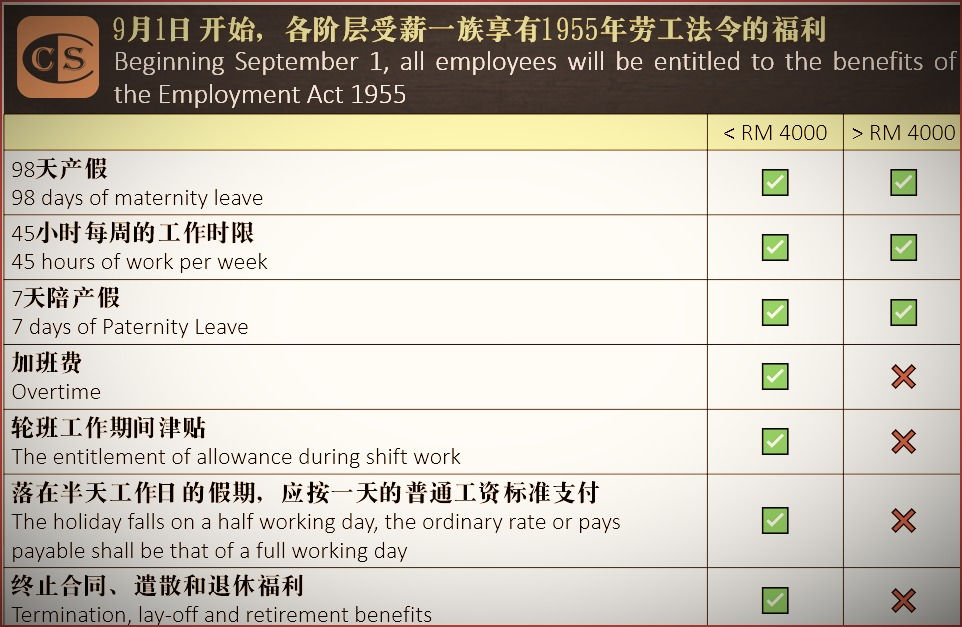
    They were both gazetted at the same time today, which means that the Employment Act 1955 will begin to provide its benefits to salaried employees of all classes commencing on September 1, 2022, regardless of the amount of salary they earn or the type of work they engage. These benefits include:

    • 98 days of maternity leave – s 37
    • 60 days’ Hospitalisation Leave + Sick Leave as per s 60F(1) [Total 74 – 82 days] – s 60F
    • 45 working hours per week – s 60A
    • 11 gazetted public holidays – s 60D
    • 7 days of paternity leave – s 60FA
    • Lodge complaints to the Labour Office
    • Sexual harassment – s 81B
    • Forced Labour – s 90B
    • Discrimination in Employment – s 69F
    • Limitation on Advances – s 22
    • Flexible Working Arrangement – s 60P

    It is important to note that the list above is not exhaustive.

    之前曾经把所有1955年劳工法令修订法做了一系列的讲解:

    https://www.ccs-co.com/publications/categories/employment-amendment-bill-2021

    我曾经提到,除了法定生效日的颁布,我们也在等待1955年劳工法令第一附表的修订的颁布。

    今天,他们同时被颁布,这意味着2022年9月1日开始,各阶层受薪一族将享有1955年劳工法令的福利,无论薪水多少,又或者是从事什么工作,这包括:

    • 98 天的产假
    • 60天的住院假 + 根据第60F(1)条规定的病假 [总共 74 – 82天]
    • 45 小时1周的工作
    • 11 个宪报颁布的公共假日
    • 7 天的陪产假
    • 到劳工部做出投诉
    • 性骚乱
    • 强迫劳动
    • 就业歧视
    • 薪金预支的限制

    要注意的是,上面的列表并不详尽。

    However, the First Schedule of the Employment Act of 1955 contains a minor detail that should be brought to your attention. That detail is the fact that certain benefits are unavailable to salaried individuals who earn more than RM4,000 per month.

    This is the list of EA provisions which will not apply to employees earning more than RM4,000/month:

    • Subsection 60(3): Overtime for work on rest days.
    • Subsection 60A(3): Overtime for work outside normal working hours.
    • Subsection 60C(2A): Shift work allowance.
    • Subsection 60D(3): Overtime and allowance for work on public holidays.
    • Subsection 60D(4): Holiday falls on a half working day; the ordinary rate or pay payable shall be that of a full working day.
    • Subsection 60J: Termination, lay-off, and retirement benefits.

    然而,1955年劳工法令第一附表内还是有一个小小的地方需要注意,那就是有一些福利,月薪4000令吉以上的受薪人士是不享有的。

    以下这是1955年劳工法令的条款,不适用于月收入超过4000令吉的雇员:

    – 第60(3)条 – 休息日的加班费

    – 第60A(3)条 – 正常工作时间以外的加班

    – 第60C(2A)条 – 轮班工作津贴

    – 第60D(3)条 – 公共假期的加班和津贴

    – 第60D(4)条 – 假日落在半个工作天,按一天普通工资支付

    – 第60J条 – 终止、解散和退休福利。

    Employment (Amendment) Act 2021 | 2022年就业(修订)法令

    Employment (Amendment of First Schedule) Order 2022 | 2022年就业(第一附表修订)指令

    It must be noted here that Employment Act 1955 applies only to West Malaysia and Federal Territories, including Labuan.

    在此必须指出,1955年劳工法令只适用于西马来西亚和联邦领土,包括纳闽。

    Keep in touch with us so that you can receive timely updates |

    要获得即时更新,请与我们保持联系

    1. Website ✍️ https://www.ccs-co.com/ 2. Telegram ✍️ http://bit.ly/YourAuditor 3. Facebook ✍

    4. Blog ✍ https://lnkd.in/e-Pu8_G 5. Google ✍ https://lnkd.in/ehZE6mxy

    6. LinkedIn ✍ https://www.linkedin.com/company/74734209/admin/

    47