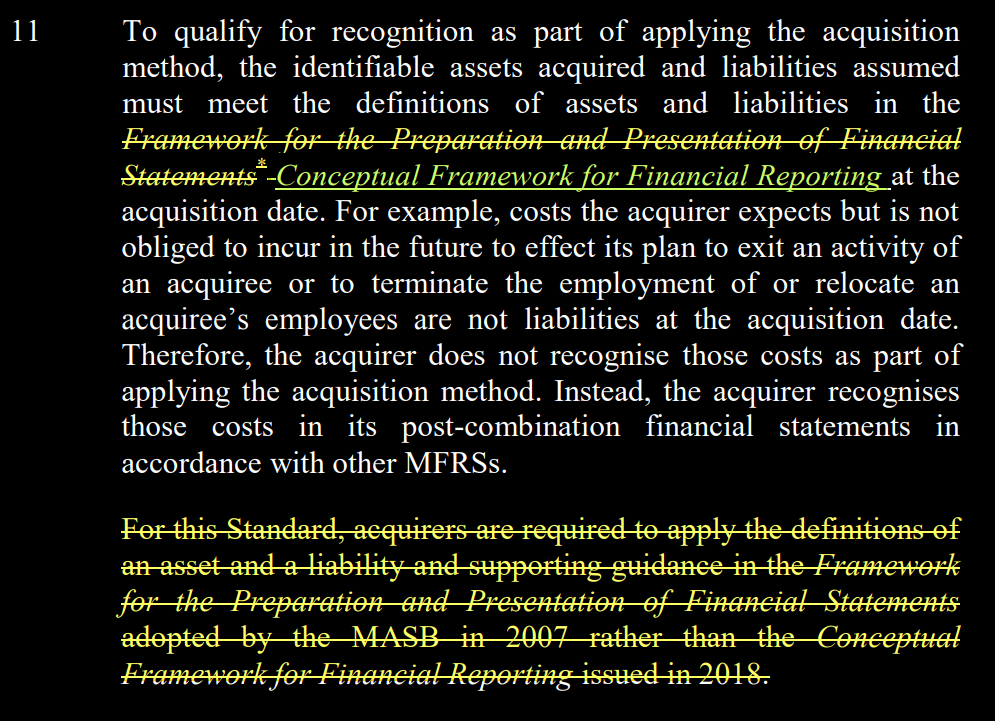
The Accounting Requirements for Business Combinations have not been altered due to the amendments made to MFRS 3 Business Combinations; instead, MFRS 3’s reference to the Conceptual Framework for Financial Reporting has been brought up to date.
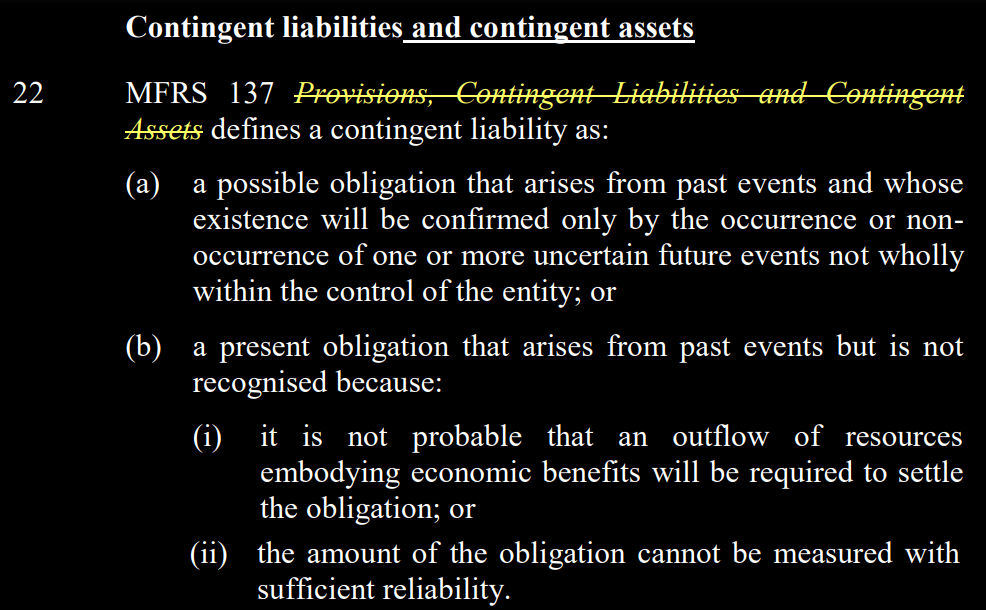
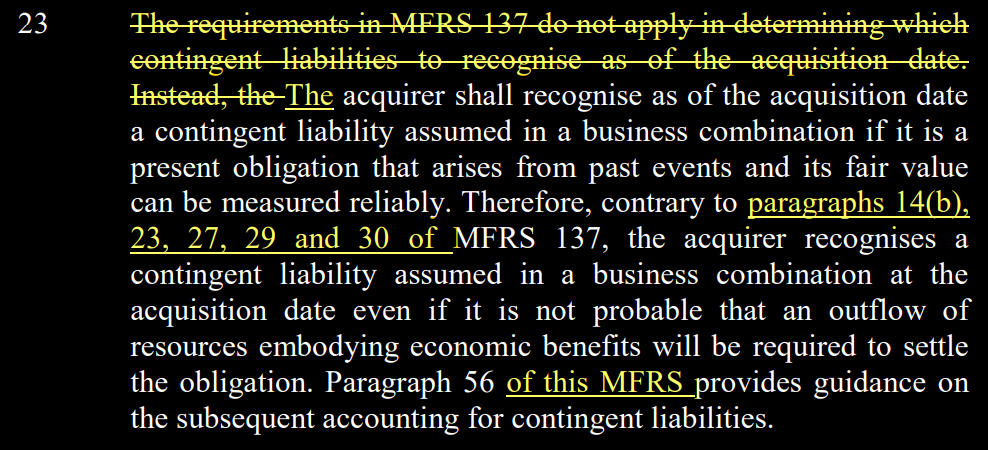
In addition, the amendments make it clear that contingent assets should not be recognised at the acquisition date.
An entity shall apply those amendments to business combinations for which the acquisition date is on or after the beginning of the first annual reporting period beginning on or after 1 January 2022.
Earlier application if at the same time or earlier an entity also applies all amendments made by Amendments to References to the Conceptual Framework in MFRS Standards issued in April 2018.
Amendments:
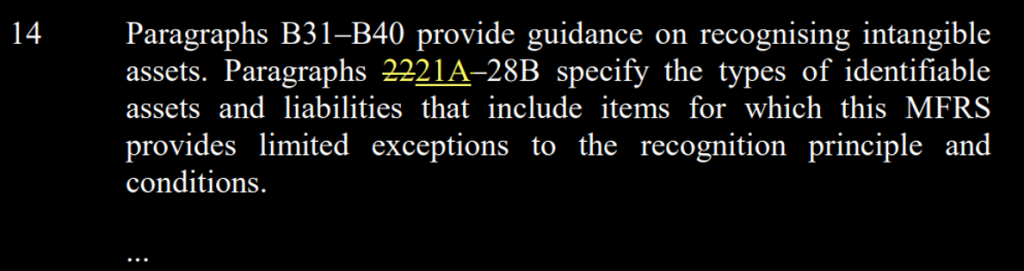
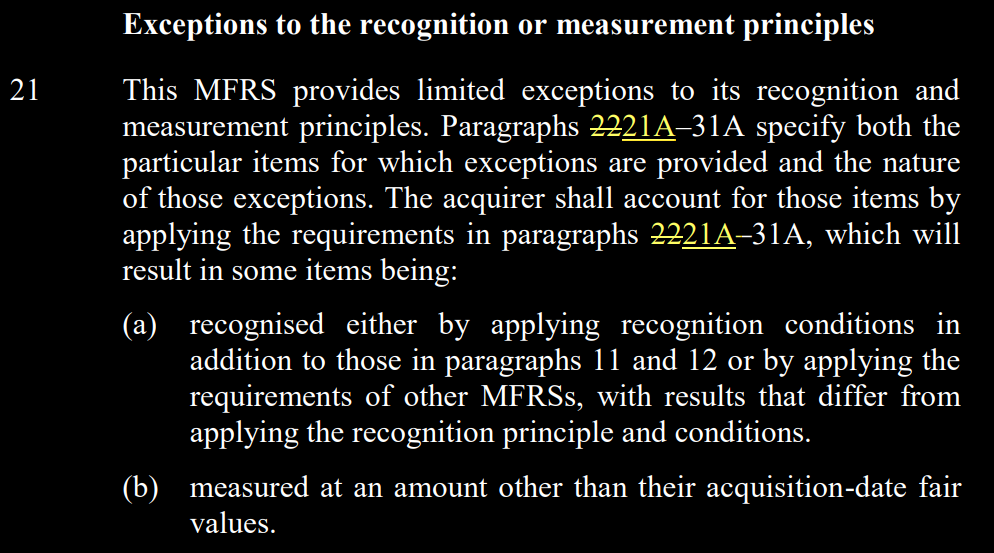
New text is underlined, and deleted text is struck through.
Paragraph 11 is amended, and the footnote to Framework for the Preparation and Presentation of Financial Statements in paragraph 11 is deleted.
Paragraphs 14, 21, 22 (The headings below paragraph 21 and above paragraph 22 are amended) and 23 are amended;
Paragraphs 21A (A heading is added above the paragraph), 21B, 21C, 23A and 64Q are added;
MFRS 1 First-Time Adoption of Malaysian Financial Reporting Standards by a subsidiary
Simplifies the application of MFRS 1 by a subsidiary that adopts MFRS later than its parent is now given the option to measure cumulative translation differences for all of its foreign operations based on the carrying amounts that would be included in the parent’s consolidated financial statements.
MFRS 9 Financial Instruments on fees in the 10% test for Derecognition of Financial Liabilities
Clarify the company’s fees when assessing whether the terms of a new or modified financial liability are substantially different from the terms of the original financial liability.
The result of the “10% test” will be impacted by this amendment; as a result, the amount of gain or loss recognised in the income statement will also be affected.
This change will affect all businesses, particularly those who apply an existing policy of including the costs of paying fees to third parties as part of the “10% test.”
Illustrative Examples accompanying MFRS 16 Leases on Lease Incentive
To eliminate any potential confusion regarding whether or not the reimbursement would fulfil the definition of a lease incentive in MFRS 16, this amendment deleted the illustration from MFRS 16 referring to the reimbursement related to leasehold improvements provided by the lessor.
MFRS 141 Agriculture on Taxation in Fair Value Measurement
Removes a requirement to exclude cash flows from taxation when measuring fair value, thereby aligning the fair value measurement requirements in MFRS 141 with those in other MFRS Standards.
On 23 January 2020, the International Accounting Standards Board (often known as the “IASB”) published amendments to paragraphs 69 to 76 of the IAS 1 Presentation of Financial Statements.
The amendments clarify:
What is meant by a right to defer settlement?
That a right to defer must exist at the end of the reporting period.
That classification is unaffected by the likelihood that an entity will exercise its deferral right.
Only if an embedded derivative in a convertible liability is itself an equity instrument would the terms of liability not impact its classification.
In this context, the Malaysian Accounting Standards Board (commonly known as “MASB”) has decided to implement the same amendments for MFRS 101.
Amendments to MFRS 101 on the classification of Liabilities as Current or Non-Current clarify the following:
Rights to defer settlement for at least 12 months
The amendments clarify that liability is non-current when an entity has the right to postpone settlement for at least a year after the date recorded on the balance sheet.
Existence of rights to defer at the end of the reporting period
The right to postpone exists only if the entity would have complied with the relevant covenants based on its circumstances at the balance sheet date, even though compliance is required only after that date.
The expectations or intentions of management do not have any impact on the classification
The question of whether or not an entity will make use of the right to defer settlement of a liability at the end of the reporting period is irrelevant to the application of the classification principle since what is important is whether or not the entity has the right to do so.
Suppose the entity has the right to defer the settlement at the reporting date because the liability meets the criteria in paragraph 69 for classification as non-current liabilities. Still, management intends or expects to settle the liability within 12 months, after the reporting date and before the authorisation of financial statements. In that case, the classification of the liability remains noncurrent.
However, the entity may need to disclose information about the timing of settlement to enable users of its financial statements to understand the impact of the liability on the entity’s financial position.
Classification of settlement
The amendments also make it clear that when a liability could be settled by the transfer of an entity’s own equity instruments, for example, a conversion option in a convertible bond, the conversion option does not affect the current or non-current classification of the convertible bond, if the option satisfies the definition of an equity instrument in accordance with MFRS 132 “Financial Instruments: Presentation.”
The amendments to the MFRS 101 standard for the presentation of financial statements will take effect for annual periods that begin on or after 1 January 2023.
How do the Amendments affect you?
Reinstatement may require
It is no longer possible for entities to categorise their financial liabilities according to the management intention.
In the past, management may have categorised its liabilities according to management intention; but this practice is no longer permissible in light of the amendments. Entities must examine their current classification to decide whether or not a reinstatement of the comparative figures is required.
A tricky question that a company needs to ask itself is whether or not the new classification will impact the loan covenants already in place.
Subject to Judgmental
There is no additional guidance and explanation of how an entity could determine whether or not such a right has substance. As a result of this, entities use their own judgment in order to decide whether the right to postpone has any basis in reality. Furthermore, if this judgement is substantial, entities are required to examine whether or not it is necessary to disclose this information in their financial statements.
Disclosure of Accounting Policies (Amendments to MFRS 101 and MFRS Practice Statement 2)
The amendments are intended to improve disclosures regarding accounting policies and to assist users of financial statements in differentiating between changes in accounting estimates and changes in accounting policies.
As a result of the amendments made to MFRS 101, entities are required to disclose accounting policies that are “material rather than significant.”
The amendments make it even more clear that insignificant accounting policies do not have to be disclosed.
Accounting estimates are monetary values in financial statements that are subject to uncertainty over their measurement, according to the amendments that were made to MFRS 108.
Accounting policies are defined in paragraph 5 of MFRS 108 Accounting Policies, Changes in Accounting Estimates and Errors, and the term is used in this Standard with the same meaning.
A change in accounting estimate does not have any impact on previous periods and does not constitute the correction of an error. Rather, a change in accounting estimate takes place as a result of new information, discoveries, or more experience.
Changes in accounting estimates are applied prospectively to future transactions and other upcoming events, whereas errors are corrected retrospectively after they have already occurred.
MFRS 132 Financial Instrument: Presentation defines a financial liability as any liability that is either:
A contractual obligation to deliver cash or another financial asset to another entity; or
to exchange financial assets or financial liabilities with another entity under conditions that are potentially unfavourable to the entity.
A contract that will or may be settled in the entity’s equity instruments and is a derivative or non-derivative with certain conditions.
When certain conditions are met, as outlined in paragraph 69 of MFRS 101 Presentation of Financial Statements, a company is required to classify its liabilities as current. An entity shall classify a liability as current when:
it expects to settle the liability in its normal operating cycle;
it holds the liability primarily for trading;
the liability is due to be settled within twelve months after the reporting period, or
it does not have the right at the end of the reporting period to defer settlement of the liability for at least twelve months after the reporting period.
When an entity recognises assets or liabilities for the first time, under IAS 12, the entity is exempted from recognising any deferred taxes.
There has been a degree of ambiguity regarding the applicability of this exemption to circumstances in which an asset and a liability are simultaneously recognised in the course of a single transaction.
For instance, it is unclear whether lessees can apply the exemption to right-of-use assets and lease liabilities as of the lease commencement date. Similarly, it is unclear whether or not entities can use the exemption to apply to decommissioning responsibilities and the accompanying payments that are recognised as part of the cost of the related asset.
What is the issue?
There is variability in practice due to the uncertainty; for example, in similar circumstances, some entities have recognised deferred taxes, but others have not recognised any deferred tax.
Amendments to IAS 12 on Deferred Tax related to Assets and Liabilities arising from a Single Transaction
The International Accounting Standards Board reviewed the IFRS Interpretations Committee’s suggestion at its meeting on October 24, 2018. The proposed amendment was regarding recognising deferred tax when an entity accounts for transactions, such as leases or decommissioning obligations, by recognising both an asset and a liability for those transactions.
The Board issued deferred tax related to assets and liabilities resulting from a single transaction in May 2021. Because of the amendments, the scope of the recognition exemption described in paragraphs 15 and 24 of IAS 12 (recognition exemption) was narrowed. As a result, the recognition exemption is no longer applicable to transactions that, when initially recognised, give rise to equal taxable and deductible temporary differences.
Because of this, lessees would not be able to use the exemption in IAS 12 for the right-of-use assets and the lease liabilities. Similarly, entities who recognise decommissioning liabilities won’t be able to utilise the exemption provided by IAS 12 either.
The Malaysian Accounting Standards Board (MASB) issued Deferred Tax related to Assets and Liabilities arising from a Single Transaction (Amendments to MFRS 112 Income Taxes) on June 30, 2021.
The Amendments are word-for-word Deferred Tax related to Assets and Liabilities arising from a Single Transaction (Amendments to IAS 12 Income Taxes) issued by the International Accounting Standards Board (IASB).
The Amendment clarifies that the exemption does not apply and that companies must recognise deferred tax on such transactions. Such clarification is expected to reduce diversity in reporting deferred tax on leases and decommissioning obligations.
Effective Date
The Amendments to MFRS 112 shall apply for annual reporting periods beginning on or after 1 January 2023. Earlier application is permitted.
What are the transition provisions?
An entity applying Deferred Tax related to Assets and Liabilities arising from a Single Transaction shall also, at the beginning of the earliest comparative period, present:
recognise a deferred tax asset – to the extent that taxable profit will probably be available against which the deductible temporary difference can be utilised – d a deferred tax liability for all deductible and taxable temporary differences associated with:
right-of-use assets and lease liabilities; and
decommissioning, restoration and similar liabilities and the corresponding amounts recognised as part of the cost of the related asset; and
recognise the cumulative effect of initially applying the amendments as an adjustment to the opening balance of retained earnings (or other equity components, as appropriate) at that date.
Illustrative example
The applicable tax rate is 24%.
Para 7 of the MFRS 112:
The Tax Base of an asset is the amount that will be deductible for tax purposes against any taxable economic benefits that will flow to an entity when it recovers the carrying amount of the asset. If those economic benefits will not be taxable, the tax base of the asset is equal to its carrying amount.
Para 8 of the MFRS 112:
The Tax Base of a liability is its carrying amount, less any amount that will be deductible for tax purposes in respect of that liability in future periods. In the case of revenue which is received in advance, the tax base of the resulting liability is its carrying amount, less any amount of the revenue that will not be taxable in future periods.
Temporary Differences are differences between the Carrying Amount of an asset or liability in the statement of financial position and its tax base. Temporary differences may be either:
taxable temporary differences, which are temporary differences that will result in taxable amounts in determining taxable profit (tax loss) of future periods when the carrying amount of the asset or liability is recovered or settled; or
deductible temporary differences, which are temporary differences that will result in deductible amounts in determining taxable profit (tax loss) of future periods when the carrying amount of the asset or liability is recovered or settled.
Applying the principle to the above example:
As no tax deductions may be taken against the ROU asset, there is no taxable base for the ROU asset.
Because the entity is eligible to receive tax deductions equivalent to the carrying amount of the lease liability, the tax base of the lease liability is “0.”
The IASB has been monitoring the implementation of IFRS 17 Insurance Contracts since it was announced in May 2017.
IFRS 17 is one of the largest accounting changes in insurance in the last decade, impacting insurance firms’ entire operating model.
During the meeting in October 2018, the Board came up with a list of 25 potential changes that may be made to the standard. They also agreed on the criteria used to evaluate any possible changes.
The IASB revised its recommendations and included further comments provided by constituents, which ultimately led to the adoption of the final amendments to IFRS 17 and Extension of the Temporary Exemption from Applying IFRS 9 (Amendments to IFRS 4) on June 25, 2020.
MFRS 17 Insurance Contracts
MFRS 17 (which has requirements identical to IFRS 17 Insurance Contracts) supersedes MFRS 4 for reporting periods beginning on or after 1 January 2021.
Amendments to MFRS 17 also defer the effective date of MFRS 17 by two years, to annual reporting periods beginning on or after 1 January 2023.
And of course, the decision to defer the effective date will enable entities to implement the new Standard in a timely manner which MASB considers to be beneficial for investors, preparers and other stakeholders.
It is a “narrow-scope amendment,” and the purpose of the amendment is to make comparative information more useful for investors on the initial application of MFRS 17.
MFRS 17 sets out the principles for the recognition, measurement, presentation and disclosures of insurance contracts while improving comparability and transparency. It fundamentally changes the way in which insurers measure and account for insurance contracts.
Nonetheless, the present version of MFRS 17 allows for a diverse range of techniques to be utilised when accounting for insurance contracts.
MFRS 17 will bring about substantial changes to the accounting practises of all entities that issue insurance contracts and investment contracts with discretionary participation characteristics.
All entities, even those that are not insurers, will be required to assess whether or not they have any contracts that meet the definition of insurance contracts and, as a result, could be affected by the future adoption of MFRS 17.
On April 11, 2022, in response to the growing expectation that organisations in Malaysia will implement governance practices that enhance the accountability, transparency, and integrity of the tax system, the Inland Revenue Board of Malaysia (IRBM) published:
The Tax Corporate Governance Framework (“TCGF”); and
This Tax Corporate Governance Framework intends to provide an overview of the IRBM’s expectations on the Tax Corporate Governance process and structure that should exist in organisational settings. It guides applying tax risk management principles and managing tax risks, such as identifying and treating tax compliance risks, in meeting an organisation’s tax obligations.
Besides promoting good governance practices, these initiatives are also relevant in enabling the organisation and the IRBM to implement the TCGF Programme in Malaysia.
The Organisation for Economic Co-operation and Development (OECD)’s report on Co-operative Tax Compliance: Building Better Tax Control Frameworks, Published on May 13, 2016, defined a TCF as a component of the system of internal control that an organisation uses to ensure that the tax returns and disclosures it produces are accurate and complete.
The IRB has closely aligned their definition of TCF with that of the OECD, which is outlined as follows:-
Tax strategy established;
Applied comprehensively;
Responsibility assigned;
Governance documented;
Testing performed; and
Assurance provided.
Is the TCGF for every Company?
Because it is a framework focused on promoting good tax governance and tax risk management of a company, in theory, any corporation should be able to commit to the TCGF.
However, to comply with the requirements of implementing a TCGF, companies must document the tax management strategies they adopt formally and spell out the accountability for such strategies and the tax risk management that is carried out.
Additionally, companies are obliged to develop methods to analyse and assess both the effectiveness of their operations and the degree to which they comply with the framework that has been established.
Consequently, there is no “one size does not fit all”. This is in line with the assertions in the guidelines given by the IRB, which said that there is no particular format to adhere to because different businesses have varying requirements.
An updated version of the Guidelines
In light of those above, the IRB has uploaded an updated version of the Guidelines and a FAQ for Tax Corporate Governance Framework & Guidelines dated July 27, 2022.
Make it clear that an organisation that has been given participation status and intends to renew its participation status must inform the IRB accordingly within 12 months before the status expires.
Provide more information regarding the TCG review procedure that will be carried out by an organisation, an independent reviewer, and the IRB.
FAQs for Tax Corporate Governance Framework & Guidelines
The TCG programme is not similar to the voluntary disclosure programme;
There is no fee charged to participate in the TCG programme;
Expenses incurred to implement the TCG are capital in nature and not allowable for tax deduction under subsection 33(1) ITA 1967;
Organisations not participating in the TCG programme will not be targeted for an audit.
It is expected that organizations declare their tax policies and/or tax strategies in any format that is available to the general public (for example, on their websites and in their annual reports). In the event that this is not done, there will be no penalties, but it may have an effect on how the IRB reviews and evaluates the TCG of the organisation.
During the announcement of the 2022 budget, it was proposed that the scope of application of the Service Tax be expanded to include services related to the delivery of goods, regardless of the status of the service providers (whether licenced or not).
However, the delivery of food and beverages and logistic services would be exempt from the tax.
This proposal is scheduled to go into effect on July 1, 2022. However, on the 30th of June 2022, the Royal Malaysian Customs Department announced that the implementation of expansion in the scope of taxable delivery services had been postponed to a later date that will soon be announced.
Before this announcement, the affected service providers, such as e-commerce platforms, expressed their concerns about the implementation’s lack of information and the insufficient time to prepare as required.
A sigh of relief can be heard from the service providers as a result of this postponement, as it will give more time to study the particulars of the proposed expansion and acquire clarity to be sure that the implementation can be carried out without any hitches.
Service providers still need to keep a careful eye on how this issue develops in the future.
Our website's articles, templates, and material are solely for reference. Although we make every effort to keep the information up to date and accurate, we make no representations or warranties of any kind, either express or implied, regarding the website or the information, articles, templates, or related graphics that are contained on the website in terms of its completeness, accuracy, reliability, suitability, or availability. Any reliance on such information is therefore strictly at your own risk.
Keep in touch with us so that you can receive timely updates |
A sales tax would be imposed on low-value goods (LVG) sold by registered sellers or sellers liable to be registered through online platforms and delivered to Malaysia under the terms of the Bill, which was presented for the first reading on Monday (1 August).
No amendments were made when the bill was debated in Parliament for the second and third readings.
Before the bill can be signed into law, it must first be approved by the Dewan Negara (Senate), Malaysia’s upper parliament.
Currently, low-valued items with prices of RM500 or less are exempt from paying any tax in Malaysia when imported under the de minimis facility.
The new low-value goods tax is scheduled to go into effect on January 1, 2023, and it is anticipated that such products will be subject to a constant rate of 10% during the duration of the tax.
The Minister has the power to determine certain goods as low-value based on goods or class of goods, the price of the goods, and the method by which the goods are imported into Malaysia.
For your convenience, we have outlined the most important aspects of the bill below:
Effective Date
The bill does not specify when the LVG sales tax will become effective or when it will be implemented. Thus there is no clear answer to this question.
This will be gazetted by the Minister of Finance (MOF).
Initially proposed that it would become effective on January 1, 2023; however, the deputy finance minister indicated that the ministry had not finalised the effective date because all parties (namely the industry, customs, and the consumers) must be ready before the implementation.
Rate
The Ministry of Finance is responsible for determining and gazetting the tax rate.
However, in response to a question in Parliament, the Deputy Minister of Finance stated that a 10% flat tax would be imposed on LVGs imported into Malaysia.
Definition of “Low-Value Goods” (LVG)
It has been defined in the bill as:
“any prescribed goods or class of goods outside Malaysia which are sold at a price not more than a prescribed amount and brought into Malaysia in the manner as prescribed.”
While the bill was being debated in Parliament, the Deputy Minister of Finance revealed the following information:
The prescribed value would be RM500;
The prescribed manner of import would include the air, sea, and land modes of transportation.
Seller
A person, whether in or outside Malaysia, who sells LVG on an online marketplace or operates an online marketplace for the sales and purchase of LVG.
Taxable Person & Registration Threshold
A registered seller or a seller who is liable to be registered under section 12.
Suppose the total sale value of a seller’s LVG transactions on an online marketplace for a period of 12 months is greater than the threshold for registration. In that case, both local and foreign sellers of LVG and the operators of online marketplaces are required to register for sales tax and charge sales tax on LVG transactions.
During the discussion of the bill in Parliament, the deputy finance minister responded by stating that the minimum required threshold for registration would be RM500,000.
Value of LVG subject to Sales Tax
To calculate sales tax, the sale value of LVG shall exclude any tax, fee or other charges imposed on LVG.
Sales Tax Due
At the time when the taxable person sells the LVG.
Taxable Period & Furnishing of Returns
A registered LVG seller has a taxable period of three months, and returns are due to customs on the last day of the month after the end of the taxable period.
Invoice
Invoices as well as any other documents that provide the required particulars (to be released)
Display of Information on Package
Every registered seller shall furnish to the Director General prescribed particulars which shall be displayed on the package of low-value goods in the manner as may be prescribed.”.
Customs Control
If the Sales Tax on LVG has either not been charged at all, has been assessed at a lesser rate, or has not been paid, the LVG cannot be released from the control of Customs until the Sales Tax has been paid in full.
Transitional Provisions
Goods acquired before the effective date but only delivered to Malaysia after the effective date are exempt from the Sales Tax.
Both sellers who use online marketplaces and those who run online marketplaces need to keep a close eye on any new information regarding this particular topic.
Please do not hesitate to get in touch with contact us if any of the preceding pertains to your company in any way or if you have any questions or require any clarification or assistance. We will be pleased to assist you.
CCS Tax Consultancy Sdn Bhd offers a comprehensive range of tax services through our team of dedicated tax specialists.
Our team’s extensive knowledge enables us to provide proactive, realistic, and cost-effective tax solutions to our clients and to deliver value.
We can provide you with a wide variety of local and international tax services, regardless of whether you are an individual or a corporation.
Our expertise:
Tax Compliance
Tax Consultancy and Advisory
Tax Audit and Investigation
Tax Incentives Application
Transfer Pricing
Indirect Tax
Sales Tax and Service Tax
Goods and Services Tax
Tax Training & Seminar
Our website's articles, templates, and material are solely for reference. Although we make every effort to keep the information up to date and accurate, we make no representations or warranties of any kind, either express or implied, regarding the website or the information, articles, templates, or related graphics that are contained on the website in terms of its completeness, accuracy, reliability, suitability, or availability. Any reliance on such information is therefore strictly at your own risk.
Keep in touch with us so that you can receive timely updates |