Day: August 6, 2022

  • The latest updates and issues in claiming RA for Manufacturing Activities

    The latest updates and issues in claiming RA for Manufacturing Activities

    The Reinvestment Allowance (RA) is an incentive provided to Malaysian resident companies involved in the manufacturing industry and specified agriculture sector.

    The purpose of this incentive is to encourage these companies to reinvest and grow their companies.

    Eligibility to Claim Reinvestment Allowance

    For these companies to be eligible for the RA incentive, they must have been actively engaged in business operations (i.e. manufacturing or agricultural) for a minimum of 36 months.

    In addition, to be eligible for RA incentives in the relevant year of assessment, these companies must have incurred capital expenditures in carrying out qualifying RA projects such as Expansion, Modernisation, Automation, and/or Diversification.

    The IRB published the following Public Rulings at the end of 2020 to assist Malaysian resident companies that were engaged in manufacturing and agricultural activities in assessing whether or not they were eligible to claim reinvestment allowance (RA):

    • PR No. 10/2020 – Reinvestment Allowance Part I – Manufacturing Activity dated 6 November 2020
    • PR 11/2020 – Reinvestment Allowance Part II – Agricultural and Integrated Activities dated 10 November 2020

    PRs No. 10/2020 and No. 11/2020 have been issued in their place, superseding PRs No. 9/2017 and 10/2017, respectively, all of which were published on the 22nd of December, 2017.

    Practice Note 1/2022

    The IRB has also recommended that Public Ruling No. 11/2020 be read in conjunction with Public Ruling No. 10/2020.

    The Inland Revenue Board of Malaysia (IRBM) published “The Practice Note 1/2022: Explanation in relation to the definition of ‘factory’ for RA claims” on the 17th of January 2022. (The Practice Note).

    Definition of ‘Factory’ for RA claims

    The meaning of ‘factory’ has been reiterated in the Practice Note as follows:

    • “Factory” means the portion of the floor areas of a building or an extension of a building used for a qualifying project to place or install plant or machinery or to store any raw materials, or goods or materials manufactured before the sale:
      • Provided that in respect of the portion of the building or extension of the building used for the storage of raw materials, goods or materials, or both, it shall not be more than one-tenth of the total floor area of the building or the extension to that building (i.e. One-tenth Rule).
    • The use of space for storage of raw materials or other goods or both which exceeds one-tenth of the total floor areas of the factory shall not be considered in calculating RA claim under Schedule 7A of the MITA;
    • Only the portion used for a qualifying project fulfils the definition of ‘factory’ and may be allowed for RA claim subject to stipulated conditions.

    Schedule 7A

    The Practice Note states that the sales office is not included in the ‘factory’ definition in Paragraph 9 of Schedule 7A of the ITA.

    Therefore, the total area of the sales office should be taken out to determine the ‘factory’ or space used for a qualifying project.

    In this Schedule, under Paragraph 8(a), “Qualifying Project“ means—

    1. a project undertaken by a company in expanding, modernising or automating its existing business in respect of manufacturing of a product or any related product within the same industry or in diversifying its existing business into any related product within the same industry;

    Back to the two Public Rulings

    The new Public Rulings provide information that is, for the most part, consistent with that of the prior Public Rulings.

    Both Public Rulings have been updated to explain and provide examples to demonstrate the legislative change enacted via the Finance Act 2018, which states that the carry-forward of unutilised RAs is restricted to seven Years of Assessment, with any unutilised allowances being disregarded after that.

    Public Ruling No. 10/2020 – Reinvestment Allowance Part I – Manufacturing Activity, dated 6 November 2020, has been revised to include a new Diagram 2 (see Paragraph 8.2 of the Public Ruling), which depicts the following fact pattern:

    1. a building is not used for manufacturing activities (not a qualifying project);
    2. the building is extended, and the extension is used for a qualifying project (diversification); and
    3. The amount of space dedicated to storage in the extended area accounts for 30% of the extension’s total floor area.

    According to the illustration of the Public Ruling, RA is not allowed on the total floor area extended as it does not fall under the factory definition as provided under Paragraph 9 of Table 7A of the ITA 1967.

    LHDNM Clarification on Their Response to CTIM Technical Issues

    Following a meeting with CTIM on the 8th of September 2021, the Inland Revenue Board of Malaysia (LHDNM) has clarified their response dated 15 July 2021 to the technical issues raised by CTIM on the 19th of May 2021.

    This clarification was issued on the 16th of September 2021 and is set out in brief as follows:

    Where the total floor area of the factory building comprises storage space, sales office space and size used for the qualifying project (expansion purpose), the treatment is as follows: –

    • Sales office space does not qualify for RA. It is not considered as part of the total floor area of the factory building for RA purposes.
    • Storage space >10% of the total floor of the factory building for RA purposes, i.e. storage space & area used for qualifying project – expansion) does not qualify for RA.
    • The area used for qualifying project – expansion qualifies for RA.

    Example

    • 25% sales office space does not qualify for RA. It is not considered part of the total floor area of the factory building for RA purposes.
    • 8% storage space also does not qualify for RA. It is considered as 10.7% storage space [8/(8+67) x 100%].
    • ONLY 67% used for qualifying projects (expansion) – qualifies for RA.
    22
  • PR No. 1/2020 – Application for Review

    PR No. 1/2020 – Application for Review

    On July 29, 2020, the RMCD published two new public rulings in the national language on review applications and drawback facilities on imported goods that are subsequently re-exported. Both of these rulings came into effect on that date.

    • Public Ruling No 1/2020 – Review Application
    • Public Ruling No 2/2020 – The application of Section 93 of the Customs Act 1967 and Section 19A of the Excise Act 1976 concerning Drawback Claims

    Amendments to the Public Ruling No. 1/2020

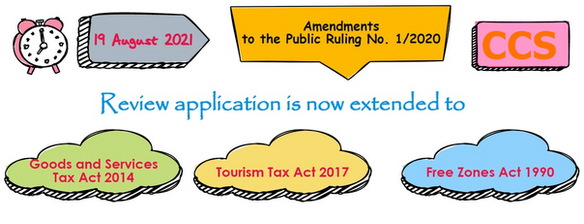
    An amended version of the Public Ruling No. 1/2020 was issued on 19 August 2021.

    The major update the guidance introduces is that the review application is now extended to cover the following legislation:

    • Goods and Services Tax Act 2014 (under Section 124)
    • Tourism Tax Act 2017 (under Section 67)
    • Free Zones Act 1990 (under Section 46)

    Our main topic of discussion for today is Public Ruling No. 1/2020.

    Public Ruling No 1/2020 – Review Application

    Any person aggrieved by a formal written decision from the Director General (DG) of RMCD may make an application for review.

    What decisions of DG are capable of a review?

    • Any formal written decisions of DG made under:
      • Customs Act 1967 (CA),
      • Excise Act 1976 (EA),
      • Sales Tax Act 2018 (SATA),
      • Service Tax Act 2018 (STA);
      • Departure Levy Act 2019 (DLA);
      • Goods and Services Tax Act 2014,
      • Tourism Tax Act 2017; and
      • Free Zones Act 1990
    • Other decisions that are final and conclusive.

    What are the law provisions under which a review application can be made?

    • Section 143, Customs Act 1967;
    • Section 47 Excise Act 1976;
    • Section 96, Sales Tax Act 2018;
    • Section 81, Service Tax Act 2018;
    • Section 59, Departure Levy Act 2019;
    • Section 124, Goods and Services Tax Act 2014;
    • Section 67, Tourism Tax Act 2017;
    • Section 46, Free Zones Act 1990;
    • Regulation 57, Customs Regulations 2019;
    • Regulation 60B, Excise Regulations 1977;
    • Regulation 32, Sales Tax Regulations 2018;
    • Regulation 25, Service Tax Regulations 2018; and
    • Regulation 17, Departure Levy Regulations 2019

    Which decisions of DG are not eligible for review?

    • Compound;
    • Decision pursuant to Section 128(3) of CA;
    • Decision pursuant to Section 67(3) of EA.

    What are the conditions to comply with for a review application?

    • A request for a review must be made within 30 days of the date that DG’s decision was sent to the individual who filed for the review.
    • The same decision made by DG has not been used to appeal to the Tribunal or the High Court.
    • Even though a request for review has been made, any due duty, tax, or levy must be paid first.

    What is the procedure for a review application?

    The application for review must now be made online via http://ereview.customs.gov.my/.

    Some key points that should be noted include the following:

    1. The application form must be filled out completely and signed by the applicant or person authorised by the applicant only. If the applicant is a company, the authorised person must be an officer of the company. Tax agents or lawyers are not allowed to sign the application form on behalf of the applicant.
    2. Ground(s) of the review must be stated clearly.
    3. The supporting documentation that must be attached with the application form are:
      1. the Director General of RMCD’s decisions;
      2. a printed copy of the review form signed by the applicant / authorised person; and
      3. any other document to support the grounds of review (if any).
    18
  • MOF – TERAS 2.0 for the Application and Renewal of Tax Agent Licence

    MOF – TERAS 2.0 for the Application and Renewal of Tax Agent Licence

    In order to facilitate the application for and renewal of income tax agent licences, the MyCukai Single Sign On (SSO) has been upgraded to the TERAS 2.0 (“Treasury Authentication System 2.0”) authentication system.

    In order to continue with the process of renewing their income tax agent licences, users of MyCukai are needed to first register and activate their MyCukai accounts in accordance with the TERAS 2.0.

    After the account has been registered in TERAS 2.0, users of MyCukai will receive an email from the TERAS MOF Administrator asking them to activate the account.

    In the event that a MyCukai user did not receive an activation email from the TERAS MOF Administrator, that MyCukai user can send an email to [email protected] to request the activation link by providing his or her full name and National Registration Identity Card (NRIC) number.

    For guidance on how to register their account, MyCukai users can refer to the user manual, MyCukai and TERAS 2.0 Panduan Pendaftaran Akaun.

    In the event that any issues arise, you can get in touch with the MOF TERAS Helpdesk by calling either 03-8882 3762 or 03-8882 3165.

    20
  • Budget 2023

    Budget 2023

    Latest Update: The tabling of the 2023 Budget will take place on Oct 7, instead of Oct 28, as previously scheduled

    According to information that can be found on the website of the Parliament [https://www.parlimen.gov.my/takwim-dewan-rakyat.html?&uweb=dr&id=3&ssid=5&lang=bm], the presentation of the Budget 2023 will take place on Friday, October 28, 2022.

    The Ministry of Finance (MOF) has issued its Pre–Budget Statement (PBS) in preparation for the 2023 Budget, which will prioritise building on the current momentum of economic recovery and continuing reforms to enhance socio-economic resilience.

    20
  • IRBM’s Response to CTIM’s Transfer Pricing Issues

    IRBM’s Response to CTIM’s Transfer Pricing Issues

    CTIM’s transfer pricing issues have received a response from the Inland Revenue Board of Malaysia (IRBM), which was provided on February 15, 2022.

    The following is a response from the IRBM to the points that CTIM made:

    1. On the threshold for preparation of transfer pricing (“TP”) documentation

    IRBM acknowledges the need to revise the thresholds to reflect the requirement of preparing the TP Documentation with the risk of tax base erosion and exclude a particular group of SMEs that only have domestically controlled transactions.

    Chapter I of the Malaysian Transfer Pricing Guidelines 2012 (MTPGL 2012) is now undergoing revision by IRBM to consider these modifications.

    2. Intercompany Financing

    IRBM’s Response: When determining an interest rate at arm’s length, taxpayers may choose to utilise any pre-approved reference rates. However, there is a discussion of implementing a more simple method shortly.

    3. In conjunction with the Safe Harbour

    IRBM’s Response: It is being thought about whether to give specific guidance on a group of intragroup services called “low value-adding intragroup services.”

    Taxpayers can choose this easy way to figure out arm’s-length charges for low-value-adding intra-group services if certain conditions are met.

    4. TP considerations for taxpayers who have been adversely affected by the COVID-19 pandemic

    Any particular issues or concerns related to the pandemic’s impact on limited-risk operating entities must be carefully documented and justified.

    The IRBM recognises that low-risk operating entities could sustain financial losses but insists that such a claim must be backed up by sufficient documentation and an adequate explanation.

    For instance, the decision of any limited risk entities to accept certain losses ought to be reviewed in light of the impact that the pandemic will have on their operations by evaluating their functions, assets, and risks.

    The IRBM has updated the Frequently Asked Questions on APA treatment due to the COVID-19 pandemic in October 2020.

    Further clarification on specific issues on APA can be forwarded to IRBM ([email protected]).

    5. Cooperative compliance program

    The IRBM is currently in the process of preparing a framework that will be known as the Tax Corporate Governance Framework (TCGF).

    This framework will be the basis upon which the IRBM and taxpayers will build and maintain a more comprehensive working relationship to guarantee that the tax compliance process is fair and effective.

    This framework also makes it possible for businesses, the IRBM, and the community to understand one another better.

    In addition, the aspects of accountability and transparency under governance arrangements to foster a better understanding of tax treatment are also crucial to ensure that proper and effective tax compliance can be achieved.

    6. Guidance on Financial Assistance Transaction

    The IRBM is in the process of incorporating some guidance provided under the OECD’s Transfer Pricing Guidance on Financial Transactions.

    Our website's articles, templates, and material are solely for reference. Although we make every effort to keep the information up to date and accurate, we make no representations or warranties of any kind, either express or implied, regarding the website or the information, articles, templates, or related graphics that are contained on the website in terms of its completeness, accuracy, reliability, suitability, or availability. Any reliance on such information is therefore strictly at your own risk.

    Keep in touch with us so that you can receive timely updates |

    要获得即时更新,请与我们保持联系

    1. Website ✍️ https://www.ccs-co.com/ 2. Telegram ✍️ http://bit.ly/YourAuditor 3. Facebook ✍

    4. Blog ✍ https://lnkd.in/e-Pu8_G 5. Google ✍ https://lnkd.in/ehZE6mxy

    6. LinkedIn ✍ https://www.linkedin.com/company/74734209/admin/

    26