At the international level, sick leave with adequate sickness benefit is enshrined in the International Labour Organization’s (ILO) Social Security (Minimum Standards) Convention (No. 102), the ILO Medical Care and Sickness Benefits Convention (No. 130), which emphasises standards of benefits, the ILO Decent Work Agenda, the Social Protection Floor Initiative led by the ILO and the World Health Organization (WHO), the Universal Declaration of Human Rights (Articles 22 and 25), and finally the International Covenant on Economic, Social and Cultural Rights (ICESCR, Article 9).
In Malaysia, an employee’s length of service determines the number of paid sick days they are entitled to receive.
This is stipulated under s. 60F of the Employment Act 1955 [s 104E(1) and s 105E(1) of the Sabah Labour Ordinance 1950 and Sarawak Labour Ordinance 1952 respectively].
Consequently, those employees who are affected with illnesses but do not require them to be hospitalised are qualified for the following paid sick leaves:
因此,那些受疾病影响但不需要住院的雇员有资格享受以下的带薪病假:-
Employees who the EA protects are eligible for an additional sixty days’ worth of paid sick leave if they are required to be hospitalised.
However, throughout a single calendar year, these employees are only eligible for a combined total of sixty days of paid sick leave, this also includes MCs issued by dental surgeons, as provided by the Act.
The idea, in its most basic form:
Total paid Sick Leave + total paid Hospitalisation Leave = 60 days.
Take, for example, the scenario in which Mr Ali started working for Company XYZ on January 1, 2022.
He is eligible for 14 days of sick leave, followed by 46 days of hospitalisation leave.
The following are examples of circumstances that qualify for hospitalisation leave:
The employee was either admitted to the hospital or underwent surgery as an outpatient.
The employee is not admitted to a medical facility, but they have been told to rest in bed. Take, for instance, the problems that can arise during pregnancy.
After being released from the hospital, the employee needs to rest or continue receiving medical care for their ailment to recuperate.
以下是符合住院假的例子:
员工被送入医院或作为门诊病人接受手术;
雇员没有住进医疗机构,但他们被告知要在床上休息。以怀孕期间可能出现的问题为例;
从医院出院后,雇员需要休息或继续接受疾病的医疗护理来休养。
The illness should be confirmed by the medical practitioner, medical officer, or dental surgeon.
One more thing that you should be aware of is that, according to the Employment Act of 1955, employees are required to inform (or attempt to inform) their employers of sick leave at least 48 hours in advance.
claim to be on sick leave but do not have a medical certificate; or
do not inform or attempt to notify their employer within 48 hours of the commencement of their sick leave,
will be regarded as absent from work without the authorization of their employer.
Absenteeism without permission and a legitimate cause is considered misconduct, which may perhaps trigger termination of employment.
雇员如果
声称正在休病假但没有医疗证明;或
在病假开始后48小时内没有通知或试图通知其雇主
将被视为未经雇主批准而缺勤。
未经许可及没有合法理由的缺勤将会被视为不当行为,也许会引发解雇。
1. Some of the most significant amendments suggested to the Employment Act 1955 as a result of the Employment (Amendment) Bill 2021 (“the Bill”) include the Amendment of Section 60F – Sick Leave
👉 to provide for matters relating to the entitlement of paid sick leave.
2. Under the current law, when hospitalisation is required, an employee’s total number of paid sick days in a calendar year, including any hospitalisation, is limited to 60 days.
👉 Total paid sick leave + total paid hospitalisation leave = 60 days.
3. With the Amendment, hospitalisation leave of 60 days would be regarded separately from any other paid sick leave.
4. With this amendment, employees will be entitled to an additional 60 days of paid hospital leave in addition to the number of paid sick leave days they are entitled to in a calendar year (depending on the length of employment)
Take, for example, the scenario in which Mr Ali started working for Company XYZ on January 1, 2022.
He is eligible for 14 days of sick leave, followed by 60 days of hospitalisation leave, a total entitlement of 74 days.
15. Amendment of Section 57B – Duty to inform Director-General of Termination of Service of Foreign Domestic Employee [第57B条的修订 – 通知总监终止外籍家庭雇员服务的义务] https://lnkd.in/eFyc27Wn / https://lnkd.in/eeggM_AN
30. Deletion of Section 81G – Application of this Part [Sexual Harassment] Irrespective of Wages of Employee [删除第81G条 – 无论雇员的工资如何, 本部分 [性骚扰] 都适用] https://lnkd.in/eTsj62rE / https://lnkd.in/eJQFdzx7
Paternity leave is defined as a leave period – paid or unpaid- reserved for fathers in relation to childbirth or leave that can be used exclusively by fathers as paternity leave.
This indicator does not specify whether the leave period is paid, the level of cash benefits, or their duration over the statutory paternity leave period.
资料来源:国际劳工组织 | 2014年
陪产假的定义是为父亲保留的与生育有关的带薪或不带薪假期或可由父亲专门用作陪产假的假期。
本指标没有具体说明休假期是否带薪,现金福利的水平,或其在法定陪产假期间的持续时间。
Paternity leave offers fathers an important opportunity to bond with their newborn children and allows them to be more involved at home.
There is evidence that the involvement of fathers in their children’s early days has a positive impact on the child’s development and health.
Moreover, increased participation of men in household activities benefits women by allowing women to balance professional priorities better.
Offering paternity leave is good for the company too. It makes the company family-friendly and helps companies to close the gender wage gap by levelling the playing field between men and women and by decreasing discrimination related to maternity.
Today, more and more companies across the world are implementing paternity leave policies.
今天,世界各地越来越多的公司正在实施陪产假政策。
1. Some of the most significant amendments suggested to the Employment Act 1955 as a result of the Employment (Amendment) Bill 2021 (“the Bill”) include New Section 60FA – Paternity Leave
👉 to provide for matters relating to paternity leave for a married male employee
2. Paternity leave can be utilised for a maximum of seven days by eligible working fathers
15. Amendment of Section 57B – Duty to inform Director-General of Termination of Service of Foreign Domestic Employee [第57B条的修订 – 通知总监终止外籍家庭雇员服务的义务] https://lnkd.in/eFyc27Wn / https://lnkd.in/eeggM_AN
30. Deletion of Section 81G – Application of this Part [Sexual Harassment] Irrespective of Wages of Employee [删除第81G条 – 无论雇员的工资如何, 本部分 [性骚扰] 都适用] https://lnkd.in/eTsj62rE / https://lnkd.in/eJQFdzx7
1. Some of the most significant amendments suggested to the Employment Act 1955 as a result of the Employment (Amendment) Bill 2021 (“the Bill”) include Substitution of Section 60k – Employment of Foreign Employee
👉 to introduce new requirements for the employment of a foreign employee
2. Therefore, Section 60K of the Employment Act 1955 is to be substituted with a new Section 60K.
3. Employers will be required to file an application and obtain prior approval from the Director-General General of Labour (“DGL”) under the amendment, which gives the impression that the laws regulating the hiring of foreign workers will become more stringent.
4. In the past, the only requirement that must have been met was for employers to notify the DGL of the particulars of the foreign workers they intended to employ.
5. The application from the employer will be conditioned on meeting specific requirements, including the following:
No outstanding matter relating to any decision, order or directive issued by the Act; or
No pending matter or case relating to any conviction for any offence under the Act, Employees’ Social Security Act 1969, the Employees Minimum Standards of Housing, Accommodation and Amenities Act 1990, or the National Wages Consultative Council Act 2011; or
The employer has not been convicted of any offence under any written legislation in regard to anti-trafficking of persons and forced labour.
15. Amendment of Section 57B – Duty to inform Director-General of Termination of Service of Foreign Domestic Employee [第57B条的修订 – 通知总监终止外籍家庭雇员服务的义务] https://lnkd.in/eFyc27Wn / https://lnkd.in/eeggM_AN
30. Deletion of Section 81G – Application of this Part [Sexual Harassment] Irrespective of Wages of Employee [删除第81G条 – 无论雇员的工资如何, 本部分 [性骚扰] 都适用] https://lnkd.in/eTsj62rE / https://lnkd.in/eJQFdzx7
1. Some of the most significant amendments suggested to the Employment Act 1955 as a result of the Employment (Amendment) Bill 2021 (“the Bill”) include New Section 60KA – Termination of Employment of Foreign Employee, etc.
👉 to provide for matters relating to the termination of employment of a foreign employee
2. Employers are required to notify the Director-General of Labour of the termination of employment of a foreign employee within thirty days of the day that employment is terminated, according to the newly introduced Section 60KA. 3. Within 14 days, the employer is obligated to notify the Director-General of Labour if the foreign worker quits their job or disappears without a sign. 4. Facebook Live 👉 https://lnkd.in/eMKwGYzD [Mandarin] 5. Join our Telegram – https://t.me/YourAuditor 🌻🌻🌻🌻🌻🌻🌻🌻 1. 2021年劳工(修正)法案对1955年劳工法令提出的一些重要修正,包括新的第60KA条 – 终止雇用外籍雇员,等等 👉 规定有关终止外籍雇员就业的事项 2. 根据新出台的第60KA条规定,雇主必须在终止雇用外籍雇员之日起30天内通知劳工部总监。
1. Some of the most significant amendments suggested to the Employment Act 1955 as a result of the Employment (Amendment) Bill 2021 (“the Bill”) include Deletion of Section 60L – Director-General may inquire into Complaint.
2. According to the current Act, the Director-General has the authority to investigate and decide on any disagreement that arises between an employee and his or her employer regarding wages or any other payments that are owed to the employee.
3. And this power of investigation does not only cover only those who fall within the First Schedule of the Employment Act 1955 but also employees who earn more than RM2,000 but not more than RM5,000 per month.
4. The amendment will repeal the provisions of the Act that currently allow the Director-General to inquire into and decide on any dispute between an employee and his employer in circumstances where the employee earns a wage of more than RM2,000 but less than RM5,000 (i.e., non-First Schedule employees) and the dispute is between the employee and his employer.
5. As there is no express provision in the Employment (Amendment) Act 2022 to extend the powers of the Director-General to investigate matters other than those involving employees covered by the First Schedule. It is unknown whether or not the Minister of Human Resources will make changes to the First Schedule in response to those Amendments.
15. Amendment of Section 57B – Duty to inform Director-General of Termination of Service of Foreign Domestic Employee [第57B条的修订 – 通知总监终止外籍家庭雇员服务的义务] https://lnkd.in/eFyc27Wn / https://lnkd.in/eeggM_AN
30. Deletion of Section 81G – Application of this Part [Sexual Harassment] Irrespective of Wages of Employee [删除第81G条 – 无论雇员的工资如何, 本部分 [性骚扰] 都适用] https://lnkd.in/eTsj62rE / https://lnkd.in/eJQFdzx7
Background of Flexible Working Arrangements (FWAs)
Workplaces in developed countries such as the United Kingdom, Northern Ireland, Europe, the United States of America, Australia, and New Zealand have had flexibility policies in place for quite some time.
In 1967, a company called MesserschmittBolkow-Blohm Bolkow located in Ottobrunn, Germany, was the first to use flexible working hours.
While other companies in Germany utilised a flexible working time programme, this company utilised it for a relatively substantial proportion of its employees.
As a result, in the late 1960s, this company established the scene for intense debate and implementation among many other German enterprises.
It has been estimated that in 1970, between 200 and 300 businesses offered flexible working hours. By 1971, this number had expanded by a factor of 10 to reach two thousand.
This mode of labour was adopted in a number of European nations, and by the year 1975, more than 30% of Switzerland’s workforce was organised in accordance with the latest model of employment.
It has come to everyone’s attention that the FWAs have supplanted the traditional notion of a work arrangement in many sections of developed countries.
In contrast to traditional work arrangements, which generally require employees to work at a standard period from 8 am to 5 pm, Monday through Friday, or at their usual workplace, FWA is a variable and changeable work in terms of its schedule or the nature of the working environment.
Suppose employees had access to the tools and technologies available in the workplace today. In that case, they could complete various duties even when they were not physically present at their place of employment.
In Malaysia’s public sector, flexible working arrangements are already in place.
And there are differences in the policies and procedures for the application of flexible working arrangements between the public and private sectors.
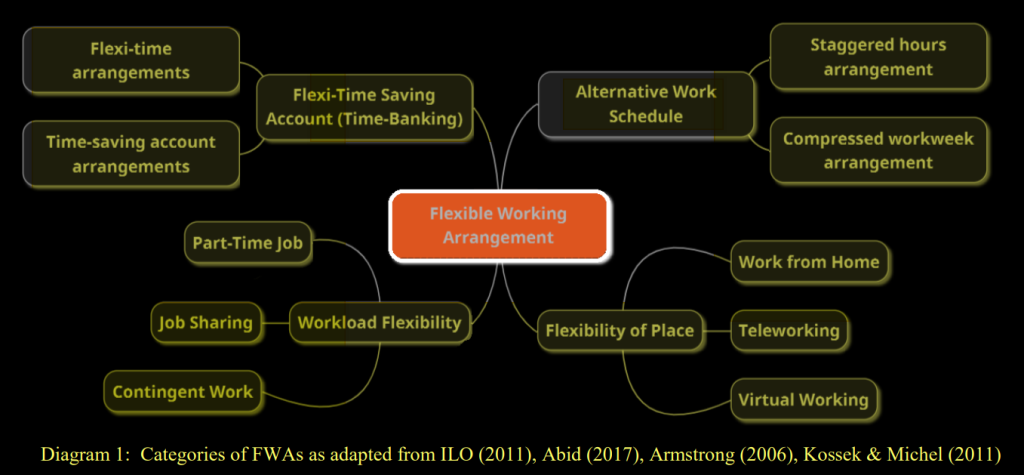
There are only two forms of flexible work arrangements (FWAs) that are available to civil servants in the public sector, and those are staggered working hours and Flexi-place (a work-from-home program).
In June of 2007, in compliance with the Service Circular Number 2 (Public Service Department of Malaysia, 2007), staggered working hours were implemented. This allows the public sector to provide a more flexible attendance system for civil servants.
The beginning and ending times of work for employees are flexible within a range of 7:30 a.m. to 4:30 p.m., 8:00 a.m. to 5:00 p.m., or 8:30 a.m. to 5:30 p.m., with the expectation that they will put in a predetermined total amount of time each day.
1. Some of the most significant amendments suggested to the Employment Act 1955 as a result of the Employment (Amendment) Bill 2021 (“the Bill”) include New Part XIIC – Flexible Working Arrangement
2. The Amendment Act allows an employee to submit a request for “flexible working arrangements” to change their working hours, days of the week, or place of employment.
3. This, however, is subject to the terms and conditions of the Employment Contract.
4. The employee can apply in writing, and the employer is compelled to respond either approve or reject the application within 60 days by notifying the employee in writing and stating the reason for the decision (in the case of a refusal).
Section 69 of the Employment Act 1955 allows the Director-General of Labour to arbitrate wage disagreements between employees whose monthly pay is up to RM5000. And, if you’re a manual worker, it doesn’t matter what your salary is.
1. Some of the most significant amendments suggested to the Employment Act 1955 as a result of the Employment (Amendment) Bill 2021 (“the Bill”) include Amendment of Section 69 – Director General’s Power to Inquire into Complaints
2. With the Amendments, the powers of the Director-General under subsection (1) shall include the power to hear and decide, in accordance with the procedure laid down in this Part, any claim by a contractor for labour against a principal for any sum which the contractor for labour claims to be due to him in respect of any labour provided by him under his contract with the contractor or sub-contractor [under s 69(2)];
3. Amendments also increase the amount of the penalty imposed under s 69(4) for failure to comply with any order or decision of the Director-General upon an inquiry and shall be liable, on conviction, to a fine not exceeding RM50,000 [previously: RM10,000]; and shall also, in the case of a continuing offence, be liable to a daily fine not exceeding RM1,000 [previously: RM100] for each day the offence continues after conviction.
The Employment Act of 1955 (also known as “EA 1955”) governs the procedures that are carried out in the “Court” known as the Labour Court.
The Director-General of Labour (abbreviated as DGL) is authorised by the Employment Act of 1955 (EA 1955) to consider matters relating to pay when a complaint is referred; hence, the ‘Labour Court’ was established.
According to Section 69 of the Employment Act of 1955, the DGL has the authority to inquire into and consider cases relating only to wage disputes that employees bring forward.
It is essential to keep in mind that the Labour Court can only consider cases brought forward by workers who are included in the First Schedule of the Employment Act of 1955.
These workers include employees whose salaries do not exceed RM2,000 and manual workers.
The DGL was also granted the authority by the EA 1955 to hear complaints concerning employees whose monthly wages do not exceed RM5,000.
This power was granted to the DGL under s 69B of the existing EA 1955.
Disputes about the non-payment of salary and/or non-payment of termination benefits are among the most typical types of cases that are heard in the Labour Court.
1. Some of the most significant amendments suggested to the Employment Act 1955 as a result of the Employment (Amendment) Bill 2021 (“the Bill”) include the Deletion of Sections 69B, 69C, 69D, and 69E
Section 69B
Additional powers of the Director-General to inquire into complaints.
Section 69C
Claims for Indemnity for Termination of Contract Without Notice
Section 69D
Order of Director-General may be in writing
Section 69E
Penalty for Offence
2. As a direct result of the deletion of section 69B, sections 69C, 69D, and 69E that corresponded to it was also deleted.
3. As a result of the deletion of sections 69B, 69c, 69D, and 69E of the Employment Act 1955, many people believe that in the future, only employees listed in the First Schedule of the Employment Act 1955 will be eligible to complain to the Labor Department in the event of a wage dispute and that employees whose salary exceeds RM2,000 will no longer be eligible to do so.
4. However, according to the Ministry of Human Resources, the government will make subsequent amendments to the First Schedule of Act 265 through an order that will be issued by the Minister of Human Resources in accordance with the powers conferred by Section 2(2) of Act 265.
5. This will be done in order to ensure that all salaried persons in the country have access to the minimum benefits and protections that are outlined in Act 265.
15. Amendment of Section 57B – Duty to inform Director-General of Termination of Service of Foreign Domestic Employee [第57B条的修订 – 通知总监终止外籍家庭雇员服务的义务] https://lnkd.in/eFyc27Wn / https://lnkd.in/eeggM_AN
30. Deletion of Section 81G – Application of this Part [Sexual Harassment] Irrespective of Wages of Employee [删除第81G条 – 无论雇员的工资如何, 本部分 [性骚扰] 都适用] https://lnkd.in/eTsj62rE / https://lnkd.in/eJQFdzx7
Source: ILO Discrimination in employment and occupation: general description and bases for discrimination
Question: What does the term “discrimination in employment and occupation” mean?
Answer: “Discrimination in employment and occupation” refers to practices that have the effect of placing certain individuals in a position of subordination or disadvantage in the labour market or the workplace because of their race, colour, religion, sex, political opinion, national extraction, social origin or any other attribute which bears no relation to the job to be performed.
Discriminatory practices can be direct or indirect. Direct discrimination arises when an explicit distinction, preference or exclusion is made on one or more grounds. For example, a job advertisement for “men only” would constitute direct discrimination.
Indirect discrimination refers to situations, measures or practices that are apparently neutral but which in fact have a negative impact on persons from a certain group. The latter type of discrimination, because of its more hidden nature, is the most difficult to tackle.
Equality of opportunity and treatment allows all individuals to fully develop their talents and skills according to their aspirations and preferences, and to enjoy equal access to employment as well as equal working conditions. To achieve full freedom from discrimination in employment and occupation, the mere removal of discriminatory practices does not suffice. It is also necessary to promote equality of opportunity and treatment in the workplace at all stages of the employment relationship, including recruitment, retention, promotion and termination practices, remuneration, access to vocational training, and skills development.
Question: What are the prohibited bases of discrimination in employment?
Answer: Bases of discrimination identified and prohibited in various International Labour Standards[1] include:
Distinctions based on race and/or colour are largely rooted in social and economic factors that do not have any objective basis. They commonly involve discrimination against an ethnic group or indigenous or tribal population.
Sex discrimination includes distinctions made on the basis of biological characteristics and functions that distinguish men and women, and on the basis of social differences between men and women.
Physical distinctions include any job specifications which are not essential to carry out the prescribed duties, e.g., minimum height or weight requirements which do not impact job performance.
Social distinctions include civil status, marital status, family situation, and maternity[2].
Women are most commonly affected by discrimination based on sex, especially in the case of indirect discrimination.
Religious discrimination includes distinctions made on the basis of the expression of religious beliefs or membership in a religious group.
This also includes discrimination against people who do not ascribe to a particular religious belief or are atheists.
Although discrimination on the basis of religious beliefs should not be permitted, there may be legitimate bases for imposing requirements in the workplace which restrict the worker’s freedom to practice a particular religion.
For instance, a religion may prohibit work on a day different from the day of rest established by law or custom; a religion may require a special type of clothing that may not be compatible with safety equipment; a religion may prescribe dietary restrictions or daily routines during work hours which may be difficult for the establishment to fully accommodate, or an employment position may require an oath incompatible with a religious belief or practice.
In these cases, the worker’s right to practice fully his or her faith or belief at the workplace needs to be weighed against the need to meet genuine requirements inherent in the job or operational requirements.
Discrimination based on political opinion includes membership in a political party; expressed political, socio-political, or moral attitudes; or civic commitment.
Workers should be protected against discrimination in employment based on activities expressing their political views, but this protection does not extend to politically motivated acts of violence.
National extraction includes distinctions made on the basis of a person’s place of birth, ancestry, or foreign origin; for instance, national or linguistic minorities, nationals who have acquired their citizenship by naturalization, and/or descendants of foreign immigrants.
Social origin includes social class, socio-occupational category, and caste. The social origin may be used to deny certain groups of people access to various categories of jobs or limit them to certain types of activities.
Discrimination based on social origin denies the victim the possibility to move from one class or social category to another.
For instance, in some parts of the world, certain “castes” are considered to be inferior and therefore confined to the most menial jobs.
Age is also a prohibited basis for discrimination. Older workers are often liable to encounter difficulties in employment and occupation because of prejudices about their capacities and willingness to learn; a tendency to discount their experiences; and market pressures to hire younger workers who are often cheaper to employ[3].
Younger workers under the age of 25 may also face discrimination.
Biased treatment against younger workers can take many forms, including overrepresentation in casual jobs with lower benefits, training opportunities, and career prospects; payment of lower entry wages even in low skilled jobs where such a wage differential is difficult to justify on grounds of lower productivity; and longer probation periods and much greater reliance on flexible forms of contract[4].
HIV/AIDS status: Persons living with HIV/AIDS often suffer discrimination in the workplace and in the community. There should be no discrimination or stigmatization of workers on the basis of real or perceived HIV status.
HIV/AIDS screening should not be required of job applicants or persons in employment. HIV infection is not a valid ground for termination of employment. Persons with HIV-related illnesses should be able to work for as long as medically fit under inappropriate conditions[5].
Disability: Worldwide, approximately 800 million people of working age have a disability. While many are successfully employed and fully integrated into society, as a group, persons with disabilities often face disproportionate poverty and unemployment. In this context, non-discrimination also includes taking positive steps where feasible to accommodate particular workplace needs that workers with disabilities may have[6].
Sexual orientation: Men and women workers may suffer from discrimination if they are known or believed to be lesbian, gay, bisexual or transgender; and may be subjected to verbal, psychological and physical intimidation or violence from the employer, supervisor or other workers[7].
Workers with family responsibilities: Current trends in working time in industrialized, developing and transition economies alike are putting increased pressure on workers with family responsibilities. “Family responsibilities” includes care of children and any other dependents[8].
The definition of persons constituting “family” may be broad and could be formulated after consultation with the workers concerned or their representatives. Workers who have family responsibilities are often discriminated against in hiring, job assignment, access to training, and promotion.
Enterprises should avoid discriminating against workers with family responsibilities. While having regard to operational needs, enterprises are encouraged to avoid excessively long hours, unpredictable over time that makes it difficult to plan for the care of family members and schedule work on traditional days of rest.
Trade union membership or activities: All workers have the right to form and join trade unions, and to participate as members or leaders in trade union activities[9] and should not be discriminated against for lawfully exercising this right.
Other bases: More generally, discrimination at work includes any “distinction, exclusion or preference … which has the effect of nullifying or impairing equality of opportunity or treatment in employment or occupation.”[10]
Workers should be selected only on the basis of their ability to do the job. Enterprises are encouraged to review their hiring and other employment practices for potential bases of discrimination which may result in treating some jobseekers or workers less favorably than others because of characteristics that are not related to the person’s competencies or the inherent requirements of the job.
Question: We found during a supplier audit that the employment contracts with employees contain the following clause: “Company retains the right to transfer the employees upfront.” Is this consistent with your standards?
Answer: The Workers with Family Responsibilities Recommendation, 1981 (No. 165) sets out in paragraph 20 the principle that “Family responsibilities and considerations such as the place of employment of the spouse and the possibilities of educating children should be taken into account when transferring workers from one locality to another.” The idea is to encourage a balanced approach between the needs of the enterprise and the needs of the worker’s/manager’s family. The enterprise should be encouraged to take family responsibilities into account to a reasonable extent when reassigning managers to new duty stations.
Question: Is there any distinction that is not considered discriminatory?
Answer: Distinctions based on skills or efforts are legitimate.
Disparities in remuneration that reflect differences in years of education or the number of hours worked are acceptable.
Enterprise compliance with government policies designed to correct historical patterns of discrimination and thereby extend equality of opportunity and treatment in employment does not constitute discrimination.
Special measures of protection or assistance provided by national law, such as the ones concerning health and maternity, are also important provisions that do not constitute discrimination.
Giving effect to the principle of equal treatment may require special measures and the accommodation of differences, for instance concerning people with disabilities.
问: 是否有任何区别不被认为是歧视性的?
答: 基于技能或努力的区分是合法的。
反映受教育年限或工作时间的差异的薪酬差异是可以接受的。
企业遵守政府的政策,旨在纠正历史上的歧视模式,从而扩大就业中的机会和待遇平等,并不构成歧视。
国家法律规定的特殊保护或援助措施,如有关健康和生育的措施,也是不构成歧视的重要规定。
落实平等待遇原则可能需要采取特别措施和照顾差异,例如有关残疾人的措施。
Question: Where can discrimination occur in the workplace?
Answer: Discrimination may occur before hiring, on the job, or upon leaving. At the enterprise level, it can occur in the following areas:
recruitment
remuneration
entitlements
hours of work and rest
paid holidays
maternity protection
security of tenure
job assignments
performance assessment and promotion
training opportunities
job prospects
occupational safety and health
termination of employment. [1]
Discrimination does not have to be intentional and often managers and workers in a company are surprised at discriminatory practices they uncover when they start to look for them.
Discrimination can be direct or indirect. Indirect discrimination refers to apparently neutral practices that in fact result in unequal treatment of people with certain characteristics[2].
For instance, organizing training courses after work late in the day may exclude workers who may be interested in attending them but cannot do so because of their family responsibilities. Workers who receive less training are likely to be disadvantaged in subsequent job assignments and promotion prospect.
1. Some of the most significant amendments suggested to the Employment Act 1955 as a result of the Employment (Amendment) Bill 2021 (“the Bill”) include New Section 69F – Discrimination in Employment
2. With the Amendments, the Director-General would be given the authority to investigate and make a decision or an order on any disagreement between an employee and his or her employer about any issue relating to discrimination in the workplace.
3. An employer’s failure to comply with any order issued as a result of the disagreement is considered a violation of the law.
👉 When a company is found guilty, the company will be subject to a fine not exceeding RM50,000.
👉 A daily fine of not more than RM1,000 per day for each day the offence continues after conviction
4. The wording of the amending legislation appears to be very broad at this stage, and it would appear that a complaint might be filed against various discriminatory acts in the workplace under its provisions. 5. For example, these may include not just discrimination based on colour, gender, or disability. Still, they may also involve discrimination in selecting employees, the approval of leave applications, and other forms of employment discrimination. 6. It is uncertain if they may be extended to cover job seekers, even though, ostensibly, job applicants are not employees and hence should not be subject to any investigation or investigation of them. 7. It remains to be seen whether the Malaysian courts will interpret these provisions narrowly or broadly, as they may have a material impact on businesses if the Director-General is permitted to substitute business management decisions with those made by the Director-General on the pretext of discriminatory practises, as has happened in the past in other countries.
15. Amendment of Section 57B – Duty to inform Director-General of Termination of Service of Foreign Domestic Employee [第57B条的修订 – 通知总监终止外籍家庭雇员服务的义务] https://lnkd.in/eFyc27Wn / https://lnkd.in/eeggM_AN
30. Deletion of Section 81G – Application of this Part [Sexual Harassment] Irrespective of Wages of Employee [删除第81G条 – 无论雇员的工资如何, 本部分 [性骚扰] 都适用] https://lnkd.in/eTsj62rE / https://lnkd.in/eJQFdzx7