Day: June 26, 2021
-

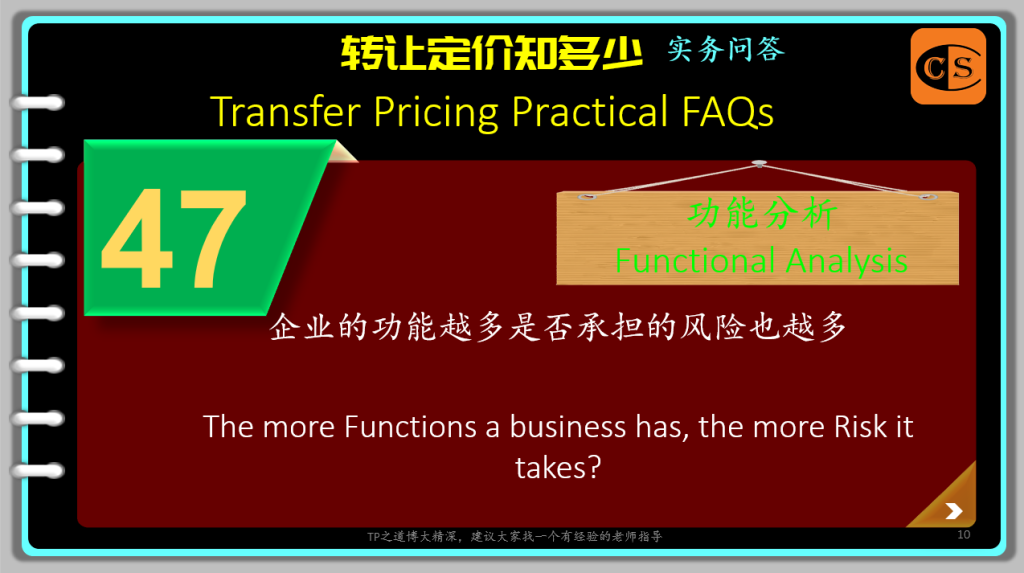
TP FAQs: Will the enterprise have More Risks with More Functions? | 企业的功能越多是否承担的风险也越多
The question of who takes risky decisions and who bears the consequences of those decisions has always been very important in transfer pricing analysis.
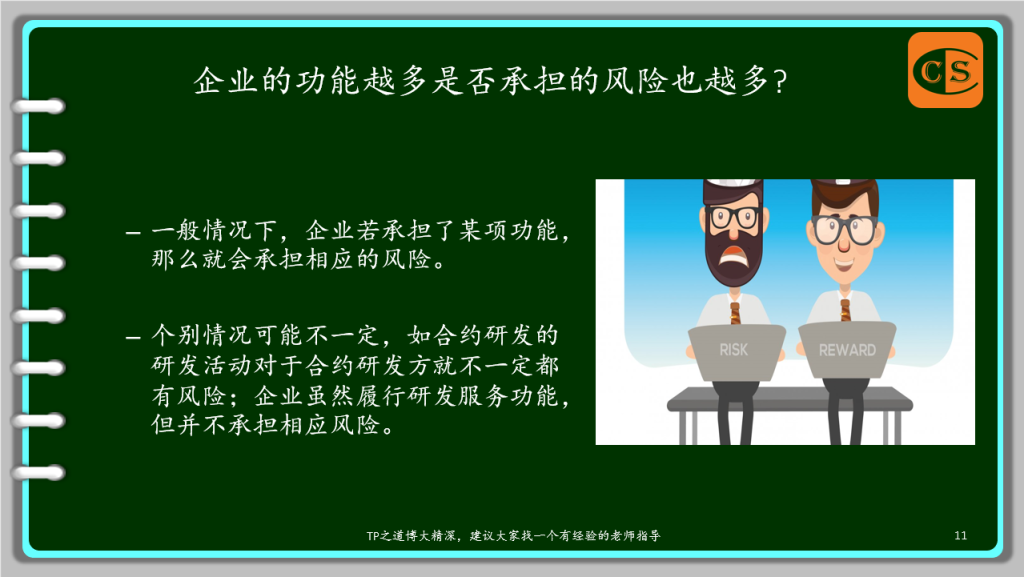
Generally, if an enterprise performs a function, it bears the corresponding risk.
However, this may not always be the case in individual cases, e.g. R&D activities in contract R&D may not always be risky for the contract developer; the enterprise performs the R&D service function but does not bear the corresponding risk.
The OECD Guidelines say that if risks are allocated to the party to the controlled transaction that has relatively less control over them, the tax authority may wish to challenge the arm’s-length nature of such risk allocation
Our website's articles, templates, and material are solely for reference. Although we make every effort to keep the information up to date and accurate, we make no representations or warranties of any kind, either express or implied, regarding the website or the information, articles, templates, or related graphics that are contained on the website in terms of its completeness, accuracy, reliability, suitability, or availability. Therefore, any reliance on such information is strictly at your own risk.
Keep in touch with us so that you can receive timely updates |
要获得即时更新,请与我们保持联系
1. Website ✍️ https://www.ccs-co.com/
2. Telegram ✍️ http://bit.ly/YourAuditor
3. Facebook ✍
- https://www.facebook.com/YourHRAdvisory/?ref=pages_you_manage
- https://www.facebook.com/YourAuditor/?ref=pages_you_manage
4. Blog ✍ https://lnkd.in/e-Pu8_G
5. Google ✍ https://lnkd.in/ehZE6mxy
6. LinkedIn ✍ https://www.linkedin.com/company/74734209/admin/
-

TP FAQs: Relationship between the Functions Performed and the Returns Received | 履行的功能与获得的回报间的关系
In general, there ought to be a positive correlation between the functionality of a company and the returns that it generates.
The more functions that are engaged and risks that are assumed by the company, the higher the expected level of profit should be; nevertheless, the more volatile the expected level of profit will be.


Our website's articles, templates, and material are solely for reference. Although we make every effort to keep the information up to date and accurate, we make no representations or warranties of any kind, either express or implied, regarding the website or the information, articles, templates, or related graphics that are contained on the website in terms of its completeness, accuracy, reliability, suitability, or availability. Therefore, any reliance on such information is strictly at your own risk.
Keep in touch with us so that you can receive timely updates |
要获得即时更新,请与我们保持联系
1. Website ✍️ https://www.ccs-co.com/
2. Telegram ✍️ http://bit.ly/YourAuditor
3. Facebook ✍
- https://www.facebook.com/YourHRAdvisory/?ref=pages_you_manage
- https://www.facebook.com/YourAuditor/?ref=pages_you_manage
4. Blog ✍ https://lnkd.in/e-Pu8_G
5. Google ✍ https://lnkd.in/ehZE6mxy
6. LinkedIn ✍ https://www.linkedin.com/company/74734209/admin/
-

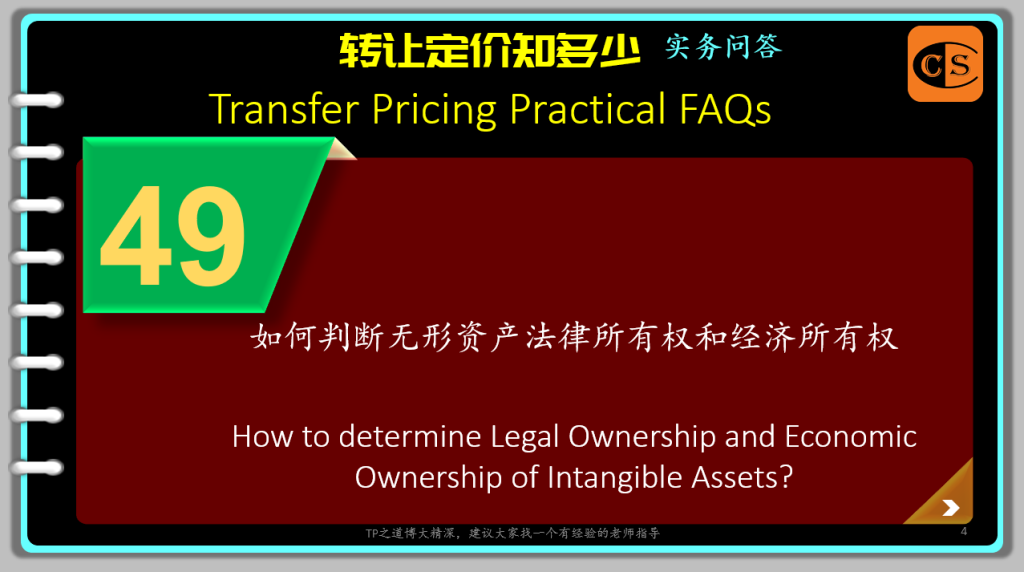
TP FAQs: How to determine Legal and Economic Ownership of Intangible Assets | 如何判断无形资产的法律和经济所有权
Ownership of intangible assets includes:
- legal ownership; and
- economic ownership.
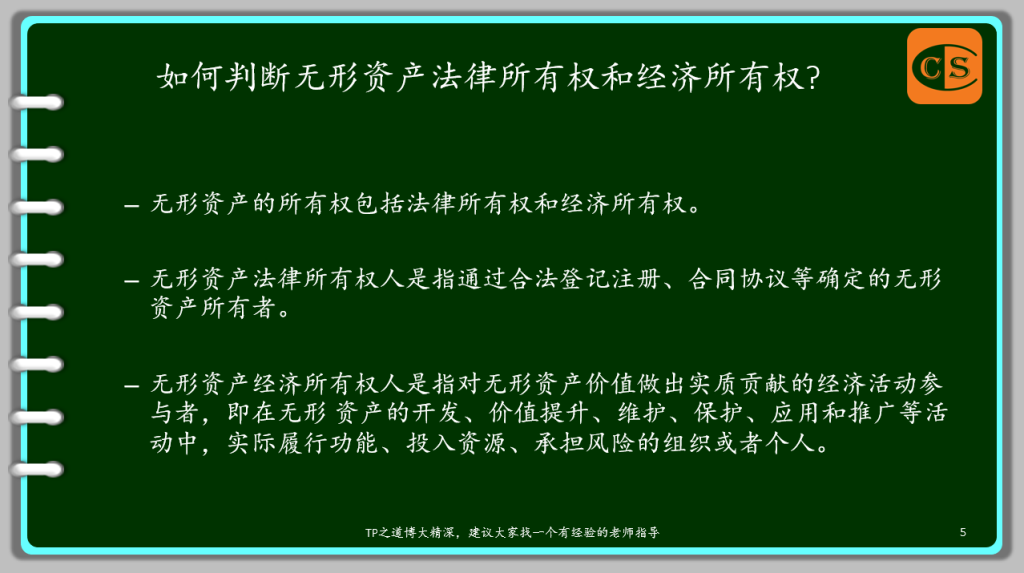
The legal ownership of intangible assets refers to the owner of the intangible assets identified through legal registration, contractual agreements, etc.
The economic ownership of an intangible asset is the participant in the economic activity who makes a substantial contribution to the value of the intangible asset, i.e. the organisation or individual who actually performs the function, invests resources and bears the risk in the Development, Enhancement, Maintenance, Protection and Exploitation (‘DEMPE Functions’) of the intangible asset.
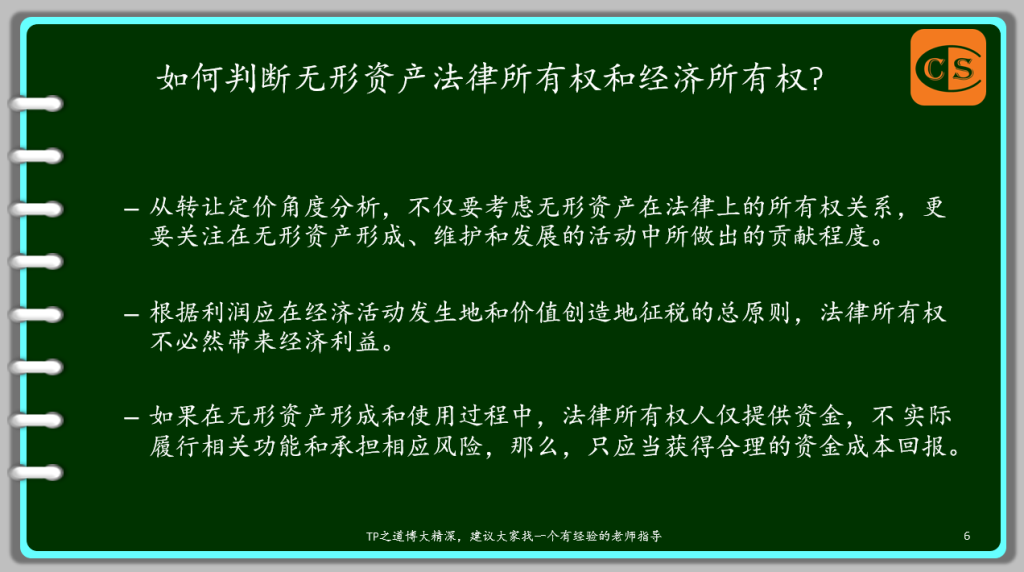
Analysis from a transfer pricing perspective should consider not only the legal ownership relationship of the intangible asset but also the extent of the contribution made in the activities of Development, Enhancement, Maintenance, Protection and Exploitation of the intangible asset.

Under the general principle that profits should be taxed where economic activity takes place and where the value is created, legal ownership does not necessarily result in an economic benefit.
If in the creation and use of an intangible asset, the legal owner only provides funds and does not actually perform the relevant functions, such as Development, Enhancement, Maintenance, Protection and Exploitation, and bears the corresponding risks, then only a reasonable return on the cost of funds should be obtained.
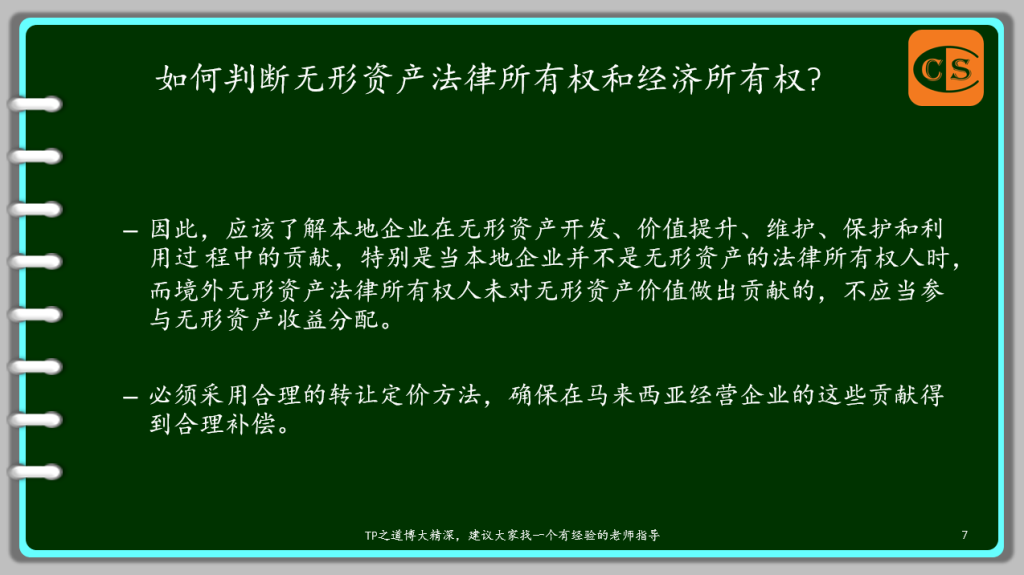
Therefore, it is important to understand the contribution of the local enterprise in the Development, Enhancement, Maintenance, Protection and Exploitation of the intangible asset, especially if the local enterprise is not the legal owner of the intangible asset and the offshore legal owner of the intangible asset has not contributed to the value of the intangible asset, and should not participate in the distribution of the proceeds of the intangible asset.
Reasonable transfer pricing methods must be used to ensure that these contributions by the business operating in Malaysia are reasonably compensated.
Our website's articles, templates, and material are solely for reference. Although we make every effort to keep the information up to date and accurate, we make no representations or warranties of any kind, either express or implied, regarding the website or the information, articles, templates, or related graphics that are contained on the website in terms of its completeness, accuracy, reliability, suitability, or availability. Therefore, any reliance on such information is strictly at your own risk.
Keep in touch with us so that you can receive timely updates |
要获得即时更新,请与我们保持联系
1. Website ✍️ https://www.ccs-co.com/
2. Telegram ✍️ http://bit.ly/YourAuditor
3. Facebook ✍
- https://www.facebook.com/YourHRAdvisory/?ref=pages_you_manage
- https://www.facebook.com/YourAuditor/?ref=pages_you_manage
4. Blog ✍ https://lnkd.in/e-Pu8_G
5. Google ✍ https://lnkd.in/ehZE6mxy
6. LinkedIn ✍ https://www.linkedin.com/company/74734209/admin/
-

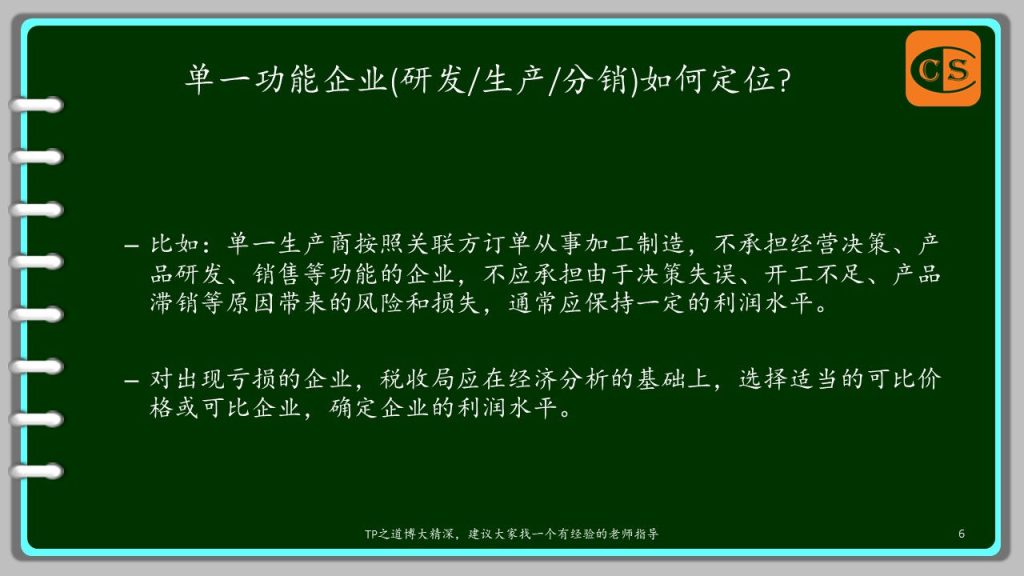
TP FAQs: Positioning of a Single-Function Entity (R&D/Production/Distribution) |单一功能企业(研发/生产/分销)如何定位
A single-function enterprise is a Malaysian company with restricted functions and risks, such as production, distribution, or contract R&D.
The Inland Revenue Board usually investigates and makes a transfer pricing adjustment because many enterprises, especially single-function businesses, have a mismatch between their functional roles and earnings.
For example, a single manufacturer engaged in processing and manufacturing according to orders from related parties and not undertaking the functions of operational decision-making, product development, and sales should not bear the risks and losses arising from poor decision-making, production shortage and lack of sales of products, and should usually maintain a certain level of profit.
For a loss-making company, the Inland Revenue Board will determine the profit level using economic analysis and comparable pricing or companies.

Our website's articles, templates, and material are solely for reference. Although we make every effort to keep the information up to date and accurate, we make no representations or warranties of any kind, either express or implied, regarding the website or the information, articles, templates, or related graphics that are contained on the website in terms of its completeness, accuracy, reliability, suitability, or availability. Therefore, any reliance on such information is strictly at your own risk.
Keep in touch with us so that you can receive timely updates |
要获得即时更新,请与我们保持联系
1. Website ✍️ https://www.ccs-co.com/
2. Telegram ✍️ http://bit.ly/YourAuditor
3. Facebook ✍
- https://www.facebook.com/YourHRAdvisory/?ref=pages_you_manage
- https://www.facebook.com/YourAuditor/?ref=pages_you_manage
4. Blog ✍ https://lnkd.in/e-Pu8_G
5. Google ✍ https://lnkd.in/ehZE6mxy
6. LinkedIn ✍ https://www.linkedin.com/company/74734209/admin/